This evaluation ranks the most prominent industry certifications from F-Tier (Lowest Utility) to S-Tier (Highest Professional Impact). Based on comprehensive market observations, technical recruitment trends, and an analysis of over 1,300 professional resumes, this guide highlights which credentials offer genuine professional mobility in the current market.
The post The Ultimate 2026 Tech Certification Tier List: Industry Value & Career Growth appeared first on Pirate Knights.
]]>2026 Certification Tier List Overview
| Tier | Certifications Included | Core Evaluation |
| S-Tier | SANS GCAD, CKAD, OSCP, AWS SysOps Admin, Nvidia AI Suite, CISSP | Advanced architectural credentials with maximum industry recognition |
| A-Tier | Azure AI Security Engineer, RHCE, AIGP, CompTIA Sec AI | Specialized, high-mobility paths adapted for the AI infrastructure era |
| B-Tier | CompTIA Security+, CISM, CISA, Cisco CCNA, CompTIA Security X, Microsoft SC-300 | Essential industry benchmarks providing solid professional foundations |
| C-Tier | Splunk Core/Power User, TCM Blue Team, CompTIA CySA+, Azure AZ-500, CyberArk Sentry | Specialized technical skills heavily sought after by corporate recruiters |
| D-Tier | CompTIA ITF+, CompTIA PenTest+, Azure AZ-104, CyberArk Defender | Niche utility; recommended only when explicitly required by a position |
| F-Tier | CompTIA A+, CEH, Google Cybersecurity Certificate, Azure AZ-900 | Redundant, strictly theoretical, or possessing low market differentiation |
F-Tier: Lowest Market Differentiation (Not Recommended)
These options provide limited practical value in the modern job market, focusing heavily on basic theory rather than applied skills.
CompTIA A+: Historically an entry-level standard for technical support, this multi-part exam carries a significant financial and time investment. In today's market, it rarely provides a competitive edge for modern enterprise roles.
Certified Ethical Hacker (CEH): This credential focuses primarily on theoretical concepts without a significant live-lab configuration component. For security assessment tracks, enterprise hiring managers increasingly prefer rigorous, hands-on alternatives.
Google Cybersecurity Certificate (Coursera): While beneficial for general professional development and introductory concepts, this foundational certificate lacks the formal industry recognition required to clear competitive recruitment filters.
Microsoft AZ-900 (Azure Fundamentals): A highly introductory overview of cloud concepts that can be completed quickly. It does not validate engineering capabilities; prospective cloud professionals are better served working directly within live environments.
D-Tier: Position-Specific Utility
These credentials offer low baseline return on investment unless mandated by a specific corporate infrastructure or contract requirement.
CompTIA ITF+ (IT Fundamentals): A cost-effective entry point designed for individuals confirming their interest in technology tracks. It serves well as a preliminary evaluation tool but holds minimal weight on a professional resume.
CompTIA PenTest+: While covering structured assessment methodologies, it relies heavily on knowledge-based testing rather than persistent sandbox environments. Its primary utility remains within specific government contracting sectors.
Microsoft AZ-104 (Azure Administrator): Administrative infrastructure roles remain relevant, but this credential must be paired with validated operating system automation skills to stand out in corporate applicant pools.
CyberArk Defender: Highly vendor-specific identity management. Specializing too early in a proprietary tool limits broader career flexibility unless targeting specific enterprise ecosystems that run this dedicated software.
C-Tier: Specialized Enterprise Credentials
These options target specific technical operational roles and excel at passing automated applicant tracking filters for dedicated job descriptions.
Splunk Core & Power User: Splunk is a major operational hub for modern Security Operations Centers (SOCs). Validating proficiency in this platform is an excellent methodology for securing introductory analyst positions.
TCM Security Blue Team Certification: Although less frequent on traditional job postings, it delivers practical, defensive configurations that assist candidates during technical interview demonstrations.
CompTIA CySA+ (Cybersecurity Analyst): A mid-level analytical credential focusing on threat detection and incident response frameworks. It holds strong alignment with standard compliance structures.
Microsoft AZ-500 (Azure Security Engineer): Bridging cloud architecture with robust administrative security protocols. This credential is actively sought out by corporate talent sourcers.
CyberArk Sentry: An advanced tier for dedicated infrastructure environments. Highly valuable if your target enterprise operates a mature CyberArk deployment.
B-Tier: Core Industry Benchmarks
Reliable, universally recognized certifications that deliver strong market utility and establish foundational engineering knowledge.
CompTIA Security+: One of the most effective foundational credentials in the industry. It serves as a baseline regulatory requirement for access to secure public sector and defense networks, making it far more impactful than entry-level certificates.
CISM (Certified Information Security Manager): Offered by ISACA, this management-oriented credential is well-suited for professionals shifting toward governance, risk, and program management without pursuing heavy engineering tracks.
CISA (Certified Information Systems Auditor): The industry standard for technology auditing, compliance, and governance. It remains a premium asset for risk management professionals.
Cisco CCNA: A premier foundational networking credential. Enterprise networks, data centers, and cloud handoffs rely on core networking concepts, making this highly respected across the industry.
CompTIA Security X: The updated evolution of advanced security practitioner benchmarks, serving as a solid validation tool for complex, public-sector defense engineering requirements.
Microsoft SC-300 (Identity and Access Administrator): Given the widespread adoption of enterprise cloud systems, securing identity perimeters is critical. This credential addresses a high-demand administrative domain.
A-Tier: High-Mobility & Future-Proof Tracks
These mid-to-advanced level paths target expanding sectors, focusing on automation, infrastructure management, and emerging security frameworks.
Microsoft Azure AI Security Engineer: Designed specifically to address the security controls required for modern enterprise data workloads. As companies implement complex analytical tools, professionals validated in this space receive significant recruitment attention.
RHCE (Red Hat Certified Engineer): A performance-based examination centered on automation and configuration management via Ansible. Modern infrastructure relies on automation, making validated Linux engineering expertise exceptionally resilient.
AIGP (AI Governance Professional): A governance-focused credential analyzing compliance, data privacy, and ethical implementation frameworks. Organizations are actively seeking risk management professionals to manage corporate technology deployment safely.
CompTIA Sec AI: A vendor-neutral framework designed for security practitioners to validate their understanding of modern infrastructure threat landscapes and defensive mitigation strategies.
S-Tier: Elite Architectural Benchmarks
These advanced, performance-based certifications require significant preparation and are designed for senior-level engineering, consulting, and architectural roles.
SANS GCAD (GIAC Cloud Security Architect and Design): SANS programs represent a premier tier of technical validation. The GCAD confirms an engineer's capability to architect secure, resilient multi-cloud environments.
CKAD (Certified Kubernetes Application Developer): A rigorous, practical exam focusing on container orchestration. In scalable software architectures, validated container management capability is a crucial asset for advanced infrastructure engineering roles.
OSCP (Offensive Security Certified Professional): The industry standard for performance-based security assessment. Candidates must demonstrate practical remediation and exploitation capabilities within a live sandbox environment within a strict timeframe.
AWS SysOps Administrator: While hybrid cloud ecosystems vary, AWS remains an industry titan. This technical administration credential verifies an engineer's capacity to deploy and manage scalable infrastructure under production conditions.
Nvidia Certifications: Focused on data science, advanced compute acceleration, and deep learning infrastructure. Validating skills through the primary provider of advanced enterprise compute hardware signals top-tier infrastructure expertise.
CISSP (Certified Information Systems Security Professional): A premier benchmark for experienced security practitioners. Requiring extensive verified professional experience, it serves as a core prerequisite for senior managerial, director-level, and leadership roles.
Strategic Implementation
Successful career progression relies on strategic selection rather than accumulation. Professionals should identify their target specialization, prioritize practical configuration skills, and choose credentials that validate real-world execution capabilities within modern enterprise environments.
Disclaimer: Market conditions, average salaries, and hiring preferences vary by region, experience level, and employer. Prospective candidates should research specific regional job descriptions alongside this guide.
The post The Ultimate 2026 Tech Certification Tier List: Industry Value & Career Growth appeared first on Pirate Knights.
]]>Affordable, self-paced professional certificates have emerged as highly efficient pathways to bridge the skills gap. This guide breaks down 11 prominent professional certificates across creative, business, and highly technical fields, analyzing their market demand, completion timelines, and typical industry salary ranges.
The post 11 High-Paying Certifications for Remote Jobs: Market Demand & Salary Guide appeared first on Pirate Knights.
]]>| Certificate Program | Career Track | Average Market Salary Range |
| Meta Social Media Marketing | Digital Marketing | $46,000 – $82,000 |
| Google UX Design | UI/UX & Creative | $74,000 – $122,000 |
| Salesforce Sales Operations | Business Operations | $52,000 – $79,000 |
| Google Project Management | Project Management | $49,000 – $129,000 |
| Google IT Support | Information Technology | $47,000 – $135,000 |
| Google Digital Marketing & E-commerce | E-commerce / Marketing | $48,000 – $81,000 |
| Google Data Analytics | Data Analytics | $66,000 – $115,000 |
| UMich Basics of Web Development | Software Engineering | $70,000 – $115,000 |
| IBM Data Science | Advanced Data Analytics | $112,000+ (Median) |
| IBM DevOps & Software Engineering | DevOps / System Eng | $103,000 – $148,000 |
| IBM Cybersecurity Analyst | Information Security | $84,000 – $176,000+ |
Category 1: Creative & Marketing Tracks
1. Meta Social Media Marketing Professional Certificate
Co-developed by Meta and Coursera, this six-course series is designed to prepare individuals for introductory roles in digital marketing and social media management.
Target Roles: Social Media Specialist, Social Media Coordinator, Digital Marketing Associate.
Market Salary Data: Industry averages for entry-level social media specialists generally range from $46,000 to $69,000 annually, while mid-level managers can command between $50,000 and $82,000.
Timeline: Though structured for 5 months at 5 hours per week, focused learners regularly complete the curriculum within a few weeks to two months.
2. Google UX Design Professional Certificate
User Experience (UX) design focuses on structural layout and intuitive website/app interfaces. This track is heavily favored by creative professionals moving into corporate environments.
Target Roles: UX/UI Designer, Product Designer, Visual Designer.
Market Salary Data: Established UX designers across the United States command market-competitive salaries ranging from $74,000 to $122,000.
Strategic Note: This domain is highly competitive. To successfully secure a remote position, candidates must supplement this certificate with a robust personal portfolio demonstrating practical user research and interface wireframes.
3. Google Digital Marketing & E-commerce Professional Certificate
A broad-spectrum introductory program designed to familiarize students with core internet marketing concepts, search engine optimization (SEO), and storefront platforms.
Target Roles: Marketing Coordinator, Email Marketing Specialist, E-commerce Analyst.
Market Salary Data: Standard entry-level marketing coordinators average $48,000 to $72,000, while email marketing specialists range from $52,000 to $81,000.
Evaluation: This serves as an excellent diagnostic tool to determine which specific sub-field of digital marketing you prefer before pursuing advanced specialization.
Category 2: Business Operations & Management
4. Salesforce Sales Operations Professional Certificate
Customer Relationship Management (CRM) software is the operational backbone of global sales structures. This four-course certificate teaches automated pipeline tracking and system management.
Target Roles: Sales Operations Specialist, CRM Administrator, Customer Success Analyst.
Market Salary Data: Certified sales operations specialists report typical industry salary bands between $52,000 and $79,000.
Evaluation: This curriculum is designed by internal platform experts to directly address the structural talent shortage in enterprise corporate sales environments.
5. Google Project Management Professional Certificate
Consistently ranked as one of the highest-rated professional credentials online, this six-course series instructs students on structural planning, Agile methodologies, resource procurement, and team leadership.
Target Roles: Project Coordinator, Project Manager, Scrum Master.
Market Salary Data: Introductory positions like Project Coordinator command average salaries between $49,000 and $75,000, while senior Project Managers routinely earn between $77,000 and $129,000.
Key Advantage: Completion of this curriculum provides prospective candidates access to specialized employer hiring consortiums, increasing visibility in remote recruitment pools.
Category 3: IT & Systems Support
6. Google IT Support Professional Certificate
The foundational program that initiated the modern professional certificate trend. It validates proficiency in networking, system administration, operating systems, and foundational computer security.
Target Roles: Help Desk Technician, Technical Support Specialist, Systems Analyst.
Market Salary Data: Entry-level technical support roles average between $47,000 and $69,000, while progressing into an IT Systems Analyst position moves average compensation up to $91,000 to $135,000.
Timeline: Highly adaptable; individual technical backgrounds allow certain students to move through the coursework in under a month.
Category 4: Data & Software Engineering
7. Google Data Analytics Professional Certificate
A highly technical program addressing the global shortage of verified data analysts. It trains students in structural database querying (SQL), spreadsheet programming, Tableau visualization, and R programming.
Target Roles: Data Analyst, Business Analyst, Junior Data Engineer.
Market Salary Data: Traditional market compensation for data analysts ranges from $66,000 to $103,000, while business analysts average $75,000 to $115,000.
Strategic Advantage: The curriculum includes an applied capstone project, directly aiding candidates in establishing a portfolio required to clear standard technical hiring filters.
8. Web Development and Coding (University of Michigan)
Offered via Coursera by the University of Michigan, this specialization instructs candidates on semantic HTML5, CSS3 styling, and JavaScript application programming.
Target Roles: Front-End Developer, Web Designer, JavaScript Engineer.
Market Salary Data: Web developers across corporate software sectors average standard salaries between $70,000 and $115,000.
Strategic Note: While baseline technical requirements have risen over recent hiring cycles, individuals with verified execution capabilities and clean code portfolios continue to secure competitive remote roles.
9. IBM Data Science Professional Certificate
An extensive, ten-course track that introduces foundational computer science, machine learning models, and advanced Python analysis.
Target Roles: Data Scientist, Quantitative Analyst, Advanced Data Modeler.
Market Salary Data: Established data scientists maintain a premium market median salary of approximately $112,000.
Implementation Strategy: For candidates without prior enterprise tech experience, the most practical roadmap involves securing a Data Analyst position first, then leveraging internal experience alongside this IBM credential to pivot into full data science engineering.
10. IBM DevOps and Software Engineering Professional Certificate
A comprehensive 14-course pathway centered around modern deployment pipelines, cloud native infrastructure, automated integration (CI/CD), and configuration systems.
Target Roles: DevOps Engineer, Release Coordinator, Site Reliability Engineer.
Market Salary Data: Corporate DevOps engineers command strong premium compensation packages, typically averaging between $103,000 and $148,000.
Prerequisite Advice: While categorized as beginner-friendly, candidates possess a distinct advantage if they establish a solid foundation in basic operating system frameworks before beginning this advanced series.
Category 5: Cybersecurity
11. IBM Cybersecurity Analyst Professional Certificate
An eight-course specialization focusing on information security fundamentals, threat intelligence data, endpoint protection protocols, and defensive security analysis frameworks.
Target Roles: Security Analyst, Junior Incident Responder, Compliance Officer.
Market Salary Data: Junior cybersecurity analysts command market salaries averaging roughly $84,000, while advanced tracks like Security Architects command premium ranges between $176,000 and $278,000.
Industry Standards: Information security mandates verified, strict operational competencies. The optimal professional strategy involves using this certificate to transition from general IT service desk roles directly into data security environments.
Executive Summary & Professional Strategy
Selecting an entry-level professional track should balance your personal aptitudes with real-time economic data. To optimize your competitive edge when applying for remote corporate jobs:
Prioritize Portfolio Value: In technical or creative sectors (UX Design, Data Analytics, Web Development), a clear portfolio demonstrating practical implementation is mandatory alongside your certificate.
Optimize Professional Timelines: Self-paced structures allow you to complete these programs ahead of traditional academic tracking, lowering your overall career pivot costs.
Utilize Financial Aid: Educational platforms frequently offer institutional scholarship applications or specialized trial access paths for candidates evaluating new professional fields.
Disclaimer: Compensation data and hiring timelines reflect general US macroeconomic trends and market reports. Individual career results vary significantly based on geographic location, individual background, historical work experience, and specific employer compensation structures.
The post 11 High-Paying Certifications for Remote Jobs: Market Demand & Salary Guide appeared first on Pirate Knights.
]]>While a significant portion of online training certificates provide minimal professional leverage, a select group of industry-validated credentials successfully "move the needle" for corporate recruiters, hiring managers, and business owners.
For professionals seeking remote-friendly career tracks or significant vertical mobility, certain certifications offer an efficient alternative to traditional higher education—requiring no prior enterprise experience or four-year degrees to begin. Below is a data-driven evaluation of five premium industry certifications, analyzed by market demand, baseline compensation ranges, and strategic training pathways.
The post 5 High-Value Professional Certifications with Exceptional Market ROI appeared first on Pirate Knights.
]]>| Certification / Certificate | Targeted Career Domain | Entry-Level Market Salary Range (0-1 Years Experience) | Overall Rating |
| AWS Certified Solutions Architect Associate (SAA) | Cloud Architecture & Engineering | $106,000 – $181,000 | 9 / 10 |
| Google Data Analytics Professional Certificate | Data Science & Business Intelligence | $65,000 – $104,000 | 9 / 10 |
| CompTIA Security+ | Information Security & Infrastructure | $82,000 – $133,000 | 8.5 / 10 |
| Project Management Professional (PMP) | Corporate Project Leadership | $64,000 – $108,000 | 8.5 / 10 |
| Salesforce Certified Administrator | Business Automation & CRM Analytics | $80,000 – $126,000 | 9 / 10 |
Detailed Certification Breakdown
1. AWS Certified Solutions Architect – Associate (SAA)
This credential validates an engineer's capacity to design, deploy, and cost-optimize robust infrastructure on Amazon Web Services (AWS), the world’s largest cloud computing platform.
Target Roles: Cloud Architect, Full-Stack Developer, DevOps Engineer.
Market Salary Data: According to Glassdoor market tracking, individuals with 0 to 1 years of experience in solutions architecture face an average compensation band of $106,000 to $181,000 annually.
Evaluation (9/10): This certification features exceptional market demand and high career ceilings. However, passing the exam alone is rarely sufficient; candidates must pair the credential with live GitHub infrastructure projects to secure interviews.
Preparation Tracks: Official training is accessible via AWS Skill Builder. For structured preparation featuring practical labs and quizzes, candidates frequently utilize the AWS Cloud Solutions Architect Professional Certificate on Coursera.
2. Google Data Analytics Professional Certificate
Technically classified as a professional certificate rather than a testing certification, this program serves as an intensive, hands-on framework covering spreadsheets, structured query language (SQL), Tableau visualization, and data analysis workflows.
Target Roles: Data Analyst, Business Analyst, Insights Coordinator.
Market Salary Data: Standard industry benchmarks for entry-level data analysts (0-1 years experience) reflect average annual salaries between $65,000 and $104,000.
Evaluation (9/10): It offers an outstanding return on investment and a clear, rapid pathway into tech. To compete effectively against traditional degree holders, students must fully utilize the program's built-in portfolio modules to showcase practical verification of skills.
Preparation Tracks: Hosted directly via Coursera as an official Google-vetted career preparation track.
3. CompTIA Security+
CompTIA is widely recognized as a primary benchmark provider across global IT and information security divisions. The Security+ credential serves as a primary regulatory and compliance filter for entering corporate security structures.
Target Roles: Information Security Analyst, Associate Systems Security Specialist.
Market Salary Data: Glassdoor metrics indicate that introductory cybersecurity analyst roles (0-1 years experience) secure average salary ranges of $82,000 to $133,000 per year.
Evaluation (8.5/10): Possesses immense structural and regulatory value for clearing automated Human Resources (HR) resume filters. In highly competitive economic climates, it should be supplemented with technical lab work and an active professional network.
Preparation Tracks: Aspiring candidates can utilize the Google Cybersecurity Professional Certificate on Coursera, alongside specific domain-aligned CompTIA test preparation courses.
4. Project Management Professional (PMP)
Administered by the Project Management Institute (PMI), the PMP is the international corporate benchmark establishing a professional’s capability to manage end-to-end project constraints, including timelines, budgets, and scopes.
Target Roles: Project Manager, Technical Project Leader, Senior Scrum Master.
Market Salary Data: General market tracking for project managers with minimal specialized experience ranges from $64,000 to $108,000 annually.
Evaluation (8.5/10): A highly authoritative credential that immediately commands professional credibility and facilitates vertical salary upgrades for working professionals. It receives a lower score for true beginners, as it targets individuals who already possess baseline project coordination experience.
Preparation Tracks: Available through the official PMI Authorized On-Demand PMP Exam Prep to fulfill the necessary 35 contact hours. Fundamental training can be supplemented with Coursera's project management specializations.
5. Salesforce Certified Administrator
Salesforce represents the dominant enterprise Customer Relationship Management (CRM) ecosystem globally. This certification validates a professional’s ability to configure automated workflow processes, manage enterprise user directories, and translate core business objectives into cloud mechanics.
Target Roles: Salesforce Administrator, CRM Platform Manager, Application Architect.
Market Salary Data: Average standard earnings for incoming Salesforce Administrators span from $80,000 to $126,000 per year.
Evaluation (9/10): The Salesforce cloud ecosystem is vast, allowing non-computer-science degree holders to transition rapidly into enterprise roles. Success requires demonstrating practical competency via platform-specific projects rather than reliance on credential paperwork alone.
Preparation Tracks: Candidates can build functional platform competencies directly through official interactive modules on Salesforce Trailhead.
Strategic Overview
Navigating the contemporary hiring market successfully requires a shift from passive credential collection to the active display of technical execution. To maximize the value of these credentials, professionals should build public-facing portfolios, document their learning transparently, and choose tracks aligned with robust market demand.
Disclaimer: Financial metrics, average salary estimates, and hiring timelines are derived from market statistical databases such as Glassdoor and do not constitute guaranteed employment outcomes. Actual compensation metrics fluctuate based on geographic location, specific corporate hiring budgets, individual backgrounds, and regional macroeconomic conditions. Prospective applicants should perform independent market research alongside this guide.
The post 5 High-Value Professional Certifications with Exceptional Market ROI appeared first on Pirate Knights.
]]>For professionals navigating this new market—whether you are an incoming beginner, a creative looking for flexible workplace options, or an experienced engineer aiming for a vertical promotion—choosing the right credential is critical. Stacking random certificates results in minimal career leverage. Instead, true professional mobility relies on targeting specific, industry-validated tracks that directly map to active enterprise needs.
This comprehensive guide serves as the ultimate master resource for the 2026 tech certification ecosystem, breaking down industry hierarchies, remote-eligible opportunities, and credentials that deliver the highest return on investment (ROI).
The post The Complete 2026 Guide to Tech Certifications: Career Paths, Remote Jobs, and High-ROI Credentials appeared first on Pirate Knights.
]]>Before investing financial resources or months of study into a credential, it is vital to understand where it stands in the global enterprise market. Not all certifications are created equal; some carry immense regulatory and architectural authority, while others have become functionally redundant due to shifts in technology.
The industry ecosystem is broadly classified into five distinct categories:
The Elite Layer (S-Tier): Performance-based, grueling examinations that command immediate authority in senior engineering, architecture, and core system administration.
The Future-Proof Layer (A-Tier): Specialized credentials aligned with high-growth infrastructure, cloud automated deployment, and modern corporate compliance.
The Core Industry Benchmarks (B-Tier): Trusted, universally recognized certifications that serve as baseline regulatory requirements or vital technical building blocks.
The Position-Specific Utilities (C/D-Tier): Specialized or vendor-specific platforms that hold immense value only if an employer’s dedicated infrastructure requires that exact software.
The Lowest Market Differentiation (F-Tier): Introductory overviews or purely theoretical credentials that rarely clear modern automated Human Resources filters.
💡 Deep Dive Analysis: To view the complete, itemized ranking of the top 30+ industry credentials alongside detailed industry feedback and resume analytics, explore our full breakdown: [Read the Ultimate 2026 Tech Certification Tier List].
2. Navigating the Remote Job Market: Matching Skills to Autonomy
One of the greatest benefits of the modern tech sector is the availability of sustainable, fully distributed remote corporate positions. However, securing a remote job requires an intentional strategy. Distributed employers rely heavily on your ability to execute tasks independently without micro-management, making specific practical portfolios mandatory.
Depending on your personal aptitudes and career goals, remote-eligible certification tracks fall into distinct professional categories:
Creative & Digital Operations
For individuals possessing strong visual, marketing, or analytical inclinations, standard platforms offer accessible pathways to transition away from traditional office environments:
User Experience (UX) Design: Validating user research, wireframing, and interactive design methodologies.
Digital Operations & Customer Relations: Mastering specialized enterprise software ecosystems, such as advanced corporate Customer Relationship Management (CRM) tools.
Systems Infrastructure & Data Analytics
For mathematically inclined or structurally minded individuals, core data systems offer immense long-term career stability:
Data Analytics & Modeling: Acquiring foundational expertise in structured query languages (SQL), spreadsheet automation, data visualization tools (Tableau), and localized programming.
Core Technical Support: Serving as the operational frontline for enterprise networks, managing distributed user groups and cloud endpoints.
📌 Salary & Timeline Guide: For an in-depth review of average corporate salary expectations, specific course lengths, and strategic portfolio blueprints for 11 premium remote paths, see our specialized guide: [Discover 11 High-Paying Certifications for Remote Jobs].
3. High-ROI Credentials: Bypassing the Traditional Academic Path
The escalating cost of higher education has caused many professionals to seek specialized, accelerated alternatives. A highly targeted technical credential—costing a fraction of university tuition and taking only weeks to months to prepare for—can successfully unlock competitive technical interview loops.
Statistical market evaluations consistently point to five core domains where validated technical execution routinely outperforms generalized degree requirements:
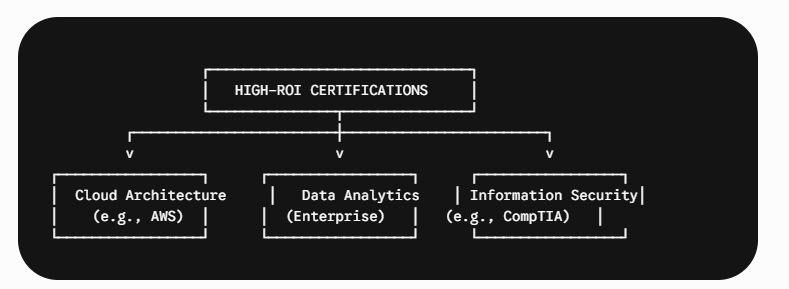
Cloud Architecture & Cost Optimization: Verifying an engineer's capacity to design, deploy, and scale robust micro-services across dominant global cloud platforms.
Enterprise Business Intelligence: Utilizing structural database querying and analytical insights to directly influence corporate operational decisions.
Information Security Compliance: Serving as an indispensable regulatory signal to clear stringent data protection and defense network screening processes.
End-to-End Project Leadership: Establishing a professional's verified capability to lead cross-functional corporate teams within strict budget, scope, and timeline constraints.
Automated Workflow Configuration: Managing enterprise business logic, automated pipeline data, and cloud-based user directories.
🎓 Success Blueprints: If you want to review real-world career transition case studies, exact exam alignment protocols, and specific study paths for these premium credentials, check out our dedicated analysis: [Explore 5 High-Value Certifications Worth More Than a Degree].
4. Strategic Implementation: Building an Infallible Career Roadmap
Transitioning into a sustainable, competitive tech career requires moving away from the passive accumulation of paper badges. To maximize your professional impact in the current economic landscape, apply the following three architectural rules to your professional development:
Prioritize Practical Proof Over Pedigree: If your chosen track is technical or creative (such as Data Analytics, Software Development, or UX Design), your certificate is simply an entry ticket. The real differentiator is a public-facing portfolio (such as a GitHub directory or a dedicated design showcase) demonstrating real-world project execution.
Align with Corporate Compliance: Focus your efforts on certifications that carry regulatory value (such as credentials mandatory for secure government or defense infrastructure). These requirements force human resource managers to prioritize your application regardless of your academic background.
Leverage Platform Training Hubs: Avoid overpaying for introductory courses. Utilize official developer networks, interactive sandbox environments, and available institutional financial aid programs to acquire core training cost-effectively.
Disclaimer: Market conditions, corporate hiring budgets, hiring timelines, and average regional salary estimates vary based on geographic location, individual professional backgrounds, macro-economic factors, and specific employer compensation structures. Readers should conduct independent local market research alongside the insights provided in this master guide.
The post The Complete 2026 Guide to Tech Certifications: Career Paths, Remote Jobs, and High-ROI Credentials appeared first on Pirate Knights.
]]>They overspend because they’re emotional.
Modern spending is deeply connected to:
- identity,
- insecurity,
- stress,
- comparison,
- validation.
And once people understand that, money suddenly makes much more sense.
The post The Psychological Reason People Overspend appeared first on Pirate Knights.
]]>People rarely buy products only for utility.
They buy emotional transformation.
A luxury watch isn’t just a watch.
It’s confidence.
Status.
Recognition.
Success.
That emotional layer quietly drives billions of dollars in spending every year.
Social Media Made Overspending Worse
Previous generations mostly compared themselves locally.
Today comparison is global.
People open Instagram and instantly see:
- luxury vacations,
- designer clothes,
- million-dollar homes,
- exotic lifestyles.
After enough exposure, unrealistic lifestyles start feeling normal.
That creates pressure people barely notice consciously.
READ NEXT:
“How Social Media Quietly Rewired Americans’ Definition of Success”
Stress Spending Became Normalized
Many Americans now spend emotionally without realizing it.
After stressful days, people often buy:
- clothes,
- gadgets,
- food,
- subscriptions,
- random online purchases.
Not because they truly need them.
Because dopamine temporarily feels like relief.
The Dangerous Illusion of Luxury
Morgan Housel once described parking luxury cars at a hotel as a teenager.
At first, he assumed everyone admired Ferrari owners.
Later he realized something important:
People weren’t imagining themselves as the driver.
They were imagining themselves being admired.
That realization changes how luxury works psychologically.
The Real Cost of Overspending
Overspending rarely destroys people overnight.
It slowly steals future flexibility.
More payments.
More stress.
More dependency.
More financial anxiety.
And eventually people realize:
many purchases created far less happiness than expected.
But overspending didn’t become a national problem by accident.
Social media fundamentally changed how people define success.
READ NEXT:
“How Social Media Quietly Rewired Americans’ Definition of Success”
The post The Psychological Reason People Overspend appeared first on Pirate Knights.
]]>Today they compare themselves to influencers flying private jets in Dubai.
That single shift changed how millions of Americans think about money, success, and even self-worth.
And most people don’t realize how deeply it affects them psychologically.
The post How Social Media Quietly Rewired Americans’ Definition of Success appeared first on Pirate Knights.
]]>For most of human history, comparison was limited.
You compared yourself to:
- coworkers,
- classmates,
- people in your town.
Now comparison is infinite.
Every scroll exposes people to:
- luxury homes,
- designer clothes,
- exotic vacations,
- expensive cars,
- “perfect” lifestyles.
The human brain was never designed for that level of constant status exposure.
The Internet Quietly Changed What “Normal” Looks Like
One of the biggest psychological effects of social media is expectation inflation.
Eventually:
- luxury starts looking normal,
- wealth starts looking common,
- expensive lifestyles stop feeling rare.
And once that happens, ordinary life suddenly feels disappointing.
Even when life is objectively stable.
Millions of Americans Secretly Feel Behind
This is one reason financial anxiety exploded despite rising incomes.
People no longer compare themselves to realistic standards.
They compare themselves to:
- internet celebrities,
- entrepreneurs,
- influencers,
- viral success stories.
And online, everyone appears richer, happier, and more successful than they actually are.
That creates a constant psychological feeling of falling behind.
Lifestyle Inflation Became a Cultural Trap
Social media also normalized extreme consumption.
Expensive restaurants.
Luxury skincare.
Designer fashion.
High-end apartments.
“Soft life” culture.
Many people slowly absorb these lifestyles emotionally long before they can realistically afford them.
Which creates dangerous pressure:
- spend more,
- upgrade constantly,
- keep up publicly.
READ NEXT:
“The Psychological Reason People Overspend”
The Most Dangerous Part Is That It Feels Normal
Very few people consciously decide:
“I want social media to control my financial expectations.”
It happens gradually.
Tiny exposures repeated thousands of times quietly reshape what people believe success should look like.
And eventually:
- ordinary salaries feel small,
- ordinary homes feel unimpressive,
- ordinary lives feel like failure.
Even when they’re not.
The Illusion of Internet Wealth
Social media hides an important reality:
Many people displaying luxury online are deeply financially unstable.
Some are:
- drowning in debt,
- renting lifestyles,
- living paycheck to paycheck,
- performing wealth instead of building it.
But audiences only see the highlight reel.
Not the stress behind it.
Real Wealth Usually Looks Boring
Morgan Housel argues that truly wealthy people often look surprisingly ordinary.
Because real wealth is usually quiet.
It looks like:
- low stress,
- flexibility,
- savings,
- time freedom,
- long-term stability.
Not endless consumption.
Not public flexing.
Not viral lifestyles.
The Real Cost of Constant Comparison
Comparison doesn’t just damage finances.
It damages peace.
Because the comparison game never ends.
There will always be someone:
- richer,
- younger,
- more attractive,
- more successful,
- more impressive online.
And chasing that moving target psychologically exhausts people.
And for many Americans, trying to keep up financially leads somewhere even more emotionally draining:
Debt.
READ NEXT:
“Why Debt Feels Emotionally Exhausting Even When You Make Good Money”
The post How Social Media Quietly Rewired Americans’ Definition of Success appeared first on Pirate Knights.
]]>But for millions of Americans, debt creates something much deeper than financial pressure:
Psychological exhaustion.
Even high earners often carry a quiet sense of anxiety that never fully disappears.
And debt is usually part of the reason why.
The post Why Debt Feels Emotionally Exhausting Even When You Make Good Money appeared first on Pirate Knights.
]]>Every monthly payment limits future flexibility.
That’s what makes debt emotionally heavy.
People don’t just lose money.
They lose options.
A large car payment might mean:
- staying in a stressful job,
- postponing career risks,
- delaying freedom,
- feeling trapped longer than expected.
Debt slowly narrows life.
Financial Stress Never Fully Turns Off
One of the hardest parts about debt is mental.
Even during relaxing moments, financial pressure often stays in the background.
People think about:
- bills,
- payments,
- balances,
- due dates,
- interest,
- emergencies.
The brain never fully relaxes.
That’s why debt exhaustion is often emotional before it becomes mathematical.
High Income Doesn’t Automatically Remove Anxiety
Many Americans secretly believe:
“Once I make enough money, the stress disappears.”
But lifestyle inflation often rises alongside income.
Bigger paycheck.
Bigger apartment.
More subscriptions.
Higher spending.
Larger debt.
As income grows, obligations often grow too.
Which is why many high earners still feel financially trapped.
Debt Creates Invisible Pressure
Debt changes behavior in subtle ways.
People may:
- tolerate toxic jobs longer,
- avoid taking creative risks,
- stay in unhealthy situations,
- delay major life changes.
Because financial obligations quietly reduce freedom.
And over time, that pressure becomes emotionally draining.
The Emotional Weight of “Keeping Up”
For many people, debt begins with comparison.
Wanting:
- the nicer apartment,
- the luxury car,
- the expensive lifestyle,
- the appearance of success.
Social media intensified this dramatically.
People now feel pressure not only to succeed —
but to visibly appear successful.
READ NEXT:
“How Social Media Quietly Rewired Americans’ Definition of Success”
Debt Often Creates Shame
Many people openly discuss success.
Very few openly discuss financial struggle.
As a result, debt becomes isolating.
People quietly feel:
- embarrassed,
- behind,
- irresponsible,
- anxious.
Even when millions of others feel exactly the same way.
Why Financial Freedom Feels So Emotional
This is why becoming debt-free often feels deeper than money itself.
People describe it as:
- relief,
- peace,
- breathing room,
- freedom,
- mental clarity.
Because financial pressure isn’t just practical.
It’s psychological.
Ironically, the people who feel richest often aren’t the people spending the most.
They’re the people with the most freedom.
READ NEXT:
“Why Financial Independence Feels Better Than Being Rich”
The post Why Debt Feels Emotionally Exhausting Even When You Make Good Money appeared first on Pirate Knights.
]]>But according to Morgan Housel, what people actually want is something much deeper:
Control over their lives.
That’s why financial independence often creates more happiness than luxury ever does.
The post Why Financial Independence Feels Better Than Being Rich appeared first on Pirate Knights.
]]>Many high earners still feel trapped.
They may have:
- expensive homes,
- luxury cars,
- impressive lifestyles.
But they also have:
- massive obligations,
- constant pressure,
- financial anxiety,
- little control over their time.
Which means outward success doesn’t always create inner peace.
Independence Is Really About Control
Financial independence gives people something status cannot buy:
Options.
The ability to:
- leave toxic environments,
- say no,
- take risks,
- rest,
- spend time intentionally,
- stop living in survival mode.
That’s why independence feels emotionally powerful.
Wealth Is Often Invisible
Morgan Housel argues that real wealth is usually hidden.
Because wealth is what people don’t spend.
It’s:
- savings,
- investments,
- flexibility,
- low stress,
- time ownership.
The truly wealthy person often looks ordinary from the outside.
And that confuses many people raised in modern consumer culture.
Savings Buy More Than Money
Most people see savings as delayed gratification.
But savings create immediate psychological benefits.
More calm.
Less panic.
More security.
More breathing room.
Money becomes emotionally valuable when it reduces fear.
Luxury Quickly Becomes Normal
One reason chasing status rarely works is psychological adaptation.
Humans quickly normalize upgrades.
The exciting apartment becomes ordinary.
The luxury car becomes expected.
The expensive lifestyle becomes baseline.
And eventually the brain searches for the next upgrade again.
That cycle never truly ends.
Time Freedom Is the Real Flex
The ultimate luxury is often invisible.
It’s:
- waking up without panic,
- controlling your schedule,
- not depending on constant approval,
- having flexibility,
- owning your time.
That level of peace is what many people are actually searching for underneath financial ambition.
Why “Enough” Matters So Much
One of the most powerful financial skills is learning when enough is enough.
Because endless comparison creates endless dissatisfaction.
But people who prioritize independence over appearance often experience something different:
Contentment.
And in modern culture, contentment is becoming increasingly rare.
Ironically, many people spend years chasing luxury because they believe it will finally make them feel successful.
But much of that desire starts somewhere deeper:
Comparison.
READ NEXT:
“How Social Media Quietly Rewired Americans’ Definition of Success”
The post Why Financial Independence Feels Better Than Being Rich appeared first on Pirate Knights.
]]>It’s not.
Some of the smartest people in America are drowning in debt, living paycheck to paycheck, and quietly stressed about money every single day.
According to bestselling author Morgan Housel, money is less about math — and far more about psychology.
The problem isn’t usually what people know.
It’s how they think.
These are the brutal money truths millions of Americans eventually learn the hard way.
The post 13 Brutal Money Truths Most Americans Learn Too Late appeared first on Pirate Knights.
]]>People rarely buy things because they truly need them.
They buy things because they want to become someone.
More admired.
More respected.
More successful-looking.
And modern social media turned that urge into a billion-dollar industry.
Many purchases today are emotional before they’re practical.
READ MORE:
“The Psychological Reason People Overspend”
2. Debt Quietly Steals Future Freedom
Debt doesn’t just cost money.
It costs options.
Every monthly payment quietly limits future choices:
- where you can live,
- what job you can quit,
- how much risk you can take,
- how much peace you feel.
And for many Americans, that pressure becomes emotionally exhausting long before it becomes financially catastrophic.
READ MORE:
“Why Debt Feels Emotionally Exhausting Even When You Make Good Money”
3. Social Media Changed What “Normal Success” Looks Like
Previous generations compared themselves to neighbors.
Today people compare themselves to influencers with private jets, luxury apartments, and impossible lifestyles 50 times a day.
The result?
Millions of people quietly feel like they’re falling behind — even while earning more than previous generations ever did.
READ MORE:
“How Social Media Quietly Rewired Americans’ Definition of Success”
4. Rich and Wealthy Are Completely Different Things
Many people who look rich are financially fragile.
And many genuinely wealthy people look completely ordinary.
Morgan Housel argues that real wealth is often invisible.
Because wealth isn’t what you spend.
It’s what you keep.
READ MORE:
“Why Financial Independence Feels Better Than Being Rich”
5. Most People Aren’t Buying Luxury — They’re Buying Validation
Luxury often has very little to do with enjoyment.
What people really want is recognition.
Status.
Attention.
Proof they matter.
But there’s a hidden psychological trap inside that pursuit:
Most strangers barely notice you at all.
6. The Hardest Financial Skill Is Learning When Enough Is Enough
For many people, the goalpost keeps moving forever.
A higher salary becomes a bigger house.
A bigger house becomes a more expensive lifestyle.
A more expensive lifestyle becomes constant pressure.
And eventually people realize:
more income didn’t create peace.
It only upgraded stress.
7. Financial Anxiety Exists at Almost Every Income Level
Many Americans secretly believe:
“If I made more money, my stress would disappear.”
But lifestyle inflation quietly follows income upward.
Which means people often earn more without ever feeling safer.
That’s one reason high earners still experience intense financial anxiety.
8. Saving Money Is Actually Buying Freedom
Most people think saving means sacrificing happiness today.
But savings create something far more valuable:
Breathing room.
The ability to say no.
The ability to leave bad situations.
The ability to stop panicking.
Money becomes powerful when it creates options.
9. Patience Matters More Than Intelligence
Financial success is often painfully boring.
It usually looks like:
- consistency,
- emotional control,
- avoiding stupid risks,
- staying calm longer than other people.
Not genius.
Not hype.
Not flashy success.
10. Many People Spend Money to Cope Emotionally
Stress spending has become normalized.
People buy things after:
- bad days,
- anxiety,
- loneliness,
- burnout,
- insecurity.
Shopping temporarily feels like relief.
Until reality returns.
11. Independence Is the Ultimate Flex
Luxury impresses strangers.
Freedom changes your life.
Being able to:
- control your time,
- choose your schedule,
- walk away from toxic situations,
- sleep peacefully…
often creates far more happiness than status symbols ever do.
READ MORE:
“Why Financial Independence Feels Better Than Being Rich”
12. Comparison Is Financial Poison
The fastest way to feel poor is comparing your life to curated internet lifestyles.
Because someone will always:
- earn more,
- travel more,
- own more,
- show off more.
The comparison game never ends.
Which is exactly why it becomes psychologically destructive.
13. The Real Goal Was Never Money
For most people, money is actually emotional.
They don’t truly want cash.
They want:
- safety,
- freedom,
- respect,
- peace,
- control,
- relief from stress.
And realizing that changes everything.
READ NEXT
- “The Psychological Reason People Overspend”
- “How Social Media Quietly Rewired Americans’ Definition of Success”
- “Why Debt Feels Emotionally Exhausting Even When You Make Good Money”
- “Why Financial Independence Feels Better Than Being Rich”
The post 13 Brutal Money Truths Most Americans Learn Too Late appeared first on Pirate Knights.
]]>The post Welcome to Ocean Pirates Blog – Your Window Into Life, Knowledge, and Experiences over the Sea appeared first on Pirate Knights.
]]>The United States is a vast and diverse nation, made up of different lifestyles, traditions, landscapes, and communities. Through Ocean Pirates Blog, we aim to bring these elements closer to you with clear, informative, and engaging content. From major cities like New York, Los Angeles, and Chicago to peaceful small towns hidden across the country, each corner of the U.S. has its own charm and unique story to tell. Our articles explore these differences to help you understand how Americans live, work, travel, and enjoy their everyday moments.
One of the core values of Ocean Pirates Blog is authenticity. All content is built from real experiences, practical knowledge, and accurate information that readers can rely on. We cover a wide range of topics, including daily living tips, cultural insights, food experiences, travel guides, financial advice, educational information, and lifestyle recommendations. Whether you are curious about how to rent an apartment, how healthcare works, what American holidays are like, or which destinations you must visit, you will find detailed and easy-to-understand articles here.
Beyond practical information, Ocean Pirates Blog also celebrates the fun and interesting side of American life. The United States is filled with unique experiences — from vibrant street festivals and sports culture to innovative technology, diverse cuisine, and breathtaking natural wonders. Our blog highlights these exciting aspects so you can better appreciate the beauty and creativity that define the American spirit. We believe learning about the U.S. should be enjoyable, not overwhelming, and we work hard to keep our content friendly, engaging, and enjoyable to read.
Whether you are an international visitor, a new immigrant, a long-term resident, or simply someone who loves discovering new things, Ocean Pirates Blog is here to accompany you on your journey. Our community values learning, curiosity, and open-minded exploration. We welcome readers from all backgrounds and encourage everyone to join us in discovering the stories, opportunities, and hidden gems found across the United States. Our blog is not just a source of information — it is a place to connect, share, and grow together.
Thank you for visiting Ocean Pirates Blog. We are excited to share our experiences with you and hope our content helps you gain a deeper, richer, and more enjoyable understanding of life in the United States. Stay tuned as we continue to publish fresh articles, updated information, and meaningful insights every week. Whether you are here to learn, explore, or simply find inspiration, Ocean Pirates Blog is always ready to welcome you.Email to us [email protected] or email in footer.
The post Welcome to Ocean Pirates Blog – Your Window Into Life, Knowledge, and Experiences over the Sea appeared first on Pirate Knights.
]]>