Table of Contents >> Show >> Hide
- Before You Start: The 10-Minute Shelf Reset
- 19 Effortless Ways to Style Your Bookshelves
- 1) Leave breathing room (yes, empty space is doing work)
- 2) Mix vertical rows with horizontal stacks
- 3) Use the Rule of Three (but don’t treat it like a law)
- 4) Vary heights like you’re building a skyline
- 5) Anchor each shelf with one “hero” item
- 6) Add something organic: plants, branches, or dried stems
- 7) Layer objects front-to-back for depth
- 8) Try “bookend energy” (even if you don’t own bookends)
- 9) Use baskets or boxes to hide the “tiny chaos”
- 10) Stick to a simple color story
- 11) Go “bookshelf wealth”: display what you actually love
- 12) Flip a few books spine-in (sparingly)
- 13) Remove dust jackets (when it makes sense)
- 14) Create mini “zones” instead of decorating randomly
- 15) Add a metallic touch for light bounce
- 16) Lean art instead of hanging more holes in your wall
- 17) Use risers or stands to elevate smaller pieces
- 18) Keep the heaviest visual weight on lower shelves
- 19) Make it maintainable: build in a “drop zone”
- Three Quick Bookshelf Styling Formulas (When You’re Stuck)
- Common Bookshelf Styling Mistakes (And Easy Fixes)
- of Real-Life Bookshelf Styling Experiences (So You Don’t Have to Learn the Hard Way)
- Final Thoughts
Bookshelves are the one place in your home where storage and personality are supposed to hang out together. But somehow, they either end up looking like a
library sale exploded… or like a showroom where nobody is allowed to actually read.
The sweet spot is a shelf that feels lived-in, balanced, and easy to maintainwithout turning your Saturday into a full-contact decorating sport.
Below are simple, designer-approved bookshelf styling ideas you can do in small steps, with real examples you can copy (and tweak) in minutes.
Before You Start: The 10-Minute Shelf Reset
This is the fastest way to make your shelves look better before you add a single “decor object.” Think of it like brushing your hair before taking a selfie.
(Yes, the bar is that lowin a good way.)
- Clear one shelf at a time. You don’t need to empty the whole bookcase unless you enjoy chaos.
- Dust quickly. Dust bunnies have no business squatting on your design moment.
- Pull out anything damaged or unwanted. If you wouldn’t display it on purpose, don’t display it by accident.
- Pick a loose “vibe.” Cozy, modern, collected, minimalist, colorfulanything works if you’re consistent.
19 Effortless Ways to Style Your Bookshelves
-
1) Leave breathing room (yes, empty space is doing work)
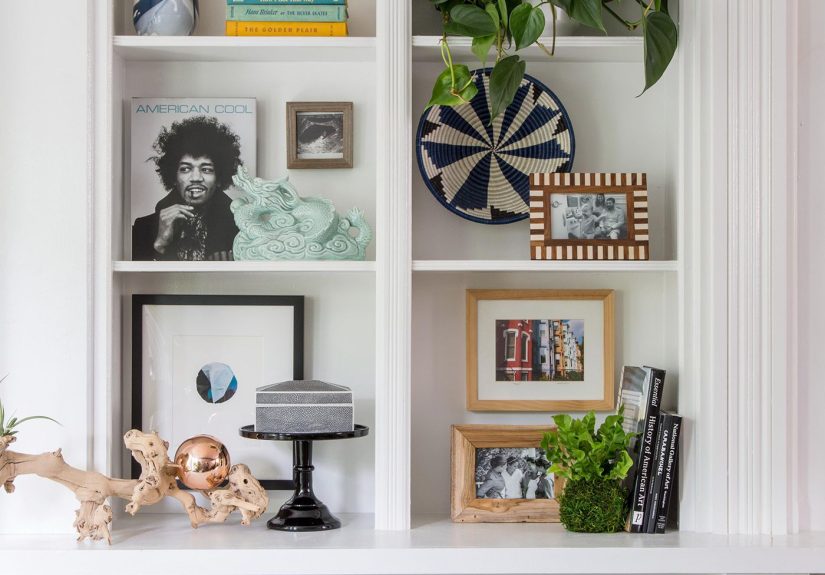
The easiest “designer upgrade” is stopping before the shelf is full. A little negative space lets the eye rest, makes your favorite items stand out,
and keeps the whole bookshelf from reading as clutter.Example: Aim to leave 15–30% of each shelf open. If that feels scary, start with one empty corner per shelf.
-
2) Mix vertical rows with horizontal stacks
Straight rows of books look tidy, but they can also look flat. Add a few horizontal stacks to create movement and “platforms” for small objects.
Example: Do one vertical section, then a stack of 3–6 books beside it, then a small object on top (candle, small bowl, framed photo).
-
3) Use the Rule of Three (but don’t treat it like a law)
Grouping items in odd numbersespecially threesoften looks more natural than perfect pairs. It creates variety without feeling random.
Example: A small vase + a framed photo + a short stack of books reads as intentional instantly.
-
4) Vary heights like you’re building a skyline
Height changes keep your shelf styling from looking like a row of same-size rectangles. Combine tall, medium, and small pieces, and avoid lining
everything up at the same height.Example: Place a taller vase or lamp on one side, a medium stack in the middle, and a small object on the other side.
-
5) Anchor each shelf with one “hero” item
A hero item is a focal point that tells your shelf where to start. When every object fights for attention, the shelf looks busy. When one thing leads,
the rest can support.Examples: A sculptural vase, a framed piece of art, a large bowl, or a standout hardcover book on a stand.
-
6) Add something organic: plants, branches, or dried stems
Natural elements soften hard lines and make shelves feel warm. You don’t need a jungleone plant can do the job.
Example: A trailing pothos on an upper shelf, or a small snake plant on a lower shelf to balance weight.
-
7) Layer objects front-to-back for depth
Shelves look more collected when items overlap slightly. Layering creates depth without adding more stuffit’s about placement, not quantity.
Example: Lean a small frame against the back, then place a short stack of books in front, then a small bowl or candle on top.
-
8) Try “bookend energy” (even if you don’t own bookends)
Bookends create structure and make stacks feel crisp. If you don’t have bookends, use sturdy objects that act like them.
Examples: A small sculpture, a decorative box, a stone paperweight, or even a heavy vase.
-
9) Use baskets or boxes to hide the “tiny chaos”
Remotes, cords, old receipts, mystery keysshelves are magnets for small clutter. Closed storage keeps the look clean and makes your shelf more functional.
Example: Two matching bins on a lower shelf = calm. Label them if you want to be the kind of organized person who impresses future-you.
-
10) Stick to a simple color story
You don’t need a monochrome bookshelf, but a loose palette helps everything feel intentional. Choose 2–3 main colors plus neutrals.
Example: White + warm wood + black accents, with one “pop” color repeated 2–3 times (like green from plants or blue from ceramics).
-
11) Go “bookshelf wealth”: display what you actually love
The most stylish shelves don’t look like a catalog pagethey look like a life. Mix books with personal objects that have a story.
Examples: Travel souvenirs, a framed postcard, your grandmother’s small dish, or a quirky thrift-store find that makes you smile.
-
12) Flip a few books spine-in (sparingly)
Turning some books around can calm visual noise and highlight shapes instead of titles. Use it as a design accent, not a full-on identity change.
Example: Try it for one small section or on one shelf, especially if your spines are all different colors and fonts.
-
13) Remove dust jackets (when it makes sense)
Hardcovers without jackets can look cleaner and more classic. Don’t do this for valuable books or anything you want protectedstyle should never bully practicality.
Example: Remove jackets from a small group to create a calmer “neutral zone” within a colorful shelf.
-
14) Create mini “zones” instead of decorating randomly
Think in small vignettes: one shelf can have 2–3 zones, each with a mix of books + an object + breathing room. This makes styling easier and more cohesive.
Example: Left zone: vertical books + bookend. Middle zone: horizontal stack + candle. Right zone: small plant + framed photo.
-
15) Add a metallic touch for light bounce
A little shine keeps shelves from looking dull, especially in darker rooms. Metallic pieces reflect light and add contrast.
Examples: Brass candlestick, silver bowl, gold frame, or a simple mirrored tray.
-
16) Lean art instead of hanging more holes in your wall
Leaning framed art on shelves is an instant upgrade. It adds height, color, and personality, and you can swap it out whenever your mood changes.
Example: Place a medium frame at the back, overlap with a smaller frame in front, then add a small object beside them.
-
17) Use risers or stands to elevate smaller pieces
Small objects can disappear on deep shelves. A riser gives them stage presence and helps you create layered height without buying bigger decor.
Examples: A small acrylic riser, a stack of books as a pedestal, or a low tray.
-
18) Keep the heaviest visual weight on lower shelves
Even if nothing will tip over, your eyes like balance. Dense stacks and bigger objects feel more grounded lower down.
Example: Put storage baskets, larger art books, and chunky ceramics on the bottom shelves; keep lighter objects up top.
-
19) Make it maintainable: build in a “drop zone”
Your bookshelf shouldn’t require a weekly photoshoot to look good. Create one area where it’s okay to add a new book, rotate items, or stash a current read.
Example: Reserve one shelf end for “now reading,” a small tray for sunglasses, or a basket for mailcontained clutter beats free-range clutter.
Three Quick Bookshelf Styling Formulas (When You’re Stuck)
- The Balanced Classic: Vertical books + horizontal stack + small object + open space.
- The Collected Look: Leaned art at the back + stack of books in front + one personal object + plant.
- The Clean Minimal: Fewer, larger items (a bowl, a vase, a framed photo) + a short row of books + lots of breathing room.
Common Bookshelf Styling Mistakes (And Easy Fixes)
- Everything is the same size. Fix: add one tall piece and one low piece to create height variation.
- Too many tiny items. Fix: swap small knickknacks for one tray or one lidded box to visually simplify.
- No “pause” for the eye. Fix: clear one small section and let it stay empty on purpose.
- It feels themed, not personal. Fix: add one meaningful item (photo, souvenir, inherited piece) to break the “store display” vibe.
of Real-Life Bookshelf Styling Experiences (So You Don’t Have to Learn the Hard Way)
The first time I tried to “style” a bookshelf, I made the classic mistake: I treated the shelf like a parking lot. Books went in wherever they fit, random
decor got sprinkled on top, and I stepped back feeling… proud? Then I took a photo and realized the shelf looked like it was hosting a yard sale for
mismatched objects.
The fix wasn’t buying new thingsit was editing. I started with one shelf and cleared it completely. That alone felt dramatic, like I was about to
renovate the whole room. But once the shelf was empty, two truths showed up fast: (1) I owned more “tiny stuff” than I thought, and (2) none of it was
strong enough to stand on its own. Everything needed a buddy, a platform, or a reason.
I rebuilt the shelf in layers. First: books, because they’re the point and they add structure. I put the ones I actually use in vertical rows so I could
find them without playing “library Jenga.” Then I created one horizontal stacknot a mountain, just a stackto give myself a pedestal for a small object.
That small object ended up being a ceramic bowl I already had in a cabinet. Suddenly it looked like decor, not dishware waiting for a purpose.
Next lesson: breathing room is not “wasted space.” When I filled every inch, the shelf looked heavy and loud. When I left a gap, the shelf
looked calmer and, weirdly, more expensive. I started leaving a small empty corner on each shelf as a visual “pause.” That one change made everything else
make more sense.
The most useful trick for real-life maintenance was creating a “drop zone.” In my house, new books appear the way socks disappearmysteriously and often.
So I reserved a small section for the current pile: the book I’m reading, the one I mean to start, and the one I bought because the cover was pretty and
I have no self-control. Because the pile had a designated spot, it looked intentional instead of chaotic. It also made it easy to rotate items seasonally:
in fall, I swap in warmer tones (wood, amber glass); in spring, I bring in lighter ceramics and a small plant cutting.
The biggest takeaway? A well-styled bookshelf doesn’t come from perfection. It comes from a simple system you can repeat: books for structure, one hero
item for focus, a few supporting pieces for texture, and enough open space to let it all breathe. Once you’ve done it once, you can refresh your shelves
in ten minutesno stress, no shopping trip, no “Why do I own seven tiny vases?” existential crisis. (Okay, maybe a small one.)
Final Thoughts
Styling your bookshelves isn’t about copying a perfect shelf photoit’s about building a display that looks good and works for your life. Start
small, use a few repeatable rules (balance, variety, breathing room), and choose objects that mean something to you. Your shelves will look curated without
looking like they’re afraid to be touched.