Table of Contents >> Show >> Hide
- What Is Cement Board, and Why Is It Tricky to Cut?
- Best Way to Cut Cement Board for Most Projects
- Tools You Need for Clean Cement Board Cuts
- Step-by-Step: How to Cut Cement Board With Score and Snap
- How to Cut Cement Board With a Circular Saw
- How to Cut Holes, Curves, and Notches in Cement Board
- Dust Control: The Part You Should Not Ignore
- Common Mistakes That Ruin Cement Board Cuts
- How to Get Consistent Results Every Time
- Which Cutting Method Should You Use?
- Extra Experience: Real-World Lessons for Cleaner Cement Board Cuts
- Conclusion
Cutting cement board is one of those remodeling jobs that looks simple until the board chips, the edge crumbles, the dust cloud rises like a tiny construction volcano, and you suddenly remember you “only needed one little piece.” The good news is that learning how to cut cement board cleanly is not complicated. The secret is choosing the right method for the cut: score and snap for straight lines, carbide or diamond tools for harder shapes, and smart dust control every single time.
Cement board, also called cement backer board or tile backer board, is commonly used behind tile in bathrooms, kitchens, laundry rooms, showers, countertops, and floors. It is moisture-resistant, strong, and much more suitable under tile than drywall in wet areas. But because it contains cementitious materials and reinforcing mesh, it behaves differently from plywood, drywall, or foam board. Treat it like drywall and it may punish you. Treat it like stone and you may overcomplicate the job. Treat it like cement board, and it cuts predictably.
This guide explains the best tools, safest methods, and practical field-tested habits for clean cement board cuts. Whether you are trimming a sheet for a shower wall, cutting around a toilet flange, or fitting a narrow strip near a tub, the goal is the same: accurate measurements, controlled cuts, minimal dust, and edges that do not look like they were chewed by a nervous raccoon.
What Is Cement Board, and Why Is It Tricky to Cut?
Cement board is a rigid panel made from cement, aggregate, glass fiber mesh, or similar reinforcing materials. Popular types include HardieBacker, Durock, WonderBoard, and PermaBASE. These boards are designed to provide a stable surface for tile, stone, thinset mortar, and other finishes. Unlike drywall, cement board resists moisture damage and does not soften when properly installed in wet environments.
The challenge is that cement board is both brittle and reinforced. The cement core wants to fracture, while the mesh wants to hold the sheet together. That is why a shallow scratch will not cut it, and a high-speed saw can create a lot of dust. Clean results come from controlling both the face of the board and the reinforcing mesh.
Best Way to Cut Cement Board for Most Projects
For most straight cuts, the best way to cut cement board is the score-and-snap method. It is simple, inexpensive, accurate enough for tile work, and produces far less dust than sawing. You need a straightedge, pencil, utility knife or carbide-tipped scoring knife, gloves, safety glasses, and a flat work surface.
Why Score and Snap Works So Well
Score-and-snap works because you weaken the cement face along a precise line, cut through the reinforcing mesh, then bend the board until it breaks along that line. It is similar to cutting drywall, but it usually requires more passes and a sharper, tougher blade. A carbide-tipped scoring knife is ideal because cement board dulls ordinary utility blades quickly.
This method is especially useful for bathroom remodels and tile installations where most cuts are straight and will be covered by tile, trim, or corner transitions. It also keeps the work quieter and cleaner, which your lungs, neighbors, pets, and future self will appreciate.
Tools You Need for Clean Cement Board Cuts
You do not need a professional tile shop to cut cement board, but you do need the right basic setup. Here is a practical tool list:
- Tape measure: For accurate layout and repeated cuts.
- Pencil or marker: Use a visible line that will not disappear in dust.
- T-square or straightedge: Keeps long cuts straight.
- Utility knife: Works for small jobs, but keep spare blades nearby.
- Carbide scoring knife: Better for repeated cuts and cleaner scoring.
- Wood rasp or rubbing stone: Smooths rough edges after snapping.
- Jigsaw with carbide-grit blade: Useful for curves and cutouts.
- Circular saw with carbide or fiber-cement blade: Best reserved for outdoor cuts and production work.
- Drill with masonry bit or hole saw: For pipe holes and fixture openings.
- Safety glasses, gloves, hearing protection, and N95 respirator: Non-negotiable when dust is involved.
Step-by-Step: How to Cut Cement Board With Score and Snap
Step 1: Measure Twice, Then Add a Tiny Reality Check
Measure the opening where the cement board will go. Mark the board carefully, and remember to account for required gaps at walls, corners, floors, tubs, and adjoining panels according to your installation instructions. A board cut perfectly to the wrong size is still wrong, just with confidence.
Use a T-square for crosscuts and a long straightedge for rip cuts. Mark both ends of the cut line, then connect the marks. For repetitive cuts, make a simple cutting station with a scrap board underneath so the sheet is fully supported.
Step 2: Score the Face of the Board
Place the straightedge firmly on the line. Pull the scoring knife or utility knife along the line with steady pressure. Do not try to win the battle in one pass. Several controlled passes are cleaner than one heroic gouge. The goal is to cut through the surface and the mesh on the face of the board.
For 1/4-inch cement board, two to four firm passes are often enough. For thicker 1/2-inch board, you may need more passes. Keep the blade tight against the straightedge so the score line does not wander.
Step 3: Snap the Board
Move the scored line to the edge of your work surface or support one side of the panel. Lift or press the board so it bends away from the score. It should snap along the line. If it resists, do not wrestle it like an alligator. Lay it back down and score again.
After snapping, the back mesh may still be attached. Fold the board slightly and cut the remaining mesh with your knife. Keep your hands clear of the edge because freshly snapped cement board can be surprisingly sharp.
Step 4: Clean the Edge
Use a rasp, rubbing stone, or coarse sanding block to knock off high spots. You do not need a furniture-grade edge. You need an edge that fits properly, sits flat, and does not interfere with spacing or fasteners. Tile and mortar are forgiving, but they are not miracle workers.
How to Cut Cement Board With a Circular Saw
A circular saw can cut cement board quickly, but it creates far more dust than scoring and snapping. Use it outdoors whenever possible. Choose a carbide-tipped blade, fiber-cement blade, or diamond blade rated for cementitious material. A dust-collection attachment and HEPA vacuum are strongly recommended.
Set the blade depth just slightly deeper than the board thickness. This reduces dust, improves control, and helps the saw work efficiently. Support the sheet on sawhorses or a sacrificial foam board so the panel does not vibrate or crack. Move slowly and let the blade do the work. Pushing too hard can chip the edge and overload the tool.
Use a saw when you need long, precise production cuts, when snapping is not clean enough for your board type, or when the project involves many sheets. For a single bathroom repair, score-and-snap is usually cleaner, cheaper, and less dramatic.
How to Cut Holes, Curves, and Notches in Cement Board
Pipe Holes
For small pipe holes, mark the center point and use a drill with a masonry bit or carbide hole saw. Drill from the finished side when possible. If the hole is large, drill several small holes around the outline, then tap out the center and smooth the edge.
Toilet Flanges and Round Openings
For larger circles, trace the opening, score the outline, then score several relief lines through the waste area like slices of pizza. Tap the pieces out carefully with a hammer. Finish the edge with a rasp. This method is not glamorous, but it works well when the cut will be hidden under a flange or tile.
Curved Cuts
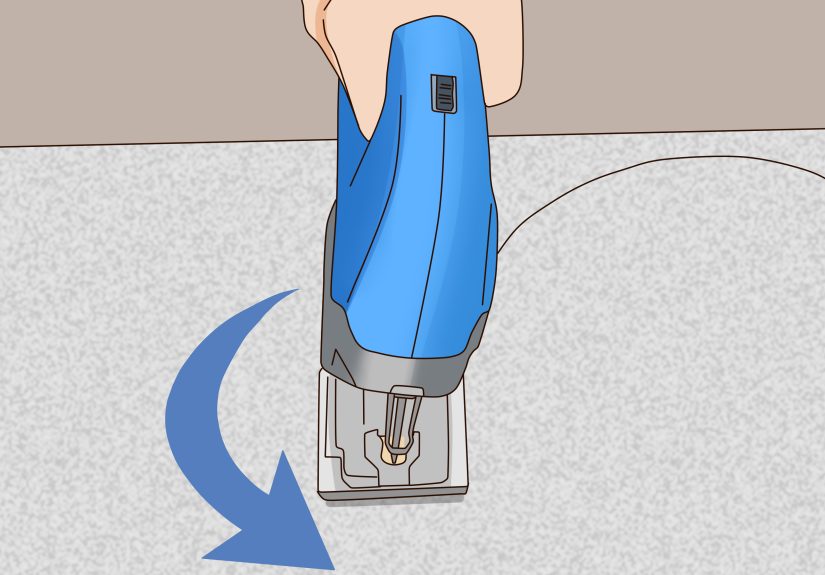
For clean curves, use a jigsaw fitted with a carbide-grit blade. Clamp the board securely and cut slowly. A standard wood blade will wear out quickly and may chatter. An angle grinder can cut curves too, but it is dusty and aggressive, so reserve it for outdoor work with proper respiratory protection and dust control.
Inside Corners and L-Shaped Cuts
For L-shaped cuts around door jambs, tub lips, or corners, score both legs of the L. Snap the longer line first, then carefully work the shorter line. For tight inside corners, drill a small hole at the corner before cutting. This reduces stress and helps prevent cracks from running beyond your line.
Dust Control: The Part You Should Not Ignore
Cement board dust can contain respirable crystalline silica, depending on the product and cutting method. That is why dust control is more than a housekeeping preference. It is a safety issue. Whenever possible, choose score-and-snap because it produces much less airborne dust than power cutting.
When using a saw, work outdoors, stand upwind, and keep other people away from the cutting area. Use a dust-collection system connected to a suitable vacuum. Wear safety glasses and a properly fitted N95 respirator at minimum. For frequent cutting, follow the product manufacturer’s instructions and applicable workplace safety rules.
Do not use compressed air to blow dust around the room. Do not dry sweep piles of cement dust if wet cleanup or HEPA vacuuming is feasible. Dry sweeping may feel satisfying for three seconds, but it can send fine particles right back into the air. Use wet methods or a HEPA-filtered vacuum for cleanup.
Common Mistakes That Ruin Cement Board Cuts
Using a Dull Blade
A dull blade tears the mesh instead of cutting it cleanly. This leads to ragged edges and frustrating snaps. Replace utility blades often or use a carbide scoring tool.
Scoring Too Lightly
If the score line is shallow, the board may break wherever it feels like breaking. Cement board has no emotional loyalty to your pencil mark. Score deeply enough to guide the snap.
Unsupported Panels
Letting the sheet hang off a bench can cause cracks before you make the cut. Support the board evenly, especially when working with narrow strips.
Cutting With a Power Saw Indoors
Power saws throw fine dust everywhere. Unless the manufacturer specifically allows a controlled method and you have proper dust collection, avoid indoor sawing. Score-and-snap or shears are better indoor options.
Forgetting the Gap
Cement board should not be jammed tightly into corners or against fixtures. Leave the recommended spacing for movement, mortar, sealant, and proper installation. A tight fit may look impressive until it creates installation problems later.
How to Get Consistent Results Every Time
Consistency comes from creating a repeatable process. Set up one cutting area. Keep your straightedge, knife, rasp, and measuring tools within reach. Mark all similar cuts together. Pre-cut panels before fastening when the layout is clear. Label pieces if the room has multiple walls or odd corners.
For shower walls, dry-fit each panel before mixing thinset or driving screws. Check that plumbing holes line up, edges land where they should, and fasteners will not be too close to a fragile edge. A five-minute dry fit can prevent a thirty-minute vocabulary expansion.
Which Cutting Method Should You Use?
| Cut Type | Best Tool | Best Use |
|---|---|---|
| Straight cuts | Carbide scoring knife and straightedge | Most tile backer board installations |
| Long production cuts | Circular saw with fiber-cement blade | Outdoor cutting with dust collection |
| Curves | Jigsaw with carbide-grit blade | Rounded openings and irregular shapes |
| Small holes | Masonry bit or carbide hole saw | Pipes, anchors, and fixtures |
| Minor edge cleanup | Rasp or rubbing stone | Smoothing snapped edges |
Extra Experience: Real-World Lessons for Cleaner Cement Board Cuts
After working with cement board on bathroom floors, tub surrounds, backsplashes, and small repair patches, one lesson stands out: most bad cuts begin before the blade touches the board. The layout is usually the real villain. A crooked pencil line, a rushed measurement, or a forgotten gap can make even a sharp carbide tool look guilty.
One practical habit is to mark the “waste side” of every cut. Cement board sheets often get flipped, rotated, and dragged around during a project. When you are tired, dusty, and thinking about lunch, it is surprisingly easy to cut on the wrong side of the line. A big X on the waste piece prevents that tiny tragedy.
Another field trick is to use a scrap strip as a test piece. Before making a visible or complicated cut, score and snap a small offcut from the same board. You will quickly learn how much pressure the material wants, how many passes work best, and whether your blade is already dull. This is especially useful when switching brands or thicknesses because not every cement board feels exactly the same.
For narrow strips, patience matters. A 2-inch strip is more likely to crumble than a 20-inch panel because there is less material to resist the snapping force. Score deeply, support both sides, and snap gently. If the strip is very narrow and important, use a saw outdoors or consider adjusting the layout so the narrow piece is avoided. In tile work, smart layout beats heroic cutting almost every time.
When cutting around plumbing, do not aim for perfection that nobody will see. A pipe hole hidden behind an escutcheon or valve trim does not need to look like it came from a laser-cutting factory. It needs enough clearance, no cracks spreading from the opening, and proper support around it. Overworking the hole can weaken the panel more than a slightly rough edge ever would.
Dust management also becomes easier when you plan the cutting station before the mess begins. Put a drop cloth under the work area, keep a vacuum nearby, and cut outside when power tools are involved. If you must carry cut panels through the house, wipe them with a damp sponge first. Cement dust has an amazing talent for appearing later on furniture you swear was in another room.
Finally, do not install a damaged panel just because you already cut it. If a crack runs across a fastener area, a corner breaks badly, or the board no longer sits flat, replace that piece. Cement board is the foundation for the tile assembly. Tile is expensive, grout is visible, and callbacks are annoying. A clean, stable backer board installation is one of those hidden details that makes the finished surface look better and last longer.
Conclusion
Cutting cement board cleanly is not about brute force. It is about matching the method to the cut. For most straight cuts, score and snap with a carbide scoring knife is the cleanest, simplest, lowest-dust option. For curves and holes, use carbide-grit blades, masonry bits, or careful relief scoring. For long production cuts, a circular saw can help, but only with the right blade, outdoor setup, and serious dust control.
The best results come from steady layout, sharp tools, supported panels, proper safety gear, and a willingness to slow down before the cut. Cement board may be tough, dusty, and a little rude to cheap blades, but once you understand its personality, it becomes predictable. And predictable is exactly what you want when tile, waterproofing, and weekend pride are on the line.