Table of Contents >> Show >> Hide
If you could bottle a decade, the 1940s would fizz like a soda at a USO canteen: part jitterbug energy, part wartime grit,
and part “we’re all in this together, pass the ration book.” The language of the era did the same thingbright, fast, and
a little bit clever under pressure. Americans swapped slang on dance floors, in factory break rooms, over radios, and in
barracks overseas. Some words were playful (because life needed levity), and some were brutally honest (because…well,
war tends to do that).
This guide breaks down 10 iconic 1940s slang termswhat they meant then, why they caught on, and how to use them now
without sounding like you’re auditioning for a black-and-white detective movie. (Although if you are auditioning, congratulations:
your fedora is already doing the most.)
Why 1940s Slang Took Off
Slang thrives when society moves fast, and the 1940s moved at a sprint. World War II reshaped daily life, pulling millions into
the military, defense plants, and new cities. People mixed dialects, cultures, and inside jokes at record speed.
Add swing music, big-band radio, Hollywood, and the rise of mass advertisingand you get a decade that practically
manufactured fresh expressions.
Two big “slang engines” powered the era:
- Military shorthand: Acronyms and clipped phrases that traveled home in letters, jokes, and postwar conversations.
- Jazz and jive talk: A vibrant, fast-evolving lexicon shaped by musicians and nightlife culture, then echoed by mainstream media.
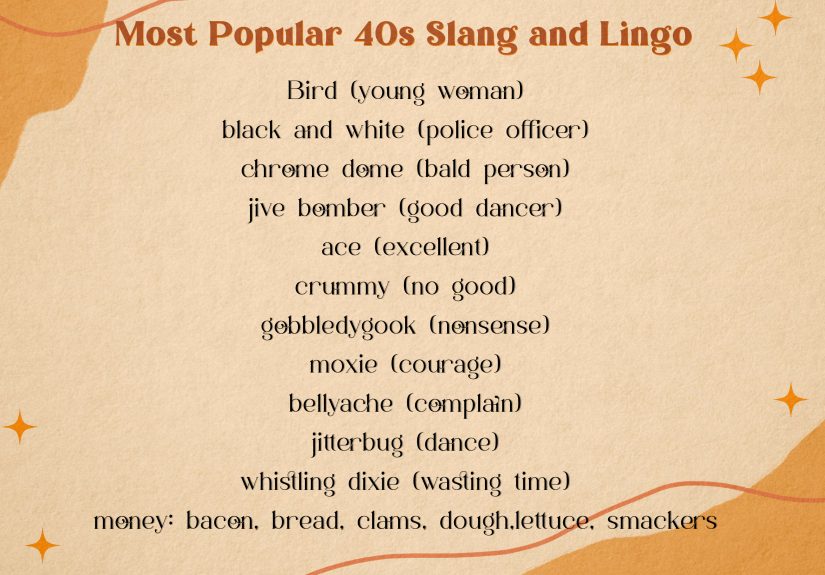
10 Unique & Iconic 1940s Slang Terms
1) SNAFU
Meaning: A messed-up situationoften one that feels “typical,” like chaos wearing a name tag that says “Hello, I’m Normal.”
The term came from military slang during WWII and was widely understood among service members. In polite company, you’ll
often see it softened as “All Fouled Up,” but the original version was…let’s call it “strongly worded.”
How it was used: Soldiers used it to describe confusion, bureaucratic mix-ups, and the kind of plans that fall apart the moment
someone says, “This’ll be easy.”
Example: “The supply drop turned into a total snafuwrong spot, wrong time, zero luck.”
Modern equivalent: “Cluster,” “mess,” “train wreck,” “what even is happening right now?”
2) FUBAR
Meaning: Something that’s wrecked beyond easy repairbroken, scrambled, or ruined. Like SNAFU, this WWII military acronym
had a “clean” version (“Fouled Up Beyond All Recognition”) and a spicier original that soldiers absolutely knew.
How it was used: When a plan didn’t just go wrongit went wrong and then wrote a sequel.
Example: “The radio’s fubar. We’re not getting a signal no matter how sweetly you talk to it.”
Modern equivalent: “Toast,” “bricked,” “beyond saving,” “done for.”
3) Hep (and “hep cat”)
Meaning: In the know. Stylish. Tuned in. If someone was “hep,” they understood the music, the scene, and the unspoken rules.
A hep cat was the person who made that look effortlessusually with jazz knowledge, confidence, and maybe a grin that said,
“Kid, you wouldn’t understand.”
Why it mattered: This word sits at the intersection of jazz culture and mainstream America’s growing fascination with what felt
modern, urban, and “cool.”
Example: “Don’t worry about Frankiehe’s hep. He knows where the good band is playing.”
Modern equivalent: “Hip,” “plugged in,” “on the scene,” “in the loop.”
4) Square
Meaning: Uncool, conventional, overly properor simply allergic to fun. In the slang ecosystem, “square” was the natural enemy
of “hep.” If hep was improvisation and nightlife, square was rules, routines, and disapproving eyebrow angles.
How it was used: Not always cruelsometimes it was teasing. But if you were called a square, it meant your vibe was
aggressively…responsible.
Example: “Don’t be such a squarecome dance once before you turn into a coat rack.”
Modern equivalent: “Basic,” “stiff,” “no fun,” “buzzkill.”
5) On the beam
Meaning: On track. Correct. Operating the way it should. The phrase connects to aircraft navigationfollowing a radio beamthen
became everyday shorthand for “right on course,” whether you were flying a plane or just trying to get through Monday.
How it was used: Compliment someone’s thinking, aim, or executionespecially when they nailed it cleanly.
Example: “Your pitch is on the beamtight, clear, and hard to argue with.”
Modern equivalent: “Spot on,” “nailed it,” “right on target.”
6) Zoot suit
Meaning: A boldly styled outfitoften with a long jacket, padded shoulders, and high-waisted, wide-legged pantsassociated with
swing-era youth culture. In the early 1940s, the zoot suit wasn’t just fashion; it was a statement. And in a time of wartime
rationing, it also became controversial.
How it was used: As a term for the look itself, and sometimes as shorthand for the whole scene around it: music, dancing, identity,
and rebellion.
Example: “Look at himsharp as anything in that zoot suit.”
Modern equivalent: “Statement fit,” “drip,” “bold look,” “full send on fashion.”
7) Scram
Meaning: Leavefast. “Scram” is the verbal equivalent of pointing at the door and politely requesting that someone become a rumor.
It’s brisk, snappy, and perfect for scenes where you don’t have time for a committee meeting about feelings.
How it was used: As a command (“Scram!”) or a quick narrative (“We scrammed before the cops showed up.”).
Example: “Scrammy mom’s coming, and she’s got questions.”
Modern equivalent: “Bounce,” “get out,” “dip,” “peace out.”
8) Duds
Meaning: Clothesespecially your outfit. “Duds” has that casual, friendly feel, like you’re talking about your wardrobe the way you’d
talk about your friends: affectionately, but with full permission to roast it.
How it was used: Often in contexts that mattered socially: dates, dances, parties, or anytime you wanted to look sharp.
Example: “Put on your best dudswe’re going out where the band is hot.”
Modern equivalent: “Fit,” “outfit,” “threads.”
9) Gams
Meaning: Legstypically used to describe attractive legs, especially in the language of the era’s pop culture and film chatter.
It shows up in a lot of vintage dialogue because Hollywood loved a playful euphemism that could slide past the censors while
still landing the wink.
How it was used: Complimenting, flirting, or describing someone’s look with a little theatrical flair.
(If you use it today, keep it light and respectfulnobody wants “vintage” to mean “creepy.”)
Example: “Those gams could stop trafficgood thing cars weren’t built that fast.”
Modern equivalent: “Legs for days” (with consent and context).
10) Razz
Meaning: To tease, mock, or rib someonesometimes playfully, sometimes not. The word is tied to “razzberry,” a variant of “raspberry,”
that classic sound of contempt (the Bronx cheer). In the 1940s, “razz” fit perfectly into a decade that loved quick banter and verbal sparring.
How it was used: Friends razzed each other for fun; rivals razzed each other to get under the skin.
Example: “Quit razzing meI missed the step once, not forever.”
Modern equivalent: “Roast,” “rib,” “mess with,” “trash talk.”
How to Use 1940s Slang Today Without Sounding Like a Cartoon Gangster
- Use it once, then move on: Sprinkle, don’t marinate. One “scram” is charming; six is a hostage situation.
- Match the moment: “On the beam” works in a work meeting. “Gams” works only if you’re quoting a movie (and doing it respectfully).
- Know your audience: WWII acronyms can be funny, but they also come from stressful contextsuse them with tact.
- Let the sentence do the work: If you have to explain the joke mid-joke, the joke has left the building.
What 1940s Slang Reveals About the Decade
The best slang isn’t randomit’s a snapshot. In the 1940s, you can hear the pressure of wartime, the need for humor, and the pull of music and youth culture.
Acronyms like SNAFU and FUBAR show how people coped with chaos using dark comedy. Words like hep and square reflect cultural
tension between old rules and new rhythms. And terms like zoot suit remind us that what you wearand what you call itcan carry real meaning.
of Experience: Trying 1940s Slang in Real Life (Without a Time Machine)
Picture this: you decide to spend one weekend talking like it’s 1944. Not in a “method actor who refuses to use elevators” wayjust a playful experiment.
Friday night, you meet friends for dinner and tell them you’re “putting on your best duds.” Someone laughs, someone squints, and someone immediately asks if “duds”
means pajamas. (A fair question. Society has blurred the lines.)
At the restaurant, you compliment your friend’s outfit as “sharp,” then toss in: “You’re really hep tonight.” The table pauses. One friend says, “Thank you?”
Another says, “Is hep…good?” And suddenly you realize slang always needs a social contract. The fun part is watching the contract get negotiated in real time.
After one quick explanation“hep means in the know”your friend grins and decides the word is officially back. Ten minutes later, they’re calling the waiter hep.
The waiter is deeply confused, but politely continues to bring bread.
Saturday morning brings errands, which is where you try out the phrase on the beam. You nail the grocery list, remember the coffee, and manage not to impulse-buy
seventeen novelty candles. “I’m on the beam today,” you announce in the parking lot. A stranger nearby nods like they understand, which feels like winning
a small cultural lottery.
Theninevitablysomething goes wrong. You get home and realize you forgot the one item you actually needed. Classic. You declare it a SNAFU.
It’s satisfying because the word doesn’t just mean “mistake.” It means “mistake with flair,” the kind of mess that feels almost scheduled. Your friend texts,
“Same. My whole morning is fubar.” You laugh, because WWII acronyms have a strange modern comfort: they name chaos bluntly, but they also turn it into a joke you can carry.
That night, you stream an old movie and notice how often characters razz each otherbanter as sport, teasing as affection, sarcasm as a love language.
You try it gently with a friend (“Look at you, big shot, all dressed up”), and it lands because the tone is warm. The experiment teaches a simple truth:
slang isn’t about sounding old-fashioned or trendy. It’s about signaling belonging. When it’s done right, it feels like a handshake made of words.
By Sunday, you’re tiredbut in a good way, like you danced through the weekend. You realize 1940s slang still works when it does what it always did:
compress a whole mood into one fast, memorable line. And honestly, in a world full of complicated explanations, sometimes you want a word that just says,
“Yep. That’s the vibe.” On the beam.
Conclusion
1940s slang isn’t just a collection of quirky old wordsit’s the decade talking back. Whether it’s the military’s sharp-edged acronyms,
the nightlife sparkle of hep culture, or the fashion-forward punch of the zoot suit, these terms capture how people stayed witty, resilient,
and socially connected in a fast-changing era. Use a few today, and you’re not just borrowing vocabularyyou’re borrowing a little bit of that
rapid-fire 1940s spirit.