Table of Contents >> Show >> Hide
- What’s actually happening in a reference check (and why your answers matter)
- Way 1: Prepare like a pro (truthful, job-relevant, and not “off the top of your head”)
- Way 2: Answer with specifics (evidence beats adjectives every time)
- Trade “They’re amazing” for “Here’s what they did”
- Use this simple format for most questions
- Common reference check questionsand strong ways to answer
- Question: “Can you describe their role and responsibilities?”
- Question: “What are their strengths?”
- Question: “What’s an area for improvement?”
- Question: “How do they handle conflict or feedback?”
- Question: “Would you rehire them?”
- Be careful with comparisons and labels
- When you don’t know the answer, say so (and redirect)
- Way 3: Stay professional under pressure (boundaries, compliance, and consistency)
- Stick to job-related topics and avoid personal or protected information
- Don’t trade honesty for drama (defamation risk is real)
- If your company policy is “dates and title only,” use a polite script
- Take short notes during or immediately after the call
- Keep your tone boringly professional (even if the candidate is your work BFF)
- Quick reference: 10 sample answers you can adapt
- Wrap-up: The best references are clear, fair, and job-relevant
- Real-world experiences and scenarios you can learn from
Reference checks are basically the professional version of “Can I get a vibe check?”except the vibe is
“Would you trust this person with your customers, your deadlines, and your Slack channel at 9:07 a.m.?”
If you’ve agreed to be someone’s reference, you’re doing them a real favor… and you’re also stepping into
a conversation where details matter, your words can travel, and “uhhh, I guess they were fine?” is not the
glowing endorsement you think it is.
The good news: answering reference check questions doesn’t require a law degree, a perfect memory, or a
microphone drop. It requires three thingspreparation, specificity, and boundaries. In this guide, you’ll
learn three practical ways to answer reference check questions with confidence, credibility,
and professionalism (plus sample scripts you can steal without sounding like a robot).
Quick note: This article is informational, not legal advice. Company policies and state laws can differ,
so when in doubt, keep it job-related and follow your organization’s guidance.
What’s actually happening in a reference check (and why your answers matter)
Most reference checks aim to confirm a candidate’s work history and learn how they performed day-to-day:
quality of work, reliability, collaboration, communication, and how they handled challenges. Hiring managers
often prefer open-ended, behavior-based questions because they reveal patternsnot just compliments.
Also, many companies keep reference responses conservative (sometimes confirming only dates and title) to reduce
risk. That means if you can provide thoughtful, factual context, your reference may carry extra weightbecause
it’s rarer than a meeting that ends early.
Way 1: Prepare like a pro (truthful, job-relevant, and not “off the top of your head”)
1) Confirm the basics before you say a single useful word
Before you start praising someone’s “next-level ownership,” pause and do a quick reality check. Reference checks
sometimes come through HR, recruiters, background screening vendors, or a hiring manager directly. You want to be sure
you’re speaking to the right person about the right candidate for the right role.
- Verify who’s calling (name, company, role, and callback number).
- Confirm the candidate’s name and your relationship (manager, peer, cross-functional partner).
- Check consent expectations: Did the candidate tell you to expect this call? If not, it’s okay to ask for confirmation or schedule a callback.
- Know your company policy: Some workplaces route all references through HR or limit what employees can share.
If you’re caught off guard, you’re allowed to say: “I want to give you an accurate referencecan I call you back later today?”
That’s not suspicious; that’s responsible adult behavior.
2) Ask what role they’re hiring for (so you can be relevant)
A reference check isn’t a biography. It’s a hiring decision tool. If you don’t know what the candidate is applying for, your feedback
may drift into generalities like “great energy” (which is nice, but doesn’t help anyone choose a product manager).
Try this: “Can you tell me the role and what success looks like in the first 6–12 months?” Then aim your examples toward the skills
that matter: leadership, customer empathy, accuracy, pace, writing, stakeholder management, technical depthwhatever fits.
3) Build a quick “story bank” from real moments
The easiest way to sound credible is to anchor your answers in specific situations you personally observed. You don’t need a speech.
You need a few true stories.
Use a light version of the STAR method (Situation, Task, Action, Result). Keep it shortlike a movie trailer, not the full director’s cut.
- One “strength” story (e.g., improved a process, led a project, mentored others).
- One “pressure” story (tight deadline, conflict, ambiguity, outage, crisis).
- One “growth” story (feedback received and what changed afterward).
- One “team” story (collaboration style, communication, reliability).
Mini checklist you can do in 3 minutes
- Write down: your relationship, dates you worked together, and the candidate’s main responsibilities.
- Pick 2–3 outcomes you can quantify (time saved, revenue impact, quality improvements, customer satisfaction, fewer errors).
- Choose one growth area you can describe fairly (and how they improved).
- Decide your boundary: what you will not discuss (confidential projects, personal info, protected characteristics).
Preparation isn’t about scripting a perfect reference. It’s about avoiding the two classic reference tragedies:
(1) rambling, and (2) forgetting the best example until 20 minutes after you hang up.
Way 2: Answer with specifics (evidence beats adjectives every time)
Trade “They’re amazing” for “Here’s what they did”
Adjectives are fluffy. Evidence is useful. “Hardworking” could mean “stays late” or “gets distracted but refuses to quit.” You want the
hiring manager to understand what the candidate actually does and what outcomes they produce.
Good references focus on behaviors you observed: how the person communicates, prioritizes, handles feedback, manages conflict,
and delivers work.
Use this simple format for most questions
For many reference check questions, you can follow a consistent pattern:
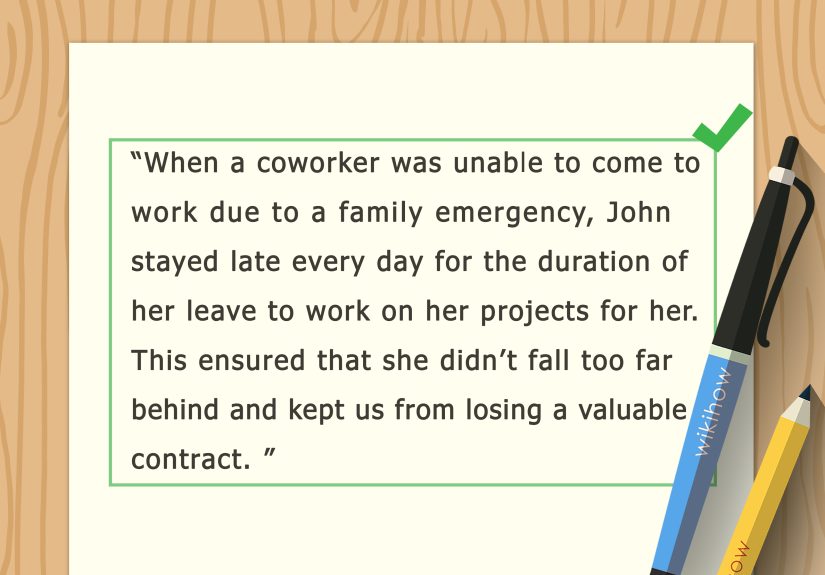
- Answer in one sentence (your headline).
- Give one example (a real moment).
- Share the impact (result or learning).
Common reference check questionsand strong ways to answer
Question: “Can you describe their role and responsibilities?”
Solid answer: “I worked with Taylor for about 18 months while I was their project lead. They owned weekly client reporting, coordinated with Sales and Ops, and led our monthly performance reviews. They were the person everyone went to when numbers didn’t line upbecause they’d find the cause, not just the symptom.”
Question: “What are their strengths?”
Solid answer: “Their biggest strength is prioritization under messy constraints. On a product launch, requirements were shifting daily; Taylor kept a simple decision log, clarified tradeoffs with stakeholders, and prevented scope creep. We shipped on time, and the post-launch support load was lower than usual because the documentation was clear.”
Question: “What’s an area for improvement?”
This is where people either (a) panic and pretend the candidate is a superhero, or (b) accidentally turn the call into a roast.
You want a balanced, job-relevant “growth edge,” plus what the person did about it.
Solid answer: “Earlier on, Taylor sometimes over-owned problems and didn’t delegate quickly enough. After feedback, they started using a weekly planning ritualassigning owners, setting check-in points, and escalating sooner. It reduced bottlenecks and helped the team move faster.”
Question: “How do they handle conflict or feedback?”
Solid answer: “They don’t get defensive. In one cross-team disagreement about priorities, they asked clarifying questions, summarized the other team’s concerns accurately, and then proposed a compromise plan with measurable milestones. It lowered tension and got us unstuck.”
Question: “Would you rehire them?”
This question is popular because it forces clarity. If you can answer it, do so directly.
Solid answer: “Yesif I had an opening aligned to their strengths, I’d rehire them.”
If it’s a “yes, but,” you can still be professional:
“I’d rehire them for roles that require strong execution and stakeholder management; I’d want to pair them with a clear strategy lead in the first few months.”
Be careful with comparisons and labels
Saying “top 1%” is tempting. If you can’t back it up, it can sound like marketing. Instead, use grounded comparisons:
“One of the strongest writers on our team,” or “Consistently among the fastest to turn around high-quality deliverables.”
When you don’t know the answer, say so (and redirect)
If asked about something outside your direct experience, avoid guessing. A clean response:
“I didn’t directly observe that, but I can speak to how they handled deadlines and cross-team communication.”
That keeps your reference accuratewhich protects both you and the candidate.
Way 3: Stay professional under pressure (boundaries, compliance, and consistency)
Stick to job-related topics and avoid personal or protected information
Reference checks should focus on work: skills, behaviors, performance, and role fit. It’s wise to avoid sharing
personal informationespecially anything that could relate to protected characteristics (even if you think you’re being “helpful”).
If a caller asks something inappropriate, you can calmly steer the conversation back:
“I can’t speak to that. I can speak to their reliability and performance while we worked together.”
Don’t trade honesty for drama (defamation risk is real)
Even when a candidate wasn’t a fit, keep your comments factual and tied to documented performance or direct observation.
Avoid speculation, exaggeration, or “I heard that…” statements.
- Good: “Missed three deadlines in Q2 after scope changes; improved after we introduced weekly check-ins.”
- Risky: “They’re unreliable and probably won’t succeed anywhere.”
If your company policy is “dates and title only,” use a polite script
Some organizations limit references to employment verification. If that’s your situation, you can still be helpful without breaking policy.
Script: “I’m not able to provide performance details, but I can confirm their title, employment dates, and (if permitted) whether they’re eligible for rehire. For anything beyond that, please contact our HR department.”
The key is consistency: follow the same approach for everyone. That reduces risk and avoids the perception of unfair treatment.
Take short notes during or immediately after the call
You don’t need a noveljust enough to remember what you shared, especially if multiple employers call. A few bullet points can help you stay
consistent and accurate:
- Who called (name, company, date/time)
- What role they’re hiring for
- Key questions asked
- Your main examples and outcomes shared
Keep your tone boringly professional (even if the candidate is your work BFF)
You can be warm without sounding like you’re trying to adopt them. Hiring managers often listen for credibility:
balanced feedback, clear examples, and calm confidence. Over-the-top praise can backfire if it sounds unrealistic.
Aim for “trusted colleague” energy, not “proud parent at a talent show” energy.
Quick reference: 10 sample answers you can adapt
Use these as starting points and customize them to what you truly observed.
- Quality of work: “Consistently high accuracy; caught issues early and documented fixes so they didn’t repeat.”
- Speed vs. quality: “Moved quickly without sacrificing quality by clarifying requirements upfront and sharing drafts early.”
- Communication: “Proactiveflagged risks early, summarized decisions in writing, and followed through.”
- Collaboration: “Made cross-team work easier by listening first, then proposing clear next steps.”
- Leadership: “Led without egoset direction, removed blockers, and gave credit to the team.”
- Reliability: “If they committed to a deadline, you could plan around it.”
- Problem-solving: “Diagnosed root causes instead of patching symptoms.”
- Adaptability: “Handled change well; recalibrated priorities quickly and kept stakeholders aligned.”
- Feedback response: “Took feedback seriously and turned it into a concrete behavior change.”
- Rehire question: “Yes, I’d rehire them for a role requiring strong execution and stakeholder management.”
Wrap-up: The best references are clear, fair, and job-relevant
If you remember nothing else, remember this: a good reference is not a hype reel. It’s a reliable signal.
Prepare a few true stories, answer with specific observations, and protect everyone by keeping your feedback job-related and consistent.
Done right, you help the hiring manager make a better decision, you help the candidate land in a role that fits,
and you keep yourself out of awkward “Wait, did I just say that?” territory. Everybody wins.
Real-world experiences and scenarios you can learn from
The most useful “experience” you can bring to a reference check isn’t a dramatic storyit’s pattern recognition.
Over time, hiring teams tend to ask similar questions because they’re trying to predict three things:
performance, reliability, and how this person will feel to work with.
Below are a few realistic (and common) scenarios that show how the same reference can either helpor accidentally hurtdepending on how the answers are framed.
Scenario 1: The “too nice” reference that says nothing
A hiring manager asks, “How was Jordan’s performance?” and the reference replies, “Jordan was great! Super positive!”
That sounds supportive, but it’s missing the “why.” Hiring managers may interpret vague praise as a polite dodge.
A stronger version keeps the warmth but adds proof: “Jordan was consistently prepared for client meetings and turned feedback into revised deliverables within 24 hours.
On one account, that responsiveness helped us retain the client during a rough quarter.”
Scenario 2: The “oops, policy” moment
Some references genuinely want to help but forget their organization’s rules. They start sharing extra detailsperformance history,
team conflicts, personal contextand later realize they may have crossed a line. The smoother approach is to set boundaries early:
“I can speak to what I directly observed in a work setting, and I’ll keep it job-related.” That single sentence reduces risk and keeps the call focused.
Scenario 3: The rehire question with a complicated truth
“Would you rehire them?” is the reference-check equivalent of “Do you want fries with that?”it’s almost always asked.
Sometimes the truthful answer is “yes, but not in every role.” If you can’t give a simple yes, don’t panic.
A nuanced, professional answer can still be fair: “I would rehire them for roles that emphasize execution and cross-team coordination.
In roles requiring frequent client presentations, I’d want them to have coaching early on, because they improved a lot but were still building confidence.”
That response gives the hiring manager something actionable instead of an unhelpful shrug.
Scenario 4: The reference who guesses (and accidentally creates doubt)
A common trap is answering questions you didn’t observelike attendance patterns, why someone left, or how they behaved on a different team.
Guessing can damage trust quickly. Experienced hiring managers can hear uncertainty. The better move is a clean limitation:
“I can’t speak to that directly, but I can speak to their responsiveness and how they handled deadlines on the projects we shared.”
Ironically, admitting what you don’t know often makes you sound more credible.
Scenario 5: The “growth area” that actually helps the candidate
Many references worry that mentioning a weakness will hurt the candidate. In practice, thoughtful hiring managers expect humans to be human.
What matters is whether the growth area is job-relevant, fairly stated, and paired with improvement. For example:
“Early on, they sometimes took on too many tasks at once. After we introduced weekly prioritization, they got better at negotiating scope,
and their on-time delivery improved.” That tells a story of learning. It also helps the new manager support the person effectivelybecause it sets realistic expectations.
In most hiring processes, the most persuasive references aren’t the loudest. They’re the ones that sound like
they’ve paid attention: specific examples, calm tone, and clear boundaries. If you deliver that, you won’t just “answer reference check questions.”
You’ll provide the kind of signal hiring managers trust.