Table of Contents >> Show >> Hide
- Why Bathrooms Make Shockingly Good “Small Museums”
- A Quick, Weird History of Toilets in Art (Because Of Course There Is One)
- Where Damien Hirst Fits (Perfectly) Into Bathroom-Installation Thinking
- How to Design a Bathroom Like an Art Installation (Without Ruining the Art)
- Three “Damien Hirst Included” Bathroom Concepts You Can Actually Build
- Museum-Level Practicalities: Protecting Art in the Bathroom
- What the Bathroom-Installation Trend Says About Us
- Conclusion
- Field Notes: The Bathroom-Gallery Experience (Yes, It’s a Thing)
There are two kinds of bathrooms: the ones that whisper “I’m here to help,” and the ones that confidently announce, “Welcome to my solo exhibition.” If you’ve ever walked into a powder room and felt like you should lower your voice, stop touching things, and maybe donate to the arts on your way outcongratulations. You’ve met the bathroom-as-art-installation.
It sounds ridiculous until you remember how much time we spend in there. Bathrooms are where we start the day, end the day, negotiate with our reflection, and occasionally contemplate the meaning of life while staring at grout. That’s not just a room. That’s a stage. A tiny, tile-lined theater where lighting, sound, scent, and surfaces can be curated as carefully as any gallery.
And yesthis is where Damien Hirst comes in. Because if you’re going to turn a bathroom into an installation, you may as well invite the artist who made clinical perfection, pharmaceuticals, and mortality look weirdly… chic.
Why Bathrooms Make Shockingly Good “Small Museums”
1) They’re already ritual spaces
Museums run on rituals: enter, slow down, look closely, reflect. Bathrooms run on rituals too, just with more hand soap. You step in, the door closes, the world hushes. There’s a mirror (the most judgmental artwork in your collection), a sink (performance art: “Washing Hands, 20 Seconds, With Feeling”), and usually lighting that can either flatter you or create a horror movie origin story.
2) The scale forces focus
Big rooms let you ignore details. Bathrooms don’t. In a small space, a single bold decisionone mural, one sculptural sconce, one unexpected artworkcan dominate the experience. Designers often call powder rooms “jewel boxes” for a reason: they’re compact, contained, and practically begging for dramatic choices.
3) Bathrooms are naturally immersive
Immersive installation art surrounds you. Bathrooms already surround you. Tile climbs the walls, mirrors multiply the room, and sound behaves differently in a hard-surfaced box (hello, accidental concert hall). Add intentional lighting, curated objects, and a narrative concept, and suddenly your bathroom isn’t just decoratedit’s designed to be experienced.
A Quick, Weird History of Toilets in Art (Because Of Course There Is One)
Duchamp: the moment plumbing became philosophy
In 1917, Marcel Duchamp upended the art world with a urinal presented as artan idea so influential it still powers half the arguments on the internet. Whether you find it brilliant, annoying, or both, it cracked open a new question: can context turn an everyday object into an artwork? In bathroom terms, that’s basically the mission statement.
Museums that literally installed art in the restroom
Fast-forward a century and the concept goes full circle: a museum restroom becomes the site of a major artwork. Maurizio Cattelan’s America famously transformed a toilet into a participatory installationequal parts luxury joke, cultural critique, and “wait… am I allowed to use this?” moment. It’s the ultimate proof that the bathroom can be a legitimate exhibition space, not just the place you visit between exhibitions.
Bathrooms as sets, props, and punchlines
Contemporary art loves spaces that feel too personal to be public and too public to be personal. Bathrooms sit right in that tension. They’re intimate, slightly awkward, and loaded with symbolism: purity, privacy, shame, vanity, vulnerability, control, mess, renewal. In other words, a conceptual artist’s all-you-can-eat buffet.
Where Damien Hirst Fits (Perfectly) Into Bathroom-Installation Thinking
Hirst’s superpower: making “clinical” feel theatrical
Damien Hirst has spent decades circling themes that bathrooms already understand: bodies, mortality, anxiety, the promise of cleanliness, the hope of medicine, and the uneasy feeling that control is mostly decorative. His aesthetic often leans crisp and clinicalwhite surfaces, orderly grids, glossy finishesthen sneaks in existential dread like it’s an ingredient on a shampoo label.
Medicine cabinets that behave like minimalist altars
Hirst’s medicine-cabinet works (and later pill-related pieces) turn pharmaceutical packaging into tidy, grid-like compositions. They’re visually satisfyingrows, symmetry, clean linesyet conceptually loaded: our faith in pills, branding as comfort, and the thin line between healing and obsession. In a bathroom, where medicine cabinets and self-care live side by side, that tension lands with extra punch.
Pharmacy: the installation that already looks like a dream bathroom (or a nightmare one)
Hirst’s room-sized Pharmacy concept leans into the seduction of sterile order: shelves, bottles, the language of cures. It’s an immersive environment that plays with how easily we trust the aesthetics of medicine. Translate that to a bathroom the home’s most “clean” roomand you get a delicious conceptual overlap: a space devoted to hygiene, lined with objects that promise transformation.
So what does “a Damien Hirst included” bathroom mean?
It doesn’t have to mean buying a major artwork (although if you do, please invite your accountant to the opening reception). It means borrowing Hirst-like strategies:
- Order as drama: grids, repetition, “scientific” arrangement
- Clinical materials with emotional intent: glossy tile, glass, stainless steel, bright white
- Beauty + discomfort: playful color that hints at something darker underneath
- Artifacts of belief: bottles, labels, symbols of “cure,” and the rituals we treat like religion
How to Design a Bathroom Like an Art Installation (Without Ruining the Art)
Step 1: Pick a concept, not a color
Installation design starts with a thesis. What do you want the bathroom to feel like? A serene spa? A futuristic lab? A maximalist “jewel box”? A gallery that just happens to have a toilet? Once you name the concept, everything else becomes easier: materials, lighting, even which towel hooks won’t sabotage the vibe.
Step 2: Treat humidity like a curatorial problem
Bathrooms are not neutral environments. Steam, splashes, and trapped moisture can damage paper, mats, and anything framed under glass. If you’re bringing real art into the space, think like a conservator: use solid ventilation, avoid the direct “splash zone,” and choose works and materials that can survive a steamy Tuesday. For framed pieces, moisture-resistant approaches (like acrylic glazing and sealed backing) can be safer than traditional glass.
Step 3: Use lighting like a museum doespurposefully
Museums don’t just “add lights.” They choreograph attention. In bathrooms, layered lighting is your best friend: ambient (overall glow), task (mirror lighting), and accent (highlighting art or texture). A single spotlight on a textured wall, a sculpture, or a bold print can make the room feel curated rather than merely furnished.
Step 4: Curate surfaces, not just objects
In a small room, the walls and floors are the installation. Tile can function like a backdrop, wallpaper can behave like a mural, and mirrors can create a controlled hall-of-reflections effect. If you want a Hirst-adjacent vibe, consider: glossy white tile (laboratory energy), a strict grid pattern (order), or one unexpected jolt of color (the “pills” moment).
Step 5: Add one “impossible” element
Great installations usually have a detail that feels slightly wrongin the best way. In a bathroom, that might be: an oversized artwork in a tiny room, a sculptural sink, a gallery label next to the light switch, or a single absurdly precious object treated with total seriousness. (If you label your soap dispenser, you are officially curating.)
Three “Damien Hirst Included” Bathroom Concepts You Can Actually Build
Concept A: The Micro-Pharmacy Powder Room
The vibe: clean, white, clinicalbut playful enough to feel intentional, not like a dental waiting room.
- Backdrop: glossy white tile or white paint with crisp trim
- Art move: a grid of small frames (think “medicine cabinet order”), or one cabinet-front piece that echoes pharmacy shelving
- Accent: a single pop color (cobalt, cherry, or neon) in a towel, vase, or small object
- Detail that sells it: a lightbox-style mirror, or lighting that feels “retail display” clean
This concept is Hirst-adjacent because it treats order as the main event. Everything looks measured. Everything looks “approved.” And somewhere in that perfection, the room quietly asks: why do we trust cleanliness so much?
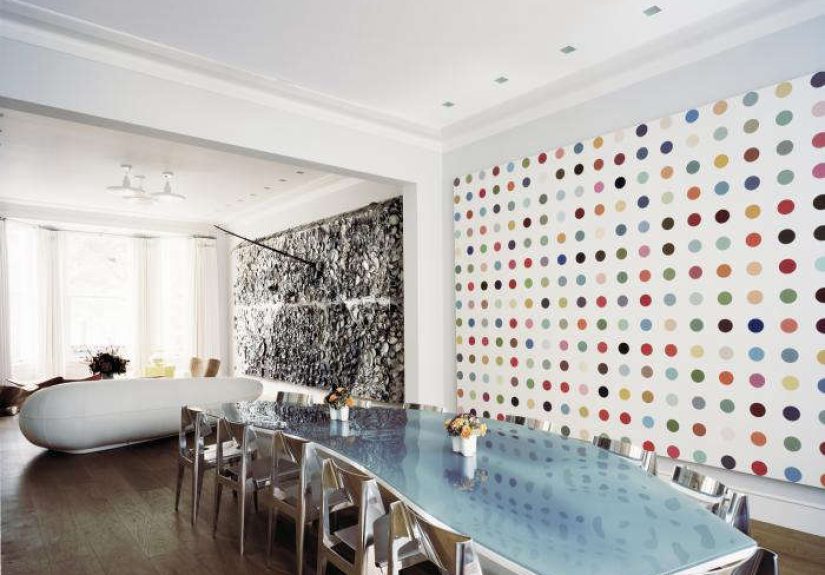
Concept B: The Spot-Painting Shower Corridor
The vibe: joyful color + controlled repetition. Like a gallery wall decided to take a bubble bath.
- Backdrop: neutral walls so color reads as intentional, not chaotic
- Art move: one large dot-print, a series of circular mirrors, or tiled “spots” in a repeating pattern
- Lighting: warm, flattering light that keeps the color from turning clinical
The secret is restraint: pick a limited palette so the repetition feels designed. The result is uplifting, graphic, and surprisingly calminglike visual white noise, but prettier.
Concept C: The Memento Mori Spa (Mortality, But Make It Relaxing)
The vibe: serene luxury with a philosophical undercurrent. You came for the bath salts and left with a new worldview.
- Backdrop: stone, warm neutrals, soft textures
- Art move: one bold piece that hints at impermanenceabstract photography, subtle vanitas imagery, or a sculptural object
- Materials: moisture-tolerant finishes; avoid precious paper unless the room is truly low-humidity
- Scent: the most underrated installation elementchoose one signature scent and commit
Hirst’s work often lives in the gap between beauty and anxiety. This bathroom does the same, but gently. It whispers: life is shorttake the bath.
Museum-Level Practicalities: Protecting Art in the Bathroom
Ventilation is not optional
If your bathroom regularly looks like a rainforest documentary, it’s not an art gallery yetit’s a humidity test chamber. Use the exhaust fan, crack windows when possible, and think twice about delicate works in full baths. Powder rooms offer far more freedom because they’re usually drier.
Choose materials that forgive you
Prints can be easier than originals. Photography mounted under acrylic or on more durable substrates can be safer than paper-and-mat. Sculptural pieces (ceramics, stone, sealed plaster) can also shine in bathrooms because they’re less vulnerable to moisture than framed works.
Placement: curate around the splash zone
Museums don’t hang paintings inside the fountain. Similarly, don’t place your favorite piece where it will be misted daily. Keep art away from direct shower spray and above towel bars that will drip. If you’re unsure, stand in the room after a hot shower and notice where condensation forms first. That’s your “nope” zone.
Think about safety and security
Bathrooms have hard floors. If you’re framing anything heavy, make sure it’s properly anchored. Acrylic glazing can reduce shatter risk. And if your bathroom installation includes genuinely valuable work, consider insurance and privacybecause nothing says “modern life” like a stolen artwork that was last seen above a toilet.
What the Bathroom-Installation Trend Says About Us
Turning a bathroom into an art installation sounds like a luxury flex, but it’s also a cultural tell. We’re craving spaces that feel intentional. We want everyday rituals to feel meaningful, even if that ritual is brushing your teeth while questioning your life choices. The bathroom is the easiest room to transform because it’s already separate from the rest of the house. It can be dramatic without “ruining” your living room.
And in a way, a Damien Hirst–tinged bathroom is oddly honest: it admits that modern life is obsessed with controlcleanliness, wellness, products that promise to fix usand then it frames that obsession like a work of art. You don’t just wash your hands. You participate in an installation about belief.
Field Notes: The Bathroom-Gallery Experience (Yes, It’s a Thing)
Imagine opening a bathroom door and feeling the tiny, unmistakable jolt of entering a curated space. Not “pretty.” Not “updated.” Curated. The light hits firstsoft but intentional, like a museum that wants you to look good while contemplating the abyss. You take one step in and the room tells you its thesis without using any words: “This is a place where rituals matter.”
The funny part is how quickly your brain adjusts. In an ordinary bathroom, you rush. In a bathroom that behaves like an installation, you slow down. You notice the grout line because it’s suspiciously perfect. You notice the mirror because it’s framed like a painting. You notice the little object on the shelfa ceramic piece, a glossy container, a single strange “specimen” of designbecause it’s placed like it has meaning. And now it does. Congratulations. You have been successfully manipulated by composition.
A Damien Hirst–influenced bathroom has a particular flavor of this manipulation. It’s the feeling of order that’s too confident: bottles lined up as if they’re being graded, labels facing forward as if the products have a publicist, and repetition that feels almost scientific. The room doesn’t just look clean; it looks like it’s proving a point about cleanliness. You can practically hear the space whispering, “Do you feel safer now?” while you reach for hand lotion like it’s a life raft.
Then there’s the color momentthe part that keeps the room from becoming a sterile sci-fi set. It might be a tight grid of bright circles, a pop-art print, or one shockingly cheerful towel that looks like it wandered in from a candy store. That color does something sneaky: it makes you feel good while also hinting at consumption. Pills, vitamins, “wellness” gummiesmodern promises in pretty packaging. In the soft glow of bathroom lighting, you realize the room isn’t just aesthetic. It’s commentary with good taste.
And because bathrooms are intimate, the experience is personal in a way big installations often aren’t. There’s no crowd. No whispering strangers. No one blocking your view of the “important” part. You’re alone with the workand with the fact that you’re part of it. Your reflection is in the piece. Your habits are in the piece. Your routine becomes the performance: wash, rinse, repeatliterally and metaphorically.
The best part? It doesn’t have to be expensive to feel intentional. A well-chosen print that can survive humidity, a small sculptural object, lighting that flatters both humans and surfaces, and a strong point of view can turn even a basic bathroom into a mini world. The goal isn’t to impress guests (though it will). The goal is to give your day a moment that feels designed, not accidental. If you’re going to do the same rituals every day, you might as well do them inside something that feels like art.