Table of Contents >> Show >> Hide
- 1) Safety and Code Basics: Where a Bathroom Chandelier Can (and Can’t) Go
- 2) Damp-Rated vs. Wet-Rated: The Label That Matters More Than the Crystal
- 3) Ceiling Support: The Unsexy Part That Keeps Your Chandelier Off Your Head
- 4) Clearance and Hanging Height: The “I Don’t Want to Clothesline Myself” Rule
- 5) Size and Scale: Make It Look Intentional (Not Like a Mistake in a Fancy Hat)
- 6) Light Quality: Bright Enough for Shaving, Kind Enough for Self-Esteem
- 7) Materials and Maintenance: Bathrooms Punish the Weak
- 8) Ventilation: The Secret Weapon for Keeping the Fixture (and Bathroom) Healthy
- 9) A Buyer’s Checklist: What to Confirm Before You Click “Add to Cart”
- Real-World Experiences: What Homeowners Commonly Learn After Installing Bathroom Chandeliers
- Conclusion
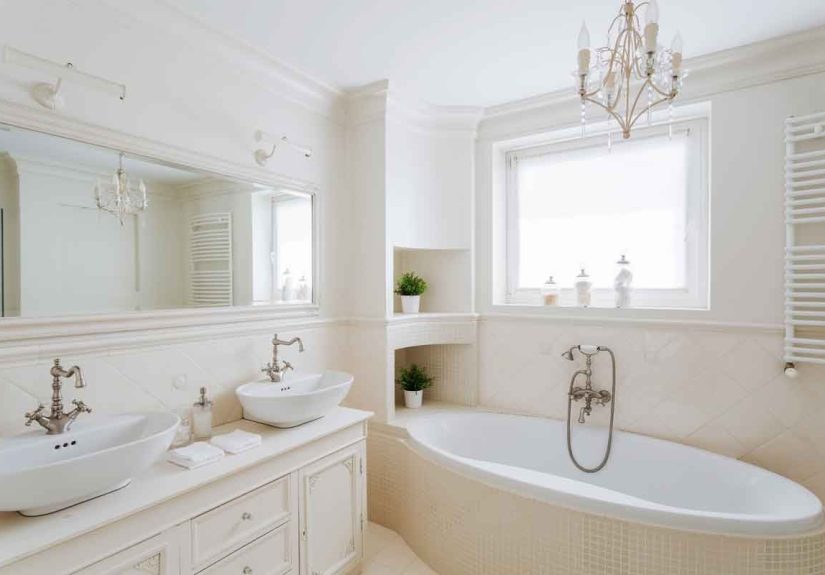
A bathroom chandelier is the design equivalent of wearing sneakers with a tuxedo: it’s unexpected, it feels a little rebellious,
and when it’s done right, everyone pretends they “always loved that look.” Done wrong, it’s… well… a sparkly humidity sponge
hanging over a slip-and-slide.
The good news: bathroom chandeliers can be safe, code-compliant, and genuinely practicalif you buy the right fixture and place it
in the right spot. The not-so-good news: bathrooms are basically tiny weather systems (steam, condensation, splash zones, and all),
so you can’t shop for a chandelier the same way you would for a dining room.
This guide walks through what to know before you buy: clearances, damp vs. wet ratings, size and style, light quality, ventilation,
and the “hidden” installation details that determine whether your chandelier becomes a spa-worthy centerpiece… or a contractor’s
favorite anecdote.
1) Safety and Code Basics: Where a Bathroom Chandelier Can (and Can’t) Go
The first question is not “Is it pretty?” It’s “Is it allowed there?” Bathrooms have special electrical safety rules because water
and electricity don’t do “cute” together.
The tub/shower zone is the big deal
In many U.S. jurisdictions that follow the National Electrical Code (NEC) as a baseline, there are restrictions near tubs and shower
thresholds. The practical takeaway most homeowners need is this:
-
Don’t hang a chandelier (or any chain/cord-suspended fixture) in the no-go zone near a tub or shower.
Suspended fixtures generally aren’t permitted within a zone measured 3 feet horizontally and 8 feet vertically
from the top of the tub rim or shower threshold. -
Fixtures located within the outside footprint of the tub/shower up to 8 feet high must be properly rated.
They’re typically required to be marked for damp locations, and if they’re subject to shower spray, they must be marked for wet
locations.
Translation: a chandelier directly over a soaking tub looks amazing on Pinterestuntil you realize your ceiling is 8 feet high and
your tub is directly under the only logical mounting point. That’s when “Pinterest dream” becomes “install a flush-mount rated
fixture and call it minimalist.”
Two placement options that usually work better
-
Center-of-room placement (away from splash zones): Great for larger primary bathrooms where the tub/shower is
separate from the main open floor area. -
Over a seating/vanity-adjacent area (if sized correctly): In very large baths, a chandelier can act as ambient
light while vanity fixtures do the real “face lighting” work.
Important note: codes and interpretations vary by location. If you’re anywhere near a tub or shower, treat this as a “talk to a
licensed electrician (or your local building department)” momentnot a “my cousin’s friend did it once” moment.
2) Damp-Rated vs. Wet-Rated: The Label That Matters More Than the Crystal
Family Handyman’s buying advice is blunt for a reason: if you’re shopping for a bathroom chandelier, look for one specifically
labeled as suitable for damp or wet locations. If the product listing doesn’t clearly say that,
keep scrollingno matter how elegant the photos look.
What those ratings really mean (in normal human language)
-
Dry location: Not normally subject to dampness (temporary dampness might occur, but it’s not the “every shower
creates a rainforest” environment). -
Damp location: Normally or periodically subject to condensationexactly what bathrooms produce when ventilation
is mediocre and showers are hot. -
Wet location: Water can drip, splash, or flow on or against the fixture (think direct spray or persistent
splashing risk).
Most bathrooms need at least a damp-rated fixture for the general environment. If the fixture is near a shower
where it could be hit by spray, you’re typically looking for a wet-rated product. This is also why many designers
love the look of chandeliers but end up specifying a damp-rated semi-flush or a wet-rated downlight in the places that actually get
soaked.
One more shopping reality: “This looks like it belongs in a bathroom” is not a rating. The rating must be explicitly listed
(commonly via UL/ETL listing details and manufacturer marking). If the listing is vague, ask the seller for the spec sheet.
3) Ceiling Support: The Unsexy Part That Keeps Your Chandelier Off Your Head
Chandeliers can be surprisingly heavy. And bathrooms add extra stressorshumidity can accelerate corrosion, and temperature swings
can loosen things over time. So before you fall in love with a 35-pound “vintage-inspired masterpiece,” make sure your ceiling
setup is actually built for it.
Know what the electrical box can support
In many standard installations, ceiling outlet boxes used for luminaires are expected to support a minimum amount of weight, but
heavier fixtures may require additional independent support or a properly listed box/brace system.
- Check the box type: Old “pancake” boxes or plastic boxes not listed for fixture support can be a red flag.
-
Check the mounting method: A proper brace to framing (or an appropriate fan/fixture brace kit) is often used
when weight approaches the upper limits. - Don’t assume “it’s screwed in” means “it’s safe”: The right screws in the wrong box is still the wrong box.
If you’re remodeling, this is the moment to upgrade the box and supportbefore tile, paint, and your patience are all fully cured.
4) Clearance and Hanging Height: The “I Don’t Want to Clothesline Myself” Rule
Even when the chandelier is allowed, it still has to be comfortable. Bathrooms are high-traffic, low-attention spacespeople walk
in half-awake, wearing towels, doing the “don’t slip” shuffle. Your chandelier can’t hang low like it’s auditioning for a haunted
house.
Practical height guidelines
-
Open floor areas: Many designers aim for the bottom of the chandelier to sit roughly 7.5 feet above the
finished floor in open areas, adjusting for ceiling height and fixture proportions. -
Near tubs: When a chandelier is installed over or near a tub area (where allowed), common code guidance is that
the lowest point must be 8 feet above the tub rim or positioned 3 feet horizontally away from the tub edge.
If your ceiling height is 8 feet and your tub rim is around 2 feet high, an over-tub chandelier can be basically impossible without
choosing a very tight, low-profile fixtureand even then, you may run into restrictions on suspended fixtures near the tub/shower
zone. That’s why many real bathrooms use a glamorous fixture in the center of the room and keep the shower/tub area to wet-rated,
code-friendly recessed lights.
5) Size and Scale: Make It Look Intentional (Not Like a Mistake in a Fancy Hat)
Chandeliers look best when they’re sized to the space and the sightlines. Bathrooms often have mirrors, glass, and reflective tile,
which can make a too-large chandelier feel visually chaoticlike a disco ball moved in and never left.
Quick sizing tricks that work surprisingly well
-
Small powder rooms: Choose a compact chandelier or mini-pendant that adds sparkle without crowding the ceiling.
If the room is under about 40–50 sq. ft., “small but special” beats “big but bonkable.” -
Primary bathrooms: If the room is large enough to have a central open area, a medium chandelier can anchor the
space. Keep it proportional to the open floor area rather than the entire footprint (especially if the shower is in a separate
enclosure). -
Over-tub visuals (where legal): Designers sometimes use “fixture diameter roughly one-third of the tub length”
as a starting point, then adjust based on ceiling height and how ornate the chandelier is.
Also consider “visual weight.” A delicate chandelier with open arms and clear glass reads lighter than a drum shade chandelier, even
if both have the same diameter.
6) Light Quality: Bright Enough for Shaving, Kind Enough for Self-Esteem
Chandeliers are fantastic at mood lighting. But bathrooms need task lighting tooespecially at the vanity. If the chandelier
is your only overhead light, you can end up with dramatic shadows that make shaving feel like a suspense film.
Use layered lighting (the bathroom lighting “triple threat”)
- Ambient: General room light (your chandelier can contribute here).
- Task: Face-focused lighting at the mirror (sconces or a quality vanity bar are usually best).
- Accent: Decorative sparkle, niche lights, toe-kick glow, or “hotel vibe” highlights.
Lighting design guides frequently target stronger illumination at vanity areas than in the rest of the bathroombecause faces are
fussy and mirrors are honest. If you want the chandelier for style, let it do what it does best (ambient + sparkle), and let vanity
fixtures do the “see every eyebrow hair” job.
Bulbs and color temperature: don’t guess
-
Color temperature (Kelvin): Warm-white light (often around 2700K–3000K) is flattering and relaxing, while
cooler light (3500K–4100K) can feel brighter and more “task oriented.” Pick based on how you use the space. -
LED advantages: Modern LEDs use far less energy and last much longer than incandescent bulbs, which matters when
your chandelier has eight tiny bulbs you’ll otherwise replace one at a time like a slow-motion holiday tradition. -
Dimmers: If you want spa vibes at night and practical brightness in the morning, plan for a compatible dimmer
and dimmable bulbs.
7) Materials and Maintenance: Bathrooms Punish the Weak
Bathrooms are rough on finishes. Steam, cleaning sprays, and salty air (hello, coastal homes) can turn the wrong chandelier into a
“distressed finish” you did not order.
Smart material choices
-
Look for corrosion-resistant finishes: polished nickel, chrome, stainless steel elements, quality lacquered
brass, or well-sealed painted finishes tend to hold up better than raw iron or delicate patinas. -
Shades matter: Glass shades can soften glare and reduce dust-catching surfaces, but they also add cleaning steps.
Open bulbs look airy but can be harsh without the right bulb and dimmer strategy. -
Choose wipe-friendly shapes: If it has 120 hanging crystals, it will look amazing… and it will also become your
new personality once you realize you have to clean it.
Pro tip: if you use aerosol hair products, anything above the vanity becomes a magnet for residue. That’s not a chandelier problem;
that’s a “gravity is undefeated” problem.
8) Ventilation: The Secret Weapon for Keeping the Fixture (and Bathroom) Healthy
A bathroom chandelier is only as “bathroom-friendly” as the room’s moisture control. Ventilation helps prevent condensation and
reduces the conditions that encourage mold growth. It also helps protect your light fixture’s metal parts and wiring compartments
from constant damp exposure.
Ventilation guidelines you can actually use
-
Fan sizing: A common minimum is 50 CFM for small bathrooms, and for 50–100 sq. ft., guidance often uses roughly
1 CFM per square foot (then add capacity for additional fixtures like showers or tubs). -
Run time: Using the fan during showers and continuing afterward helps clear moisture faster. Timers and humidity
sensors make this easier and more consistent. -
Airflow path: A fan can’t exhaust much if the room can’t draw replacement air (undercut doors or transfer
grilles help).
If your mirrors stay fogged for ages, your chandelier is living in a cloud. Fix the ventilation and the chandelier becomes a design
feature instead of a maintenance hobby.
9) A Buyer’s Checklist: What to Confirm Before You Click “Add to Cart”
- Rating: Marked suitable for damp locations (or wet locations if exposure to spray is possible).
- Placement plan: Clear of tub/shower restricted zones and hung high enough for safe clearance.
- Support: Ceiling box and bracing appropriate for fixture weight (and stable in a humid environment).
- Lighting plan: Vanity lighting included; chandelier is not your only source of usable illumination.
- Bulbs + dimmer: Correct base (often E12), dimmable if needed, with a color temperature you actually like.
- Finish durability: Corrosion resistance and wipe-friendly surfaces for real-life cleaning.
- Ventilation: Exhaust fan sized and used consistently to manage humidity.
Real-World Experiences: What Homeowners Commonly Learn After Installing Bathroom Chandeliers
People rarely regret a bathroom chandelier because it’s “too pretty.” Regret usually shows up as a practical surpriseoften within
the first month of steamy showers.
One of the most common experiences is the rating revelation. A homeowner finds a chandelier labeled “perfect for a
glam bath,” only to discover the specs never mention damp or wet suitability. The fixture arrives, looks gorgeous, and then an
electrician (or a conscientious DIYer reading the manual) points out the missing location rating. That can mean returns, restocking
fees, and the emotional journey of accepting that not all sparkle is bathroom sparkle.
Next comes the ceiling box reality check. Many bathroomsespecially older oneshave a basic ceiling box that was
fine for a lightweight dome light. Swap in a heavier chandelier and suddenly the conversation includes words like “brace,” “framing,”
and “please don’t turn on the fan while I’m up there.” Homeowners often learn that a safe installation isn’t just about attaching the
fixture; it’s about the ceiling structure supporting the fixture over time. In remodels, people who upgrade the box and support
early tend to be happier than those who try to “make it work” after tile is already installed.
Another frequent lesson is glare and shadow drama. Chandeliers can create beautiful sparklebut sparkle isn’t the same
as face lighting. Without dedicated vanity lighting (often sconces or a proper vanity bar), homeowners notice odd shadows under eyes
and chin, and makeup application becomes a guessing game. A common “fix” experience is adding side lighting at the mirror and putting
the chandelier on a dimmer so it can shift between “getting-ready mode” and “spa mode.” When people do that, the chandelier becomes
a mood feature instead of a functional compromise.
Then there’s maintenance honesty. Crystal strands and intricate arms look incredible in listing photos, but bathrooms
create dust + moisture + aerosol residue in ways that don’t show up on Instagram. Homeowners who choose simpler silhouettes (or at
least designs with fewer tiny crevices) often report that the chandelier stays “fresh-looking” with basic wiping. More ornate fixtures
still look stunningbut they can demand periodic deep cleaning. The experience tends to be: the chandelier becomes a centerpiece, and
also becomes something you schedule cleaning for, like a very glamorous pet.
Finally, people learn that ventilation is not optional. In bathrooms with weak exhaust fans, metal finishes can dull
faster, glass can spot more easily, and condensation can linger longernone of which helps a chandelier look its best. Many homeowners
end up upgrading the exhaust fan (or adding a timer/humidity sensor) after noticing persistent fogging or musty smells. Once moisture
control improves, the chandelier “behaves” better: less residue buildup, less corrosion anxiety, and a bathroom that feels cleaner
overall.
In short, the real-life experience is that a bathroom chandelier is totally worth itwhen it’s treated like a bathroom product,
supported like a ceiling fixture (not a decoration), and paired with the lighting and ventilation the room actually needs.
Conclusion
Buying a bathroom chandelier isn’t just choosing a styleit’s choosing a fixture that can survive humidity, meet safety rules, hang
at the right height, and still deliver flattering light. Start with placement and ratings (damp vs. wet), confirm ceiling support,
and build a layered lighting plan so your chandelier can be glamorous without being responsible for every task in the room.
Do that, and you get the best version of a bathroom chandelier: a functional, code-smart statement piece that makes everyday routines
feel a little more like a boutique hotelminus the tiny shampoo bottles.