Table of Contents >> Show >> Hide
- What “Hacking Apollo” Really Means in a Hack Chat
- Meet the Crew: Four Hosts, One Moonshot Computer
- The Apollo Guidance Computer in Two Trays
- Why the “Hacking Apollo” Conversation Felt Like Digital Archaeology
- Restoration War Stories: Voltage Rails, Connectors, and the “Tray B” Problem Child
- The Famous 1202 Alarm: A Tiny Alarm with a Giant Lesson
- Modern Engineering Lessons Hidden in a 1960s Box
- How to Run Your Own “Hack Chat” the Apollo Way
- FAQ: Quick Answers from the Apollo Rabbit Hole
- Conclusion: The Moonshot Lives in the Details
- Experience Notes: What It’s Like to Live Inside a “Hacking Apollo Hack Chat”
“Hacking Apollo” sounds like you’re about to break into a lunar lander with a lockpick and a dream. In reality, the
Hacking Apollo Hack Chat is the wholesome, brainy kind of hacking: a community deep-dive into how the Apollo era
guidance computer worked, how a modern restoration team brought one back to life, and what today’s builders can learn
from a machine that helped land humans on the Moon with less computing power than a blinking birthday card.
This article unpacks what made that Hack Chat so compellingequal parts history lesson, engineering detective story,
and “wait, that actually worked?” momentwhile keeping the vibe fun, practical, and grounded in real documentation and
public technical records.
What “Hacking Apollo” Really Means in a Hack Chat
On Hackaday, a “Hack Chat” is basically a live, text-based hangout where curious people ask questions and subject
matter nerds answer them in real time. The “Hacking Apollo” edition focused on restoring and understanding the
Apollo Guidance Computer (AGC)the onboard computer used in Apollo spacecraftthrough a mix of hardware
restoration, software archaeology, and the kind of teamwork that makes you want to high-five the internet.
Also, quick clarity: this is not “hacking” as in cybercrime. This is hacking as in tinkering, reverse-engineering,
preserving history, and learning in public. Think museum meets maker lab meets lunch-hour Q&A.
Meet the Crew: Four Hosts, One Moonshot Computer
The Hack Chat featured four well-known names in retrocomputing and electronics restoration: CuriousMarc, Ken Shirriff,
Mike Stewart, and Carl Claunch. Their backgrounds are a big part of why the conversation landed so well:
-
CuriousMarc is known for deeply documented restoration videos and a serious knack for making
“mysterious old box of wires” feel approachable. -
Ken Shirriff has a long track record of explaining old systems (often by patiently dissecting them
until they confess), and he’s done extensive work on aerospace computing history. -
Mike Stewart brought deep Apollo software knowledge and “digital archaeology” energyworking from
listings, drawings, and surviving binaries to reconstruct understanding. -
Carl Claunch is a veteran restorer of large vintage systems and a strong voice for careful,
documentation-driven hardware work.
One of the most charming themes of the chat: you don’t need a mythical “born-an-engineer” origin story to do serious
technical work. The group repeatedly emphasized learning as you go, leaning on documentation, simulation tools, and
each other’s complementary skills. Translation: curiosity beats credentials when you’re willing to do the homework.
The Apollo Guidance Computer in Two Trays
A tiny computer with a massive job description
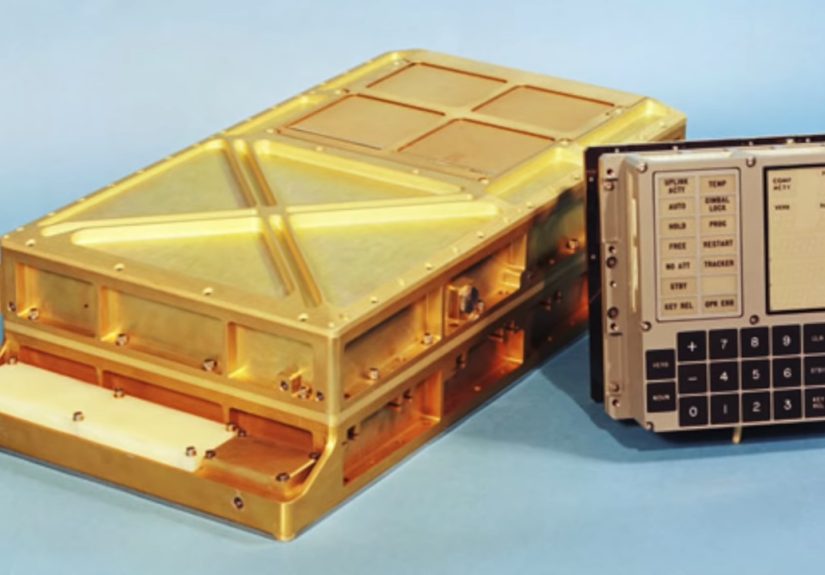
The AGC wasn’t a general-purpose desktop computer. It was a real-time guidance and navigation system designed to run
reliably under mission pressure, in a spacecraft, with humans depending on it. Its world was sensors, timing, and
prioritiesless “open 36 browser tabs” and more “don’t crash the landing.”
Hardware-wise, the AGC is famous for using integrated circuits early in the IC era. It also used magnetic core memory
(for erasable memory/RAM) and a special kind of read-only memory called core rope memory for the flight program. The
astronaut-facing interface was the DSKY (Display and Keyboard), which let crews input “verbs” and “nouns” (commands
and data requests) and read status back in a constrained but mission-friendly way.
Core rope memory: software you can literally weave
If you’ve ever joked that software “lives in the cloud,” Apollo’s rope memory says, “Cute. We store software in a
loom.” Rope memory encoded bits by threading wires through tiny magnetic cores in specific patterns. In simple terms:
wire through the core could represent one value, wire around the core another. Either way, it physically embodied the
program. The result was stable, radiation-tolerant, and not exactly easy to “patch,” because patches don’t love being
sewn into hardware.
This is one reason the Apollo software process became legendary: changes had to be controlled, tested, and integrated
with extreme care. The Hack Chat community often gravitates toward this point because it connects two modern obsessions
in one device: reliable systems engineering and beautifully weird hardware.
Why the “Hacking Apollo” Conversation Felt Like Digital Archaeology
Restoring an AGC isn’t like restoring a vintage game console where replacement parts are one shopping cart away. It’s
closer to archaeology: you’re reconstructing truth from artifacts. The artifacts can include:
- engineering drawings and schematics (sometimes archived in government collections),
- program listings and documentation,
- surviving rope modules and erasable memory modules,
- test equipment behavior, connector drawings, and wiring conventions,
- and modern emulators that let you compare “expected” vs. “observed” behavior.
The Hack Chat highlighted a key reality: the most time-consuming part often isn’t solderingit’s reading. When you’re
dealing with a machine designed for a mission profile, the documentation is part of the product. Understanding the
intent behind a circuit or a timing assumption is how you avoid “fixing” something into being wrong.
Restoration War Stories: Voltage Rails, Connectors, and the “Tray B” Problem Child
One detail from the broader restoration story became a fan-favorite because it’s so absurdly satisfying: when powered
on after decades, the AGC’s supply voltage came up astonishingly close to specaround 4.99 volts with a tiny tolerance.
That’s the kind of moment that makes engineers stare at a meter, stare at each other, and then stare at the meter
again, just in case the laws of physics are playing a prank.
But “it powers on” is not the same as “it runs the mission software.” The team described multiple practical
challengesespecially connectors and memory. In the real restoration effort, replacement connectors had to be recreated
because original 1960s-era connector parts weren’t readily available. Meanwhile, memory (particularly the more complex
pieces) created a bigger bottleneck: some modules are dense, fragile, or physically sealed, making diagnosis and repair
hard.
A particularly clever move in the restoration narrative was using modern hardware (like FPGA-based memory simulation)
to help the old computer take steps forward before the hardest memory problems were fully solved. That approachbuild a
safe bridge between erasshows up again and again in successful “vintage-to-modern” engineering projects.
The Famous 1202 Alarm: A Tiny Alarm with a Giant Lesson
Even people who don’t know what “DSKY” stands for have heard of Apollo 11’s alarmsoften cited as proof that Apollo’s
software team designed for resilience. The short version: during the lunar landing, the computer signaled overload (the
well-known 1201/1202 family of alarms). Instead of freezing, it prioritized critical tasks and shed lower-priority work,
letting the landing proceed with the data that mattered most.
The Hack Chat discussion went deeper than the popular one-paragraph retelling. The group talked about how subtle the
root causes were and how easy it is for historical retellings to flatten a complicated systems interaction into a neat
myth. One technical thread discussed how the overload involved extra, unnecessary input activity and complex behavior
in supporting hardware (not just a single “oops” moment). The takeaway isn’t merely “software saved the day,” but
“systems behave in layered, surprising waysand your safety margins should assume that.”
Modern Engineering Lessons Hidden in a 1960s Box
1) Design for graceful degradation, not perfect conditions
Apollo-era constraints forced discipline: you assume tasks will compete, sensors will misbehave, and humans will be
busy. Instead of betting everything on “nothing goes wrong,” the software and operating approach planned for overload
and recovery. In today’s worldcloud services, embedded devices, medical wearablesthis lesson is still painfully
relevant: “degrade safely” beats “fail dramatically.”
2) Documentation is a feature, not a chore
The restoration story repeatedly reinforces a modern truth: documentation is how you scale knowledge across time.
Without schematics, listings, and engineering drawings, the AGC would be a mysterious sculpture. With them, it becomes
a teachable system. The Hack Chat format shines here because it turns documentation into conversation: people ask, the
team contextualizes, and suddenly a 1960s design decision has a 2026 lesson.
3) Teams beat lone-genius legends
Apollo history gets mythologized into heroic individuals, but the real magic was coordinated competence. The Hack Chat
hosts modeled the same pattern: one person simulations, another digs into circuits, another reconstructs software from
binaries, another pulls context from museum work. The result is bigger than any single contributor.
4) Preserve the “how,” not just the “what”
Open repositories of Apollo-era source code and emulation tools do more than preserve artifactsthey preserve
understandability. That matters because future engineers learn best when they can trace decisions, not just admire
outcomes. The AGC isn’t inspiring because it’s old; it’s inspiring because it’s explainable.
How to Run Your Own “Hack Chat” the Apollo Way
Want to capture some of the same magic for your own technical community? Here are practical, non-cheesy moves that map
well to the “Hacking Apollo” vibe:
-
Pick a real artifact. A board, a protocol, a vintage system, a teardownsomething concrete that
generates specific questions. -
Bring both “builders” and “explainers.” The best chats blend hands-on troubleshooting with big-picture
context. -
Open with a 2-minute story. What’s the object, why does it matter, and what’s the mystery you’re
trying to solve? -
Encourage “why” questions. Apollo-style learning happens when you chase constraints and tradeoffs, not
just facts. - Publish a transcript. Live chats are fun, but searchable transcripts turn a moment into a resource.
-
Keep it ethical. Focus on education, restoration, and responsible researchnot bypassing security or
enabling misuse.
FAQ: Quick Answers from the Apollo Rabbit Hole
Is Apollo flight software actually available today?
Yessubstantial portions of Apollo-era source code have been digitized and hosted publicly alongside emulation tools,
enabling historians and hobbyists to study how the software worked.
Can you “run” the AGC on modern hardware?
You can emulate the AGC and related systems on modern computers using public emulation projects. That doesn’t recreate
the physical experience of real rope/core memory, but it does preserve logic and behavior for learning.
What makes the DSKY interface so iconic?
It’s minimal, consistent, and designed for real-time operations: limited displays, structured inputs, and a workflow
built around “what do you want the computer to do?” and “what do you want it to tell you?” It’s less “app UI” and more
“mission instrument.”
Why does everyone obsess over rope memory?
Because it’s the perfect collision of software and hardware: a program embodied physically, produced with meticulous
manual craftsmanship, and tied directly to reliability in a high-stakes environment.
Conclusion: The Moonshot Lives in the Details
The Hacking Apollo Hack Chat works because it’s not just nostalgia. It’s a masterclass in how complex systems
are built, understood, and preserved. The AGC reminds us that constraints can sharpen design, documentation can outlive
hardware, and “hacking” at its best is a respectful form of curiositytaking something apart so you can put the story
back together, clearer than before.
If you’re building anything that must keep working under pressurerobots, embedded devices, safety-critical software,
or even just a homebrew project you don’t want to babysitthe Apollo mindset is still worth stealing. (Politely. With
citations. And preferably without requiring a clean room and a lunar module.)
Experience Notes: What It’s Like to Live Inside a “Hacking Apollo Hack Chat”
There’s a specific kind of joy that shows up when you join a live technical chat about Apollo hardware. It’s part
classroom, part campfire story, part “group debugging session,” except the bug was born in the 1960s and refuses to
apologize. People arrive with wildly different backgroundssome have restored mainframes, some have never held a logic
probe, and some are just there because the phrase “computer program woven into memory” sounds like science fiction
written by an engineer.
The first experience you notice is the pace. A Hack Chat moves fast, but not in a frantic way. Someone asks a simple
question“How did they store software?”and suddenly you’re watching a mini-explainer unfold: core rope memory, factory
workflows, how changes were managed, why reliability mattered more than convenience, and how a single design choice
echoes into modern computing. It’s the kind of learning where you start with a curiosity and end with a whole new
mental model.
The second experience is the tone: surprisingly human. Yes, there are serious technical detailsconnectors, memory
trays, timing assumptions, overload behaviorbut the chat is full of the gentle humor of people who have spent too many
evenings chasing one more clue. You’ll see admiration for craftsmanship (“how is that voltage still that stable?”),
empathy for the effort (“documentation is the real boss fight”), and the occasional wink at the obsessive nature of the
work (“we operate at the hairy edge of family resentment” is the sort of line that makes the whole room laugh and nod).
A third experience is how the community turns “spectating” into “participating.” The best questions aren’t always the
most advanced; they’re the most curious. Asking “What surprised you the most?” can unlock stories about how a team
approached powering unknown hardware safely, how they used simulation to understand circuits, or how they bridged gaps
in missing records. In that sense, you don’t need to be an expert to contributeyou need to be attentive. That’s a
powerful feeling, especially in a world where tech can sometimes feel gatekept.
Then comes the afterglow: the transcript effect. A live chat is great, but the real gift is returning later to reread
sections you didn’t fully absorb. You notice new details on the second pass: a reference to a particular failure mode,
an offhand comment about how parity helped recover data, a mention of how hardware and software teams coordinated
priorities, or a recommendation for a book that becomes your next rabbit hole. People often report that one Hack Chat
becomes a week of side questswatching restoration videos, skimming original program listings, reading about rope
manufacturing, or exploring emulation projects. The chat doesn’t just answer questions; it seeds projects.
Finally, there’s the emotional experience: awe, but the practical kind. Not “Apollo was cool” awemore like “humans
built a system that could handle overload, keep critical tasks alive, and communicate clearly with a crew under stress.”
It can make modern engineering feel a bit more purposeful. You leave with the sense that reliability is not a dry
checkbox; it’s a design philosophy. And if you’re a maker, you also leave with a dangerous thought: “I could build a
little demo of that.” That’s how it starts. One innocent chat later, you’re pricing vintage core planes and practicing
saying “DSKY” like it’s a normal word.