Table of Contents >> Show >> Hide
- What You Need to Know Before You Start
- How to Calculate the Mass of a Sphere: 13 Steps
- Step 1: Identify Whether the Sphere Is Solid or Hollow
- Step 2: Measure the Diameter
- Step 3: Find the Radius
- Step 4: Choose the Correct Units
- Step 5: Cube the Radius
- Step 6: Calculate the Volume of the Sphere
- Step 7: Find the Density of the Material
- Step 8: Multiply Density by Volume
- Step 9: Convert the Answer if Needed
- Step 10: Try the Diameter Formula for a Shortcut
- Step 11: Check Your Answer for Common-Sense Accuracy
- Step 12: Account for Imperfect or Composite Spheres
- Step 13: Write the Final Answer Clearly
- Complete Example: Calculating the Mass of a Steel Sphere
- How to Calculate the Mass of a Hollow Sphere
- Common Mistakes When Calculating Sphere Mass
- Practical Uses for Sphere Mass Calculations
- Experience Notes: What Real Sphere Calculations Teach You
- Conclusion
Calculating the mass of a sphere sounds like something that belongs in a physics textbook, next to a diagram of a very serious-looking ball. But the idea is surprisingly practical. Whether you are estimating the weight of a steel bearing, checking a marble for a science project, designing a 3D-printed ball, or trying to figure out why a “small” stone sphere feels like it was forged by a planet, the method is the same: find the sphere’s volume, know its density, then multiply.
The short formula is simple: mass = density × volume. For a sphere, the volume is V = 4/3 × π × r³, where r is the radius. Put those together, and you get: mass = density × 4/3 × π × r³. The only real trick is keeping your units consistent. Math is forgiving in many ways, but mix inches with grams per cubic centimeter and it will absolutely send you to calculation jail.
This guide breaks the process into 13 clear steps, with examples, common mistakes, and real-world advice so you can calculate the mass of a sphere without needing a lab coat, a chalkboard, or a dramatic movie soundtrack.
What You Need to Know Before You Start
Before jumping into the steps, let’s define the three main players: radius, volume, and density.
Radius
The radius is the distance from the exact center of the sphere to its outer surface. If you know the diameter, which is the distance all the way across the sphere through the center, divide it by 2 to get the radius.
Formula: radius = diameter ÷ 2
Volume
Volume tells you how much space the sphere takes up. A beach ball and a steel ball may have the same volume if they are the same size, but they definitely do not have the same mass. One floats around happily; the other threatens your toes.
Sphere volume formula: V = 4/3 × π × r³
Density
Density is mass per unit of volume. It describes how much “stuff” is packed into a given amount of space. Lead, steel, glass, wood, rubber, and plastic all have different densities, which is why two spheres of the same size can feel completely different in your hand.
Density formula: density = mass ÷ volume
Rearranged to find mass:
mass = density × volume
How to Calculate the Mass of a Sphere: 13 Steps
Step 1: Identify Whether the Sphere Is Solid or Hollow
First, decide what kind of sphere you are working with. A solid sphere is filled all the way through with the same material, like a steel ball bearing or a glass marble. A hollow sphere has empty space inside, like a ping-pong ball or a metal ornament.
For a solid sphere, use the standard volume formula:
V = 4/3 × π × r³
For a hollow sphere, calculate the outer volume and subtract the inner empty volume:
Shell volume = 4/3 × π × (R³ − r³)
Here, R is the outer radius and r is the inner radius. If your sphere is solid, life is easier. Enjoy that tiny mathematical vacation.
Step 2: Measure the Diameter
The easiest way to begin is usually by measuring the diameter. Use a ruler, measuring tape, or caliper. For small objects like marbles, ball bearings, and beads, a digital caliper gives the most accurate result. For larger spheres, such as exercise balls or decorative globes, a flexible tape measure may work better.
Measure across the widest part of the sphere. If you are slightly off center, your diameter will be too small, and the final mass will be inaccurate. Since the radius is cubed in the volume formula, even a small measurement error can grow into a surprisingly chunky mistake.
Step 3: Find the Radius
Once you know the diameter, divide it by 2.
Example: If a sphere has a diameter of 10 centimeters, then:
radius = 10 ÷ 2 = 5 centimeters
This radius is the number you will plug into the sphere volume formula. Do not use the diameter by accident unless you are using the special diameter-based formula. Using diameter where radius belongs is one of the classic “oops, my answer is eight times too large” mistakes.
Step 4: Choose the Correct Units
Units matter. If your radius is in centimeters, your volume will be in cubic centimeters. If your radius is in meters, your volume will be in cubic meters. Your density must match the same volume unit.
Use these common pairings:
- g/cm³ with radius measured in centimeters
- kg/m³ with radius measured in meters
- lb/in³ with radius measured in inches
For example, if the density of steel is given as 7.85 g/cm³, measure the sphere in centimeters. If density is given as 7,850 kg/m³, measure the sphere in meters. These are equivalent density values, just wearing different unit outfits.
Step 5: Cube the Radius
Cubing the radius means multiplying the radius by itself three times.
r³ = r × r × r
If the radius is 5 cm:
5³ = 5 × 5 × 5 = 125 cm³
Remember, cubing applies to the number and the unit. Centimeters become cubic centimeters. Meters become cubic meters. This is where the sphere officially enters three-dimensional territory.
Step 6: Calculate the Volume of the Sphere
Now use the sphere volume formula:
V = 4/3 × π × r³
Suppose the radius is 5 cm. You already found that r³ = 125 cm³.
V = 4/3 × π × 125
V ≈ 523.6 cm³
This means the sphere occupies about 523.6 cubic centimeters of space. If the sphere were made of air, foam, glass, or steel, the volume would remain the same. The mass changes because density changes.
Step 7: Find the Density of the Material
Next, identify what the sphere is made of. Density depends on the material. A sphere made of aluminum will have a different mass than the same-size sphere made of copper, plastic, rubber, or wood.
Approximate densities for common materials include:
- Water: about 1.00 g/cm³
- Aluminum: about 2.70 g/cm³
- Glass: about 2.4 to 2.8 g/cm³
- Steel: about 7.85 g/cm³
- Copper: about 8.96 g/cm³
- Lead: about 11.34 g/cm³
These values can vary depending on alloy, temperature, composition, air gaps, and manufacturing method. A stainless-steel sphere and a carbon-steel sphere are both “steel,” but they may not have exactly the same density. For schoolwork, use the density value provided in the problem. For real-world estimating, use a trusted reference value and label your answer as approximate.
Step 8: Multiply Density by Volume
Now comes the main event:
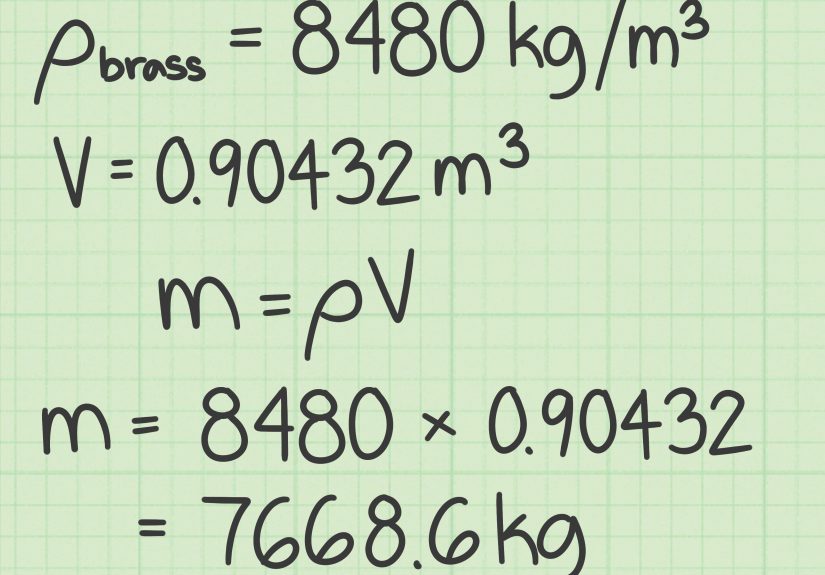
mass = density × volume
If your sphere has a volume of 523.6 cm³ and is made of aluminum with a density of 2.70 g/cm³:
mass = 2.70 × 523.6
mass ≈ 1,413.7 grams
So the aluminum sphere has a mass of about 1,414 grams, or 1.414 kilograms. Not bad for a ball that looks innocent on the table.
Step 9: Convert the Answer if Needed
Your final mass may need to be converted into a more useful unit. For example:
- 1,000 grams = 1 kilogram
- 1 kilogram ≈ 2.205 pounds
- 1 pound = 16 ounces
If your answer is 1,413.7 grams:
1,413.7 g ÷ 1,000 = 1.4137 kg
In pounds:
1.4137 × 2.205 ≈ 3.12 lb
So the mass is about 1.41 kg, or roughly 3.12 pounds. Conversions help make the answer more understandable, especially when you are comparing objects in everyday terms.
Step 10: Try the Diameter Formula for a Shortcut
If you know the diameter and do not want to calculate the radius separately, you can use this formula:
V = π × d³ ÷ 6
Then multiply by density:
mass = density × π × d³ ÷ 6
For example, if a glass marble has a diameter of 1.6 cm and a density of 2.5 g/cm³:
V = π × 1.6³ ÷ 6
V ≈ 2.14 cm³
mass = 2.5 × 2.14 ≈ 5.35 g
The marble’s mass is about 5.35 grams. This shortcut is handy, but only if you are careful to use the diameter formula exactly as written.
Step 11: Check Your Answer for Common-Sense Accuracy
A good calculation should pass the “does this sound ridiculous?” test. If a marble-sized glass sphere comes out to 300 pounds, something has gone sideways. Maybe the radius was entered in meters while density was in g/cm³. Maybe the diameter was used as the radius. Maybe the calculator was in a rebellious mood.
Ask yourself:
- Did I use radius, not diameter?
- Did I cube the radius correctly?
- Do my density and volume units match?
- Does the final mass seem reasonable for the material?
This quick review can catch most mistakes before they sneak into your final answer wearing a fake mustache.
Step 12: Account for Imperfect or Composite Spheres
Real spheres are not always perfect. A ball may have seams, coatings, bubbles, holes, or mixed materials. A sports ball, for example, may contain rubber, fabric, air, adhesive, and surface texture. In that case, calculating mass from one density value will only produce an estimate.
For composite spheres, you can improve accuracy by dividing the object into layers or parts. For example, a hollow metal sphere with a coating can be treated as:
- Outer coating volume × coating density
- Metal shell volume × metal density
- Any filler volume × filler density
Then add the masses together. If the sphere is too complex, weighing it directly may be easier. Math is powerful, but sometimes the kitchen scale wins by knockout.
Step 13: Write the Final Answer Clearly
Your final answer should include the mass, units, and any assumptions. A complete answer might look like this:
“A solid aluminum sphere with a radius of 5 cm and density of 2.70 g/cm³ has a mass of approximately 1,414 g, or 1.41 kg.”
This is much better than simply writing “1414,” which leaves readers wondering whether you mean grams, kilograms, jellybeans, or emotional baggage.
Complete Example: Calculating the Mass of a Steel Sphere
Let’s solve a full example from start to finish.
Problem: A solid steel sphere has a radius of 2 cm. Steel has a density of about 7.85 g/cm³. What is the mass of the sphere?
Step 1: Write the known values
Radius: 2 cm
Density: 7.85 g/cm³
Step 2: Calculate the volume
V = 4/3 × π × r³
V = 4/3 × π × 2³
V = 4/3 × π × 8
V ≈ 33.51 cm³
Step 3: Multiply by density
mass = density × volume
mass = 7.85 × 33.51
mass ≈ 263.05 g
Final Answer
The steel sphere has a mass of about 263 grams, or 0.263 kilograms.
How to Calculate the Mass of a Hollow Sphere
A hollow sphere requires one extra step because the empty space inside does not contribute much mass. You calculate the volume of the outer sphere, subtract the volume of the inner empty space, and multiply the remaining shell volume by density.
Formula: mass = density × 4/3 × π × (R³ − r³)
Example: A hollow plastic sphere has an outer radius of 6 cm and an inner radius of 5.5 cm. The plastic density is 1.2 g/cm³.
Shell volume = 4/3 × π × (6³ − 5.5³)
Shell volume = 4/3 × π × (216 − 166.375)
Shell volume ≈ 207.87 cm³
mass = 1.2 × 207.87 ≈ 249.44 g
The hollow plastic sphere has an approximate mass of 249 grams. If you had treated it like a solid plastic sphere, the answer would have been much larger. Hollow objects are sneaky like that.
Common Mistakes When Calculating Sphere Mass
Using Diameter Instead of Radius
This is the most common mistake. Because the radius is cubed, using diameter in the radius formula makes the volume eight times too large. Always divide diameter by 2 first unless you are using the diameter-based formula.
Mixing Units
If density is in g/cm³, your volume must be in cm³. If density is in kg/m³, volume must be in m³. Mixing unit systems is like putting diesel in a coffee maker: technically a liquid went in, but the result will not be useful.
Forgetting to Cube the Radius
Squaring the radius gives surface-area-style behavior, not volume. A sphere is three-dimensional, so the radius must be cubed.
Assuming Every Sphere Is Solid
Many spheres are hollow, layered, or filled with air. If the inside is empty, use the hollow sphere formula or weigh the object directly.
Using an Overly Precise Density
Density values can vary. If your measurements are rough, do not report a final answer with six decimal places. Precision should match the quality of your measurements.
Practical Uses for Sphere Mass Calculations
Knowing how to calculate the mass of a sphere is useful in science, engineering, manufacturing, crafts, sports equipment design, shipping estimates, and classroom experiments. Engineers may estimate the mass of ball bearings, pellets, spherical tanks, or machine components. Students may use sphere mass calculations in physics and chemistry problems. Makers and designers may estimate material cost before 3D printing or casting an object.
The formula also helps with comparisons. A sphere twice as wide is not twice as massive if made from the same material. Since volume depends on radius cubed, doubling the radius makes the volume eight times larger. That is why a small increase in size can create a surprisingly heavy object. Geometry does not mess around.
Experience Notes: What Real Sphere Calculations Teach You
When people first learn how to calculate the mass of a sphere, the formula looks neat and tidy. In real use, the biggest lesson is that the formula is only as good as the measurements you feed it. A beautiful equation cannot rescue a sloppy diameter reading. If a sphere is small, even a tiny measurement error can noticeably affect the answer because the radius is cubed. That is why calipers are so useful for marbles, bearings, beads, and small lab samples. A ruler can work, but it often asks your eyeballs to do more engineering than they signed up for.
Another practical lesson is that density is not always as simple as a table value. A steel sphere may be made from a specific alloy. A wooden sphere may contain moisture, grain variation, or tiny voids. A plastic sphere may include pigments, fillers, or air bubbles. If you are calculating for homework, the given density is usually perfect. If you are calculating for a project, your answer is usually an estimate unless the material is very well known.
Experience also teaches the importance of unit discipline. Many wrong answers come from mixing centimeters with meters or grams with kilograms. The math may still produce a number, but that number quietly wanders away from reality. A good habit is to write units beside every value at every step. It may feel slower at first, but it prevents confusion and makes your work easier to check later.
In hands-on projects, sphere mass calculations are especially useful before buying or building anything. Imagine designing a decorative concrete garden sphere. A diameter that sounds modest on paper can produce a heavy object once concrete density enters the chat. The same applies to metal balls, stone spheres, and resin castings. Calculating mass beforehand can save money, prevent broken shelves, and protect innocent toes from gravity’s enthusiasm.
One more real-world trick: compare your calculated result with a direct measurement whenever possible. If you calculate that a small glass marble should weigh about 5 grams and your scale says 5.2 grams, you are probably in good shape. If your calculated answer says 80 grams, something is wrong. That simple reality check is one of the best tools in math, science, and everyday problem-solving.
Finally, sphere mass calculations build intuition. Over time, you start to understand why dense materials feel shockingly heavy, why hollow balls can be large but light, and why increasing radius has such a powerful effect. The formula is not just a school exercise. It is a compact way to understand size, material, and mass all at once.
Conclusion
To calculate the mass of a sphere, you need two things: the sphere’s volume and the material’s density. For a solid sphere, use V = 4/3 × π × r³, then multiply that volume by density. If you know the diameter, divide it by 2 to find the radius, or use V = π × d³ ÷ 6. For a hollow sphere, subtract the inner volume from the outer volume before multiplying by density.
The most important rules are simple: use consistent units, measure carefully, know whether the sphere is solid or hollow, and check whether your final answer makes real-world sense. Once you understand the relationship between radius, volume, density, and mass, calculating the mass of a sphere becomes less mysterious and much more useful. It is geometry with a purposeand occasionally, with a very heavy paperweight.
Note: This article is written for educational and practical calculation purposes. For engineering, laboratory, medical, aerospace, or safety-critical applications, use verified material specifications and calibrated measuring equipment.