Table of Contents >> Show >> Hide
- Why sharing a job posting on LinkedIn works (when you do it right)
- How to share a job posting on LinkedIn (step-by-step)
- What to say when you share a job posting on LinkedIn
- The “clean and clear” hiring post template
- The “human + honest” template (more clicks, fewer eye-rolls)
- The referral-focused template (a polite nudge that actually works)
- The hiring manager template (authority + specificity)
- The employee advocacy template (easy for teammates to repost)
- A direct message (DM) template that doesn’t feel weird
- Make your LinkedIn job post perform better (without begging the algorithm)
- Common mistakes when sharing a job opening on LinkedIn
- How to measure results (and improve the next post)
- Conclusion
- Bonus: of real-world experience (a.k.a. what actually happens after you post)
You’ve got an open role. Your hiring manager is optimistic. Your recruiter is caffeinated. And your LinkedIn feed? It’s currently 40% “I’m humbled to announce…” and 60% people arguing about whether links belong in comments.
The good news: sharing a job posting on LinkedIn is easy. The real work is sharing it in a way that doesn’t sound like a corporate fax machine learned how to type.
This guide walks you through exactly how to share a job posting on LinkedIn (step-by-step) and exactly what to say so your post gets clicks, referrals, and actual applicantsnot just sympathetic likes from your coworkers.
Why sharing a job posting on LinkedIn works (when you do it right)
LinkedIn is built for professional discovery: people follow companies, watch former coworkers’ moves, and quietly stalk roles they “aren’t actively looking for” (which is LinkedIn for “I’m looking, but with dignity”).
When you share a job opening on LinkedIn, you’re not just posting a link. You’re tapping into:
- Warm reach: Your network, your company followers, alumni, and industry peers.
- Employee referrals: The fastest way to find strong candidates is often “someone who already knows someone.”
- Employer branding: A good hiring post signals momentum and culture (a bad one signals “we have meetings about meetings”).
The secret sauce is context: what the role is, who it’s for, why it matters, and what happens next.
How to share a job posting on LinkedIn (step-by-step)
Option A: Share a job you posted (from your job management area)
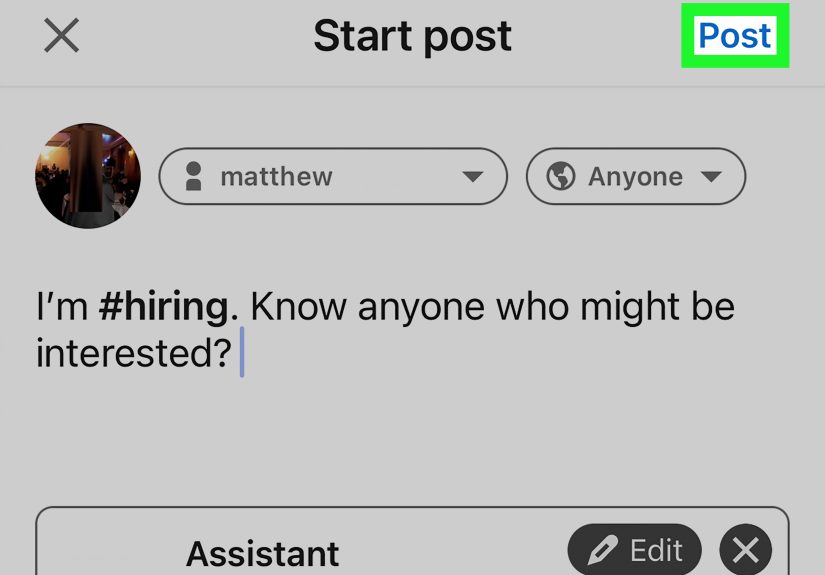
- Go to the Jobs tab on LinkedIn.
- Open Manage job posts (or the equivalent job management view on your account).
- Find the job you want.
- Select the More (or overflow) menu.
- Choose Share to post it to your feed or send it in a message.
This method is ideal for recruiters and hiring managers because it keeps everything tied to the original LinkedIn job posting.
Option B: Share a job you found (copy the job link and share anywhere)
- Open the job posting page.
- Click the More or Share options on the posting.
- Select Copy link.
- Paste it into a LinkedIn post, message, email, Slack channel, or carrier pigeon note (results may vary).
This option is perfect for employees who want to share an opening for referrals or for people amplifying a company’s job opening.
Option C: Share via a direct LinkedIn message (DM)
If you’re sharing a job posting with one specific person, a message is often more effective than a public post. It feels personal, and it avoids the “I posted this for everyone and secretly for you” vibe.
- Copy the job link (as above).
- Open LinkedIn messaging.
- Send a short, friendly note with the link and a clear ask.
Option D: Share in a LinkedIn Group (carefully)
Some groups welcome job posts; others treat them like spam. Before you post:
- Check group rules for job sharing and self-promotion.
- Make your post useful (role fit, location, why it’s interesting), not just “HIRING!!!”
- Engage in the group outside of hiring posts so you’re not “that person.”
What to say when you share a job posting on LinkedIn
Your goal is simple: help the right person recognize themselves in the role. Do that, and you’ll get more qualified applicants, stronger referrals, and fewer “Is this remote?” comments (you’ll still get some, but fewer).
The “clean and clear” hiring post template
Use when: You want something professional, readable, and easy to share internally.
Example copy:
We’re hiring a [Job Title] to join our [Team] at [Company].
Location: [City / Remote / Hybrid]
You’ll work on: [1–2 core responsibilities]
Ideal for someone who’s strong in: [2–3 skills]
Apply here: [Job Link]
Questions? Drop a comment or message me.
The “human + honest” template (more clicks, fewer eye-rolls)
Use when: You want to attract people who care about mission, growth, and reality.
Example copy:
We’re adding a [Job Title] and I’m genuinely excited about this one.
This role will matter because [impact in plain English].
If you love [problem type], enjoy working with [team/collaboration style], and can bring [skill] to the table, you’ll probably have a good time here.
The details + application: [Job Link]
And if you’re on the fence, message mehappy to share what “a normal week” actually looks like.
The referral-focused template (a polite nudge that actually works)
Use when: You want employees and your network to refer someone (without sounding like a guilt trip).
Example copy:
Hiring for [Job Title] at [Company].
If you know someone who’s great at [skill/problem] and wants to work on [impact], I’d love an intro.
Here’s the job posting: [Job Link]
Bonus points if they’re the kind of person who [specific trait that matters].
Thanks in advancereferrals are how we keep building a team we actually enjoy working with.
The hiring manager template (authority + specificity)
Use when: The hiring manager is willing to post (this often boosts credibility fast).
Example copy:
I’m the hiring manager for our new [Job Title] role at [Company].
In the first 90 days, you’ll aim to:
- [Goal #1]
- [Goal #2]
- [Goal #3]
If that sounds like your kind of challenge, apply here: [Job Link]
If you have questions, ask in the commentsothers might be wondering the same thing.
The employee advocacy template (easy for teammates to repost)
Use when: You want a shareable post employees can copy/paste without rewriting their life story.
Example copy:
My team at [Company] is hiring a [Job Title].
If you’re looking for a role focused on [focus area] with a team that values [culture value], check it out:
[Job Link]
Happy to answer questions if you’re curious.
A direct message (DM) template that doesn’t feel weird
Use when: You’re sharing the job posting with one person you think is a great fit.
Example DM:
Hey [Name]hope you’re doing well. I saw this [Job Title] opening and it immediately made me think of you because of [specific reason].
Here’s the link: [Job Link]
No pressure at alljust wanted to share. If you want, I can also tell you what the team’s priorities are this quarter.
Make your LinkedIn job post perform better (without begging the algorithm)
1) Lead with “what’s in it for them”
People don’t click job posts because you’re hiring. They click because the role offers something: growth, impact, interesting problems, great mentorship, flexibility, or a mission they can get behind. Put that near the top.
2) Keep it skimmable
LinkedIn is a scrolling environment. Short paragraphs, clear line breaks, and a few bolded details beat a wall of text every time.
3) Use a simple visual (optional, but powerful)
A basic image that says “We’re hiring: [Role]” plus location can increase stop-the-scroll attention. Keep it clean and readable on mobile.
4) Hashtags: use a few, not a novel
Add 2–5 relevant hashtags like #hiring, #jobs, and 1–3 niche tags related to the field (e.g., #cybersecurity, #productmanagement). Avoid turning your post into a hashtag salad.
5) Tag thoughtfully (don’t summon the entire internet)
Tag your company page, maybe the hiring manager, and possibly a team page if relevant. Don’t tag 17 people who had nothing to do with the role. That’s not networking; that’s notification spam.
6) Links in the post vs. links in the comments
You’ll hear advice like “never put a link in the post.” In reality, what matters most is clarity and engagement. If you do include the link in the post, keep everything else concise. If you put the link in the comments, make sure you actually… put it in the comments. (Yes, people forget. Yes, it’s painful.)
7) Post timing: pick workdays, then test
Most engagement happens during workweek windows. Start with mornings or lunch hours for your audience, then check performance and adjust. The “best time” is the time your ideal candidates are online.
Common mistakes when sharing a job opening on LinkedIn
Mistake 1: “We’re hiring!!!” and nothing else
A hiring post without details forces the reader to do extra work. Give the essentials: role, location/remote status, top skills, why it matters, and the link.
Mistake 2: Posting once and calling it a strategy
The best LinkedIn recruiting posts often come in waves: an initial post, a follow-up a week later, and employee shares throughout. One post is an announcement. A handful is distribution.
Mistake 3: Sharing roles that aren’t ready (or aren’t real)
Don’t amplify “maybe” roles. Make sure the job posting is accurate, active, and approved. If the role closes, update your post with a comment so people don’t keep applying to a ghost listing.
Mistake 4: Forgetting to respond
If people ask questions in the comments, answer them. Your responsiveness is part of your employer brandand candidates notice.
How to measure results (and improve the next post)
You don’t need a dashboard that looks like mission control. Track a few basics:
- Reach & engagement: Views, reactions, comments, reposts.
- Click-throughs: If you can, use trackable links (UTMs) so you know what worked.
- Quality signals: Did applicants match the role? Did referrals convert?
Then iterate. If the post got attention but low-quality applicants, tighten the “who this is for” section. If it got low reach, test a stronger first line, a clearer benefit, or an employee repost campaign.
Conclusion
Sharing a LinkedIn job posting is easy. Sharing it well is where the magic happens. Be specific, be human, and make it effortless for the right people to say, “Oh… that’s me.”
And remember: the best LinkedIn hiring post doesn’t sound like it was written by a committee. It sounds like a person who knows what the job is, why it matters, and who will thrive doing it.
Bonus: of real-world experience (a.k.a. what actually happens after you post)
After years of watching companies share job openings on LinkedIn, here’s the part nobody puts in the “best practices” slide deck: the post is only the beginning. The real difference shows up in the first 48 hourswhen comments come in, DMs start trickling, and someone internally asks, “Can we add three more requirements?” (No. Put the keyboard down.)
The biggest win I’ve seen is when the hiring manager postsnot the company page, not the recruiter. Not because recruiters aren’t great (they are), but because candidates read hiring manager posts like they’re getting a preview of what it’ll feel like to work there. A manager who writes, “Here’s what you’ll ship in 90 days,” instantly filters in the people who want ownership and filters out the people who want a title with minimal responsibility. That clarity saves everyone time.
Second biggest win: a coordinated employee share. One company I worked with didn’t ask employees to “please share.” Instead, they made it ridiculously easy:
- They dropped three copy options in Slack (short, medium, and story-based).
- They included a one-line “why this role is cool” blurb employees could personalize.
- They gave people permission to be themselves (no forced corporate voice).
The result wasn’t just more reachit was better reach. Employees’ networks often include former classmates, ex-coworkers, and industry peers who actually match the role. And when those applicants came in, they arrived pre-warmed: “I saw you shared this, what’s it like there?” That’s the start of a high-quality candidate conversation.
Third: the post that flops isn’t always “bad.” Sometimes it’s just missing one sentence. I’ve seen identical job links perform wildly differently based on the opening line. Compare these:
- “We’re hiring a Senior Analyst.” (Fine. Also: sleepy.)
- “If you love turning messy data into decisions people actually use, this role is for you.” (Now we’re talking.)
Lastly, don’t underestimate follow-up. The best posters reply to comments quickly, pin the job link if needed, and add a short update a week later: “Still open, interviews in progress, would love a few more strong candidates.” That second post often converts better because it signals momentum and urgency.
LinkedIn recruiting isn’t a single postit’s a conversation. Start it like a human, and you’ll attract humans. Preferably the ones who can do the job.