Table of Contents >> Show >> Hide
- Where This Question Came From
- 30 “Totally Normal” American Things That Aren’t Actually Universal
- 1. Tipping on Almost Everything
- 2. Sales Tax Added at the Register
- 3. Free Drink Refills
- 4. Ice in Every Drink
- 5. Advertising Prescription Drugs on TV
- 6. Huge Portion Sizes at Restaurants
- 7. Driving Everywhere (Even Short Distances)
- 8. Obsession with College Sports
- 9. Flag Everywhere, All the Time
- 10. Huge Open-Plan Grocery Stores
- 11. Bathroom Stalls with Big Gaps
- 12. Free Water at Restaurants
- 13. Keeping Shoes On Indoors
- 14. Garbage Disposals in Kitchen Sinks
- 15. Giant Refrigerators
- 16. Air Conditioning Almost Everywhere
- 17. School Buses and Lockers Like in the Movies
- 18. Healthcare Tied to Employment
- 19. Student Loan Debt as a Life Stage
- 20. Putting Peanut Butter on Everything
- 21. Red Solo Cups at Parties
- 22. Drive-Thru Everything
- 23. Calling the Country “America”
- 24. Asking “So, What Do You Do?” Right Away
- 25. Strong Customer Service Culture
- 26. Black Friday Shopping Chaos
- 27. Coffee To-Go in Giant Cups
- 28. Measuring with Cups, Inches, and Fahrenheit
- 29. Signing Receipts for Card Payments
- 30. Constant Small Talk with Strangers
- Why Americans Think These Things Are Normal
- What the Rest of the World Sees
- Experiences and Reflections on “American Things” Going Global
If there’s one thing the internet does well, it’s convincing us that our everyday habits are totally normalright up until someone from another country goes,
“Wait… you all do what?” That’s exactly what happened when a netizen asked online: “What is an American thing, but Americans think everyone outside of America does it?”
The comment section exploded with answers, and it turns out a lot of “regular” American behavior is downright baffling to the rest of the world.
From tipping on a cup of coffee to putting ice in drinks like it’s a competitive sport, these responses are a reminder that culture is weird, funny, and very, very local.
Let’s take a tour through 30 American habits that many people in the U.S. assume are universalbut really aren’t.
Where This Question Came From
The original question popped up on Reddit, where users love trading cultural observations and mild existential crises.
The thread caught the attention of Bored Panda, which rounded up some of the funniest and most eye-opening examples and shared them with a global audience.
What followed was a mix of gentle roasting, cultural education, and “oh no, we really do that” moments for Americans reading along.
While the answers are lighthearted, they also highlight real differences in how societies think about money, space, comfort, and even basic services.
Here are 30 standout responses, grouped and explained so you can see why these habits feel normal inside the U.S.and strange almost everywhere else.
30 “Totally Normal” American Things That Aren’t Actually Universal
1. Tipping on Almost Everything
In the U.S., tipping 15–25% at restaurants is standard, and tip prompts now pop up for coffee, takeout, and sometimes even self-checkout tablets.
Many Americans assume this is how service workers are paid everywhere. Outside the U.S., though, tipping is often optional, small, or reserved for truly exceptional service.
For many visitors, American tipping culture feels less like a “thank you” and more like a surprise math exam attached to every receipt.
2. Sales Tax Added at the Register
Americans are used to seeing one price on the shelf and a higher one on the receipt once sales tax is added.
Tourists, however, are often shocked to find out that the price tag is more of a “suggestion.”
In many countries, taxes are already included in the sticker price, so what you see is what you actually pay.
3. Free Drink Refills
Bottomless soda at restaurants feels like a birthright in the U.S. You order one soft drink and it magically refills until you physically tap out.
Elsewhere, drinks are sold per glass or bottle, and refills are definitely not infinite.
For non-Americans, the concept of “free refills” sounds less like a dining norm and more like a marketing prank.
4. Ice in Every Drink
Americans love icea lot of ice. Glasses stuffed with cubes and a splash of beverage on top are completely normal.
In many parts of Europe and Asia, drinks are served cool or at room temperature with little or no ice, and asking for a cup full of it can get you some very puzzled looks.
5. Advertising Prescription Drugs on TV
“Ask your doctor if this drug is right for you,” says the commercial, right before rattling off side effects that sound like the end of the world.
For most of the planet, this kind of direct-to-consumer pharmaceutical advertising doesn’t exist.
In the U.S., it’s just another commercial break between touchdowns and cliffhangers.
6. Huge Portion Sizes at Restaurants
The classic American restaurant experience often involves a plate big enough to feed two or three people.
Many Americans assume “big portions” are standard everywhere, but visitors are often stunned by the amount of food that arrives.
Doggie bags are common in the U.S.elsewhere, they may not even be an option because the portions are already reasonable.
7. Driving Everywhere (Even Short Distances)
With cities and suburbs built around cars, driving 30–40 minutes to work or the store is normal in much of the U.S.
In more compact countries, that much driving could literally mean crossing a border.
Americans tend to see cars as a default necessity, while many other societies build around walking, biking, and public transit.
8. Obsession with College Sports
In the U.S., college football and basketball can pack giant stadiums, fuel regional rivalries, and bring in millions of dollars.
To many non-Americans, the idea that a university sports team has a bigger stadium than some professional clubs is mind-boggling.
9. Flag Everywhere, All the Time
American flags fly from porches, cars, schools, gas stations, and sometimes just random fences.
While national flags are important symbols everywhere, the sheer volume of U.S. flags on display often surprises visitors, who may associate that level of flag-waving with official buildings or national holidays only.
10. Huge Open-Plan Grocery Stores
Americans often take for granted gigantic supermarkets where you can buy groceries, clothes, electronics, and a kayak in the same trip.
In many other countries, people still shop at smaller markets, bakeries, and specialty stores.
The one-stop mega-store is a distinctly American flavor of convenience.
11. Bathroom Stalls with Big Gaps
One of the most common “why is it like this?” complaints: the gap under and around U.S. bathroom stall doors.
Americans grow up accepting that privacy is… negotiable. Many visitors find it extremely strange that you can basically make eye contact with someone washing their hands while you’re sitting down.
12. Free Water at Restaurants
In the U.S., a glass of ice water appears on your table almost by default, and refills are free.
In other places, water is often bottled, charged, or only served if you order it.
Americans sometimes don’t realize how unusual it is to be constantly topped up with free chilled water.
13. Keeping Shoes On Indoors
Many American households don’t have a strict “shoes off” rule, so keeping footwear on indoors feels normal.
But in parts of Europe and most of Asia, walking indoors with shoes is a big no-no and considered dirty or disrespectful.
14. Garbage Disposals in Kitchen Sinks
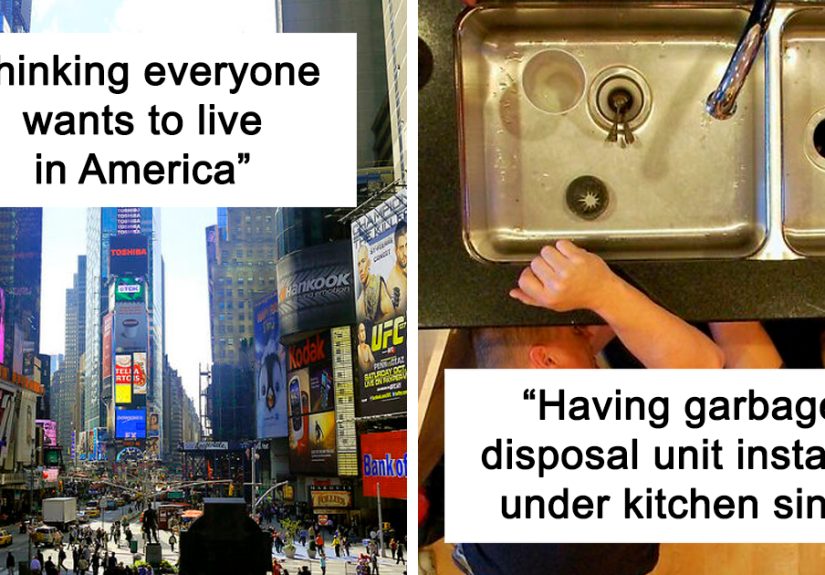
That loud grinding sound from under the sink? Totally normal to Americans, thanks to garbage disposals built into many kitchen drains.
Yet in much of the world, people scrape plates into a trash bin and would rather not have a blender attached to their plumbing.
15. Giant Refrigerators
American fridges are often huge, double-door beasts packed with a week’s worth of groceries (and then some).
In many other countries, smaller kitchens and frequent shopping mean compact fridges that hold a few days of food, not a full frozen Costco run.
16. Air Conditioning Almost Everywhere
Offices, homes, cars, restaurantsair conditioning is everywhere in the U.S., and people expect indoor spaces to be cool even in brutal summer heat.
Visitors from cooler climates, or places where AC is a luxury, can be shocked by how cold American interiors are kept.
17. School Buses and Lockers Like in the Movies
Yellow school buses, hall lockers, and letterman jackets show up constantly in American TV and moviesand yes, they’re real.
Many non-Americans are surprised to learn that some U.S. schools really do look like teen dramas, minus the dramatic background music.
18. Healthcare Tied to Employment
In the U.S., getting health insurance through your job is normal, and losing your job can mean losing your coverage.
Many Americans don’t fully realize how unusual this is globally, where public healthcare, national insurance, or universal systems are common.
19. Student Loan Debt as a Life Stage
“I’ll be paying off my student loans until I’m 40” is a sentence that feels normal to many Americans.
In other countries, tuition is low, heavily subsidized, or free, so the concept of starting adult life with tens of thousands of dollars in education debt feels shocking.
20. Putting Peanut Butter on Everything
PB&J sandwiches, peanut butter cookies, peanut butter with apples, celery, or just straight from the jar with a spoonAmericans love their peanut butter.
While it exists elsewhere, it’s rarely as central to everyday snacking as it is in the U.S.
21. Red Solo Cups at Parties
Thanks to movies and TV, those red plastic cups have become an unofficial symbol of American house parties.
Many non-Americans thought they were just a film prop until they visited and saw real-life college parties stocked with them.
22. Drive-Thru Everything
It’s not just fast foodthere are drive-thru pharmacies, coffee shops, banks, and even wedding chapels in some places.
For countries built around walking or public transit, the idea of living so much of life through a car window is genuinely wild.
23. Calling the Country “America”
Americans casually use “America” to refer to the United States, even though technically the Americas include many other countries.
People elsewhere sometimes find this presumptuous, even if Americans see it as just shorthand.
24. Asking “So, What Do You Do?” Right Away
In the U.S., one of the first small-talk questions is often about your job.
Career and identity are tightly linked, so it feels natural.
In other cultures, that question can feel intrusive, or at least not something you’d ask someone you just met at a barbecue.
25. Strong Customer Service Culture
Smiling staff, “How are you today?”, constant check-ins at your table…
For Americans, this is normal customer service.
Visitors may find it over-the-top, scripted, or even suspicious, because service in many countries is more reserved.
26. Black Friday Shopping Chaos
Lining up in the dark for discounts, doorbuster sales, and viral videos of people racing for TVsit’s all part of the American Black Friday ritual.
While other countries now copy the sales, the original culture of post-Thanksgiving shopping madness is uniquely U.S. flavored.
27. Coffee To-Go in Giant Cups
Americans are used to walking around with large paper cups of coffee, often with flavored syrups, milk options, and elaborate names.
In many places, coffee is consumed at small cafés in smaller cups, sitting down rather than sprinting to the next thing.
28. Measuring with Cups, Inches, and Fahrenheit
Most of the world: grams, liters, Celsius, and meters.
The U.S.: cups, ounces, Fahrenheit, and feet.
American recipes and weather reports can feel like a secret code that everyone else has to translate.
29. Signing Receipts for Card Payments
With chip-and-PIN and contactless payments, signatures have disappeared in many countries.
But in some American stores and restaurants, being handed a pen and a slip to sign is still part of the routine, even if the cashier barely glances at it.
30. Constant Small Talk with Strangers
Chatting with the cashier, complimenting a stranger’s shirt, talking about the weather in elevatorsAmerican small talk is everywhere.
For some cultures, speaking to strangers at all is rare, so the sheer amount of casual chit-chat can be surprising or exhausting.
Why Americans Think These Things Are Normal
A big part of this disconnect comes down to cultural bubbles. Many Americans grow up consuming mostly American TV, news, and social media.
If everyone around you tips, drives, and drinks iced water, it’s easy to assume that’s simply how the world works.
On top of that, the U.S. is geographically huge and diverse, so Americans can experience different cultures without ever leaving the countryTex-Mex vs. New England seafood, big coastal cities vs. tiny Midwestern towns.
That makes it feel even more like a self-contained world.
Meanwhile, for people in smaller or more interconnected countries, international travel and cross-border media may make global differences more obvious.
So when they see U.S. habits online, their first reaction is often, “That’s… not a thing here.”
What the Rest of the World Sees
For non-Americans, these habits can be charming, confusing, frustrating, or all three at once.
Some visitors love the friendly service and free refills; others feel overwhelmed by the tipping culture or anxious about healthcare costs.
The important thing to remember is that none of this is about who’s “right” or “wrong.”
It’s about expectations. When you assume your way is the default, cultural friction is guaranteed.
When you treat differences as something to learn from (and gently laugh about), travel and online conversations get a lot more fun.
Experiences and Reflections on “American Things” Going Global
Spend enough time reading comment sections on threads like “What is an American thing but Americans think everyone outside of America does it?” and you start to see a pattern: the actual habits matter less than the reactions to them.
Americans are often genuinely surprised that something as basic as getting free tap water isn’t universal.
Non-Americans are equally shocked that ordering dinner can feel like a full financial negotiation, complete with tip calculations and tax surprises.
One common experience you’ll see described by travelers goes like this: they arrive in the U.S. for the first time, sit down at a restaurant, and before they’ve said a word, a huge glass of iced water appears.
The server is smiling, checking in constantly, and topping off drinks like it’s an Olympic event.
For someone used to more hands-off service, that level of attention can feel almost theatrical.
But after a few days, many people admit they start to enjoy itand then miss it when they go home.
On the flip side, Americans visiting other countries often experience a kind of reverse culture shock.
They may walk into a café, order coffee, and stand at the counter awkwardly waiting for a to-go cup that never comes.
Instead, the drink is served in a small ceramic cup meant to be enjoyed slowly, sitting down.
There’s no tipping screen, no giant ice cubes, and no one checking in every two minutes to ask how everything tastes.
For some Americans, that slower pace feels luxurious; for others, it’s “Why is this taking so long?” in disguise.
Another recurring storyline in these discussions involves money and measurements.
People trading recipes online quickly discover that American “cups” and “sticks of butter” don’t map neatly onto grams and milliliters.
Weather conversations become comedy routines when one person says, “It’s 100 degrees today,” and half the world has to clarify whether that means “hot but survivable” (Fahrenheit) or “surface of the sun” (Celsius).
These little translation hiccups show up constantly in global online communities, and they’re often the spark for good-natured teasing.
Healthcare and education bring a more serious tone to the thread.
Non-Americans often react with disbelief to stories about student loan burdens or medical bills that could bankrupt a family.
For Americans, those stories are part of normal adulthood; for readers elsewhere, they’re closer to disaster movie plotlines.
In the comments, you’ll frequently see a mix of sympathy, horror, and sometimes relief from non-Americans that their own systems, while imperfect, don’t demand quite so much personal financial risk.
There’s also a softer, more emotional side to these conversations.
Many people point out that American friendlinesshowever performative it may sometimes seemcan feel genuinely comforting.
Being greeted warmly, having strangers compliment your outfit, or getting excited chatter from a cashier about your day can leave a lasting impression.
Even those who initially find it “too much” will admit later that the warmth feels good, especially when traveling alone.
Ultimately, threads like this one become more than just a list of funny quirks.
They’re a reminder that none of us are truly “normal”; we’re all just deeply trained by our environments.
Americans aren’t strange for liking ice or drive-thrus, and non-Americans aren’t strange for preferring smaller fridges and less small talk.
The magic happens when people recognize those differences, laugh together, and maybe steal a few ideas from each otherlike free tap water for everyone, or at least slightly smaller bathroom stall gaps.
So next time you see someone online asking, “Do Americans really do this?”, you can answer:
“Yes, they really doand they probably think you do it, too.”
And that’s exactly why conversations like this are worth having.