Table of Contents >> Show >> Hide
- Space-Time Is Not Just a Science-Fiction Wallpaper
- The New Mapmakers of the Universe
- Why LISA Could Be a Big Deal in Capital Letters
- Timekeeping Is Secretly Part of the Plot
- What Scientists Hope to Discover Next
- The Engineering Challenge Is Wild
- Experiences Related to “Scientists Are About to Chart a Course Through the Fabric of Space-Time”
- Conclusion
For more than a century, space-time has been physics’ most famous invisible stage. It bends. It stretches. It tells planets where to go and tells clocks how fast to tick. Unfortunately, it has also been extremely rude about letting humans observe it directly. We have seen its effects, trusted the math, and nodded along as Einstein rewired the universe in 1915 and 1916. But now scientists are doing something far bolder than admiring the theory from a safe distance. They are building tools to map it.
That is the thrilling idea behind the next era of gravitational-wave astronomy. Researchers are no longer satisfied with catching a few cosmic ripples and calling it a day. They want to chart the contours of space-time itself, especially around the most extreme objects in the universe: black holes, neutron stars, and ancient systems that have been shaking the cosmos for eons. In practical terms, this effort includes ground-based observatories like LIGO, pulsar timing experiments such as NANOGrav, and the upcoming Laser Interferometer Space Antenna, or LISA. In less poetic terms, humanity is turning the universe into a very fancy survey project.
The result could transform astronomy. Instead of relying only on light, scientists are learning to read gravity as information. That matters because light can be blocked, scattered, distorted, or swallowed. Gravity is much harder to hide. If the coming observatories perform as expected, researchers will gain a new way to study supermassive black holes, test Einstein’s theory under brutal conditions, and maybe even glimpse signatures from the early universe. Not bad for something once dismissed as too faint to detect.
Space-Time Is Not Just a Science-Fiction Wallpaper
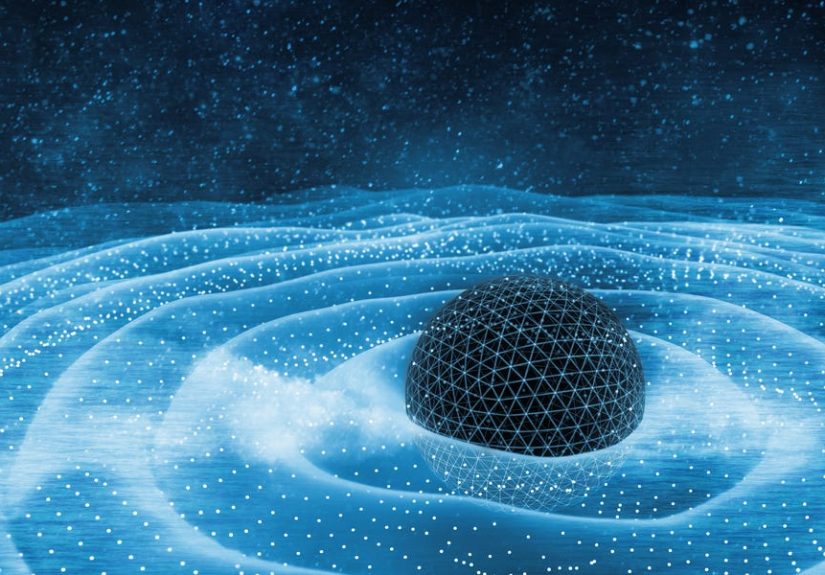
When people hear “the fabric of space-time,” they often imagine a stretchy blanket with bowling balls rolling around on it. That classroom image is helpful, but it also undersells the drama. In Einstein’s view, gravity is not a mysterious force pulling objects together like cosmic magnetism. It is the geometry of the universe. Matter and energy shape space-time, and space-time guides motion. In other words, planets are not being yanked around the sun by invisible ropes. They are following the curves written into reality itself.
That geometric picture led to one of Einstein’s strangest predictions: accelerating massive objects should create ripples in space-time. These ripples are gravitational waves. Imagine two black holes circling each other like heavyweight figure skaters with terrible self-control. As they spiral inward, they stir the structure of the universe and send waves racing outward at the speed of light. When those waves pass through Earth, they stretch and squeeze distances ever so slightly. “Ever so slightly” is doing an absurd amount of work here, because the changes are tiny beyond ordinary human intuition.
For decades, gravitational waves sounded like the kind of thing physicists invent to make graduate students nervous. Then came the breakthrough. In 2015, LIGO directly detected gravitational waves from a pair of merging black holes, proving that the waves were real and launching a new branch of astronomy. Since then, gravitational-wave science has gone from one spectacular detection to a growing catalog of collisions, including neutron-star mergers and increasingly massive black-hole events.
The New Mapmakers of the Universe
LIGO Opened the Door
LIGO changed everything by showing that space-time can be measured, not merely theorized about. Its twin observatories in Louisiana and Washington use laser interferometry to detect exquisitely small changes in distance. When a gravitational wave passes, the detectors’ long arms change length by a minuscule amount. The laser light no longer lines up exactly as expected, and scientists get a signal. It is less like taking a photograph and more like hearing a cosmic chirp that has traveled across millions or even billions of years.
That first success was historic, but it was also just the trailer. LIGO is best at catching higher-frequency waves from stellar-mass black holes and neutron stars near the end of their violent inspirals. It gives us the last frantic moments of a cosmic crash. Spectacular, yes. Complete, not quite.
NANOGrav Uses the Galaxy’s Most Reliable Clocks
To study much slower, lower-frequency gravitational waves, scientists have turned to pulsars. These spinning neutron stars send out pulses of radio waves with astonishing regularity, which makes them nature’s version of obsessive-compulsive metronomes. If a long-wavelength gravitational wave rolls through the galaxy, it subtly changes the arrival times of those pulses. By monitoring many pulsars over years, researchers can look for a correlated pattern that reveals a gravitational-wave background.
That is exactly why NANOGrav matters. Its measurements offer evidence that ultra-low-frequency gravitational waves are washing through our cosmic neighborhood, likely generated by enormous pairs of supermassive black holes slowly orbiting each other in distant galaxies. If LIGO is hearing the sharp crack of a cymbal, NANOGrav is listening for the bass note that has been rumbling beneath the orchestra the entire time.
LISA Will Connect the Middle of the Score
And then there is LISA, the mission that gives this article its swagger. LISA will place three spacecraft in a vast triangular formation in space and use lasers to measure changes in the distances between them. Instead of detector arms on Earth, it will have laser links stretching across millions of kilometers. That enormous scale will let it detect gravitational waves in the millihertz band, a range that ground-based detectors cannot reach well and pulsar timing arrays do not target.
In plain English, LISA will listen to a different part of the universe’s soundtrack. It will be sensitive to systems such as merging massive black holes, compact binaries, and extreme mass-ratio inspirals, in which a smaller dense object spirals into a supermassive black hole. Those events are not just exciting; they are scientifically priceless, because their waveforms encode detailed information about the geometry of space-time around black holes.
Why LISA Could Be a Big Deal in Capital Letters
The phrase “chart a course through the fabric of space-time” sounds like marketing copy from a luxury starship brochure, but it captures something real. LISA is designed to do more than confirm that gravitational waves exist. Scientists expect it to help trace how space-time behaves in the harshest environments known to physics. That includes regions near supermassive black holes, where gravity becomes so intense that even our best theories deserve a stress test.
One of LISA’s most powerful targets is the extreme mass-ratio inspiral. In these systems, a stellar-mass black hole or neutron star circles a much larger black hole again and again before finally plunging inward. Because the smaller object spends so long orbiting in a strongly curved gravitational field, it acts like a probe moving through the black hole’s surrounding geometry. The emitted gravitational waves carry a record of that journey. Scientists can use those signals to examine whether the central object truly behaves like the black hole predicted by general relativity.
This is where the story stops being merely impressive and becomes deliciously nosy. Researchers want to know whether black holes really obey the neat rules Einstein’s theory suggests. Are they fully described by mass and spin in the clean way the “no-hair” idea proposes? Does the space-time around them match the Kerr solution as closely as theory predicts? LISA may help answer those questions with unprecedented precision.
Timekeeping Is Secretly Part of the Plot
Any discussion of space-time eventually drags time into the spotlight, and fair enough. Time is half the name. One of the most remarkable lessons of relativity is that time is not universal. Clocks tick at different rates depending on gravity and motion. Atomic clocks have confirmed this over and over, and modern navigation systems already rely on relativistic corrections. If engineers ignored relativity, technologies like GPS would age badly in a matter of hours.
That is why ultra-precise clocks are not just useful gadgets. They are scientific instruments for measuring the structure of reality. NIST researchers have shown how clocks can detect tiny relativistic effects over very small height differences, while NASA and JPL have long pursued deep-space atomic clock technologies to improve navigation. The better the clock, the more precisely scientists can test how gravity shapes time. Suddenly, watchmaking sounds a lot less quaint and a lot more like an advanced branch of cosmology.
This matters for the broader project of charting space-time because measurement is everything. Gravitational-wave observatories depend on timing, stability, and a level of instrumental patience that borders on heroic. In some cases, researchers are trying to identify changes smaller than an atom’s width over immense distances. The universe is subtle. Fortunately, physicists are stubborn.
What Scientists Hope to Discover Next
Supermassive Black Hole Mergers
Galaxies merge. When they do, their central black holes can end up orbiting one another. Over long periods, those giants lose energy and spiral closer together, producing gravitational waves. LISA should be able to observe many of these systems, potentially revealing how black holes grow along with galaxies. That is important because supermassive black holes are not weird side characters anymore. They are central to the story of cosmic evolution.
The Missing Middle of Gravitational-Wave Astronomy
Scientists now have evidence from high-frequency detectors like LIGO and from ultra-low-frequency pulsar timing arrays. LISA promises to fill in the middle range. That gives researchers a more complete map of gravitational-wave sources across frequencies, which is a lot like going from a few snapshots to a full documentary. Different detectors will observe different populations of objects and, in some cases, may even follow the same systems at different evolutionary stages.
Tests of Fundamental Physics
General relativity has survived every serious challenge thrown at it, which is both admirable and a little annoying for anyone hoping for easy new physics. But strong-field environments remain one of the best places to look for cracks. Gravitational-wave observations can test whether black holes ring down the way relativity predicts, whether gravity has unexpected polarizations, and whether subtle deviations appear in long, information-rich signals. If nature is hiding a surprise, this is a good place to ambush it.
Possibly Clues From the Early Universe
Some scientists also hope future space-based detectors could help probe ancient signals tied to the early universe. That does not mean LISA will casually discover the cosmic origin story on a Tuesday afternoon. It does mean the mission could open a new window on processes that traditional telescopes cannot see directly. Even when those signals remain speculative, the opportunity is profound: gravity may preserve traces of eras that light cannot cleanly reveal.
The Engineering Challenge Is Wild
All of this beautiful science comes with a practical problem: space-time ripples do not send appointment reminders. Detecting them requires extraordinary control over noise, motion, temperature, and instrumentation. LISA’s hardware must keep lasers stable enough to measure picometer-scale changes. Its spacecraft must fly in formation while letting internal test masses fall as freely as possible. Ground-based detectors, meanwhile, spend their lives battling vibrations from Earth itself, which is rude but very on-brand for a living planet.
And yet progress keeps coming. Prototype hardware advances, clock technologies improve, data analysis becomes more sophisticated, and the gravitational-wave catalog keeps growing. Each improvement turns an impossible-sounding idea into a working scientific method. That is the real story here. Not that scientists have mastered the fabric of space-time, but that they are learning to read it with increasing confidence.
Experiences Related to “Scientists Are About to Chart a Course Through the Fabric of Space-Time”
One of the most fascinating experiences related to this topic is the shift from thinking of the universe as something you only look at to something you can also listen to and measure in a deeply physical way. For students, readers, and researchers alike, the first encounter with gravitational-wave science can feel oddly personal. You start with a concept that sounds abstract and almost theatrical: black holes colliding, space-time rippling, clocks ticking differently in gravity. Then, suddenly, you realize these are not just poetic ideas. They are measurable events. The universe stops being a distant wallpaper and starts behaving like an active system you can interrogate.
For many people, the first emotional jolt comes from hearing the famous “chirp” associated with a black-hole merger. It is brief, almost modest, yet it carries the force of a scientific revolution. That sound is not audio in the ordinary sense; it is data translated into a human-friendly form. Still, it leaves an impression. You are listening to the aftermath of an event that happened unimaginably far away, long before humans built cities, smartphones, or confusing kitchen appliances with too many buttons. It makes the cosmos feel less silent and far more dramatic.
Another experience tied to this subject is the mental whiplash of scale. LIGO measures distortions smaller than common intuition can handle. LISA will stretch that ambition across millions of kilometers in space. Pulsar timing arrays work over years and across the galaxy. Atomic-clock experiments can detect relativistic effects over tiny changes in height. In one corner of physics, the differences are smaller than an atom; in another, the measuring stick spans the solar system. The human brain does not love switching between those scales, but that discomfort is part of the wonder. It reminds us that reality is not obligated to fit neatly inside everyday experience.
There is also a quieter, more human experience: the growing awareness that advanced science is often built from patience rather than instant epiphanies. Gravitational-wave astronomy did not arrive because one genius dramatically pointed at the sky and yelled “Aha!” It came from decades of instrument building, theoretical work, calibration, false starts, software refinement, and stubborn international collaboration. Following this field teaches a valuable lesson about discovery. Breakthroughs are often made of many unglamorous improvements stacked on top of one another until the impossible becomes routine.
For young people especially, this topic can be a gateway into a different relationship with science. It shows that physics is not just a collection of equations in a textbook. It is a way of asking whether time itself changes with gravity, whether black holes really behave the way our theories claim, and whether the universe still carries old scars from its earliest ages. That kind of question has a special power. It invites curiosity without pretending the answers are simple.
And maybe that is the most meaningful experience of all: humility mixed with excitement. The closer scientists get to charting the fabric of space-time, the clearer it becomes that the universe is both understandable and gloriously strange. We can measure it, model it, and test it, but we can also still be amazed by it. Frankly, that is a very healthy combination.
Conclusion
Scientists are not literally steering a ship through wrinkles in the cosmos, but the metaphor is close enough to be useful. With LIGO, NANOGrav, atomic clocks, and the coming promise of LISA, researchers are learning how to navigate the structure of reality itself. They are measuring how gravity moves, how black holes sing, and how time responds to the shape of the universe.
That is why this moment feels so important. Astronomy is evolving from a mostly light-based science into a richer, multi-messenger enterprise that can study the universe through motion, timing, and gravitational structure. The next great map of the cosmos may not look like a map at all. It may look like a waveform, a timing residual, or a pattern in laser light. But make no mistake: it is a map, and scientists are finally learning how to read it.