Table of Contents >> Show >> Hide
- Why the Suez Canal Is a Big Deal (Even If You Don’t Own a Boat)
- How a Container Ship Runs Aground in a Canal That’s Literally Made for Ships
- The Instant a Ship Gets Stuck, the Canal Turns Into a Waiting Room
- How They Actually Unstick a Mega-Ship (Spoiler: It’s Not Just “Reverse”)
- Why the Backlog Hurts Even After the Ship is Freed
- Real-World Impacts: From Factory Floors to Online Carts
- “Is This Going to Happen Again?” The Uncomfortable Answer
- What Shippers and Businesses Do During a Suez Canal Traffic Jam
- Lessons the World Keeps Re-Learning (Because Global Trade Has a Short Memory)
- Conclusion: One Stuck Ship, One Big Reminder
- Bonus: of Real-World Experiences From a Suez-Style Shipping Snarl
If you’ve ever watched someone park a shopping cart sideways in the world’s narrowest grocery aisle, you already understand the basic physics of a Suez Canal traffic jamjust scale it up to a 1,300-foot container ship, add wind, sand, currents, and billions of dollars of cargo, and you’ve got yourself a global group chat meltdown.
When a container ship runs aground in the Suez Canal, it’s not just a bad day for that ship. It’s a bad day for ports, truckers, factories, retailers, energy markets, and anyone who has ever clicked “2-day shipping” with confidence. And because the canal is a narrow, high-traffic chokepoint, a single grounded vessel can trigger a backup that grows faster than your unread emails after a long weekend.
Why the Suez Canal Is a Big Deal (Even If You Don’t Own a Boat)
The Suez Canal is a shortcut with enormous consequences. It connects the Red Sea to the Mediterranean, letting ships move between Asia and Europe (and beyond) without taking the long way around Africa. That “shortcut” is the difference between a relatively predictable schedule and a voyage that adds daysor even weeksplus extra fuel, crew time, insurance complexity, and fresh opportunities for someone to ask, “So…where’s the shipment?”
It’s also an energy superhighway. Oil, refined products, and liquefied natural gas frequently transit the canal system, and U.S. government energy analysis has long described the Suez and the parallel SUMED pipeline as critical chokepoints for energy trade flows. When the canal is disrupted, it’s not just consumer goods that feel itenergy logistics and pricing nerves can kick in, too.
How a Container Ship Runs Aground in a Canal That’s Literally Made for Ships
On paper, “run aground” sounds like something a distracted pirate would do. In reality, groundings in narrow waterways can happen through a messy mix of:
- High winds and reduced visibility (think sandstorms and crosswinds that push a tall-sided ship sideways).
- Hydrodynamics in tight spaces (ships can “squat” deeper at speed, and narrow channels can create bank effects that tug the stern toward the side).
- Mechanical or steering issues (rudder or propulsion problems don’t care about your schedule).
- Human factors (fatigue, judgment calls, communication gaps, and the general reality that steering a floating city is hard).
Modern container ships are massive for a reason: scale lowers costs per container. But mega-ships are also less forgiving. A small drift in a narrow channel can become a big problem fast, because there’s not much “oops room” between “still fine” and “fully sideways.”
The Instant a Ship Gets Stuck, the Canal Turns Into a Waiting Room
The Suez Canal doesn’t operate like an open freeway where everyone just merges politely. It relies on traffic management, convoys, and (in some stretches) limited passing ability. If a grounded vessel blocks a single-lane segment, traffic can’t simply “go around.” Ships stack up at both ends, and a neat flow turns into a maritime version of: “Please remain on hold. Your call is important to us.”
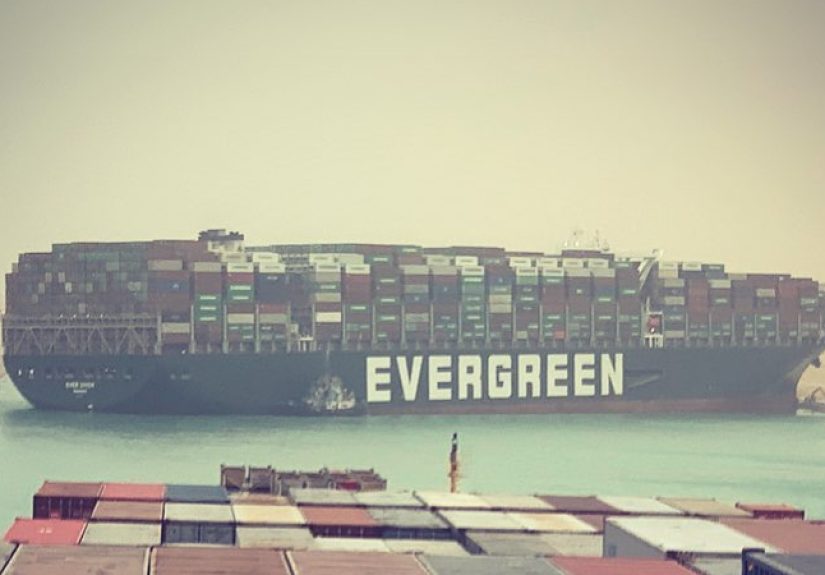
During the famous 2021 Ever Given incident, the blockage lasted days and created a backlog of hundreds of vessels. Once the ship was freed, clearing the queue still took timebecause you don’t dissolve a floating parking lot instantly. Even after the canal reopens, ships must be scheduled, prioritized, and moved through safely without creating new problems.
How They Actually Unstick a Mega-Ship (Spoiler: It’s Not Just “Reverse”)
Getting a grounded container ship moving again is part engineering, part patience, and part “please let the tide do a little extra credit.” In 2021, public reporting described a combination of dredging (removing sand and silt), multiple tugboats pulling from strategic angles, and careful timing around higher tides. In that case, spring tideshelped by lunar alignmentadded a small but meaningful lift that made refloating more achievable.
Common tools in a salvage playbook
- Dredgers and excavators to remove material from around the bow and stern.
- Tugboats to pull and push from multiple directions to change angle and regain steerage.
- Ballast adjustments to shift weight and improve buoyancy/trim.
- Tide timing to take advantage of higher water levels (sometimes a difference of inches matters).
- Traffic control to stop movement in affected stretches and prevent secondary incidents.
If you’re wondering why they don’t just unload containers until the ship is light enough: that’s usually a last resort. Offloading thousands of containers in a narrow canal requires specialized cranes, barges, safe staging space, and time. It’s possiblebut it’s slow, complex, and turns a crisis into a logistical triathlon.
Why the Backlog Hurts Even After the Ship is Freed
A Suez Canal traffic jam has two pain phases: the blockage itself, and the hangover. Once the canal reopens, the backlog must be cleared, and that creates ripple effects:
- Port bunching: Ships arrive late in clusters, overwhelming terminals that expected a smoother flow.
- Equipment imbalance: Containers, chassis, and even empty boxes end up in the “wrong” places.
- Schedule chaos: Carriers scramble to reset rotations, skip ports, or reshuffle which cargo gets priority.
- Warehousing pressure: Late cargo can collide with new arrivals, stressing storage and labor.
In other words: freeing the ship is the dramatic scene in the movie. The cleanup is the part where everyone quietly realizes the credits are still 45 minutes away.
Real-World Impacts: From Factory Floors to Online Carts
When a grounded ship blocks a global chokepoint, the impacts show up in places that don’t look “maritime” at all:
1) Consumer goods delays (the “where’s my stuff?” era)
A shipment of furniture components delayed by a week can pause a production line. Seasonal products (holiday décor, fashion drops, back-to-school inventory) can miss their selling window. And some cargolike perishable goods or live animalsfaces higher stakes than “arrives late.”
2) Freight rates and surcharges
Congestion encourages carriers to add surcharges, shippers to pay for premium services, and everyone to renegotiate timelines. Even if the canal disruption is short, the rate reaction can linger because the system is trying to regain balance.
3) Energy and commodity anxiety
Energy trade often depends on predictable maritime routes, and U.S. energy analysis has highlighted the Suez/SUMED system’s role in moving petroleum and LNG. Disruption can raise risk premiums and force rerouting decisions that cost time and money.
4) Egypt’s canal revenue (and reputational pressure)
The canal is a major source of revenue for Egypt. During major disruptions, public statements have described significant daily losses. Beyond the direct financial hit, there’s reputational urgency: shipping lines don’t like uncertainty, and repeated disruptions encourage them to rethink routing strategies.
“Is This Going to Happen Again?” The Uncomfortable Answer
The canal is engineered and managed for heavy traffic, but risk can’t be eliminatedonly reduced. Smaller incidents have occurred in recent years where ships ran aground or mechanical failures caused temporary disruption, sometimes resolved in hours with tug assistance. These events are a reminder that even when nothing like 2021 repeats, the canal’s tight margins and intense throughput leave little room for error.
After high-profile disruptions, Egypt has announced plans to widen and deepen parts of the canal to improve safety and capacity. Infrastructure upgrades help, but so do operational changes: better traffic management, more powerful tug availability, refined pilotage procedures, and improved incident response playbooks.
What Shippers and Businesses Do During a Suez Canal Traffic Jam
When the canal clogs, logistics teams shift from “optimize” to “triage.” Common moves include:
- Rerouting around the Cape of Good Hope (longer, more expensive, but avoids the blockage).
- Prioritizing critical SKUs (move the must-have goods first; let “nice-to-have” wait).
- Switching modes for urgent cargo (air freight for high-value, time-sensitive items).
- Communicating early and often (retailers update customers; manufacturers revise production schedules).
- Building resilience (diversified suppliers, buffer inventory, and better visibility tools).
In practice, the “best” response depends on what you’re shipping. Furniture can wait. Medical supplies, critical manufacturing parts, or time-sensitive components? Not so much.
Lessons the World Keeps Re-Learning (Because Global Trade Has a Short Memory)
Lesson 1: Chokepoints create outsized consequences
The whole idea of a chokepoint is that it’s narrow and vital. The Suez is efficient precisely because it concentrates traffic. That efficiency is also why disruptions echo globally.
Lesson 2: “Just in time” is greatuntil it isn’t
Lean inventory saves money, but it can magnify the pain of delays. Many companies now aim for “just in case” buffers for critical items, especially those with long lead times or limited suppliers.
Lesson 3: Visibility beats guessing
Modern tracking (AIS maps, carrier updates, port data) doesn’t prevent groundings, but it helps businesses react faster. The winners aren’t the ones who predict the futurethey’re the ones who notice problems early and adapt quickly.
Conclusion: One Stuck Ship, One Big Reminder
A container ship running aground in the Suez Canal is a headline that looks simple“ship stuck, ships wait”but the real story is how tightly global trade is tuned. The canal is a marvel of engineering and coordination, yet it operates with the same truth as any complex system: small disruptions can snowball when there’s no spare capacity.
The good news is that the playbook is improving: better response plans, infrastructure upgrades, and smarter supply chain strategies. The funny news (funny in a “please laugh so we don’t cry” way) is that we’ll probably keep getting reminded of this lessonbecause the world likes efficiency, and efficiency loves chokepoints.
Bonus: of Real-World Experiences From a Suez-Style Shipping Snarl
If you’ve never worked in logistics, a Suez Canal traffic jam can feel abstractlike a faraway nautical problem. But the lived experience is surprisingly human, and it usually starts with someone staring at a screen thinking, “That dot is not moving…why is the dot not moving?”
The operations manager experience: Your day becomes a loop of refresh buttons. You’re tracking vessels, rechecking ETAs, and trying to translate maritime reality into office language. “It’s delayed” sounds calm. “It’s delayed because a floating skyscraper is sideways in the world’s busiest shortcut” sounds like you’re pitching an action movie. Meanwhile, your inbox fills with polite panic: sales wants dates, procurement wants options, and leadership wants a one-sentence answer to a problem that is basically a physics lecture.
The small business owner experience: You’re not moving “global volumes.” You’re moving “my entire spring inventory.” A container of packaging, a batch of parts, or a best-selling product line is somewhere in that queue. Customers ask for tracking, and you’re tempted to reply with a screenshot of the canal backlog and the caption: “Because…this.” You learn quickly which customers are patient, which are not, and which assume you personally parked the ship across the canal for fun.
The warehouse and trucking experience: Delays don’t just push timelines backthey bunch them up. Instead of a steady stream of arrivals, you get a wave. Labor planning turns into a guessing game. Equipment gets stretched. Yard space gets tight. And when the cargo finally shows up, it often arrives alongside the next scheduled shipment, like two buses arriving at the stop after a 45-minute wait.
The “I just wanted my stuff” consumer experience: You see “shipment delayed,” shrug, and move onuntil it’s the item you need right now. That’s when you realize how often modern life depends on invisible logistics. Many people first learned the phrase “global supply chain” because one ship got stuck and the internet collectively discovered that trade routes are real things.
The bigger takeaway experience: After a disruption, everyone makes a promise: we’ll diversify suppliers, add buffers, improve visibility, build resilience. Some companies follow through. Others drift back to the cheapest, fastest option once the headlines fadeuntil the next time a dot on a map stops moving and the world remembers, again, that efficiency is amazing right up until it isn’t.