Table of Contents >> Show >> Hide
- 1. Uranus Spins on Its Side Like a Rolling Ball
- 2. It Survives as an Ice Giant With a Fiery Heart
- 3. That Blue-Green Color Comes From Methane Magic
- 4. Uranus Hosts the Solar System’s Brutal Deep Freeze
- 5. Its Seasons Are Extreme, Slow-Motion Experiments
- 6. Uranus Has a Dark, Delicate Ring System
- 7. The Moons Are Named for Poets and Might Hide Ancient Oceans
- 8. Its Magnetic Field Is Wildly Misaligned and Off-Center
- 9. Voyager 2’s Brief Flyby Changed Everything
- 10. Studying Uranus Helps Decode a Galaxy Full of Ice Giants
- Bonus: Real-World & Observational Experiences With Uranus
- Conclusion
Uranus is the only planet in the solar system that can make a professional astronomer say its name with a straight face and still sound like they’re telling a joke.
Behind the memes, though, this sideways-spinning, ice-giant oddball is one of the most scientifically intriguing worlds we’ve ever found.
With a brutal deep-freeze atmosphere, ghostly rings, tilted magnetic chaos, and moons that might be hiding ancient oceans, Uranus packs serious science under that calm blue glow.
Below are ten incredible, science-backed facts about the planet Uranusexplained in clear, engaging language, built on data from leading space agencies and research institutions,
and polished for readers (and search engines) who crave real information, not recycled space trivia.
1. Uranus Spins on Its Side Like a Rolling Ball
Most planets spin roughly upright compared to their orbit. Uranus does not care about “most planets.”
Its rotational axis is tilted by about 97.77 degrees, which means it’s essentially lying on its side as it orbits the Sun.
The most widely accepted explanation is a colossal ancient impact (or a series of them) with a proto-planet large enough to knock an ice giant sideways and scramble its interior.
This extreme axial tilt makes Uranus orbit the Sun like a rolling ball and sets up some of the wildest seasons in the solar systemeach pole can spend about 21 Earth years in continuous daylight,
then 21 years in darkness. For climate stability, terrible. For planetary science, perfect.
2. It Survives as an Ice Giant With a Fiery Heart
Uranus is classified as an ice giant, not a gas giant like Jupiter or Saturn.
Beneath its chilly blue atmosphere lies a massive mantle of “ices”water, ammonia, and methane in hot, high-pressure fluid stateswrapped around a relatively small rocky core.
Deep inside, temperatures are estimated to reach thousands of degrees Fahrenheit, even while the visible atmosphere above hovers near the coldest values measured on any planet.
That contrast between a hot interior and freezing exterior helps scientists test models of planetary formation and energy transport, especially for the many Neptune-sized and Uranus-like exoplanets we’ve discovered.
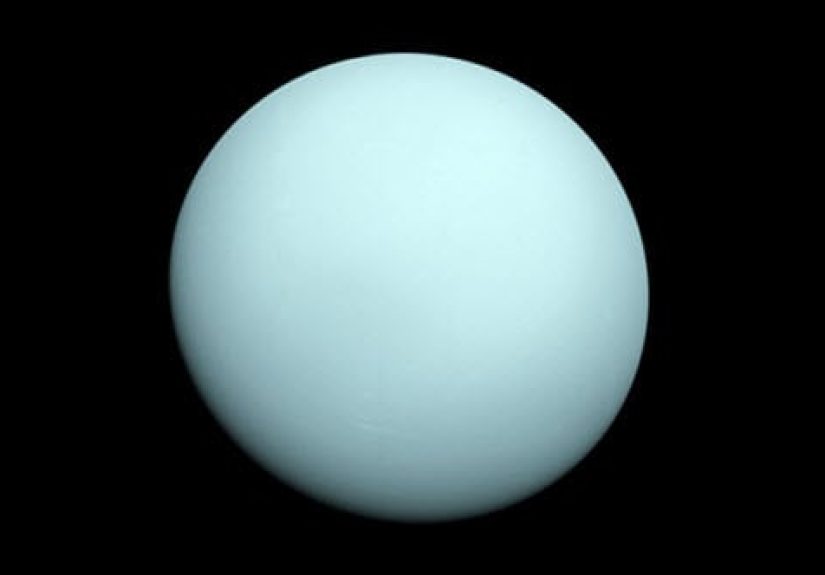
3. That Blue-Green Color Comes From Methane Magic
Uranus’s iconic blue-green tint is not just for aestheticsit’s chemistry.
The upper atmosphere is mostly hydrogen and helium with a small but powerful dose of methane gas.
Methane efficiently absorbs red light and allows blue and green wavelengths to scatter and reflect back to our telescopes, creating that soft cyan glow.
Subtle differences in color and brightness recorded by spacecraft and space telescopes also give clues to cloud layers, hazes, and seasonal changes in its atmosphere.
4. Uranus Hosts the Solar System’s Brutal Deep Freeze
Even though Neptune is farther from the Sun, Uranus has recorded some of the lowest atmospheric temperatures of any planet.
In parts of its upper atmosphere, minima around 49 K (about −224°C / −371°F) have been measuredan almost physics-textbook definition of “do not forget your coat.”
Unlike Jupiter and Saturn, Uranus emits surprisingly little internal heat, which makes its energy balance and frigid temperatures a major puzzle.
Understanding why Uranus is so cold helps researchers refine theories of how giant planets cool, evolve, and trap or release heat over billions of years.
5. Its Seasons Are Extreme, Slow-Motion Experiments
A day on Uranus lasts about 17 hours, but its year stretches to roughly 84 Earth years.
Combine that long year with the sideways tilt and you get seasons that are both extreme and glacially slow.
Entire hemispheres take turns facing the Sun for decades at a time, then spend equally long spells in polar night.
These bizarre lighting conditions reshape atmospheric circulation, cloud formation, and polar chemistry on timescales human observers can track over a lifetimeturning Uranus into a natural long-term climate laboratory.
6. Uranus Has a Dark, Delicate Ring System
Saturn hogs the ring publicity, but Uranus quietly wears its own set: thirteen known rings, most of them narrow, faint, and made of very dark material.
First detected in 1977 when astronomers saw background starlight blink as it passed behind the planet, the rings were later imaged in detail by Voyager 2 and powerful telescopes.
They’re nothing like Saturn’s bright disks: Uranus’s rings are thin, sharp-edged, and likely composed of radiation-darkened icy debris and rock, sculpted in part by small “shepherd” moons.
Their structure helps scientists study collisional physics, dust dynamics, and how delicate systems survive in harsh planetary environments.
7. The Moons Are Named for Poets and Might Hide Ancient Oceans
Uranus’s known moons28 and countingbreak the mythological naming tradition.
Instead of Roman gods, you’ll meet Titania, Oberon, Miranda, Ariel, and Umbriel, borrowed from Shakespeare and Alexander Pope.
Voyager 2 flybys revealed fractured cliffs, canyons, and patchwork terrains, most famously on Miranda, whose tortured surface looks like someone badly overdid the “terrain editing” slider.
Recent analyses of Voyager-era data suggest that several of Uranus’s major moons may once have harbored subsurface salty oceansand might retain thin remnants today.
That possibility upgrades these worlds from “cold rocks” to potential ocean-world cousins, important for understanding habitability in the outer solar system.
8. Its Magnetic Field Is Wildly Misaligned and Off-Center
If Earth’s magnetic field is a neat bar magnet, Uranus’s is a chaotic experimental sketch.
The magnetic axis is tilted by roughly 60 degrees from the planet’s rotation axis and shifted off-center by about a third of the planetary radius.
As Uranus spins on its side, this lopsided field creates a twisted, corkscrew-shaped magnetotail and auroras that don’t line up cleanly with its poles.
This bizarre configuration suggests the magnetic field might be generated in a shallower, more complex shell of conductive fluids than on Jupiter or Earth,
offering a rare test case for planetary dynamo theories.
9. Voyager 2’s Brief Flyby Changed Everything
Only one spacecraft has ever visited Uranus: NASA’s Voyager 2, which flew past in January 1986.
In a single, high-speed encounter, Voyager 2 discovered new moons and rings, mapped that skewed magnetic field, sampled the atmosphere, and gave us our first close-up look at Uranus’s cloud tops and satellites.
Those few days of data remain the foundation of modern Uranus science.
Decades later, planetary scientists are still mining the measurements, refining models of its interior, atmosphere, and magnetosphereand using the results to argue (loudly and correctly) that Uranus deserves its own dedicated orbiter and atmospheric probe.
10. Studying Uranus Helps Decode a Galaxy Full of Ice Giants
Uranus is not just a local oddity; it’s a blueprint.
Many of the exoplanets we’ve found are Neptune- or Uranus-sized: intermediate-mass worlds with thick atmospheres and possible icy mantles.
Yet we barely understand our own ice giants compared with Mars or Jupiter.
Every constraint on Uranus’s composition, heat flow, rings, moons, and magnetic field feeds directly into models of distant planetary systems.
By unravelling why Uranus is tilted, cold, under-luminous, and magnetically weird, scientists get better at interpreting exoplanet atmospheres, densities, and climatesturning one punchline planet into a key for reading the universe.
Bonus: Real-World & Observational Experiences With Uranus
Facts are cool; actually engaging with Uranus (from Earth, safely not freezing) is what turns casual readers into long-term space nerds.
While no tourist has strolled past its rings, we already have several meaningful “experiences” tied to this planetscientific, observational, and educationalthat you and your readers can tap into.
1. Spotting Uranus in the Night Sky
Seeing Uranus with your own eyes is a subtle but unforgettable milestone.
Under dark skies, it can be just visible to the naked eye as a dim, star-like point; with a small backyard telescope, it becomes a tiny bluish disk, obviously different from twinkling stars.
Planning a Uranus “hunt” teaches people how to read star charts, use astronomy apps, understand planetary motion, and appreciate just how far 1.8 billion miles really is.
For outreach blogs or Listverse-style content, encouraging readers to track down Uranus themselves transforms the article from trivia into a challenge:
“Don’t just read about the ice giantgo find it.”
2. Replaying Voyager 2’s Encounter
One of the most powerful Uranus experiences is revisiting Voyager 2’s flyby data.
Publicly available images and reconstructions show the pale globe, razor-thin rings, and strange moons that stunned scientists in 1986.
Walking readers through that brief encounterwhat we expected, what shocked us (like Miranda’s Frankenstein terrain and the tilted magnetic field), and what remains unexplainedhelps them relive a historic moment in deep-space exploration.
Educators, bloggers, and creators can use those visuals and timelines to build interactive features, quizzes, or “then vs. now” comparisons that make Uranus feel alive, not abstract.
3. Using Uranus as a Gateway Topic for Big Ideas
Uranus is an ideal hook for explaining serious science without losing readers.
Its sideways spin makes axial tilt intuitive.
Its icy mantle opens doors to discussions about high-pressure physics and exotic materials.
Its bizarre magnetosphere offers a clean way to talk about planetary dynamos and space weather.
Its suspected ocean-bearing moons let you segue into the search for life in hidden oceans across the solar system.
Content built around “10 incredible facts” can easily branch into explainers, infographics, classroom activities, and podcast episodeseach one leveraging Uranus’s weirdness to illuminate complex concepts.
In other words, the jokes bring people in; the science makes them stay.
4. Looking Ahead to a Uranus Orbiter Era
Finally, there’s the collective anticipation experience.
Planetary scientists are actively pushing for a flagship Uranus Orbiter and Probe mission, which would dive into the atmosphere, study the moons up close, and map the rings and magnetic field in exquisite detail.
Framing Uranus as “the next big mission target” turns your article into a living document: readers can follow news on mission approval, design, and launch timelines, feeling like they’re early to a story that will dominate planetary science headlines in the coming decades.
For your audience, that sense of being ahead of the curve is gold.
Conclusion
Uranus might sound like a punchline, but scientifically it’s a masterpiece of cosmic misbehavior: a sideways-spinning ice giant with an off-kilter magnetosphere, shadowy rings, theatrical moons, record-breaking cold, and clues to worlds across the galaxy.
Presenting these 10 incredible scientific facts in a sharp, story-driven format doesn’t just entertainit deepens understanding of how planets form, evolve, and surprise us.
sapo:
Uranus isn’t just a cosmic jokeit’s one of the strangest, most important worlds in our solar system.
This in-depth guide breaks down 10 incredible scientific facts about the planet Uranus, from its sideways spin and eerie deep-freeze atmosphere to its dark rings, off-center magnetic field, and Shakespearean moons that may once have hidden salty oceans.
Along the way, you’ll see how a single pale-blue ice giant helps us decode distant exoplanets, revisit Voyager 2’s legendary flyby, and even plan your own backyard encounter with the seventh planet from the Sun.