Table of Contents >> Show >> Hide
- What an “Entryway” Really Needs (Hint: It’s Not a Chandelier)
- 18 Stealthy Ways to Fake an Entryway in a Tight Space
- 1) Use a Rug as Your “Invisible Tape Line”
- 2) Hang a Mirror Where You Want the Entryway to “Begin”
- 3) Install a Peg Rail or Fold-Down Hook Rack (So It Disappears When Not in Use)
- 4) Float a Narrow Shelf Instead of Using a Console Table
- 5) Try a “Half-Moon” (Demilune) Table for Tight Door Swings
- 6) Turn the Back of the Door into a Storage Wall
- 7) Use a Slim Shoe Cabinet (The Kind That Tilts Out)
- 8) Add a Bench That Works Overtime
- 9) Create a “Drop Zone Tray” That’s Too Small for Chaos
- 10) Fake a Foyer with Paint (Yes, Really)
- 11) Use a Curtain as a Soft Divider
- 12) Place a Tall Plant or Floor Lamp to “Mark the Border”
- 13) Turn a Rolling Cart into a Micro-Mudroom
- 14) Add a Wall-Mounted Mail Sorter (So Paper Doesn’t Breed)
- 15) Use Matching Baskets to Hide the Mess in Plain Sight
- 16) Build a Mini “Command Center” for Daily Grab-and-Go Items
- 17) Repurpose an Unexpected Surface as a Landing Strip
- 18) Create a “One-Step Entryway” with a Vertical Storage Panel
- Three Tiny Layout Formulas That Work in Most Tight Spaces
- Keep It From Turning Into a Clutter Magnet
- Extra: Real-Life “Tight Space Entryway” Experiences (What People Say Actually Works)
- Conclusion
No foyer. No hall. No “proper” place to drop your keys without them teleporting under the couch. Welcome to the
modern entryway strugglewhere your front door opens directly into your living room, your kitchen, or (for extra
chaos points) your entire life.
Here’s the good news: an entryway isn’t a room. It’s a system. And systems can be built almost anywhere
even in a tight spaceif you use a few visual tricks and some smart, vertical storage. Below are 18 stealthy,
renter-friendly ways to “fake” an entryway so your home feels more organized the moment you walk in.
What an “Entryway” Really Needs (Hint: It’s Not a Chandelier)
Before we get into the fun stuff, let’s define the mission. A functional entry zone usually does three things:
- Stops clutter at the door (shoes, bags, mail, umbrellas, dog gear).
- Creates a landing strip for small essentials (keys, wallet, sunglasses, earbuds).
- Signals “this is the entrance” with a visual boundary so the space feels intentional.
If you can cover those three, congratsyou have an entryway. Even if it’s technically a 2-by-3-foot vibe.
18 Stealthy Ways to Fake an Entryway in a Tight Space
1) Use a Rug as Your “Invisible Tape Line”
A small rug or runner instantly draws a boundary: door zone here, living room there. In tight spaces,
choose a low-profile, easy-clean rug (flatweave or washable) and size it so it feels like a purposeful padnot an
accidental doormat that wandered in from outside.
Stealth bonus: A runner can visually “stretch” a narrow entry corridor, making it feel longer and more
polished.
2) Hang a Mirror Where You Want the Entryway to “Begin”
Mirrors do double-duty: they bounce light and create a visual anchor. If your door opens into the main room, hang a
mirror near the door and treat it like the “start sign” of your entry zone. Add a small hook or tiny shelf beneath
it for a believable “foyer moment.”
3) Install a Peg Rail or Fold-Down Hook Rack (So It Disappears When Not in Use)
Hooks are the MVP of small entrywaysuntil they become a coat-and-bag avalanche. A peg rail or flip-hook rack keeps
things tidy and often looks like wall art when “closed.” Use it for your daily items only: one coat, one bag, one
hatanything beyond that goes in a closet.
4) Float a Narrow Shelf Instead of Using a Console Table
If a console table would block your walkway, install a floating shelf at hip height. It becomes your landing strip
without stealing floor space. Add a shallow tray for keys and a small catchall bowl. Keep it slim so it stays
graceful, not bulky.
5) Try a “Half-Moon” (Demilune) Table for Tight Door Swings
In a cramped entry zone, corners and curves matter. A demilune-style console hugs the wall while still giving you a
surface for essentials. It’s ideal when the door swing would smack into anything too deep. Think: less furniture,
more finesse.
6) Turn the Back of the Door into a Storage Wall
The back of your front door is prime real estate. Add an over-the-door organizer for hats, gloves, small umbrellas,
pet leashes, or even a slim shoe organizer. If the look bothers you, pick a neutral fabric organizer and treat it
like “built-in utility,” not “college dorm energy.”
7) Use a Slim Shoe Cabinet (The Kind That Tilts Out)
Shoe piles make a home feel messy fastespecially when your “entryway” is also your living room. Slim, tilt-out
shoe cabinets store multiple pairs in a surprisingly shallow footprint. Keep only the current-season shoes by the
door; everything else lives elsewhere.
Specific example: If you wear bulky winter boots or tall rain boots, combine a slim cabinet for
everyday shoes with a single boot tray tucked beside it.
8) Add a Bench That Works Overtime
A small bench creates the “foyer illusion” immediately, because it implies: this is where you sit to take off
shoes. Choose a bench with a lower shelf or bins underneath, so you get seating and storage in one move. If your
space is super tight, try a narrow stool or wall-mounted flip-down seat.
9) Create a “Drop Zone Tray” That’s Too Small for Chaos
Big surfaces invite big clutter. A tray is a boundary that politely says, “Keys and mail only. Not your entire
backpack.” Put a tray on a shelf, cabinet, or even a sturdy windowsill near the door. Add a tiny dish for coins and
a spot for your building key fob so it doesn’t vanish into the void.
10) Fake a Foyer with Paint (Yes, Really)
Paint is a magician in a can. If the door opens into a larger room, paint a small “block” of wall near the entrance
in a contrasting color or use a subtle wallpaper moment. You’ve now created a visual room-within-a-roomno walls
required. It’s the design equivalent of putting up a velvet rope.
11) Use a Curtain as a Soft Divider
No space for a screen or bookcase? A ceiling-mounted curtain track (or even a tension rod in the right spot) can
create a soft separation between the door area and the living space. Keep it lightlinen-look panels or a neutral
weaveso it reads airy, not dramatic (unless you want dramatic; you’re the director here).
12) Place a Tall Plant or Floor Lamp to “Mark the Border”
When furniture won’t fit, use something vertical to declare the entry zone. A tall plant, slim floor lamp, or
sculptural coat tree can visually cordon off the door area. This is especially helpful in open-plan apartments
where the entrance blends into everything else.
13) Turn a Rolling Cart into a Micro-Mudroom
A narrow rolling cart can hold keys, mail, hand sanitizer, and a small basket for dog accessories. When guests
come over (or you need the floor space), roll it into a closet or against a different wall. It’s an entryway that
knows how to make an exit.
14) Add a Wall-Mounted Mail Sorter (So Paper Doesn’t Breed)
If your mail tends to reproduce on the nearest surface, give it a dedicated home. A wall-mounted file holder or
mail sorter keeps paper vertical and contained. Pair it with a tiny recycling bin nearby so junk mail gets dealt
with immediately instead of becoming “a pile you’ll handle later” (famous last words).
15) Use Matching Baskets to Hide the Mess in Plain Sight
Baskets are the stealth storage heroes of small homes because they look decorative while hiding chaos. Put one or
two baskets under a bench, on a shelf, or in a corner. Assign them roles: “Hats & Gloves,” “Dog Stuff,” “Out-the-Door
Extras.” The key is labelsphysical or mentalso you don’t end up with a single basket called “Everything.”
16) Build a Mini “Command Center” for Daily Grab-and-Go Items
For families, roommates, or anyone with a lot of daily gear, create a tiny command center near the door: hooks for
bags, a small shelf for keys, and a spot for chargers. If you’re short on wall space, stack functions vertically:
hooks below, shelf above, small organizer beside.
17) Repurpose an Unexpected Surface as a Landing Strip
No room for a table? Fine. Use what you have: a sturdy windowsill, a radiator cover, a bookcase end panel, or a slim
wall ledge. Add a tray so it reads intentional. The trick is to keep the “landing strip” shallow and curated so it
doesn’t become a clutter buffet.
18) Create a “One-Step Entryway” with a Vertical Storage Panel
When space is painfully tight, think like a pro organizer: build up, not out. A vertical panel (or wall section)
can hold a shelf, hooks, and a small bin system. Even a renter-friendly approachlike removable strips, lightweight
rail systems, or a mounted boardcan create a compact entry station that feels built-in.
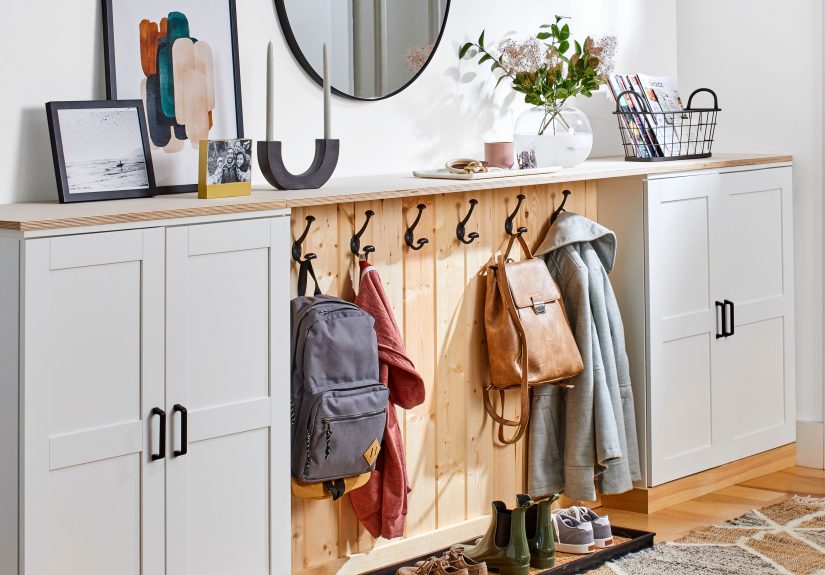
Specific example: A simple vertical panel with a top ledge (for keys), two hooks (coat + bag), and a
small basket (gloves) can replace an entire foyer’s worth of function.
Three Tiny Layout Formulas That Work in Most Tight Spaces
If decision fatigue is hitting, pick one formula and run with it:
- The “Two-Foot Drop Zone”: Rug + hooks + tray shelf. Minimal, clean, effective.
- The “Bench Moment”: Runner + narrow bench + baskets underneath + mirror above.
- The “Vertical Command Center”: Wall shelf + key dish + mail sorter + two hooks + shoe cabinet nearby.
Keep It From Turning Into a Clutter Magnet
Even the cutest fake entryway can collapse into chaos if it’s allowed to collect “temporary” items (which, as we
know, is a long-term lifestyle choice).
- Set a hook limit: 2–4 hooks for daily items. Everything else goes in a closet.
- Rotate by season: store off-season shoes, coats, and accessories elsewhere.
- Use a tray rule: if it doesn’t fit in the tray, it doesn’t live in the entryway.
- Do a 60-second reset: once a day, put strays back where they belong.
Extra: Real-Life “Tight Space Entryway” Experiences (What People Say Actually Works)
When people try to fake an entryway, the first surprise is emotional: the mess at the door doesn’t just look badit
feels stressful. You walk in carrying groceries, your bag is sliding off your shoulder, your keys are in your
hand, and your brain is already negotiating with tomorrow’s to-do list. If there’s no obvious place to put
anything, stuff lands wherever gravity wins. The floor. The couch arm. The kitchen counter. The nearest chair that
becomes “the chair.” You know the one.
In small apartments, the most common “aha” moment is realizing that an entryway isn’t built with furniture first.
It’s built with habits. People report the biggest improvement when they choose one consistent landing
spot for the essentials: keys always in the dish, shoes always in the cabinet, bag always on the same hook. That
predictability is what makes a tiny setup feel like a real foyerbecause it behaves like one.
Another common experience: hooks feel like a miracle… until they’re not. At first, everyone loves the convenience.
Then a week later, the hook rack looks like it’s auditioning for a coat-themed reality show. The fix people swear by
is the “daily-only rule”: one coat, one bag, one hat. Anything beyond that becomes visual noise. If you need more
storage, it’s usually better to hide it (baskets, closed cabinets, closet bins) than to add more hooks in plain
sight.
Families and roommates often say the hardest part is preventing mix-ups: whose keys are these, whose shoes are
those, why are there three water bottles here, and who keeps leaving one lone sock by the door like a warning
signal? In those situations, the most successful tiny entryways use simple zones: one labeled basket per person,
or one bin shelf per person, even if it’s just a small tote tucked under a bench. People also mention that placing
a small trash/recycling spot nearby stops paper clutter from taking over, because junk mail is dealt with
immediately instead of “temporarily” stacked.
Weather changes the game. In rainy regions, people say the entryway only works if it includes a plan for wet stuff:
a boot tray, a towel hook, or a washable rug that can handle real life. In snowy areas, the most praised setup is a
two-step system: everyday shoes hidden in a cabinet plus a visible tray for boots that need to dry. That way, you
aren’t stuffing wet boots into closed storage where everything gets funky.
Finally, there’s the “tight entry opens into the living room” scenarioone of the most common layouts. People say
the biggest difference comes from creating a visual border: a runner, a painted block of wall, a mirror,
or a tall plant that signals, “This is the entrance zone.” Once the space looks defined, it becomes easier to keep
it defined. You’re no longer tossing items into the room; you’re placing them into a designated system. And that’s
the real trick: you’re not faking an entrywayyou’re faking the feeling of having your life together the moment you
walk in. Which, honestly, is the dream.
Conclusion
A tight space doesn’t mean you’re doomed to door-area chaos. With a few stealthy visual cues (like a rug, mirror, or
paint moment) and some compact storage (hooks, slim shoe solutions, and baskets), you can create a practical
entryway that feels intentionaleven if it’s technically just a corner of your living room.
Start small: define the zone, add one landing spot, and pick one shoe strategy. Once the “door chaos” has a home,
the rest of your space will instantly feel calmerbecause you’ve stopped the clutter at the border.