Table of Contents >> Show >> Hide
- What Is a 1930s Louis XVI Oval Back Armchair?
- The Design DNA: Why Louis XVI Style Still Works
- Key Features to Look For
- 1930s Revival vs. Original Louis XVI: What Is the Difference?
- Why the 1930s Matter in Furniture Design
- How to Style a 1930s Louis XVI Oval Back Armchair
- Buying Tips: What to Check Before You Say Yes
- Restoration and Reupholstery Ideas
- Care and Maintenance
- Is a 1930s Louis XVI Oval Back Armchair Worth Buying?
- Experience Notes: Living With a 1930s Louis XVI Oval Back Armchair
- Conclusion
A 1930s Louis XVI Oval Back Armchair is the kind of furniture piece that walks into a room before you do. It has posture. It has manners. It looks like it should be holding a tiny porcelain teacup and politely judging your throw pillows. But beneath all that elegant French-inspired confidence is a surprisingly practical accent chair: graceful, structured, decorative, and useful in nearly any traditional, transitional, or modern home.
Although the original Louis XVI period belongs to late 18th-century France, the style never packed its bags and left. It kept returning in revivals, reproductions, and decorator-friendly interpretations. By the 1930s, furniture makers and interior tastemakers were still borrowing from the Louis XVI playbook: oval backs, fluted legs, carved rosettes, restrained ornament, painted or gilt wood frames, and tailored upholstery. A 1930s version often gives you the charm of antique design without requiring you to live inside a museum or whisper every time you sit down.
This guide explores what makes the 1930s Louis XVI oval back armchair so appealing, how to identify its main features, where it fits in modern interiors, and what to consider before buying, restoring, or styling one.
What Is a 1930s Louis XVI Oval Back Armchair?
A 1930s Louis XVI oval back armchair is usually a vintage chair made around the 1930s in the Louis XVI style. It is not necessarily an original 18th-century French royal chair, and that distinction matters. Original Louis XVI seating dates to the reign of King Louis XVI, from 1774 to 1792. A 1930s example is typically a later revival or reproduction inspired by that period.
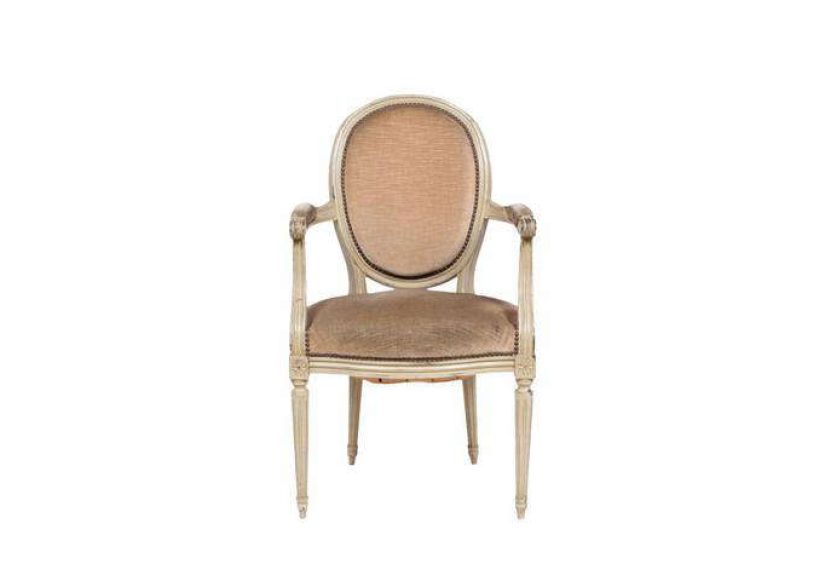
The phrase “oval back” refers to the chair’s rounded medallion-shaped backrest. In French-style furniture, this type of back is often called a medallion back. It gives the chair its instantly recognizable silhouette: refined, upright, balanced, and slightly formal without being stiff. The “armchair” part means it has arms, often open and gracefully connected to the seat frame.
Many 1930s Louis XVI style armchairs feature a carved wood frame, painted or distressed finish, upholstered seat and back, brass nailhead trim, and straight or tapered legs. Some examples include velvet, velour, damask, needlepoint, linen, or muslin upholstery. Others may have cane backs or seats, though fully upholstered oval backs are especially common in decorative accent chairs.
The Design DNA: Why Louis XVI Style Still Works
The Louis XVI style is rooted in neoclassicism, which means it looked back to ancient Greek and Roman design for inspiration. Instead of the swirling, asymmetrical curves associated with earlier Rococo furniture, Louis XVI furniture preferred symmetry, order, geometry, and cleaner lines. Imagine the difference between a dramatic opera singer and a well-dressed architect. Both are impressive, but one is definitely more likely to label the pantry.
That discipline is exactly why the style remains useful today. A Louis XVI oval back armchair has enough ornament to feel special, but not so much that it overwhelms a room. The oval back softens the shape. The straight legs keep it grounded. The carving adds detail. The upholstery makes it comfortable. It can look at home beside a marble fireplace, in a bedroom corner, at the head of a dining table, or next to a sleek modern sofa.
Key Features to Look For
1. The Oval or Medallion Back
The oval back is the star of the show. It creates the chair’s elegant profile and helps distinguish it from other French chair styles. A well-proportioned oval back should look balanced from the front, with a smooth curve and a frame that feels refined rather than bulky.
Some backs are fully upholstered, while others may include cane or exposed wood details. Upholstered oval backs often feel softer and more inviting, especially in living rooms and bedrooms. Cane backs feel lighter and airier, making them excellent for dining rooms or sunrooms.
2. Straight, Tapered, or Fluted Legs
Louis XVI style legs are usually straight rather than curved. This is one of the easiest ways to separate Louis XVI from Louis XV furniture. Louis XV chairs often have cabriole legs with graceful curves, while Louis XVI chairs prefer legs that resemble classical columns. Fluting, or vertical grooves carved into the leg, is especially common.
On a 1930s Louis XVI style armchair, the legs may be turned, tapered, painted, gilt, or carved. Check that all four legs sit evenly on the floor. A little wobble is charming in a dinner guest, less so in a chair.
3. Carved Wood Details
Typical decorative motifs include rosettes, ribbons, laurel leaves, beadwork, acanthus leaves, floral crests, and small classical ornaments. The best examples show crisp carving with enough detail to catch the eye without looking overly busy.
In many 1930s examples, the carving is decorative rather than museum-level craftsmanship, but that does not make the chair undesirable. In fact, a well-made 1930s revival chair can offer wonderful style, sturdy construction, and a price that is less terrifying than an original 18th-century piece.
4. Painted, Gilt, or Distressed Finish
A painted wood frame is common in Louis XVI revival furniture. Cream, antique white, gray, pale blue, and soft gold finishes are popular because they highlight the carved details while keeping the chair light and elegant. Some chairs are intentionally antiqued or distressed to suggest age.
Giltwood versions feel more formal and glamorous. A gold frame can be stunning, especially when paired with neutral upholstery, but it needs the right setting. Too much gold in one room and suddenly your living room starts applying for a palace internship.
5. Upholstery and Nailhead Trim
Upholstery plays a huge role in the personality of a 1930s Louis XVI oval back armchair. Velvet gives it a plush, vintage feel. Linen makes it relaxed and current. Damask leans formal. Needlepoint feels collected and old-world. Bouclé or performance fabric can bring the chair into a modern home without erasing its historic character.
Brass nailhead trim is also common. It outlines the upholstery, adds a tailored edge, and gives the chair a subtle sparkle. When the nailheads are evenly spaced and securely attached, they can make the whole piece look finished and intentional.
1930s Revival vs. Original Louis XVI: What Is the Difference?
An original Louis XVI armchair from the late 1700s is a true antique with historical significance, likely made by skilled French craftsmen using traditional joinery and high-quality materials. These pieces may appear in museums, major auctions, or serious private collections.
A 1930s Louis XVI oval back armchair is usually a vintage revival piece. It borrows the look, proportions, and motifs of the original style but was made much later. That can actually be an advantage for decorators. A 1930s chair may be easier to live with, easier to reupholster, and less intimidating to place in everyday spaces.
Collectors should pay close attention to how a chair is described. Terms such as “Louis XVI style,” “in the manner of Louis XVI,” “French style,” or “revival” usually mean the piece is not from the original Louis XVI period. That is perfectly fine as long as the price, description, and expectations match reality.
Why the 1930s Matter in Furniture Design
The 1930s were an interesting decade for furniture. Art Deco was influential, modernism was gaining attention, and traditional European revival styles were still very popular in American and European interiors. People wanted homes that felt polished, comfortable, and cultured. A Louis XVI style armchair fit that mood beautifully.
During this period, many homes combined formal furniture with livable upholstery. Chairs were not only decorative; they were used in bedrooms, parlors, dining rooms, foyers, and sitting areas. The Louis XVI oval back armchair offered elegance without the heavy visual weight of larger upholstered club chairs or bulky Victorian seating.
Today, that same quality makes it useful again. In a world full of oversized sectionals and minimalist boxes, a vintage French-style armchair brings shape, history, and a little theatrical flair. It is proof that a chair does not need to recline, swivel, vibrate, charge your phone, and make espresso to earn its place in a room.
How to Style a 1930s Louis XVI Oval Back Armchair
In the Living Room
Place one Louis XVI oval back armchair near a sofa to create a graceful conversation area. It pairs beautifully with a marble-top side table, a small brass lamp, or a round pedestal table. For a fresh look, mix it with clean-lined modern furniture. The contrast makes the chair feel intentional rather than inherited by accident from an imaginary duchess.
In the Bedroom
A single oval back armchair can turn an empty bedroom corner into a reading spot, dressing area, or elegant place to toss tomorrow’s outfit. Choose soft upholstery such as linen, velvet, or a muted floral. If the frame is painted cream or gray, it can blend easily with bedding, drapery, and vintage mirrors.
At the Dining Table
A pair of Louis XVI oval back armchairs can work beautifully as host chairs at the ends of a dining table. They add formality without making the room feel too stiff. Pair them with simpler side chairs to keep the arrangement balanced.
In an Entryway
An entryway chair should look good even when no one is sitting in it. That is where this style shines. A 1930s Louis XVI armchair beside a console table, under a mirror, or near a stair landing creates an instant design moment. It says, “Welcome,” but in a slightly fancy accent.
Buying Tips: What to Check Before You Say Yes
Before buying a 1930s Louis XVI oval back armchair, inspect the frame carefully. Look for cracks, loose joints, repairs, missing carving, or signs of woodworm. Sit gently and listen for creaks. Some creaking is normal in older furniture, but dramatic cracking sounds are not the chair applauding your taste.
Check the upholstery condition. Faded fabric may be acceptable if you plan to reupholster, but stains, odors, sagging seats, or failing webbing can increase restoration costs. Examine the nailhead trim to see whether it is original, replaced, loose, or uneven.
Look underneath the chair. Older construction may include corner blocks, stretchers, webbing, springs, or hand-applied materials. Labels, stamps, or maker’s marks can add interest, though many vintage revival chairs are unmarked. If a seller claims a chair is 18th-century or rare, ask for documentation, provenance, or an expert evaluation.
Restoration and Reupholstery Ideas
Reupholstering a Louis XVI oval back armchair can completely transform it. For a classic look, choose linen, velvet, damask, toile, or a small-scale stripe. For a modern twist, try performance velvet, textured neutral fabric, animal print, bold botanical patterns, or even a tailored check.
If the painted frame has honest wear, consider preserving it. Patina gives vintage furniture depth. Over-restoring can sometimes remove the very character that made the chair attractive in the first place. However, if the frame is badly chipped, unstable, or covered in a poor later paint job, professional refinishing may be worthwhile.
For valuable or delicate examples, consult a furniture conservator or experienced upholsterer. The goal is not to make the chair look brand-new. The goal is to make it structurally sound, comfortable, and beautiful while respecting its age.
Care and Maintenance
Keep the chair away from direct sunlight, which can fade upholstery and damage finishes. Avoid placing it next to radiators, heating vents, fireplaces, or damp exterior walls. Wood expands and contracts with changes in humidity, so a stable indoor environment is better than dramatic seasonal swings.
Dust the frame with a soft cloth. Vacuum upholstery gently using a brush attachment or low suction. If the fabric is fragile, place a fine mesh screen between the nozzle and the textile. Clean spills immediately, but avoid soaking old upholstery or wood. When in doubt, call a professional cleaner or conservator rather than launching a heroic DIY rescue mission involving mystery chemicals from under the sink.
Is a 1930s Louis XVI Oval Back Armchair Worth Buying?
For many homeowners, decorators, and vintage lovers, yes. A 1930s Louis XVI oval back armchair offers beauty, history, and versatility. It can be formal or playful depending on the upholstery. It works in traditional rooms but also adds tension and charm to modern interiors. It is small enough to move around but distinctive enough to anchor a corner.
Value depends on condition, quality, materials, provenance, age, and market demand. A single decorative chair may be affordable, while a matched pair or set with excellent carving and upholstery can command more. Pieces associated with known makers, high-end decorators, or documented European origin may be especially desirable.
Still, the best reason to buy one is not because it might impress a future appraiser. Buy it because it makes your room better. Buy it because you like the curve of the back, the carved detail on the frame, the elegance of the legs, or the way it turns an empty corner into a scene.
Experience Notes: Living With a 1930s Louis XVI Oval Back Armchair
Spending time with a 1930s Louis XVI oval back armchair teaches you that good furniture does not need to shout. The first thing you notice is the silhouette. The oval back softens the room immediately. Even when the chair is placed against a plain wall, it creates architecture. It frames space in a way that square modern chairs often do not.
One of the most enjoyable experiences is choosing where the chair belongs. In a living room, it can become the “guest of honor” seat. In a bedroom, it feels personal and quiet. In a hallway, it becomes decorative sculpture. Move it near a window and it suddenly looks like a reading chair from an old apartment in Paris. Move it next to a contemporary sofa and it becomes a clever design contrast. This flexibility is one of the chair’s best qualities.
Another practical lesson is that upholstery changes everything. The same frame can look formal in gold damask, relaxed in oatmeal linen, dramatic in emerald velvet, or witty in a bold animal print. If you enjoy decorating, this chair is like a blank canvas with excellent bone structure. You can dress it up, calm it down, or give it a personality makeover worthy of a design show finale.
Comfort depends on the individual chair. Some oval back armchairs are surprisingly supportive, especially when the seat has been properly re-webbed and padded. Others are better for occasional seating. That is not a flaw; it is simply part of understanding vintage furniture. This may not be the chair for a six-hour movie marathon, but it is perfect for reading, conversation, dressing, or creating a polished seating moment.
There is also a certain pleasure in the imperfections. Small chips in the painted finish, softened carving, aged brass tacks, and gentle fabric wear can make the chair feel authentic and lived-in. Unlike mass-produced furniture, a vintage Louis XVI style armchair carries visual memory. It has survived changing homes, changing tastes, and possibly several decades of people saying, “We should really reupholster that,” before not doing it.
When cared for properly, the chair becomes more than decoration. It becomes a bridge between old-world craftsmanship and modern living. It reminds a room to slow down. It adds shape where everything else is rectangular. It brings elegance without demanding a chandelier, although it certainly would not object to one.
The best experience is seeing how easily guests notice it. People may not know the phrase “Louis XVI oval back armchair,” but they recognize that the chair has presence. They comment on the frame, the fabric, the color, or the carved details. That is the quiet magic of this style: it feels familiar and special at the same time.
Conclusion
A 1930s Louis XVI Oval Back Armchair is more than a pretty vintage seat. It is a design classic with neoclassical roots, decorator-friendly proportions, and enough personality to make a room feel collected rather than simply furnished. With its oval medallion back, carved wood frame, straight legs, and elegant upholstery options, it offers a timeless balance of structure and softness.
Whether you are shopping for a single accent chair, a pair of dining host chairs, or a restoration project with serious charm, this style deserves attention. Choose carefully, inspect condition, respect the frame, and do not be afraid to refresh the upholstery. The right 1930s Louis XVI oval back armchair can bring grace, history, and a wink of French sophistication into everyday American living.
Note: This article is original editorial content synthesized from reputable design-history, vintage-furniture, marketplace, and conservation information. Before purchasing a vintage or antique chair, verify age, condition, maker, and provenance with a qualified dealer, upholsterer, or appraiser.