Table of Contents >> Show >> Hide
- Why Tight Hips and Lower Back Pain Are So Connected
- Safety First: When to Be Careful with Yoga for Back Pain
- Pose 1: Child’s Pose (Balasana) – Gentle Reset for Hips and Low Back
- Pose 2: Supine Figure Four (Thread the Needle) – Deep Hip & Piriformis Release
- Pose 3: Low Lunge Hip Flexor Stretch – Opening the Front of the Hips
- Putting It All Together: A 10-Minute Mini-Sequence
- When to See a Professional
- Real-Life Experiences and Tips with These 3 Poses
If your hips feel like rusted door hinges and your lower back complains every time you stand up, welcome to the club. Long hours at a desk, driving, scrolling on your phone, or even certain workouts can leave the hip flexors, glutes, and lower back muscles tight and cranky. The good news? You don’t necessarily need fancy equipment or a full 60-minute class to feel better. Just a yoga mat, a bit of floor space, and three carefully chosen poses can make a surprisingly big difference.
Research suggests that yoga can help reduce chronic lower back pain and improve daily function when practiced consistently as part of a comprehensive self-care plan. It’s often recommended as a non-drug option alongside things like heat, massage, and physical activity for mild to moderate back pain. At the same time, experts are clear: not every pose is right for every body, and you should always respect your limits and talk with a healthcare professional if your pain is severe, persistent, or radiates down your leg.
Below, you’ll find three yoga poses for tight hips and lower back pain that are gentle, beginner-friendly, and easily adapted: Child’s Pose, Supine Figure Four (also called Thread the Needle on your back), and a Low Lunge hip flexor stretch. Done regularly, they can help you loosen stubborn tight spots, support better posture, and give your nervous system a chance to chill.
Why Tight Hips and Lower Back Pain Are So Connected
Your hips and your lower back don’t live separate lives; they’re joined at the pelvis, sharing muscles, ligaments, and tendons. When one area is unhappy, the other often joins the drama.
Key players in the “tight hips + sore back” combo include:
- Hip flexors (like the psoas): These run from your lumbar spine through the pelvis to the front of the thigh. When you sit a lot, they stay shortened, which can tug on the spine and tilt the pelvis forward, increasing strain on the lower back.
- Glutes and deep hip rotators (like the piriformis): These muscles help stabilize the pelvis. When they’re tight or weak, your lower back often steps in to do extra work it wasn’t designed for.
- Hamstrings: When overly tight, they can limit hip mobility, making you round the lower back more in everyday movements and adding stress to the lumbar area.
Yoga for tight hips and lower back pain aims to lengthen what’s short, wake up what’s sleepy, and encourage your body to move more efficiently. Think of these poses as your daily “reset button” after hours of being folded into chair shape.
Safety First: When to Be Careful with Yoga for Back Pain
Before we dive into the poses, a quick safety check:
- If you have acute injury, recent surgery, or a diagnosed condition such as a herniated disc, spinal stenosis, or severe arthritis, talk with your doctor or physical therapist before trying new stretches.
- If any pose causes sharp, shooting, or burning pain (especially down the leg), stop immediately and gently come out of it.
- Move slowly and breathe. You’re not trying to “win” at stretching; you’re trying to coax your body into relaxing.
Now, let’s get into the three yoga poses that love tight hips and sore lower backs almost as much as you’ll love the relief.
Pose 1: Child’s Pose (Balasana) – Gentle Reset for Hips and Low Back
How to Do Child’s Pose
- Start on your hands and knees in a tabletop position, with your wrists under your shoulders and knees under your hips.
- Bring your big toes together and either keep your knees hip-distance apart or widen them toward the edges of your mat (wider knees often feel better for tight hips and lower back).
- Sink your hips back toward your heels. Don’t worry if your hips don’t touch your heelsgo only as far as is comfortable.
- Walk your hands forward and lower your chest toward the floor. Rest your forehead on the mat, a folded towel, or a yoga block.
- Relax your shoulders and jaw. Breathe slowly in and out through your nose for 5–10 deep breaths, or longer if it feels good.
Why It Helps Tight Hips and Lower Back Pain
Child’s Pose gently lengthens the muscles along the spine and around the hips without forcing them into a deep stretch. As you fold forward and sit back toward your heels, your lower back gets a mild traction-like feeling, and the hips soften. It also encourages deep, diaphragmatic breathing, which can help dial down muscle guarding and stressboth of which tend to amplify pain.
Modifications If You’re Stiff or Sore
- Knee or hip sensitivity: Place a folded blanket or pillow between your calves and thighs so you don’t have to sit as low.
- Very tight hips or back: Stack a pillow, bolster, or firm couch cushion under your chest and belly so you’re resting on something instead of hanging in space.
- Limited shoulder range: Bring your arms back alongside your body with palms facing up to relax the shoulders.
Common Mistakes
- Forcing your hips to your heels even if your lower back feels pinched.
- Holding your breath. (If you realize you’re clenching your teeth, that’s your cue to ease up.)
Pose 2: Supine Figure Four (Thread the Needle) – Deep Hip & Piriformis Release
This classic yoga-inspired stretch is a favorite for easing tight hips and butt muscles that can tug on the lower back. It targets the glutes and deep hip rotatorsespecially the piriformis, which can irritate the sciatic nerve when overly tight.
How to Do Supine Figure Four
- Lie on your back with your knees bent and feet flat on the floor, hip-width apart.
- Lift your right foot and cross your right ankle over your left thigh, just above the knee, creating a “figure 4” shape.
- Flex your right foot (to protect the knee).
- Thread your right hand through the space between your legs and clasp your hands behind your left thigh (or on top of your shin if you’re more flexible).
- Gently draw your left leg toward your chest. You should feel a stretch in the right glute and outer hip, not sharp pain in the knee.
- Hold for 20–30 seconds with slow, steady breathing, then switch sides.
Why It Helps Tight Hips and Lower Back
Supine Figure Four combines hip external rotation with a gentle pull toward the chest, giving you a focused stretch in the glutes and small rotator muscles that often get knotted up from sitting or intense lower-body workouts. When those muscles relax, your pelvis can sit more neutrally, taking pressure off the lower back and helping painful stiffness ease up.
Easy Variations and Props
- If clasping your leg is too intense, loop a strap, belt, or towel behind the thigh and hold the ends instead.
- If your head and neck feel strained, place a pillow or folded blanket under your head so your neck feels neutral.
- If your hip is extremely tight, you can simply cross the ankle over the thigh and stay there without pulling the leg in.
What to Avoid
- Pulling so hard that your hip lifts off the mat, which can twist the lower back excessively.
- Feeling sharp pain in the knee. If you do, back off, uncross a bit, or try a gentler hip stretch like a basic knee-to-chest pose instead.
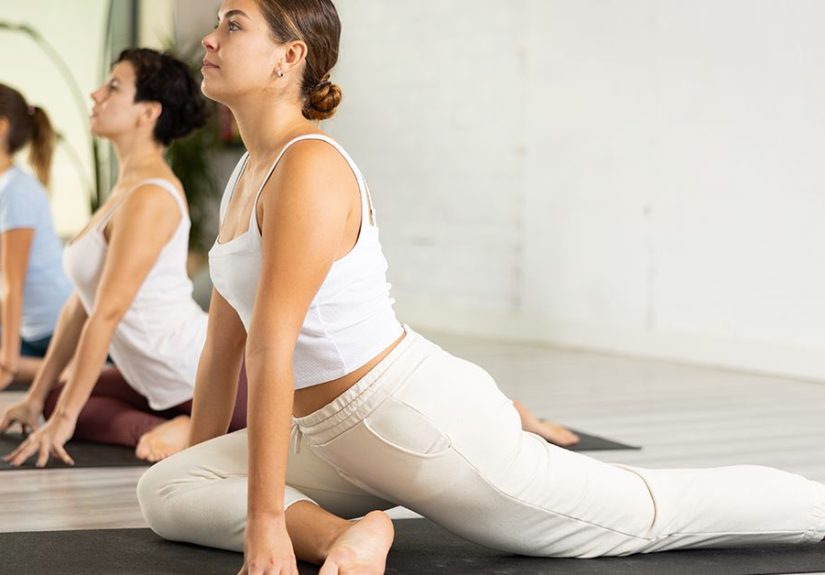
Pose 3: Low Lunge Hip Flexor Stretch – Opening the Front of the Hips
Low Lunge (a kneeling lunge variation) is one of the most powerful yoga poses for tight hips because it targets the hip flexors at the front of the pelvis and thigh. When these muscles are short and tight from hours of sitting, they can pull the pelvis into an anterior tilt, increasing the arch in your lower back and feeding pain.
How to Do a Low Lunge Hip Flexor Stretch
- Start in a kneeling position. Place a folded blanket or towel under your knees if the floor is hard.
- Step your right foot forward so your right knee is stacked over your right ankle in a 90-degree angle.
- Slide your left knee back slightly until you feel a stretch in the front of your left hip and thigh.
- Important: Gently tuck your tailbone under and engage your lower abs, so you’re not collapsing into your lower back.
- Place your hands on your front thigh, on yoga blocks, or at your hips. Lift through your chest and keep your gaze forward.
- Hold for 20–30 seconds while breathing deeply, then repeat on the other side.
Why It Helps Tight Hips and Lower Back Pain
By lengthening the hip flexors, Low Lunge helps re-balance the muscles around the pelvis. This can reduce excessive lumbar arch and allow the lower back muscles to relax. Many people notice that releasing the front of the hip makes standing, walking, and even sitting feel more natural and supported.
Modifications for Comfort
- Sensitive knees: Double up your mat or add extra padding under the back knee.
- Too intense in the front hip: Scoot the back knee a little closer and ease off the tuck of the tailbone slightly.
- Want a bit more stretch: Once stable, you can gently raise your arms overhead, keeping your ribs down and core engaged.
Common Alignment Errors
- Letting the front knee drift far past the toes, which can stress the knee joint.
- Dumping into the lower back instead of creating length through the spine with a light core engagement.
- Holding the breath and clenching the jawremember, this is not a showdown with your hip flexors.
Putting It All Together: A 10-Minute Mini-Sequence
If you’re short on time or just want a simple yoga routine for tight hips and lower back pain, try this mini-sequence:
- Child’s Pose – 5–10 slow breaths. Focus on lengthening your spine and relaxing your shoulders.
- Supine Figure Four – 20–30 seconds per side, 1–2 rounds. Feel the stretch in the glutes and outer hips.
- Low Lunge Hip Flexor Stretch – 20–30 seconds per side, 1–2 rounds. Move gently in and out of the stretch to explore your range.
You can do this sequence once a day after work, after a workout, or anytime your back and hips start whispering (or shouting) for attention. Consistency matters far more than intensity: a few mindful minutes daily usually beats a single heroic stretching session once a week.
When to See a Professional
While these yoga poses can be soothing and effective for everyday stiffness, they’re not a cure-all. Reach out to a healthcare professionalsuch as a physical therapist, sports medicine doctor, or other qualified providerif you notice any of the following:
- Pain that’s getting worse instead of gradually improving.
- Numbness, tingling, or weakness in your legs or feet.
- Difficulty controlling your bladder or bowels (this is an emergency).
- Back or hip pain after a serious fall, accident, or trauma.
Think of yoga as one helpful tool in a larger toolbox that might also include walking, strength training, ergonomics, and medical care when needed.
Real-Life Experiences and Tips with These 3 Poses
It’s one thing to read about yoga poses for tight hips and lower back pain; it’s another to actually fit them into a normal, busy life. Here’s how these three moves often show up in real-world routinesand what people commonly notice when they stick with them.
The Desk Worker Reset
Imagine someone who spends 8–10 hours a day at a computer. By midafternoon, their lower back feels tight, their hips feel glued to the chair, and their posture has slowly morphed into a question mark. A realistic, low-friction strategy might look like this:
- Before lunch, they take two minutes for Child’s Pose on a mat or even on a carpeted office floor. This gives the spine a chance to round gently and the hips to soften after hours of sitting upright.
- After work, they spend five minutes doing Supine Figure Four, holding each side for a few breaths and noticing if one hip is tighter than the other (it usually is!).
- They finish with a Low Lunge on each side, especially focusing on whichever hip is tightest from driving or sitting.
After a couple of weeks of consistency, many people find their baseline stiffness goes down. Standing up from the chair feels smoother, and those first few steps across the room don’t involve as much creaking and groaning.
The Active but Tight Athlete
On the other end of the spectrum, consider someone who works out regularlymaybe running, lifting weights, or playing recreational sportsbut doesn’t stretch very much. They’re strong, but their hips and lower back stay “on” even when they should be turning down.
These three poses work well as part of a post-workout cool-down:
- After a run or heavy squat session, Supine Figure Four becomes a go-to move to unravel tight glutes and piriformis, which can otherwise pull on the lower back.
- Low Lunge is ideal after activities that involve hip flexion, like cycling or sitting on rowing machines, to give the front of the hip a chance to lengthen.
- Child’s Pose rounds things out (literally) by letting the spine decompress and the nervous system slide from “fight or flight” into “rest and digest.”
This kind of athlete often reports that adding 5–10 minutes of these stretches reduces that “day after leg day” tightness and helps them move more smoothly in later workouts. They may also notice improved squat depth or easier hip hinge movements as the hips gain freedom.
The “I’m New to Yoga and a Bit Nervous” Beginner
If you’re brand new to yoga, it’s normal to worry about doing things “wrong” or not being flexible enough. The nice part about this trio of poses is that they’re forgiving and adaptable:
- Child’s Pose can be propped with pillows until it feels more like a restorative nap than a stretch.
- Supine Figure Four lets gravity do the work while you lie on your backno balancing on one leg or folding yourself into a pretzel.
- Low Lunge can be supported with blocks and padding so your knees and hips feel safe.
Many beginners notice that the hardest part isn’t the stretch itselfit’s slowing down enough to breathe, listen to the body, and not push. A good rule of thumb: aim for a sensation of gentle stretching, not fighting for survival. If you can breathe steadily and your face is relaxed, you’re probably in the right zone.
Simple Habit Tricks to Stay Consistent
Even the best yoga poses for tight hips and lower back pain won’t help if you only do them once every few months. Here are a few habit tricks that make regular practice more realistic:
- Pair it with something you already do. For example, do your three poses right after brushing your teeth at night or while your morning coffee is brewing.
- Keep it tiny. Commit to just one minute of Child’s Pose on days when you’re exhausted. Once you’re there, you’ll often want to add the other two poses.
- Make the environment inviting. Leave a yoga mat rolled out in a corner of your living room or bedroom as a visual reminder.
- Track how you feel. Jot a quick note in your phone or journal about your hip and back stiffness before and after. Seeing improvement is motivating.
Over time, this small, consistent practice can become one of your favorite ritualsa quick body “reset” that helps you feel more open, more stable, and a lot less creaky.
Bottom line: You don’t need to master advanced yoga postures to help your hips and lower back feel better. With Child’s Pose, Supine Figure Four, and a Low Lunge hip flexor stretch in your toolkitand a little bit of patienceyou can chip away at stiffness, support healthier posture, and give your body the message it’s been waiting for: “Hey, I’ve got your back.”