Table of Contents >> Show >> Hide
Humans love making lists, especially lists that quietly flatter us. We rank movies, burgers, athletes, and apparently the entire animal kingdom. But when it comes to the smartest animals on Earth, the truth is both more complicated and way more fun. There is no universal jungle SAT. A crow will never file your taxes, but you probably cannot bend a twig into a hook with your face. Fair is fair.
Animal intelligence shows up in many forms: tool use, memory, self-recognition, communication, cooperation, planning, emotional awareness, and the ability to solve new problems. Some animals are social masterminds. Some are engineering nerds. Some are escape artists that make locked lids look like a personal insult. Taken together, they prove one thing: brains come in many styles, and nature has been running genius experiments for a very long time.
What Makes an Animal Smart?
Before we start crowning valedictorians, it helps to define what “smart” actually means. Scientists usually look at a bundle of abilities rather than one magic trait. Can the animal learn quickly? Does it remember individuals, places, or routes? Can it use objects as tools? Does it read social cues, plan ahead, or adjust its behavior when conditions change? Intelligence in animals is less about acting human and more about solving life’s problems efficiently.
That means a dolphin, a chimpanzee, an octopus, and a honeybee can all be brilliant in very different ways. One excels at social communication, another at tool use, another at flexible problem-solving, and another at navigating the world with astonishing precision. So this list is not a strict scientific ranking carved into stone by a very judgmental owl. It is a broad, evidence-based celebration of 35 remarkably intelligent animals.
35 Of the Smartest Animals on Earth
Primates: The obvious overachievers
- Chimpanzees Chimpanzees are the gold standard of nonhuman problem-solvers. They make and use tools, cooperate, remember social relationships, and adapt strategies depending on the situation. If evolution had handed them a hardware store and Wi-Fi, humanity might have had some competition.
- Bonobos Bonobos combine social intelligence with emotional sensitivity. They read group dynamics well, resolve tension in complex ways, and show impressive flexibility in communication. In the animal kingdom, they are the clever relatives who also somehow keep the group chat from exploding.
- Orangutans Orangutans are thoughtful, patient, and highly skilled tool users. They learn by observation, solve foraging problems, and often appear to study a challenge before acting. They do not rush, which honestly may be the smartest trait on this list.
- Gorillas Gorillas may look like pure muscle, but they also show strong memory, emotional awareness, and the ability to learn symbolic communication and routines. Their intelligence is often quieter than that of chimpanzees, but it is very real and deeply social.
- Capuchin monkeys Capuchins are tiny chaos engineers with serious brainpower. They use tools, crack nuts, manipulate objects, and learn quickly from trial and error. If one steals your snack, assume the theft involved planning, timing, and zero remorse.
- Baboons Baboons live in complex social groups that require sharp memory and constant relationship management. They recognize rank, alliances, and threats with impressive accuracy. Their intelligence leans heavily toward social strategy, which is still intelligence even if it sometimes looks like office politics with fur.
- Macaques Macaques are adaptable, curious, and unusually good at navigating human-dominated spaces. They learn from each other, exploit new food sources, and adjust behavior rapidly. In short, they are excellent at reading the room, especially when the room contains unattended snacks.
- Gibbons Gibbons are not always the first apes people mention, but they are skilled problem-solvers with sharp spatial awareness and strong social coordination. Their intelligence shows up in learning, communication, and the ability to manipulate enrichment puzzles and new routines.
Marine mammals: The ocean’s brain trust
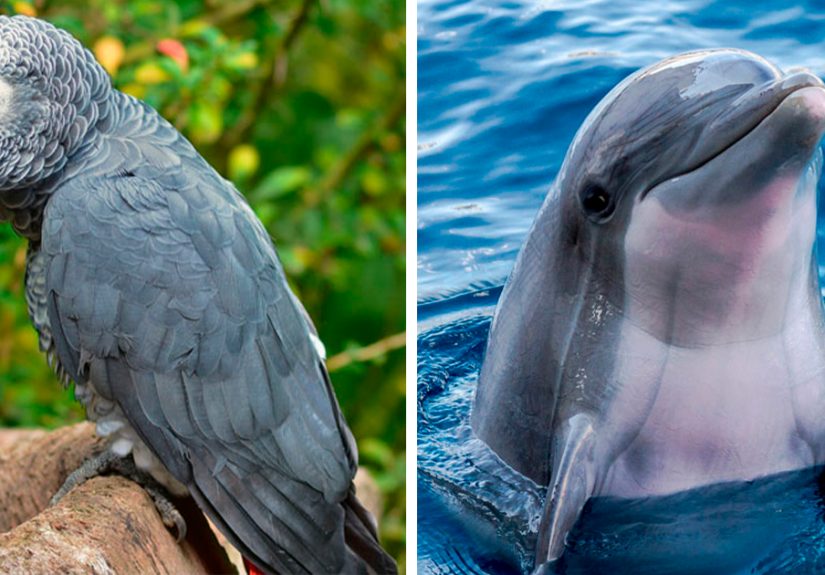
- Bottlenose dolphins Dolphins are famous for good reason. They show advanced communication, social learning, play behavior, individual recognition, and extraordinary memory. Their intelligence is not just flashy; it is deeply social and highly flexible.
- Orcas Orcas combine memory, communication, coordinated hunting, and culture-like behavior. Different groups can develop distinct habits and hunting techniques passed between generations. That is not just smart; that is tradition with teeth.
- Sperm whales Sperm whales live in structured social groups and communicate through patterned clicks that scientists are still trying to decode. Their huge brains are not a random decoration. These animals appear built for memory, coordination, and social complexity on a massive scale.
- Elephants Yes, elephants are land mammals, but they deserve their own dramatic entrance. They are known for long memory, emotional awareness, cooperation, and signs of self-recognition. An elephant never forgetting is not just a saying; it is practically a brand identity.
Domestic and familiar animals that quietly judge us
- Dogs Dogs are experts at reading human gestures, tone, and routine. Their intelligence is social, cooperative, and highly tuned to life with people. They may not solve every abstract puzzle, but they often understand us better than we understand ourselves before coffee.
- Pigs Pigs are curious, trainable, and excellent at learning patterns. They can navigate spaces, remember solutions, and interact with their environment in sophisticated ways. Anyone still using “pig-headed” as an insult may need a vocabulary update.
- Horses Horses learn quickly, read body language well, and build strong memory for routes, people, and routines. Their intelligence is often underestimated because it looks calm instead of flashy. Quiet competence is still competence.
- Rats Rats are brilliant little survivors. They learn mazes, remember routes, solve simple problems, and adapt rapidly to new conditions. Their reputation is terrible, but their cognitive skills are annoyingly impressive.
- Domestic cats Cats are smart in a selective, energy-efficient way. They learn patterns, recognize people and routines, and solve problems when sufficiently motivated. The catch is that their motivation often arrives on a mysterious schedule known only to the cat.
- Goats Goats are better problem-solvers than many people expect. They can learn mechanical tasks, remember solutions for long periods, and adapt their behavior based on experience. They look like casual hill-climbing comedians, but the brains are very real.
- Wolves Wolves combine cooperation, communication, and strategic coordination in ways that support pack hunting and survival. Their intelligence is deeply social and situational. Think teamwork, but with more fur and fewer inspirational posters.
Land mammals with serious street smarts
- Spotted hyenas Hyenas are not just scavengers with a bad PR team. They are socially sophisticated, cooperative, and strong problem-solvers. Research has shown they can handle coordination tasks with surprising efficiency, which should earn them a formal apology from pop culture.
- Raccoons Raccoons are masters of manipulation, memory, and urban adaptability. They open latches, investigate containers, and remember how to access food. Give a raccoon a puzzle box, and it treats the assignment like a personal challenge from the universe.
- Squirrels Squirrels rely on memory, spatial mapping, and flexible planning. Their food-caching behavior requires organization and recall, especially in environments full of competitors. The average squirrel looks frantic, but that may just be what advanced logistics looks like at high speed.
- Foxes Foxes are adaptable hunters that learn quickly and adjust well to changing environments, including suburbs and cities. Their intelligence lies in observation, timing, and tactical flexibility. They often win by being quiet, careful, and annoyingly effective.
- Sea lions Sea lions show strong learning ability, excellent memory, and responsiveness to training. They can distinguish patterns and handle tasks that require flexibility and attention. Also, they somehow manage to look amused while doing it.
Birds: Tiny dinosaurs with suspiciously good ideas
- New Caledonian crows These crows are famous for tool use, planning, and understanding cause and effect. They shape sticks and even use one tool to get another. That is the sort of layered thinking that makes people stare at a bird and rethink everything.
- Common ravens Ravens are excellent problem-solvers with strong memory and social awareness. They can manipulate objects, anticipate outcomes, and remember other animals and humans. They have the vibe of a medieval wizard trapped in bird form.
- African grey parrots African grey parrots are celebrated for vocal learning, object recognition, and surprising conceptual ability. They do not just mimic sounds; they can connect words to categories and contexts. They are basically feathery proof that talking trash may require real talent.
- Sulfur-crested cockatoos Cockatoos are inventive, social learners. Some populations have learned how to open trash bins through multi-step actions and spread those techniques socially. Few things say “smart” like turning neighborhood garbage day into a collaborative research project.
- Kea Kea, the alpine parrots of New Zealand, are playful, curious, and famously good at solving puzzles. Their intelligence often appears as relentless experimentation. If one existed in human form, it would absolutely be the kid taking apart the toaster “to see how it works.”
- Pigeons Pigeons have superb navigation and can learn visual categories with surprising accuracy. They remember locations, discriminate shapes, and handle pattern tasks far better than their city-bird reputation suggests. Respect the sidewalk scholar.
- Scrub jays Scrub jays are remarkable cachers with strong memory and signs of future-oriented behavior. They remember where food is hidden and may even adjust caching depending on who is watching. In bird terms, that is basically strategic asset management.
- Magpies Magpies are clever, social, and unusually flexible. They learn quickly, adapt to new challenges, and are often included in discussions of avian self-awareness. They are flashy in appearance and apparently unwilling to be average in cognition either.
- Great-tailed grackles Grackles have shown impressive behavioral flexibility and problem-solving despite being overlooked for years. They are a reminder that intelligence research sometimes misses obvious talent because the animal did not arrive with a glamorous résumé.
Invertebrates and other unexpected geniuses
- Octopuses Octopuses are escape artists, puzzle-solvers, and masters of flexible behavior. They explore, manipulate, and improvise in ways that make them feel almost alien. The fact that such intelligence evolved in a soft-bodied mollusk is one of nature’s boldest plot twists.
- Cuttlefish Cuttlefish combine camouflage genius with learning, memory, and even signs of self-control in experiments. They can adjust behavior in subtle ways and seem to process choices with impressive sophistication. Imagine a mood ring that also outsmarts you.
- Honeybees Bees have tiny brains but enormous collective and navigational intelligence. They communicate food locations, learn associations, and solve surprisingly complex route problems. Their size is small; their efficiency is frankly rude.
- Ants Ants are masters of distributed intelligence. Individually simple, collectively astonishing, they build, farm, defend, organize, and optimize routes with brutal efficiency. They prove that intelligence does not always wear a single face; sometimes it wears ten thousand.
- Jumping spiders Jumping spiders are visually sharp hunters that seem to plan routes rather than simply charge at prey. For such tiny animals, their decision-making and spatial problem-solving are impressive. They are little eight-legged tacticians.
- Crocodiles Crocodiles are more behaviorally flexible than many people assume. They can learn routines, recognize patterns, and in some cases use bait-like tactics while hunting. Apparently even ancient-looking reptiles can still surprise the class.
So, Which Animal Is the Smartest?
If you want one champion, scientists will gently ruin your neat little trophy ceremony. Chimpanzees excel at tools and complex problem-solving. Dolphins dominate in social learning and communication. Crows and ravens are astonishing planners. Elephants combine memory with empathy. Octopuses are the weird geniuses of the sea. Bees and ants show that intelligence can also be collective, not just individual.
The smarter answer is that intelligence evolves to fit a lifestyle. A hunting animal needs one kind of cognition. A social animal needs another. A migratory bird, a city raccoon, and an octopus hiding in a reef are all solving different problems. Nature does not hand out one exam to everybody. It builds specialized minds for specialized lives.
Why Animal Intelligence Matters
Learning about the smartest animals on Earth is not just a fun trivia exercise for people who enjoy yelling “Actually, crows are geniuses” at dinner. It changes how we think about conservation, animal welfare, and our place in the natural world. The more we understand animal cognition, the harder it becomes to pretend that other species are simple, mechanical creatures moving through life on autopilot.
Smart animals also remind us that intelligence is not ownership property of humans. We may have cities, satellites, and suspiciously long passwords, but other animals have culture-like traditions, emotional complexity, route planning, symbolic learning, and problem-solving skills that still surprise researchers. The animal kingdom is not short on brainpower. It is just multilingual, multi-species, and very bad at filling out human application forms.
Experiences That Make This Topic Feel Real
Reading about animal intelligence is fascinating, but seeing it up close is where the topic really comes alive. Watch a dog pause for half a second before following a point toward a hidden toy, and suddenly intelligence does not feel abstract anymore. It feels personal. There is a little flash in the animal’s eyes that says, “Yes, I understand the assignment, and frankly you could have thrown the ball sooner.” That moment is familiar to millions of pet owners, but it also mirrors what researchers study in formal cognition labs: memory, inference, attention, and social communication.
A similar feeling hits in city parks. You see a squirrel pretend to bury food in one spot, then dash off to hide it somewhere else when another squirrel is watching. You watch a pigeon avoid a crowd with better timing than half the humans on the sidewalk. Maybe a crow drops a nut in traffic so a car can crack it open and then retrieves the prize when the light changes. These are not cartoon tricks. They are examples of animals adapting to modern environments with the kind of flexibility that makes people stop mid-walk and say, “Okay, that was suspiciously clever.”
Zoos and aquariums can create the same sense of awe when enrichment activities reveal how animals think. An orangutan studies a puzzle feeder with the patience of a mechanic. A sea lion learns a routine and then anticipates the next cue. An octopus reaches out, explores a latch, and appears to test possibilities before committing to a solution. What makes these experiences powerful is not just the result. It is the process. You can almost watch the wheels turning, even when the wheels are technically tentacles.
Then there are the social moments, which may be the most moving of all. Anyone who has watched elephants greet each other gently, dogs respond to human sadness, or dolphins coordinate movement in perfect timing has seen that intelligence is not only about cracking puzzles. It is also about relationships. Social awareness, empathy, timing, trust, and communication are forms of brainpower too. They are harder to measure than opening a box for food, but in daily life they often feel even more profound.
That is why this topic sticks with people. Smart animals do more than impress us. They challenge us. They make us reconsider the old idea that humans sit alone on a bright mental mountain while everything else wanders below. Spend enough time really watching animals, and that story starts to fall apart in the best possible way. The world begins to look less like a ladder and more like a sprawling neighborhood of different minds, each shaped by survival, environment, and experience. And once you notice that, a backyard crow, a family dog, or even a raccoon on a midnight mission never looks quite the same again.