Table of Contents >> Show >> Hide
Why Cabinets Set the Whole Vibe
If your kitchen were a band, your cabinets would be the lead singer: they take up the most visual space, they set the tone,
and everyone notices when they’re off-key. The good news? Cabinet design isn’t just “white vs. not white.” It’s door style,
finish, proportions, hardware, and smart storage choices that make your kitchen feel customeven when your budget is more
“weeknight pasta” than “private chef.”
Below are 38 kitchen cabinet ideas you can mix and match across design stylesfrom modern minimal to cozy cottageplus a
real-world “things I wish someone told me” section at the end.
Before You Pick a Style: 5 Decisions That Matter
1) Door profile: the cabinet equivalent of a haircut
Shaker doors read clean and timeless. Raised-panel doors skew traditional. Flat-panel (slab) doors feel modern and
streamlined. And if you want “custom energy,” look at details like a slimmer Shaker frame, an inset door, or a reeded
texturesmall moves, big impact.
2) Inset vs. overlay: how tailored do you want it?
Inset doors sit inside the cabinet frame for crisp, furniture-like lines (and a slightly higher price tag). Full overlay doors
cover more of the face frame for a sleek look with fewer “lines.” Partial overlay is a classic, budget-friendly middle ground.
3) Framed vs. frameless: the structure behind the look
Face-frame cabinets feel traditional and forgiving in older homes. Frameless (often called European-style) maximizes interior
space and gives you a more modern façade. Both can be excellentjust make sure the box construction and hardware are solid.
4) Finish: paint vs. stain (and why “warm” is winning)
Painted cabinets deliver color and polish; stained wood brings warmth, texture, and a little “grown-up” depth. Many designers
are leaning into warmer neutrals, richer hues, and wood-forward kitchens that feel lived-innot sterile.
5) Hardware and lighting: the jewelry (and the spotlight)
Swapping pulls and knobs is one of the fastest cabinet upgrades. Add under-cabinet lighting or interior cabinet lighting and
suddenly your kitchen looks like it got a professional photoshoot. (No paparazzi required.)
The 38 Ideas
Timeless and Traditional
1) Classic Shaker doors. Clean lines, nearly any color works, and they pair well with modern or traditional finishes. If you’re unsure, Shaker is the “little black dress” of cabinet design.
2) Warm white (not stark white) cabinets. Choose an off-white or creamy tone so your kitchen feels invitingespecially with warm metals and natural wood floors.
3) Inset cabinetry for a furniture look. Inset doors add tailored detail and look especially good in historic homes, cottage kitchens, and elevated transitional spaces.
4) Raised-panel doors for classic charm. They’re traditional by nature, but they can feel fresh with updated paint colors and simpler hardware.
5) Glass-front uppers as a “breathing space.” Use a few glass doors to break up a wall of cabinets and show off a curated set of disheskeep it intentional, not chaotic.
6) Crown molding that goes all the way up. Bring cabinets to the ceiling (or add a topper) to avoid dust ledges and make the kitchen feel taller and more custom.
7) Beadboard or V-groove panel details. Great for cottage, farmhouse, or coastal stylesjust use it strategically so it reads charming, not theme-park.
8) Furniture-style feet on an island. Turn your island into a statement piece with leg details and panelsinstant “custom kitchen” energy.
9) Built-in look using freestanding pieces. Try a hutch-style cabinet or glass-front “china cabinet” vibe to add character without full custom millwork.
10) Decorative end panels. Finished panels on the sides of cabinets (especially islands) keep everything looking intentional and polished.
Modern, Contemporary, and Scandinavian
11) Flat-panel (slab) doors. The go-to for modern kitchens: smooth, minimal, and perfect for matte finishes or dramatic colors.
12) Handleless or ultra-minimal pulls. Use push-to-open, integrated pulls, or slim edge pulls for a clean facegreat for modern and minimalist homes.
13) High-contrast black-and-wood combo. Pair walnut or white oak with matte black lowers or an island for a modern, grounded look that still feels warm.
14) Light oak cabinets for Scandi calm. White oak tones (or similar) brighten the room and pair beautifully with white counters, soft grays, and simple hardware.
15) Soft-matte finishes instead of glossy glare. Matte and satin finishes hide fingerprints better and feel more currentespecially in busy family kitchens.
16) Horizontal wood grain. A subtle shift that reads modern and architectural. Keep the rest of the kitchen clean so the grain can do its thing.
17) Open shelving used like punctuation. Replace a small section of uppers with open shelves to keep things airybut limit it to “pretty storage,” not your entire mug collection.
Farmhouse, Cottage, and Coastal
18) Two-tone cabinets (uppers vs. lowers). White uppers with deeper lowers is popular for a reason: it feels lighter up top and grounded below.
19) Island in a different color. Keep perimeter cabinets classic and make the island the “statement jacket”navy, green, black, or stained wood.
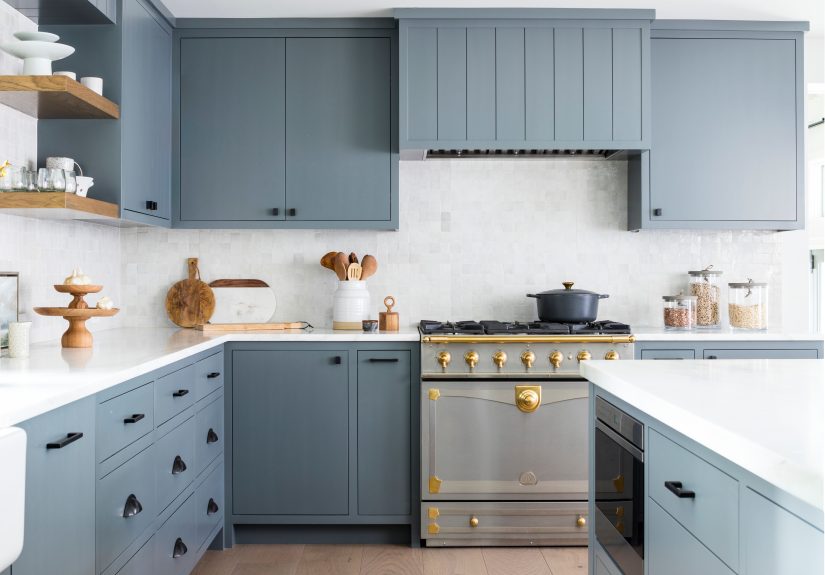
20) Soft blues and sandy neutrals. Coastal style doesn’t require seashell décor. Choose airy colors, natural textures, and simple hardware for a relaxed look.
21) Painted “unfitted” look. Mix cabinet styles (or add a freestanding pantry/hutch) for a collected kitchen that feels like it evolved over time.
22) X-front or crossbuck accents (use sparingly). Add character on a pantry door or island end panelone or two is charming; twelve is a barn convention.
23) Warm metals with creamy cabinet paint. Brushed brass or aged bronze reads cozy and classic with warm whites, taupes, and greiges.
24) Curtain-front lower cabinets for cottage charm. Great for a breakfast nook or secondary prep area; it softens the space and adds personality on a budget.
Bold Color and High-Impact Finishes
25) Moody navy lowers. Navy pairs well with white counters, warm woods, and mixed metalsdramatic without being too “look at me.”
26) Deep green cabinets. Forest and olive tones feel grounded and timelessespecially with brass or warm wood accents.
27) Soft, warm neutrals (taupe, mushroom, putty). If you’re tired of cool gray, warm neutrals add depth while still acting like a “neutral.”
28) Nearly-black charcoal for a modern classic. Charcoal reads softer than pure black and looks sharp with light counters and natural textures.
29) Color-drenched cabinets and walls. Painting cabinets and walls in related tones can make a kitchen feel designed, not decorated. Keep counters and backsplash simpler for balance.
30) Two finishes, one palette. Combine painted uppers with stained lowers (or vice versa) for a designer lookespecially good in open-concept homes.
Texture, Glass, and Custom Details
31) Reeded or ribbed glass inserts. They add texture and hide visual clutter. Perfect for uppers near a bar zone or coffee station.
32) Fluted or reeded wood detailing. Use on an island, pantry door, or a single run of cabinets to add dimension without overwhelming the room.
33) Mixed door styles. Shaker on the perimeter + slab on the island can look intentional and modernjust keep finishes coordinated.
34) Statement hardware (yes, like jewelry). Try elongated pulls, knurled textures, or even a carefully chosen color accentespecially on a simple door style.
35) Interior cabinet lighting. Add lighting inside glass-front cabinets or open shelves. It’s cozy at night and makes everyday dishes feel fancy.
36) Wallpaper inside cabinets (or on the back of open shelves). A small surprise moment that adds personalitybest for glass-fronts, pantries, or bar cabinets.
Storage That Feels Like Magic
37) Drawer-heavy lower cabinets. Big drawers for pots, pans, and plates are easier to use than deep shelves. Your knees will send a thank-you note.
38) Purpose-built pullouts. Pull-out trash/recycling, spice pullouts, tray dividers, and corner solutions make cabinets work harderespecially in small kitchens.
of Real-World Cabinet Lessons (So You Don’t Learn the Hard Way)
Here’s what homeowners and remodel pros tend to discover after living with “pretty” cabinets for a few months: beauty is
wonderful, but usability is the relationship that lasts.
First, pick the cabinet layout before you fall in love with a door style. A gorgeous slab door won’t save you from a corner
cabinet that eats your pots like a black hole. Prioritize drawers in the lowers whenever possibleespecially near the range and
prep zonesbecause drawers let you see everything at once. Deep shelves are fine for slow-moving items (think: the waffle iron
you swear you’ll use more often). For daily cooking, drawers are the MVP.
Second, be honest about your clutter threshold. If you love the look of glass-front cabinets, you have two options:
(1) curate the contents like a mini showroom (matching dishes, repeat shapes, leave breathing space), or (2) choose reeded glass
so you get the airy vibe without broadcasting every random mug from the office holiday party. Open shelving has the same rule:
it works best when you treat it like display space, not overflow storage.
Third, your cabinet color should match your lifestyle, not just your Pinterest board. Dark, moody cabinets can look stunning,
but they need decent lighting. Warm whites and light woods are forgiving and bright, which is why they stay popular. If you’re
going bold (green, navy, charcoal), build in under-cabinet lighting and consider lighter counters/backsplash so the room doesn’t
feel like it’s wearing sunglasses indoors.
Fourth, hardware is not an afterthought. The “right” pull is the one that feels good in your hand at 6:45 a.m. when you’re
half-awake looking for coffee. Bigger pulls can be easier to grab, and mixing finishes can look intentional when you repeat
each finish at least twice (for example: brass pulls + a brass faucet, matte black lighting + black accents).
Fifth, budget-friendly upgrades can be surprisingly high-impact. If your cabinet boxes are solid, refacing or repainting can
transform the whole kitchen with less disruption than a full replacement. Add new pulls, soft-close hinges, and better interior
organizers, and suddenly the kitchen feels “new” in the ways that actually matter.
Finally, remember the goal: a kitchen that supports real life. The best cabinet design isn’t the trendiest oneit’s the one
that makes your mornings smoother, your cooking easier, and your space feel like home.
Conclusion
The best kitchen cabinet ideas aren’t one-size-fits-all. Start with the structure (inset vs. overlay, framed vs. frameless),
choose a door profile that matches your home’s architecture, then make it personal with finish, hardware, lighting, and smart
storage. Whether you lean modern, farmhouse, transitional, or wildly “I refuse to be beige,” the right cabinet plan makes your
kitchen look better and work betterevery single day.