Table of Contents >> Show >> Hide
If you needed a reminder that the planet is still showing off, the World Nature Photography Awards 2025 delivered it in glorious fashion. This year’s winners move from snowy vineyards in Slovenia to the mudflats of Western Australia, from the open water of Timor-Leste to a lava-torn road in Iceland. In other words, Mother Nature did not come to play.
The 2025 edition brought together photographers from dozens of countries and a wide mix of styles, subjects, and emotional tones. Some images are breathtaking because they are beautiful. Others hit harder because they reveal risk, fragility, survival, or the uneasy truce between wildlife and humans. Together, these award-winning photos do what the best nature photography always does: they make you stare first, then think second, and then quietly reconsider your relationship with the natural world.
At the center of it all is Maruša Puhek’s Run, the overall winning image and the gold winner in Nature Art. It shows two deer sprinting through a snowy vineyard in Slovenia, and it works because it feels both cinematic and accidental, like the kind of moment that lasts half a heartbeat but somehow says everything. The scene is elegant, cold, fast, and oddly peaceful all at once. That balancing act sets the tone for the rest of the 2025 collection.
Why These 2025 Winners Feel Bigger Than Pretty Pictures
Nature photo contests can sometimes blur into a parade of “wow, nice bird” moments. Not this one. The strongest winners in the World Nature Photography Awards 2025 do more than chase beauty. They show tension. They show behavior. They show ecosystems under pressure. They show animals in spaces that are either disappearing, changing, or awkwardly sharing the frame with human development.
That range is what makes this set memorable. One category gives you luminous lanternflies that look like they were designed by a maximalist jewelry brand. Another gives you a robber fly trapped in a spider’s web. Then you get a baby olive ridley sea turtle heading into the ocean, a polar bear playing with a stick, fishermen gathering anchovies in Vietnam, and a volcanic eruption swallowing a road in Iceland like the Earth just got tired of infrastructure.
So yes, these are award-winning nature photos. But they also double as a visual essay about motion, adaptation, vulnerability, and the fact that the natural world is still far stranger than fiction.
The Photo Everyone Will Remember: Run by Maruša Puhek
Let’s start with the headline image, because it deserves the spotlight. Puhek’s winning photograph was made on a snowy day in Slovenia, when she spotted two deer running through a vineyard. She was using a wide-angle lens rather than the telephoto lens many wildlife photographers would instinctively want. That turned out to be a blessing in disguise.
The wider view preserves the geometry of the vineyard and the hush of the winter landscape, making the deer feel like part of a larger visual poem instead of isolated subjects. The result is a photograph that feels painterly without losing its documentary honesty. It is fast, but not frantic. Stylized, but not artificial. Quiet, but not static. In short, it’s exactly the kind of image that wins an overall nature photography title because it rewards both an immediate glance and a long look.
There is also something refreshing about the story behind it. This was not a tale of expensive gear, far-flung expedition drama, or heroic suffering on a cliff edge. It was a local scene, a split-second chance, and a photographer who made the most of what she had. That gives Run an underdog charm that fits the image’s elegance.
The 2025 Winners, Category by Category
One of the best ways to appreciate the full sweep of these awards is to look at how the categories stack up. Here is the 2025 winners map, with the gold, silver, and bronze placements that shaped the year’s conversation.
Nature Art
Gold: Maruša Puhek (Slovenia) for Run, the same image that also took the overall title. Silver: Pandula Bandara (Sri Lanka). Bronze: Yasmin Namini (USA). This category leaned into abstraction, composition, and mood, proving that nature photography can be deeply artistic without losing its roots in the real world.
Animal Portraits
Gold: Khaichuin Sim (Malaysia) with a striking portrait of brilliantly colored lanternflies. Silver: Vince Burton (United Kingdom). Bronze: Ngar Shun Victor Wong (Hong Kong). The winning portrait is the kind of image that makes insects look like runway models with better styling.
Behavior – Mammals
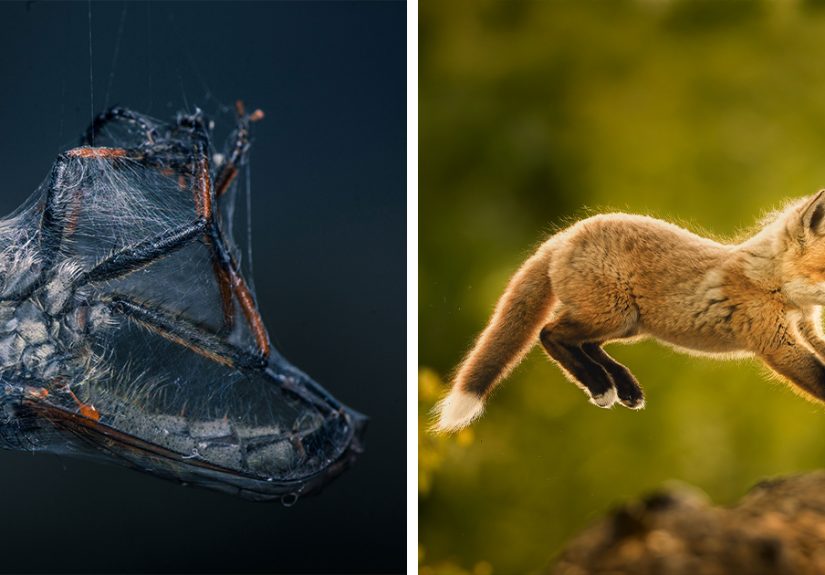
Gold: Tom Nickels (Finland) for a playful polar bear scene in Svalbard. Silver: Jonathan Hodgetts (United Kingdom) for battling hippos in golden light. Bronze: Donna Feledichuk (Canada) for a lively fox cub image. This category captured the drama, humor, and unpredictability of mammal behavior without overcooking it.
Behavior – Amphibians and Reptiles
Gold: Georgina Steytler (Australia) for a blue-spotted mudskipper leaping into the air in territorial display. Silver: Jules Oldroyd (UK). Bronze: Marti Phillips (USA). The mudskipper image is a reminder that some of nature’s biggest personalities come in very tiny, very splashy packages.
Behavior – Invertebrates
Gold: Niki Colemont (Belgium) for a robber fly caught in a spider’s web. Silver: Rory J. Lewis (United Kingdom). Bronze: Pawel Tyl (Poland). If you ever needed proof that “small-scale drama” is still drama, this category brought receipts.
Behavior – Birds
Gold: Clive Burns (United Kingdom) for a dense flight of red knots and other coastal waders. Silver: Hermis Valiyandiyil (United Arab Emirates). Bronze: Mohammad Murad (Kuwait). The gold image is all motion and pattern, a reminder that a flock can become pure visual rhythm when the timing is right.
People and Nature
Gold: Robert Middleton (United Kingdom) for fishermen harvesting anchovies off the coast of Phu Yen, Vietnam. Silver: Asaf Amran (Israel). Bronze: John Edwards (USA). This category is where the awards become especially thoughtful, showing not just scenery or species, but the complicated relationship between human livelihoods and ecosystems.
Plants and Fungi
Gold: Marcio Esteves Cabral (Brazil) for glowing Paepalanthus flowers in the Veadeiros Tablelands. Silver: Indranil Basu Mallick (India). Bronze: Irina Petrova Adamatzky (United Kingdom). Cabral’s winner is one of the most visually theatrical images in the whole collection, yet it is anchored by a serious conservation undertone.
Underwater
Gold: Daniel Flormann (Germany) for Lenuk Tasi, showing a young olive ridley sea turtle at Kasait, Timor-Leste. Silver: Sina Ritter (Germany). Bronze: Ilaria Mariagiulia Rizzuto (Italy). The gold winner feels gentle at first glance, but the story behind it makes it even more powerful: the journey from hatchling to adulthood is brutally uncertain.
Planet Earth’s Landscapes and Environments
Gold: Jake Mosher (USA) for a long-awaited Milky Way reflection at Hyalite Lake, Montana. Silver: Santanu Majumder (India). Bronze: Brian Creek (USA). This category shows that landscape photography still has plenty of magic left, especially when patience and a sense of place do the heavy lifting.
Black and White
Gold: Paul Goldstein (United Kingdom) for a wide-angle shot of cheetahs feeding on a young hartebeest in Kenya. Silver: Tom Way (United Kingdom). Bronze: Fressia Junqi Peng (China). The black-and-white winners prove that stripping away color can sometimes make behavior, texture, and form hit even harder.
Animals in Their Habitat
Gold: Malini Chandrasekar (United Kingdom) for a walrus on pack ice in Svalbard. Silver: Irene Amiet (United Kingdom). Bronze: Rajarshi Banerji (India). This category stands out because it resists the urge to crop the world away; habitat is not just background here, it is part of the story.
Urban Wildlife
Gold: Benjamin Smail (United Kingdom) for a pin-tailed whydah against the industrial backdrop of a fuel depot in Gambia. Silver: Elizabeth Yicheng Shen (USA). Bronze: Christian Passeri (Italy). The best urban wildlife photos never let viewers forget the contradiction at the center of the frame, and this category nailed that discomfort.
Nature Photojournalism
Gold: Ael Kermarec (Iceland) for a volcanic eruption overtaking infrastructure on the Reykjanes Peninsula. Silver: Thomas Vijayan (Canada). Bronze: Charlotte Keast (United Kingdom). Here, beauty and bad news arrive in the same package, which is often exactly what environmental storytelling looks like in real life.
Standout Themes Across the 42 Winners
1. Motion Was Everything
A surprising number of the strongest 2025 images are built around movement: deer running, a mudskipper leaping, birds exploding into flight, hippos colliding, a turtle setting off into open water. These are not static trophy shots. They are photographs that feel alive even when you are looking at them on a silent screen.
2. Beauty Came With Consequences
The flowers in Brazil glow like fireworks, but they belong to a biome threatened by deforestation. The sea turtle image is delicate, but its survival odds are grim. The anchovy fishing scene is visually mesmerizing, yet it hints at overfishing. Again and again, the winners pair visual pleasure with ecological reality.
3. Human Presence Was Never Far Away
Sometimes people are directly in the frame, as in the People and Nature category. Other times, they are the invisible pressure behind the image: roads, industrial edges, habitat loss, traffic risk, or climate-driven events. The awards do not preach, but they also do not pretend nature exists in some untouched, fantasy version of Earth.
Why This Collection Works So Well for Viewers
Part of the appeal is variety. You can move from macro subjects to sweeping landscapes without getting visual whiplash. Another part is emotional pacing. The collection knows how to alternate wonder, tension, tenderness, spectacle, and unease. It is almost edited like a great documentary film, except every scene has to stand on its own.
And then there is the simple fact that these photos reward curiosity. A casual viewer can enjoy them for the color, drama, or composition. A more engaged viewer starts noticing habitat, migration, conservation, behavior, and the technical choices behind the frame. That layered quality is what separates “nice photo” from “award-winning photo.”
What It Feels Like to Spend Time With These Images
Looking through the World Nature Photography Awards 2025 winners is not just a visual experience. It feels more like being gently dragged out of your own routine and reminded that the planet is busy doing astonishing things while you are answering emails and pretending your third coffee is a personality trait.
The experience begins with awe, of course. You see the snowy geometry of Run and immediately understand why it won. Then you move into the rest of the gallery and the emotional texture changes. A flock of birds becomes a living weather system. A mudskipper turns into a tiny action hero. A turtle becomes a symbol of hope and absurdly bad odds. A lava flow makes the road below it look embarrassingly temporary. You realize, pretty quickly, that the collection is not trying to flatter the viewer. It is trying to wake the viewer up.
What makes the experience especially memorable is the rhythm between intimacy and scale. One minute, you are inches away from the details of an insect, a mushroom, feathers, or a reptile’s skin. The next, you are looking at mountains, ice, open water, or a sky full of stars over Montana. That constant shift keeps the gallery from feeling repetitive. It also mirrors how nature actually works. The planet is not only grand vistas. It is also webs, spores, scales, mud, migration, and split-second instincts.
There is also a strange emotional honesty in these winning photos. They do not treat nature like a greeting card. Some images are funny, some are graceful, some are tense, and some are plainly unsettling. A chained elephant, an advancing lava flow, and a predator-prey scene all sit in the same broader conversation as flowers glowing at dawn or a bear playing with a stick. That emotional range matters because it makes the collection feel truthful. Nature is not one mood. It is every mood, often before breakfast.
For photographers, the experience is even richer. You can almost feel the patience behind certain frames: the waiting, the missed shots, the weather, the technical compromises, the small burst of luck that arrives after a long stretch of nothing. Several of the most compelling winners carry that feeling. They do not look overdesigned. They look discovered. That is part of their charm. They remind viewers that great nature photography is not just about being skilled. It is also about being observant, stubborn, adaptable, and occasionally willing to admit that the lens you did not want to have might be exactly the one you needed.
For everyone else, these images offer something rarer than spectacle: perspective. They shrink human ego without making humans irrelevant. They suggest that we are participants in the same world we so often bulldoze, pave, drain, light, fence, and rename. The best of the 2025 winners hold that contradiction in full view. We are capable of appreciating nature, documenting it, celebrating it, and threatening it, sometimes all at once.
That is why spending time with these 42 award-winning photos feels worthwhile. They are beautiful, yes, but beauty is only the entry point. Stay longer and the collection becomes a lesson in attention. It asks you to notice behavior, habitat, fragility, resilience, and luck. It invites admiration, but it also quietly demands responsibility. Not bad for a gallery that starts with deer in a vineyard and ends with the unsettling certainty that the wild world is still magnificent, still vulnerable, and still very much not under our control.
Final Thoughts
The World Nature Photography Awards 2025 succeeded because the winners do not all chase the same idea of greatness. Some go big. Some go small. Some lean into elegance. Others lean into conflict. But taken together, they build a compelling portrait of a planet that is still dazzling, still dramatic, and still worth protecting.
If there is one takeaway from these 42 award-winning photos, it is this: the natural world is not short on wonder. What it is short on, sometimes, is our attention. These images fix that, one frame at a time.