Table of Contents >> Show >> Hide
- Why 1Password’s “$7B” story matters
- Driver 1: Build a great product (and support like your reputation depends on itbecause it does)
- Driver 2: Profitability is power (and optionality is the real flex)
- Driver 3: Select investors with purpose (don’t collect logoscollect outcomes)
- Driver 4: Evolve from generalists to specialists (without losing your soul)
- Driver 5: Bridge B2C and B2B by focusing on people (not segments)
- Driver 6: Remotebut connected (because culture doesn’t run on Wi-Fi alone)
- Driver 7: Look after your people (culture, communication, and compensationtogether)
- Putting the 7 drivers into a single scaling system
- Bonus: of real-world scaling experiences inspired by these drivers
- Conclusion
Scaling a company to “multi-billions” sounds like a Silicon Valley bedtime story: a unicorn gallops in, investors sprinkle glitter, and suddenly your org chart needs its own zip code.
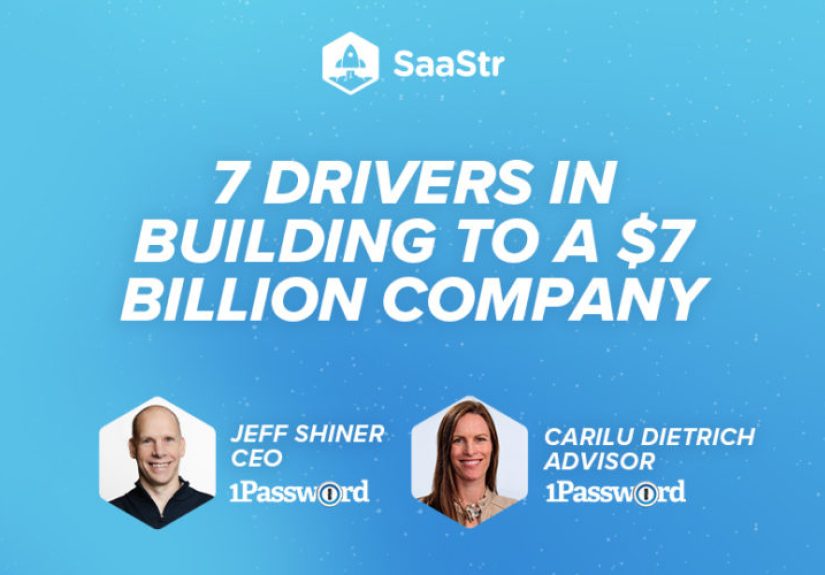
The reality is less magical and more repeatable. In SaaStr Pod 556 (and the companion video), Jeff Shiner and Carilu Dietrich break down seven drivers that helped
1Password grow from a beloved product into a category-defining company.
If you’ve ever tried to build software people actually trustsecurity software, no lessyou already know the bar is higher. You’re not just shipping features.
You’re shipping confidence. And you’re doing it while the world changes (remote work), threats evolve (phishing, credential stuffing), and buyers get pickier (procurement).
Here are the seven drivers, expanded with practical examples and “steal-this” tactics you can apply whether you’re at $1M ARR or eyeing that nine-digit milestone.
Why 1Password’s “$7B” story matters
1Password’s trajectory is notable because it wasn’t a “raise-first, figure-out-money-later” playbook. The company operated for years with a strong profitability mindset,
then chose fundraising strategicallyusing capital to accelerate go-to-market and expansion. That blend (craft + discipline + timing) is the quiet superpower behind many
enduring SaaS winners.
Driver 1: Build a great product (and support like your reputation depends on itbecause it does)
The first driver sounds obvious until you’ve seen what “obvious” looks like at scale. A great product isn’t just “works on my machine.”
It’s “works for a frantic IT admin on a Monday morning” and “works for a new hire who has never met your company’s security team.”
What 1Password did
1Password leaned into product excellence and customer support as a growth engine, not a cost center.
The idea: if people love the experience enough to adopt it themselves, your product becomes its own sales motion.
That’s the heart of product-led growthyes, even when you sell to enterprises.
A specific growth loop worth copying
One clever mechanism: when an organization uses 1Password Business, employees can redeem a complimentary 1Password Families membership.
That creates a human, everyday “flywheel”: the tool becomes part of life at home, which increases familiarity, advocacy, and word-of-mouth back at work.
Instead of “security software you tolerate,” it becomes “the one thing that makes logins less annoying.”
How to apply this driver
- Make onboarding a first-class product: Treat setup as a feature. Instrument it, A/B test it, and optimize it like checkout.
- Turn support into product intelligence: Your best roadmap inputs are usually sitting in tickets, chats, and call notes.
- Design for humans, not personas: The person clicking “Approve” in procurement is still a person who hates friction.
Driver 2: Profitability is power (and optionality is the real flex)
In SaaS, there’s a difference between “growth” and “growth you can steer.” Profitabilityat the right stagesgives you leverage:
leverage in negotiations, leverage in hiring, leverage when markets tighten, and leverage when competitors panic-buy ads like it’s Black Friday.
The point isn’t to move slowlyit’s to move deliberately
A profitability mindset forces clarity: Are we building what customers value? Are we buying vanity metrics? Are we trading mission for milestones?
When your fundamentals are solid, you don’t have to accept every external timeline or contort your product just to hit the next “investor-friendly” narrative.
How to apply this driver
- Track efficiency alongside growth: Know your CAC payback, net retention, and gross margin trendsthen actually act on them.
- Protect the “trust budget”: Security and reliability investments often look expensive until the day they’re priceless.
- Use constraints as strategy: “We can’t do everything” becomes a feature when it sharpens focus.
Driver 3: Select investors with purpose (don’t collect logoscollect outcomes)
Fundraising is often framed as an achievement. It’s not. It’s a tool. And tools are only impressive when they help you build something.
The better question is: What are we trying to unlock that we can’t unlock fast enough on our own?
What 1Password optimized for
The “purpose” lens is simple: raise when it fills a capability gap. For 1Password, early outside capital helped build out go-to-market strength and
amplify brand visibilityturning a loved product into a broadly recognized company. Later rounds supported deeper scaling and expansion.
Practical investor selection checklist
- Distribution: Can they help you tell your story crediblycustomers, press, talent, partnerships?
- Operating pattern match: Do they understand your growth style (PLG, enterprise, security, remote)?
- Talent gravity: Will great people take your call because of them?
- Long-horizon alignment: When the market gets weird, do they pressure you into “short-term theater”?
Bonus reality check: if your investors aren’t users (or at least true believers), you’ll spend more time explaining your value than compounding it.
Driver 4: Evolve from generalists to specialists (without losing your soul)
Early-stage companies run on heroic generaliststhe people who can ship a feature, write the help doc, and still jump into a customer call.
But as you grow, “good at everything” turns into “stretched thin across everything.” That’s when specialization becomes necessary.
The painful part (and how to make it less painful)
The transition can feel like replacing the engine while driving. It may also force hard conversations about roles, expectations, and structure.
The healthiest path is to invest early in training so your best generalists can grow into specialized leadershiprather than being displaced by it.
How to apply this driver
- Codify roles before chaos does: Write down what “great” looks like for key functions (support, product, security, marketing, sales).
- Build career ladders early: Growth creates anxiety when people can’t see where they fit in “the next version” of the company.
- Keep the founder mindset: Specialists should deepen excellence, not introduce bureaucracy as a hobby.
Driver 5: Bridge B2C and B2B by focusing on people (not segments)
Many companies pick a lane: consumer or business. 1Password’s advantage is that the same human exists in both worlds.
The “user” at work is still the “user” at homejust with different stakes, constraints, and approvals.
The human-centric strategy
When you design for humans, you end up building experiences that scale across contexts. In security, that matters because behavior drives outcomes.
If a product is hard to use, people route around it. If it’s easy, adoption spreadsand security improves by default.
How to apply this driver
- Map one person, multiple contexts: Same user, different jobs-to-be-done (personal vault vs. shared team secrets).
- Let end-user love help enterprise sales: Bottom-up pull makes top-down conversations faster and less adversarial.
- Be careful with “one-size-fits-all” packaging: Shared foundations, context-specific workflows.
Driver 6: Remotebut connected (because culture doesn’t run on Wi-Fi alone)
Remote work is not a perk; it’s an operating system. Done well, it expands hiring reach and increases focus. Done poorly, it creates silos, loneliness,
and a thousand tiny misunderstandings that eventually turn into “why is everything so hard?”
What strong remote companies do differently
- Over-communicate decisions: Not every update needs a meeting, but every decision needs a home.
- Make leadership accessible: AMAs, transparent docs, recurring Q&A, and real answersnot corporate riddles.
- Design for serendipity: Casual Slack channels, cross-team demos, and lightweight rituals that create shared context.
Remote “connection” isn’t about forcing fun. It’s about reducing ambiguity, increasing trust, and making collaboration feel safe and fast.
Driver 7: Look after your people (culture, communication, and compensationtogether)
Companies don’t scale; teams scale. And teams scale best when people believe three things:
(1) the mission is real, (2) leadership is honest, and (3) they can do great work without burning out.
The three-part care model
- Culture: What you reward, what you tolerate, and how you treat people when things go wrong.
- Communication: Clarity about priorities, trade-offs, and the “why” behind decisions.
- Benefits & compensation: Competitive pay, meaningful benefits, and a real commitment to mental health.
One underappreciated truth: in security companies, employee care is a product issue. Burned-out teams ship worse code, miss more risks,
and stop caring about craftexactly the opposite of what customers are paying you for.
Putting the 7 drivers into a single scaling system
The drivers aren’t independent “tips.” They reinforce each other:
a great product creates advocacy; advocacy improves efficient growth; efficiency creates profitability; profitability creates leverage;
leverage lets you choose investors strategically; strategic investors help you hire specialists; specialists execute at scaleespecially in a remote environment;
and caring for people keeps the whole system stable.
A quick “Monday morning” checklist
- What is one friction point we can remove from onboarding this month?
- Where are we buying growth that doesn’t compound?
- Which specialist hire would unlock disproportionate progress?
- What decision are we not documenting clearly enough for a remote team?
- What’s one signal that our culture is driftingand what will we do about it?
Bonus: of real-world scaling experiences inspired by these drivers
Talk to enough founders and operators who’ve scaled security or IT-adjacent SaaS, and you hear the same war storiesusually told with a laugh that sounds
suspiciously like trauma recovery. The “build a great product” driver often shows up as a moment of humility: a team ships a feature they’re proud of,
only to watch adoption stall because the last 10%setup, permissions, invitations, recoverywasn’t polished. The fix is rarely “more features.”
It’s making the product feel obvious to a tired human who just wants to get through their day.
Profitability-as-power looks, in practice, like the ability to say “no” when the market gets noisy. Plenty of teams have learned the hard way that
chasing every enterprise checkbox creates a bloated roadmap and a confused product. The healthier pattern is to protect the core experience,
then add enterprise depth with a clear philosophy. In security, customers can smell inconsistency. If your UI says “simple,” but your workflow says
“congratulations, you’ve unlocked 14 new settings,” trust erodes quietly.
The investor-purpose driver often becomes real the first time a company tries to hire its “adult leadership team.” Great executives have options.
They join when the story is crisp, the trajectory is believable, and the board feels like a strategic asset instead of a monthly anxiety appointment.
Operators who’ve done this well describe investors less as “money” and more as “force multipliers”: introductions that shorten sales cycles,
brand credibility that unlocks partnerships, and experience that helps you avoid unforced errors (like scaling sales before retention is healthy).
The generalist-to-specialist transition is where many companies accidentally break culture. Early employees can feel displaced by “professionalization.”
Teams that navigate it best create explicit paths: mentorship, training, and honest role definition. One practical tactic is to formalize internal transfers
(support to product, product to security, engineering to developer relations) so institutional knowledge stays inside the company. Another is to celebrate
craftsmanship publiclyso specialization feels like elevation, not replacement.
Remote-but-connected is its own learning curve. High-performing remote orgs tend to become obsessive about writing: decision logs, specs, launch notes,
and clear ownership. The best teams also build “small rituals” that reduce distanceweekly demos, rotating host roles, lightweight peer recognition.
And when it comes to looking after people, the most credible companies don’t rely on slogans. They create systems: real time off, sane on-call rotations,
psychological safety in retros, and leaders who communicate trade-offs like adults. In the long run, that’s not just kindnessit’s how you keep execution sharp
while the company grows bigger than any one person.
Conclusion
Building toward a $7B outcome isn’t about secret hacksit’s about sustained excellence in the fundamentals: product quality, financial discipline,
intentional capital, evolving org design, human-centric positioning, remote execution, and genuine people care.
What makes the 1Password story compelling is how these drivers compound over time. Practice them consistently, and you don’t just growyou become hard to copy.