Table of Contents >> Show >> Hide
- What You’ll Learn
- Before You Scent: Make Odors Leave (Not Just Hide)
- Method 1: Vent Clip Freshener (Clothespin or Felt)
- Method 2: Under-Seat Odor Absorber (Baking Soda or Charcoal)
- Method 3: Gel Jar Freshener (Slow-Release Scent)
- Scent Recipes (That Don’t Smell Like a Mall Candle Store)
- Safety + “Please Don’t Melt Your Dashboard” Tips
- of Real-World Experiences and What to Expect
- Wrap-Up
If your car currently smells like “gym bag meets drive-thru” (a bold, regrettable fragrance), you don’t need to buy another neon pine tree
and hope for the best. You can make a DIY car air freshener that actually fits your taste, costs a few bucks, andmost importantlydoesn’t
just try to perfume-punch a bad smell into submission.
Here’s the truth: the best “car freshener” strategy is a two-step comboremove/neutralize odors and then add a gentle scent.
That’s why you’ll see baking soda and activated charcoal show up a lot in odor-fighting advice, while essential oils and fragrance blends shine
as the finishing touch.
Before You Scent: Make Odors Leave (Not Just Hide)
If your car smells bad, it’s usually not because your air freshener is “weak.” It’s because the odor source is still living its best life
somewhere in your cabintrapped in upholstery, floor mats, the trunk, or that mysterious crevice where French fries go to retire.
Quick odor triage (5–15 minutes)
- Trash + food: Remove it first. (Groundbreaking, I know.)
- Mats: Shake them out; vacuum if possible.
- Soft surfaces: A quick vacuum pass over seats and carpets helps a lot.
- Moisture: If it smells musty, check for wet mats or leaksmusty odors often mean trapped moisture.
Once the obvious offenders are gone, the DIY fresheners below work much better and last longerbecause they’re not fighting a doomed battle
against a week-old latte spill.
Method 1: Vent Clip Freshener (Clothespin or Felt)
This is the fastest DIY car air freshener: you load a small, porous material with fragrance, then use your car’s airflow to gently distribute
the scent. It’s like aromatherapy… but for commuters who just got cut off in traffic.
Best for
- People who want an instant scent boost
- Anyone who likes to switch scents often
- Small cars where a tiny amount of fragrance goes a long way
Option A: Wooden clothespin vent clip
Wood holds scent well, and a clothespin conveniently clips to an air vent. When the fan runs, you get a light fragrance without spraying
anything into the cabin air.
What you’ll need
- 1 plain wooden clothespin (unpainted is best)
- Essential oil or fragrance oil (car-safe use)
- Optional: washi tape (for decoration), but keep tape off the “scent side”
Steps
- Add 3–6 drops of essential oil to one side of the clothespin. Start smallyou can always add more.
- Let it absorb for 5–10 minutes so you don’t drip oil onto plastic trim.
- Clip it to an air vent. Run the fan on low and see how it feels.
- Refresh with a few drops every few days (or whenever the scent fades).
Option B: Felt hang freshener (cute + customizable)
Felt is absorbent and easy to cut into shapes (circles, hearts, tiny dinosaursfollow your muse). You can hang it from a hook, a headrest post,
or even stash it in a door pocket.
What you’ll need
- Craft felt (thicker felt holds scent longer)
- Scissors + hole punch
- String/twine or ribbon
- Essential oil
- Optional: wooden bead (helps hold scent too)
Steps
- Cut 2–3 identical felt shapes and stack them (more layers = longer lasting).
- Punch a hole near the top; thread string through and tie.
- Add 5–10 drops of essential oil across the felt layers.
- Let it dry/absorb fully before hanging to avoid oil marks.
Pro tips
- Use the “fan test”: If it smells strong with the fan on low, you used enough.
- Store it smart: Keep your freshener in a small zip bag when parked in extreme heatheat can burn off scent faster.
- Rotate scents by season: Citrus in summer, cozy woods/spices in winter, “clean laundry” anytime you need emotional support.
Method 2: Under-Seat Odor Absorber (Baking Soda or Charcoal)
If your car smells “fine” for five minutes after you hang a freshener and then goes right back to funk-town, you need an odor absorber.
This method is less about perfume and more about neutralizing the stuff that causes bad smells.
Best for
- Stubborn odors (fast food, pets, old smoke, dampness)
- People who want a low-scent option
- Anyone who prefers “clean air” over “very loud vanilla”
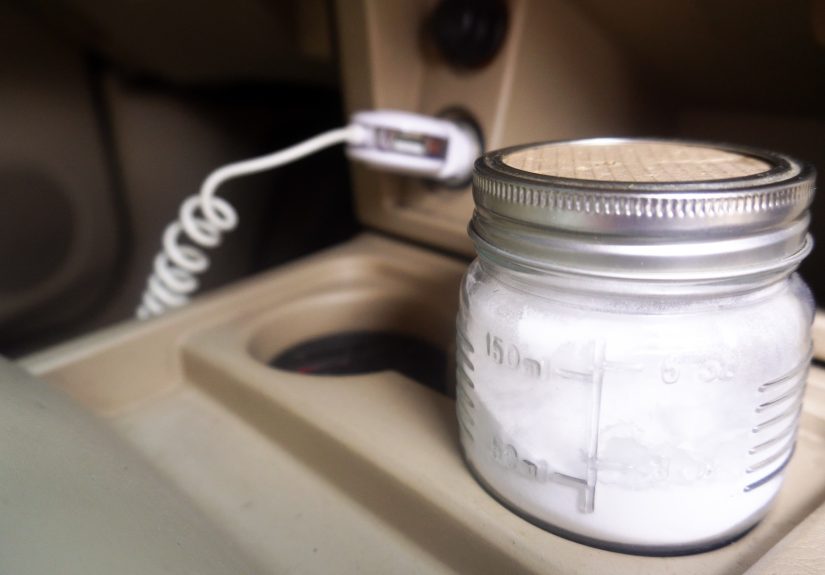
Option A: Baking soda odor absorber cup (classic + cheap)
Baking soda is widely used for odor control because it can help neutralize many odor-causing compounds. In an enclosed space like a car,
it works best when it’s exposed to airflow (not sealed shut).
What you’ll need
- 1 small plastic food container with a lid (or a jar with a lid)
- 1 cup baking soda
- Optional: 5–10 drops essential oil (for a light scent)
- Tool to make vents: scissors, nail, push pin, or a heated skewer (adult-only, please)
Steps
- Pour baking soda into the container.
- If using essential oils, add 5 drops first, stir, then smell-check. Add a few more drops if needed.
- Make small vent holes/slits in the lid (enough for airflow, not enough to spill).
- Close the lid and place the container under a front seat or in the trunk.
- Replace the baking soda about once a month (or sooner if odors are intense).
Option B: Activated charcoal sachet (the “set it and forget it” move)
Activated charcoal (often bamboo charcoal) is popular for odor control because it can adsorb odor-causing molecules. Many charcoal bags are
designed to work for long periods, and some can be “recharged” by placing them in sunlight.
What you’ll need
- Activated charcoal (granules) or a pre-filled charcoal bag
- Breathable fabric (cotton) + string (if making your own)
- Optional: 3–5 drops essential oil on the outside of the fabric (not on loose charcoal)
Steps (DIY sachet version)
- Place charcoal granules in the center of a fabric square.
- Gather fabric into a pouch and tie securely.
- Put it under a seat, in a door pocket, or near the source of odor.
- “Recharge” occasionally by placing it in sunlight if the product instructions recommend it.
Which should you choose?
- Baking soda: cheapest, easy to replace, great starter option.
- Charcoal: longer-lasting, often unscented, excellent for people with scent sensitivity.
Method 3: Gel Jar Freshener (Slow-Release Scent)
Gel fresheners are the “slow cooker” of car fragrance: they release scent gradually over time. The trick is to make a gel that sets well,
doesn’t leak, and doesn’t turn into a science fair project in your cupholder.
Best for
- People who want a steady, gentle scent
- Cars where hanging items are annoying or cluttery
- Anyone who likes the idea of a “refillable” freshener
DIY gel jar recipe (gelatin-based)
This style of gel freshener uses unflavored gelatin to create a solid gel that slowly releases fragrance as it sits uncovered or lightly vented.
What you’ll need
- Small glass jars with lids (or heat-safe plastic containers)
- 1 cup boiling water
- 4 packets unflavored gelatin
- 1 teaspoon essential oil
- 1 cup cool water
- 1 tablespoon salt (helps the mixture keep longer)
- Optional: 1 drop food coloring (purely for looks)
Steps
- Boil 1 cup of water. Pour into a heat-safe bowl.
- Whisk in the gelatin until fully dissolved.
- Add essential oil and stir well.
- Add 1 cup cool water and 1 tablespoon salt; stir again.
- Pour into small jars and let cool until gel sets.
- For car use, keep a lid on while driving, then crack the lid open (or poke a few tiny holes) when parked to release scent safely.
Where to place it
- In a cupholder (if stable), door pocket, or under-seat tray
- Avoid direct sun if possibleheat can soften gel and intensify fragrance fast
Scent Recipes (That Don’t Smell Like a Mall Candle Store)
Essential oils are powerfulespecially in a small space like a car. The goal is “fresh,” not “I can taste lavender with my eyes.”
Try these simple blends, then adjust drop-by-drop.
Fresh + clean blends
- Clean Citrus: 3 drops lemon + 2 drops grapefruit
- Soft Linen: 3 drops lavender + 2 drops lemon
- Herbal Reset: 2 drops rosemary + 2 drops eucalyptus + 1 drop lemon
Cozy blends (great in colder months)
- Vanilla Woods: 3 drops cedarwood + 2 drops sweet orange (add vanilla fragrance oil if you prefer)
- Warm Spice (light): 3 drops orange + 1 drop clove (go easyclove is bold)
Low-scent approach
If scents bother you (or your passengers), use Method 2 with charcoal or plain baking soda first, and add only 1–2 drops of oil
to a felt freshener for occasional use.
Safety + “Please Don’t Melt Your Dashboard” Tips
Car-safe placement
- Don’t block visibility: Hanging items should never obstruct the driver’s view.
- Avoid oil-on-plastic contact: Some oils can stain or soften plastics and finishes. Let oils absorb fully before placement.
- Heat changes everything: A hot car can intensify fragrance fast. Start with fewer drops than you think.
Sensitivity-friendly guidance
- If you’re prone to headaches, asthma symptoms, or irritation, choose unscented odor absorbers (charcoal) and keep fragrance minimal.
- Ventilate your car when possiblefresh airflow helps more than doubling down on scent.
- Keep essential oils away from kids and pets, and wash hands after handling concentrated oils.
of Real-World Experiences and What to Expect
DIY car air fresheners are simple, but the experience of using them day-to-day can surprise peoplemostly because cars are tiny, hot,
high-traffic environments where scent behaves like it’s had three energy drinks. So here’s what you can realistically expect when you try these
three methods, based on the most common DIY outcomes and the way these materials typically perform in small enclosed spaces.
First, the “too much scent” moment is real. A lot of folks assume “more drops = more better,” and then discover their car now
smells like a spa that got locked overnight. The fix is easy: use fewer drops, let the freshener air out for a few minutes at home, and remember
that your car’s heat will amplify everything. On day one, a felt or clothespin freshener often smells strongest in the first 30 minutes of driving,
then mellows into something more pleasant. If it stays aggressive, you probably over-oiled it or placed it directly in a high-blast vent stream.
Second, odor absorbers feel “boring” until you realize they’re doing the hard work. Baking soda and charcoal don’t always give
you that instant “ahhh” smell because their main job is to reduce what’s already nasty. People often notice this as a “the car just smells… normal”
effect after a day or two. That’s a win. In practice, baking soda tends to help most when the odor is mild-to-moderate and the container is vented
well. Charcoal bags feel almost magical for musty or lingering smells because they don’t add fragrance at allthey just make the background funk
stop shouting.
Third, gel fresheners are the steadiestif you place them wisely. When a gel jar sits securely (cupholder, door pocket, or a
stable tray), you get a consistent scent that doesn’t spike as hard as an oiled felt freshener. The tradeoff is that gel can soften in heat if it
sits in direct sun, and then you risk leaks or a sudden scent blast. The best real-life setup is keeping the lid closed while driving and only
cracking it open when parked or when the car is cooler. Some people also keep the gel jar in the trunk so it scents the cabin more subtly.
Fourth, the “my car still smells” problem usually isn’t the freshener. If odor keeps coming back, it’s often because the source
is still there: damp carpet under mats, a spill that soaked into foam, a trunk that stayed wet, or upholstery that needs a deeper clean. In those
situations, DIY fresheners become the final stepnot the whole solution. The most satisfying outcome tends to happen when you vacuum first, wipe
down hard surfaces, and then deploy Method 2 (odor absorber) for a week before adding Method 1 or 3 for fragrance.
Finally, the best “experience” is customization. Once you’ve made one DIY freshener, you can tune everythingstrength, scent
profile, and placementso your car smells like you (or at least the version of you who definitely does not eat fries in the driver’s seat).
Start small, tweak weekly, and you’ll land on a setup that feels clean, calm, and not like a chemical surprise.
Wrap-Up
A great DIY car air freshener isn’t complicatedit’s strategic. Use a vent clip (clothespin or felt) for quick fragrance, an under-seat absorber
(baking soda or charcoal) to actually tackle odors, and a gel jar for slow-release consistency. Mix and match based on your car, your commute,
and your tolerance for “strong scent energy.”
And if anyone asks why your car smells so nice, feel free to say, “Oh, it’s a custom blend,” like you’re a perfumer and not a person with a jar
of baking soda under the seat. Your secret is safe.