Table of Contents >> Show >> Hide
- Why Maps Make Brilliant Children’s Room Accessories
- Best Types of Maps for Children’s Room Decor
- How to Choose the Right Map for Your Child’s Age
- Design Ideas for Decorating With Maps
- Safety Tips for Map Decor in Children’s Rooms
- Color and Style Tips for a Beautiful Map-Themed Room
- DIY Map Decor Ideas
- How Maps Encourage Family Conversations
- Common Mistakes to Avoid
- Personal Experience: Living With Maps in a Child’s Room
- Conclusion
- SEO Tags
Some children want dinosaurs on the wall. Some want astronauts, jungle animals, rainbows, race cars, or a mural so dramatic it looks like the bedroom has its own passport. But few accessories work as hard as a map. A map in a child’s room is art, conversation starter, learning tool, travel dream board, and emergency answer to “Where is Madagascar?” all rolled into one handsome rectangle.
Using maps as children’s room decor is one of those rare design ideas that feels playful without being babyish. A nursery can wear a soft watercolor world map like a gentle bedtime story. A grade-school bedroom can handle a colorful U.S. map, a vintage-style globe print, or a peel-and-stick wall mural packed with animals, flags, oceans, mountains, and enough labels to make geography homework less mysterious. For tweens, a framed antique map, subway map, constellation chart, or personalized travel map can look stylish and grown-up without draining the room of personality.
The beauty of map decor is that it meets children where they are. Toddlers point at animals. Early readers sound out state names. Older kids start asking why borders look the way they do, how long it takes to fly to Japan, or whether they can please, please, please visit Italy because “the boot country has pasta.” That is the secret power of map accessories: they turn blank walls into invitations.
Why Maps Make Brilliant Children’s Room Accessories
Children’s rooms need decor that can survive changing interests. A wall full of cartoon characters may be adorable today and deeply embarrassing by next Tuesday. Maps have a longer shelf life. They are colorful enough for childhood, smart enough for school years, and stylish enough to grow with a room as bedding, rugs, and storage change over time.
Maps also support spatial thinking, which is the ability to understand location, distance, direction, scale, and relationships between places. In everyday terms, that means children begin to understand that the park is north of home, the ocean is not “behind the grocery store,” and Australia is not simply “down there with kangaroos.” When a map is visible every day, it quietly builds familiarity. No flashcards required. No quiz voice. Just a wall doing educational heavy lifting while looking fabulous.
They Mix Learning With Imagination
A good children’s map does not need to look like a school worksheet. The best ones are visually inviting. They may include animals, landmarks, ocean creatures, mountains, flags, famous buildings, or playful illustrations. A map can inspire a child to invent stories: a pirate sailing from island to island, a family road trip across the United States, a safari in Kenya, or a train ride through Europe.
That combination of learning and imagination is what makes maps so useful as accessories. They do not shout, “Education is happening!” They whisper, “What if we went here?” Children are much more likely to engage with a map that feels like an adventure than one that feels like homework in wallpaper form.
They Work With Many Room Styles
Map decor is surprisingly flexible. A muted vintage map looks beautiful in a classic bedroom with wood furniture and plaid bedding. A bold illustrated world map pairs well with bright storage bins and modern bunk beds. A black-and-white city map can fit a minimalist tween room. A pastel map mural can soften a nursery. A cork travel map can become a practical pinboard for photos, postcards, and tiny souvenirs.
In other words, maps are not locked into one theme. They can lean academic, adventurous, cozy, modern, rustic, Montessori-inspired, or globe-trotting chic. That is a lot of personality for one wall accessory.
Best Types of Maps for Children’s Room Decor
Before buying the first world map that appears online, think about your child’s age, the size of the room, and how interactive you want the decor to be. A map can be a framed print, a mural, a decal, a fabric hanging, a puzzle, a rug, or even a lampshade. Yes, a map lampshade exists somewhere, because the internet is both useful and dramatic.
World Map Wall Murals
A world map mural is the big, bold choice. It can cover an entire wall and instantly define the room. This works especially well behind a bed, above a play area, or along one long wall in a shared bedroom. Large-scale maps give children room to explore details, trace routes with a finger, and notice how continents and oceans connect.
For smaller bedrooms, choose a mural with breathing room in the design. Light backgrounds, soft colors, and clear labels can keep the room from feeling crowded. If the mural is busy, balance it with simple bedding and fewer competing patterns. The map should be the star, not one more contestant in a visual talent show.
Framed Map Prints
Framed map prints are perfect if you want flexibility. You can hang one large print above a desk, create a gallery wall of several maps, or choose a custom map of a meaningful place: a hometown, birth city, favorite vacation spot, national park, or the state where grandparents live.
Frames make map decor feel polished. They also make it easy to update the room later. Swap a nursery animal map for a vintage U.S. map, a national parks map, or a transit map when your child gets older. The wall stays useful, and no one has to peel 47 square feet of wallpaper while questioning every life decision.
Peel-and-Stick Map Decals
Peel-and-stick decals are a renter-friendly option and a lifesaver for parents who like the phrase “low commitment.” They are especially useful for nurseries, playrooms, and apartments where painting or permanent wallpaper is not ideal. Many peel-and-stick map designs include animals, flags, landmarks, and cheerful colors.
For best results, apply decals to a clean, smooth wall and follow the product directions carefully. Let fresh paint cure before installing anything adhesive. Order a sample if available, especially if wall texture, paint finish, or humidity might affect adhesion. Peel-and-stick is easier than traditional wallpaper, but it is not magic. It still appreciates patience, a level, and at least one adult who has not had too much coffee.
Map Rugs and Floor Mats
A map rug can turn the floor into a play zone. Road-map rugs are classics for toy cars, while world map rugs or U.S. map mats bring geography down to a child’s level. This is great for younger kids who learn through movement. They can hop from state to state, place animal figures on continents, or build block towers in the middle of the Pacific Ocean because toddlers respect no maritime boundaries.
Choose rugs with washable materials, non-slip backing, and low pile if the room already contains building toys, train tracks, or tiny plastic pieces that enjoy hiding from bare feet.
Globes as Decorative Accessories
No map-themed room is complete without considering a globe. A globe adds dimension and helps children understand that the Earth is round, not a flat poster with oceans politely staying in place. Classic blue globes work well on desks and bookshelves. Illuminated globes can double as soft evening lighting. Modern globes in muted colors can look elegant in older children’s rooms.
Place globes where children can safely touch and spin them. A globe that is too precious to handle becomes just another dust collector. A child-friendly globe, on the other hand, becomes a launchpad for questions: Why is Antarctica so big? Where do penguins live? Can we go to Brazil? How long would it take to walk to Canada? Please do not test that last one.
How to Choose the Right Map for Your Child’s Age
The best map decor changes with a child’s developmental stage. A toddler does not need a politically detailed map with every capital city labeled. A 10-year-old may want exactly that. The goal is to choose a map that invites curiosity without overwhelming the room or the child.
For Babies and Toddlers
For nurseries and toddler rooms, focus on simple shapes, soft colors, and friendly illustrations. Animal maps, continent maps, and gentle watercolor designs work beautifully. At this age, the map is more about visual warmth and early exposure than accuracy drills.
Hang wall decor securely and avoid placing heavy framed pieces directly above cribs, beds, or changing tables. Soft fabric maps, decals, or murals are often better choices near sleep areas. Keep cords, hanging pieces, and anything climbable out of reach.
For Preschool and Early Elementary Kids
This is the sweet spot for interactive maps. Children ages 3 to 8 often love pointing, naming, matching, and asking questions. A colorful world map with animals and landmarks can help them connect places with memorable images. A U.S. map can introduce states, regions, rivers, mountains, and where relatives live.
Consider adding a small basket of related items nearby: animal figures, postcards, travel photos, picture books, or a magnifying glass. Suddenly the map becomes a mini learning station. Fancy name: geography corner. Real-life name: the place where your child asks 19 questions while you are trying to fold laundry.
For Tweens and Teens
Older children may prefer map decor that feels more sophisticated. Think antique-style maps, city grids, national park posters, constellation maps, topographic prints, subway maps, or push-pin travel maps. A teen who loves history may enjoy a historic map reproduction. A future architect may love a black-and-white city plan. A nature-loving child may prefer a map of U.S. national parks or mountain ranges.
At this stage, let children help choose. Their room is becoming part retreat, part study space, part identity lab. Map decor can support their interests without making the bedroom look like a classroom after a bulletin-board explosion.
Design Ideas for Decorating With Maps
Maps are versatile, but placement matters. The right map in the right spot can make a room feel intentional. The wrong map in the wrong spot can make it look like someone lost a geography fair.
Create a Map Accent Wall
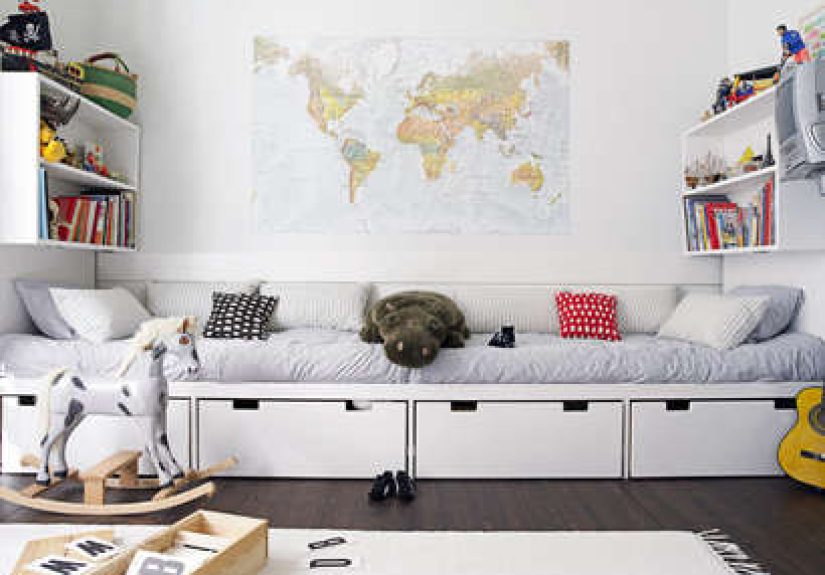
An accent wall is the easiest way to make a map feel like a design feature rather than an afterthought. Choose the wall behind the bed, behind a desk, or opposite the doorway so the map is visible when entering the room. Keep surrounding furniture simple. Natural wood, white furniture, navy accents, sage green, mustard yellow, and warm neutrals all pair beautifully with map colors.
If the map is vibrant, repeat one or two colors from it elsewhere in the room. For example, pull blue from the oceans into the curtains, green from continents into storage baskets, or red from map icons into a throw pillow. This simple trick makes the room feel designed rather than decorated by a very enthusiastic cartographer.
Build a Travel Memory Wall
A map becomes more meaningful when it connects to family stories. Frame a map and surround it with photos from trips, postcards from relatives, ticket stubs, museum brochures, or small handwritten notes. Mark places your family has visited or places you hope to visit.
This does not require world travel. Local adventures count. Mark the zoo, a favorite beach, a national park, grandma’s house, the town with the best doughnuts, or the campground where everyone learned that raccoons are basically tiny burglars.
Use Maps Around a Study Space
Maps work especially well near desks. They support homework, reading, writing, and daydreaming, which is an underrated academic skill when used responsibly. A U.S. map can help with history and social studies. A world map supports geography, current events, and cultural learning. A city map can help children understand neighborhoods, transit, and how communities fit together.
Add a small shelf with an atlas, children’s geography books, a globe, and labeled bins for pencils and art supplies. The result is a study area that feels purposeful but not stiff.
Try a Map Gallery Wall
A gallery wall can combine several map styles: a world map, a state map, a constellation chart, a national parks poster, and a framed quote about adventure. Keep frames consistent for a cleaner look, or mix natural wood, white, and black frames for a collected feel.
For younger children, hang gallery pieces higher than climbing height and use secure hardware. For older kids, include one interactive piece like a cork map, magnetic map, or dry-erase map to keep the display from becoming purely decorative.
Safety Tips for Map Decor in Children’s Rooms
Beautiful children’s room decor should also be safe. Any wall accessory in a child’s bedroom needs smart placement, secure installation, and regular checks. This is especially important with heavy frames, shelves, large boards, or furniture placed below wall decor.
Avoid Heavy Frames Above Beds
Do not hang heavy framed maps above cribs, toddler beds, or areas where children jump, climb, or nap. Use lightweight canvas, fabric maps, decals, or murals in those zones. If you do hang framed art elsewhere, use proper wall anchors and check that the frame is secure.
Anchor Furniture Near Map Walls
If a map is placed above a dresser, bookshelf, or desk, make sure nearby furniture is anchored to the wall. Children may climb furniture to reach a map, sticker, pin, or interesting corner of a mural. Tall or heavy furniture should be secured with appropriate anti-tip hardware.
Be Careful With Pins and Magnets
Push-pin maps are wonderful for older children, but they are not ideal for toddlers or preschoolers. Small pins and magnets can be choking hazards. For younger kids, use stickers, felt markers, Velcro pieces, or adult-supervised activities instead.
Color and Style Tips for a Beautiful Map-Themed Room
Map decor can become the room’s color palette. If the map has ocean blues, sandy neutrals, leafy greens, and tiny red labels, you already have a decorating plan. Pull those colors into bedding, curtains, lamps, baskets, or pillows. This keeps the room calm even when the map itself is detailed.
For a Calm Nursery
Choose soft watercolor maps, muted pastels, or neutral-toned continent prints. Pair them with cream walls, light wood furniture, woven baskets, and gentle lighting. Keep labels large and minimal if the goal is serenity.
For an Adventurous Kids’ Room
Choose a colorful illustrated world map with animals, landmarks, ships, airplanes, or hot air balloons. Add striped bedding, canvas storage, a reading tent, and a few travel-themed books. The room will feel adventurous without requiring a full pirate ship bed, although no judgment if your child is lobbying hard for one.
For a Sophisticated Tween Room
Try a vintage map, black-and-white city grid, topographic print, or national parks map. Pair it with solid bedding, a sturdy desk, metal lighting, and simple shelves. The look feels mature but still personal.
DIY Map Decor Ideas
Maps do not have to be expensive to be effective. A little creativity can turn basic maps into custom children’s room accessories.
Frame Wrapping Paper or Poster Maps
Many beautiful maps are available as posters or even wrapping paper. Place one in an inexpensive frame for instant art. This is a budget-friendly way to create a large focal point without buying custom artwork.
Make a Map Letter Display
Cover wooden letters with map paper to spell a child’s name, initials, or a word like “explore.” This small accessory works well on shelves, above desks, or on bedroom doors.
Create a Postcard-and-Map Board
Mount a map on cork board and add postcards, family photos, or small notes. For younger children, skip pins and use clips or removable adhesive dots. For older kids, let them mark dream destinations or places they are learning about in school.
Decorate Drawer Fronts or Storage Boxes
Use map-patterned paper to cover drawer fronts, storage boxes, or magazine holders. This adds a subtle map theme without overwhelming the walls. It is also a clever way to rescue plain storage from looking like it came straight from the land of beige responsibility.
How Maps Encourage Family Conversations
One of the best parts of decorating with maps is that they naturally invite conversation. A child may ask where a parent grew up, where a grandparent was born, where a favorite animal lives, or why some places are colder than others. These questions can turn into stories about family history, culture, food, language, weather, wildlife, and travel.
A map can also help children understand the news in an age-appropriate way. When they hear about a country, state, ocean, or storm, they can look for it on the wall. This gives abstract information a physical place. The world becomes less vague and more connected.
Common Mistakes to Avoid
The first mistake is choosing a map that is too detailed for the child’s age. Tiny labels and dense political borders may look impressive, but they can frustrate younger kids. Start with clarity, then add complexity as the child grows.
The second mistake is letting the map clash with every other pattern in the room. If the map is busy, simplify the bedding and rug. If the room already has patterned wallpaper, choose a framed map with a quieter design.
The third mistake is treating the map as permanent. Children change. Rooms evolve. Choose removable options when possible, especially in rentals or early childhood spaces. A map should support curiosity, not become a wall-sized commitment that haunts you through three furniture rearrangements.
Personal Experience: Living With Maps in a Child’s Room
In real life, map decor works best when it is not treated as precious. The most successful map-themed children’s rooms are the ones where kids are allowed to interact with the map, ask questions, make observations, and occasionally point at Greenland with peanut-butter fingers. A map that can be touched, discussed, and used will always beat a perfect map that everyone is afraid to approach.
One practical experience many families discover quickly is that maps become part of bedtime conversation. A parent might say, “Pick one place for tonight’s story,” and the child points to Egypt, Alaska, Hawaii, or the Amazon rainforest. Suddenly bedtime has a setting. The story has camels, glaciers, volcanoes, or jaguars. The child learns a little geography without anyone opening a workbook. That kind of learning sticks because it is attached to warmth, routine, and imagination.
Maps can also help children process distance and relationships. When relatives live far away, a wall map gives children a way to understand where those people are. A sticker on grandma’s state, a heart near a cousin’s city, or a photo beside a country of origin can make family connections visible. For children in military families, immigrant families, blended families, or families with loved ones who travel often, a map can become emotionally meaningful, not just decorative.
Another useful experience is rotating map activities by season. During summer, the family can mark road trips or local day trips. In winter, children can learn about polar regions, snowy mountains, or holiday traditions around the world. Around birthdays, they can find where favorite foods, animals, or inventions come from. A map keeps offering new angles, which makes it more durable than many themed accessories.
There is also a design lesson here: children’s rooms do not need to be filled with expensive items to feel special. A single large map can do more for a room than a dozen small decorations. It adds color, scale, meaning, and structure. If the budget is tight, invest in one strong map feature and keep the rest simple. A map wall, clean bedding, a few baskets, and a cozy reading light can look more polished than a room crowded with random accessories.
Parents also learn that map decor grows with the child when it is chosen thoughtfully. The animal map that delights a preschooler may eventually be replaced by a national parks map, then a city transit print, then a framed vintage map. The theme remains, but the style matures. That is a major advantage for anyone who does not want to redecorate from scratch every time a child develops a new obsession.
Finally, maps remind children that their room is not the whole world. That may sound obvious, but it is a lovely message. A bedroom should feel safe and personal, yet it can also point outward. Maps say there are mountains to climb, oceans to protect, languages to hear, foods to taste, people to meet, and questions worth asking. As children’s room accessories go, that is a pretty impressive job description for something hanging on a wall.
Conclusion
Maps as children’s room decor are more than attractive accessories. They bring color, curiosity, learning, and personal meaning into a space where children sleep, play, read, build, dream, and occasionally hide socks in places no map can explain. Whether you choose a peel-and-stick mural, framed world map, globe, map rug, cork board, or vintage city print, the right map can make a child’s room feel bigger in the best possible way.
The smartest approach is to match the map to your child’s age, interests, and room style. Keep safety in mind, especially around beds, heavy frames, furniture, pins, and small pieces. Choose designs that invite interaction. Add books, photos, postcards, or travel memories to make the map personal. Most of all, let the map become part of daily life. The best children’s room decor does not just sit there looking cute. It starts conversations, sparks imagination, and gives kids a gentle nudge toward the wide, wonderful world beyond their bedroom door.