Table of Contents >> Show >> Hide
- Why Energy Efficiency Matters in Software
- What the Research Actually Suggests
- What Makes One Language More Energy Efficient Than Another?
- A Practical Look at Major Languages
- How to Assess Energy Efficiency Fairly
- How to Improve Energy Efficiency Without Switching Languages
- Experiences From Real-World Engineering Practice
- Conclusion
- SEO Tags
Programming languages are a bit like cars in a parking lot. Some are tiny hybrids that sip power politely. Some are muscle cars that roar, burn fuel, and still make you grin. And some are roomy family SUVs that do everything reasonably well, even if they are not winning any eco-rallies. The catch is that software energy efficiency is not as simple as crowning one language the green champion and calling it a day.
That is exactly why assessing the energy efficiency of programming languages has become such a fascinating topic. Developers want faster applications, lower cloud bills, cooler laptops, longer battery life, and smaller environmental footprints. Businesses want more throughput without setting the electricity meter on fire. Meanwhile, engineers everywhere would prefer not to rewrite an entire codebase just because a benchmark chart on social media looked dramatic.
The real answer is more nuanced and far more useful. Yes, language choice can influence runtime behavior, memory allocation, garbage collection, startup cost, and optimization opportunities. But execution time, implementation details, compiler settings, algorithms, parallelism, and libraries often matter just as much, and sometimes more. In other words, the greenest language is not always the one wearing the flashiest cape.
Why Energy Efficiency Matters in Software
Energy efficiency in programming is no longer a niche concern for people who enjoy hugging servers. It has become a practical engineering issue. On mobile devices, inefficient code drains batteries faster. In data centers, inefficient applications can increase electricity use, cooling demands, and infrastructure costs. In edge computing and embedded systems, every watt matters. Even for ordinary web applications, inefficient backend code can quietly turn into a monthly invoice that ruins someone’s mood.
There is also a performance angle. In many workloads, the same factors that improve speed can also improve energy efficiency. Less time spent executing instructions often means less total energy consumed. That is why the conversation around green software often overlaps with performance engineering. Faster code is not always greener, but it frequently heads in that direction.
Still, developers should resist the temptation to oversimplify the issue. Energy is not determined by language syntax alone. A beautifully written algorithm in a higher-level language may outperform a clumsy low-level implementation. Likewise, a managed runtime with a smart JIT compiler may beat an ahead-of-time compiled binary in some real-world cases. Software engineering, as usual, refuses to be boring.
What the Research Actually Suggests
Benchmark studies usually reward native, compiled code
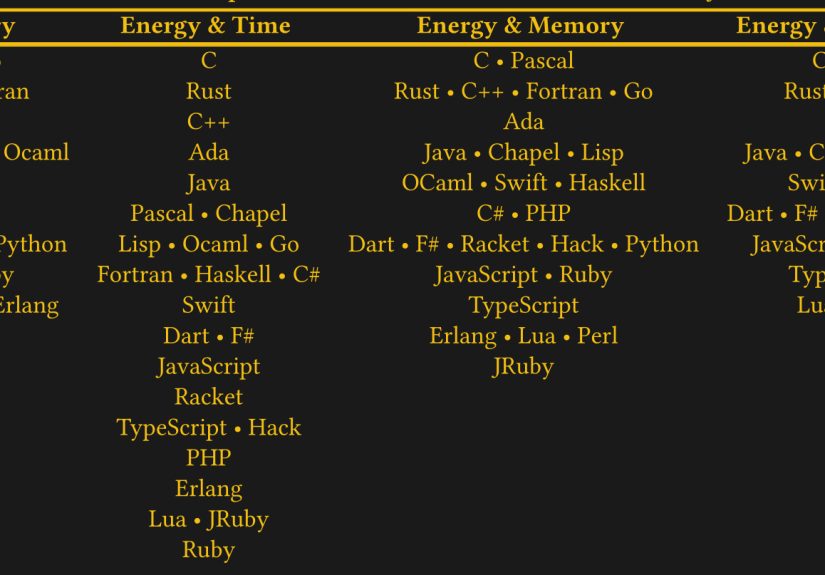
Many widely discussed benchmark studies have shown that languages such as C, C++, Rust, and sometimes Ada or Fortran often perform well in CPU-heavy workloads. That tends to happen for understandable reasons. These languages are typically compiled ahead of time to efficient machine code, offer tighter control over memory, and often introduce less runtime overhead than heavily managed or interpreted environments.
When you run tight loops, numeric simulations, or algorithm-heavy workloads, native compiled languages often shine. They usually start quickly, allocate less overhead per abstraction, and let the compiler squeeze more value out of the hardware. That combination can reduce both execution time and total energy use. In benchmark-friendly scenarios, this pattern appears again and again.
But modern research adds an important correction
Newer analysis has pushed back on simplistic language rankings. The more careful view is that what people often call a “language effect” is really a bundle of implementation effects. Garbage collection strategy, JIT warm-up, runtime version, compiler flags, memory activity, number of active cores, and even benchmark-specific coding choices can heavily shape the result.
That means a headline like “Language X uses half the energy of Language Y” may sound much more definitive than the evidence actually supports. In many cases, the bigger driver is execution time. If a program finishes sooner, it often uses less total energy. Once confounding factors are controlled, the language itself may matter less than the quality of its implementation and the efficiency of the program being run.
So the responsible conclusion is not that language choice is irrelevant. It is that language choice should be evaluated as part of a complete system, not as magic wallpaper pasted over the laws of physics.
What Makes One Language More Energy Efficient Than Another?
Compilation model
Ahead-of-time compiled languages usually convert source code into native machine code before execution. This often reduces startup overhead and can make runtime behavior more predictable. Languages built on strong optimizing toolchains can benefit from inlining, interprocedural optimization, vectorization, and link-time optimization. That tends to help both speed and energy usage.
JIT-compiled languages, on the other hand, make trade-offs. They may start slower or spend energy profiling and recompiling hot code paths, but they can also optimize aggressively based on actual runtime behavior. For long-running server applications, this can be a major advantage. For short-lived CLI tools, the warm-up cost may hurt efficiency.
Memory management
Memory is where many energy stories become interesting. Automatic garbage collection improves developer productivity and safety, but it introduces runtime work. Collections, object tracing, compaction, write barriers, and heap growth all have costs. Those costs are not automatically disastrous, but they are real. Languages and runtimes differ in how well they hide or reduce them.
Rust takes a different route with ownership and borrowing, aiming for memory safety without a garbage collector. That can reduce runtime overhead in many workloads. Go uses garbage collection but offers tunable trade-offs between CPU use and memory. Java and .NET use highly optimized generational garbage collectors that can perform impressively well when the workload fits their design. Python and JavaScript combine higher-level ergonomics with memory managers that are friendly to humans, though not always to raw efficiency contests.
Abstraction overhead
Not all abstractions cost the same. Some are almost free after compilation. Others keep charging rent every time your code runs. Languages designed around zero-cost abstractions try to give developers expressive tools without adding runtime penalties. Rust is famous for this approach, and C++ has pursued similar goals for years. In contrast, dynamic typing, reflection, boxed values, and heavy object models can increase overhead if used carelessly.
That said, abstraction is not the villain. Badly chosen data structures, excessive allocations, and inefficient algorithms usually do far more damage than a tasteful layer of abstraction. The real question is whether your abstractions help the compiler and runtime, or force them to carry your code uphill.
A Practical Look at Major Languages
C and C++
C and C++ are still central to conversations about energy-efficient programming because they offer close-to-metal control and mature compiler ecosystems. With good optimization flags, careful memory layout, and efficient algorithms, they can deliver excellent results. They are common in systems programming, embedded software, high-performance computing, and performance-critical libraries.
The downside is that this power comes with sharp edges. Manual memory management, undefined behavior, complex optimization interactions, and maintainability challenges can offset theoretical efficiency if the codebase becomes fragile or hard to improve. A fast program nobody can safely change is not always a long-term win.
Rust
Rust has earned its reputation as a strong candidate for energy-aware systems work because it combines native compilation with memory safety and no tracing garbage collector. Its ownership model shifts a lot of safety checking to compile time, and its zero-cost abstraction philosophy aims to keep high-level constructs from turning into runtime baggage.
That makes Rust appealing for teams that want much of the efficiency profile associated with C and C++ but with stronger guardrails. It is especially attractive in infrastructure, networking, security-sensitive systems, and tools where reliability and performance need to share the same apartment.
Java and C#
Java and C# are sometimes treated unfairly in simplistic efficiency debates. Yes, they run on managed platforms and use garbage collection. But modern JVM and .NET runtimes are packed with performance engineering. Tiered compilation, profile-guided optimization, compact representations, escape analysis, and generational GC can make these languages far more efficient than outdated stereotypes suggest.
For long-running enterprise services, they can be remarkably competitive. Warm-up overhead may exist, but once hot code paths settle in, managed runtimes can deliver strong throughput. In real business systems, developer productivity, stability, observability, and mature tooling often make Java and C# highly sensible choices, especially when the alternative is a heroic rewrite followed by regret.
Go
Go often lands in a practical middle ground. It compiles to native code, starts quickly, and supports concurrency well. Its runtime and garbage collector introduce overhead, but the language is designed for operational simplicity and predictable deployment. For cloud services, APIs, and infrastructure tools, Go often achieves a solid balance between performance, energy efficiency, and team velocity.
Its memory model and GC settings matter, though. In memory-heavy services, tuning the garbage collector and reducing allocations can noticeably improve resource use. Go is a good reminder that “efficient by default” is nice, but “efficient after profiling” is nicer.
Python and JavaScript
Python and JavaScript are productivity superstars, and that matters. They let teams build features quickly, automate workflows, and tap into enormous ecosystems. In pure interpreter-bound or dynamically typed hot loops, they are often less energy efficient than native compiled alternatives. But that does not make them bad engineering choices.
Python often wins in data science, scripting, and machine learning because critical work is offloaded to optimized native libraries written in C, C++, or CUDA-backed frameworks. JavaScript benefits from sophisticated engines such as V8, which use interpreters and optimizing compilers to improve both startup and peak performance. In practice, the energy story for these languages depends heavily on whether the workload is dominated by the language runtime itself or by optimized libraries underneath.
How to Assess Energy Efficiency Fairly
If you want to compare programming languages responsibly, you need a testing method that would survive an engineering review instead of collapsing like a folding chair. Start with the same algorithm, the same input data, and the same hardware. Measure execution time, CPU usage, memory activity, and energy consumption together. Warm up JIT runtimes before drawing conclusions. Pin versions of compilers, interpreters, and libraries. Document optimization flags. Repeat runs enough times to smooth out noise.
You should also account for startup versus steady-state behavior. A short-lived command-line utility may favor ahead-of-time binaries. A server that runs for weeks may benefit from JIT optimization. Likewise, parallelism matters. A program that burns more power but finishes much faster may still consume less total energy. Looking only at watts without considering time is like judging a road trip by engine noise alone.
And please do not treat microbenchmarks as a full model of production software. They are useful, but they are not a prophecy. Real systems include databases, networks, disk I/O, caches, serialization, framework overhead, and user traffic patterns. Benchmarks tell you something. They do not tell you everything.
How to Improve Energy Efficiency Without Switching Languages
Pick better algorithms first
If one version of your program performs one billion unnecessary operations, no language choice will rescue it elegantly. Algorithmic improvements usually deliver the biggest gains in both speed and energy efficiency.
Reduce unnecessary allocations
Allocation-heavy code creates more work for memory managers and increases cache pressure. Reuse objects where appropriate, prefer efficient data structures, and avoid building mountains of temporary objects just because your CPU seems friendly.
Use optimized libraries
High-level languages often become far more efficient when the expensive work is delegated to optimized native libraries. This is one reason Python remains dominant in many technical fields despite not winning raw loop contests.
Tune the runtime
Garbage collector settings, heap size, JIT modes, startup configuration, and compiler flags can change outcomes materially. Sometimes the greenest rewrite is not a rewrite at all. It is one thoughtful configuration file and an afternoon with a profiler.
Measure real workloads
If your application spends most of its time waiting on the network, switching from Python to Rust may not magically slash the power bill. Measure the part of the system that actually costs energy. Otherwise, you may end up optimizing the software equivalent of a decorative throw pillow.
Experiences From Real-World Engineering Practice
One of the most consistent experiences teams report when assessing the energy efficiency of programming languages is that their first assumption is usually too simple. A team starts with a neat theory: “We should move this service from Python to Go,” or “Rust will cut our power use in half,” or “The JVM is the problem.” Then they measure the workload and discover that the real issue is an inefficient query, a chatty API, a memory-hungry cache layer, or a background task doing the same work three times because nobody wanted to touch the legacy scheduler. The language was not innocent, exactly, but it was also not the criminal mastermind.
Another common experience shows up in short-lived versus long-running programs. For command-line tools, build scripts, and tiny batch jobs, startup overhead becomes very visible. Native binaries often feel wonderfully lean because they begin working right away. Managed runtimes can spend noticeable time warming up, loading metadata, and preparing hot paths. But once teams measure web services or streaming systems that stay alive for days, the results often shift. A runtime with JIT optimization may spend a little more energy getting started and then make it back through better steady-state throughput. That is why seasoned engineers try hard not to confuse “fast in the first second” with “efficient over the next six months.”
There is also a recurring lesson around libraries. Teams benchmarking Python or JavaScript sometimes come away discouraged after looking at interpreter-bound code. Then they rerun the test using optimized libraries for array math, parsing, compression, or machine learning inference and suddenly the gap narrows dramatically. The practical experience is that ecosystems matter. A language with access to highly tuned native components can deliver much better energy behavior than its bare syntax would suggest. In production, nobody wins points for refusing to use a fast library just to protect a tidy benchmark narrative.
Developers also learn, sometimes painfully, that memory behavior is a huge part of the story. Excess allocation, object churn, poor locality, and careless data structure choices can quietly wreck efficiency in almost any language. Teams working in Go, Java, or C# often report that reducing allocations and tuning runtime behavior produced larger gains than rewriting entire modules. Teams working in C++ or Rust often discover the mirror image: low-level control helps, but it does not automatically save a design with poor cache behavior or unnecessary copying.
Perhaps the most valuable experience is cultural rather than technical. Once an organization starts measuring energy as part of performance work, decision-making gets smarter. Engineers stop arguing in absolutes. Product teams become more comfortable with trade-offs. Leaders learn that the best language for energy efficiency is often the one that lets a team ship an efficient design, profile it well, and keep improving it safely. That answer is less dramatic than a top-ten ranking, but it is far more useful when the electric bill arrives.
Conclusion
Assessing the energy efficiency of programming languages is worth doing, but it should be done with a calm head and a profiler nearby. Native compiled languages often look strong in benchmark settings, especially for CPU-bound work. Managed and dynamic languages can carry more runtime overhead, yet modern virtual machines, garbage collectors, and optimized libraries narrow the gap more than many people expect.
The smartest takeaway is not “always choose Language X.” It is “understand your workload.” If your goal is greener software, focus on algorithms, execution time, memory behavior, compiler and runtime tuning, and the realities of your deployment environment. Language choice matters, but it matters as part of a system. In software, as in life, context is doing a suspicious amount of work.
Note: This article is cleaned for web publishing and excludes stray citation placeholders or contentReference-style artifacts.