Table of Contents >> Show >> Hide
- Why De Maria Became a Design Conversation, Not Just a Restaurant
- What “Bauhaus” Actually Means Here (And Why It’s Not Just a Buzzword)
- Inside the Room: The Design Moves That Did the Heavy Lifting
- Menu and Space: Why the Food Strategy Matched the Design Strategy
- Recognition, Momentum, and the Short Arc
- What Hospitality Brands Can Learn from “Bauhaus on the Bowery”
- Why the Story Still Resonates in 2026 and Beyond
- Extended Experience Section (Approx. )
- Conclusion
Some restaurants want to feed you. Some want to impress you. A very small number try to redesign your relationship with time, space, and maybe your laptop battery percentage. De Maria, the all-day cafe that landed on Kenmare Street near the Bowery, did all threewhile looking like a playful Bauhaus sketchbook took a sabbatical in downtown Manhattan.
If you heard people call it “Bauhaus on the Bowery,” they weren’t being dramatic (well, maybe a little). The room balanced geometry and warmth, rigor and whimsy, and the kind of modernist restraint that says, “Yes, I own exactly one ceramic mug and it is perfect.” Yet this wasn’t a sterile design showroom. It was a social machine: breakfast, lunch, afternoon work session, impromptu date, early dinner, and one more sparkling water because nobody wanted to leave.
This story is about more than a trendy NYC cafe that had a bright burst and a short run. It’s about why De Maria still matters in conversations about hospitality design, all-day cafe culture, and what happens when Bauhaus ideas collide with Bowery energy. We’ll unpack the design language, the urban context, the menu philosophy, and the practical lessons modern restaurant brands can steal (politely, creatively, and preferably with consent).
Why De Maria Became a Design Conversation, Not Just a Restaurant
De Maria opened at a moment when New York’s all-day cafe culture was accelerating: spaces that looked like restaurants, felt as relaxed as coffee shops, and invited guests to drift between work, meals, and social time. Instead of forcing strict dining rituals, these places embraced fluidity. Come in at 10:30 a.m. with a notebook. Stay for lunch. Maybe return for dinner. Maybe never emotionally leave.
That format shaped De Maria’s identity from day one. It wasn’t trying to be a classic white-tablecloth destination or a quick espresso bar. It offered a hybrid rhythm: visually striking enough for design lovers, informal enough for regulars, and comfortable enough for the “I’ll just sit here for twenty minutes” crowd who mysteriously become a four-hour tenancy.
Location, Location, Cultural Friction
The Kenmare Street address placed De Maria at a crossroads: Nolita’s boutique intimacy, SoHo’s design-conscious legacy, and Bowery’s rawer edge. That mix mattered. A purely polished location might have made the concept feel too curated. A purely gritty one might have muted the design narrative. Here, the tension worked in De Maria’s favor: art-school seriousness with downtown looseness.
The result was a cafe that felt both intentional and open-ended. It belonged to the neighborhood but also staged a new version of itless “old New York diner,” more “creative studio where lunch happens to be very good.”
What “Bauhaus” Actually Means Here (And Why It’s Not Just a Buzzword)
Let’s clear one thing up: “Bauhaus” does not mean plain white walls and pretending you don’t need storage. Historically, Bauhaus (founded in 1919 by Walter Gropius) pursued a radical goal: unite art, craft, and design to build a modern material culture. In other words, make objects and spaces that are useful, beautiful, and built for real lifenot just museum pedestals.
That philosophy evolved toward production-minded design: humble materials, practical forms, visual clarity, and structural honesty. For hospitality spaces today, that translates into a simple question: can the room do its job brilliantly while still feeling emotionally alive?
From Theory to Table
De Maria’s design language read as Bauhaus-adjacent in three key ways:
- Functional planning: clear sightlines, defined zones, and a bar that worked as social anchor and visual center.
- Geometric confidence: arches, tiled mural blocks, and orderly patterns that made the room legible without over-explaining itself.
- Material pragmatism: brick, wood, tile, leather, and metal used with restraintenough texture to feel human, not so much that the room became noisy.
Bauhaus values rarely appear as historical cosplay in good restaurant design. They appear as discipline. De Maria didn’t look like a 1920s classroom. It looked like a contemporary answer to a classic design challenge: how do you make a high-traffic social space feel calm, useful, and distinct?
Inside the Room: The Design Moves That Did the Heavy Lifting
Coverage of De Maria repeatedly described the interior as an artist’s loft with Bauhaus references and nods to 1970s SoHo. That’s a loaded phrase, but in this case it wasn’t fluff. The design by The MP Shift (Amy Morris and Anna Polonsky, with Julie Nerenberg on the award-winning team) assembled a coherent visual system from a handful of disciplined moves.
1) The Archway as Urban Stage
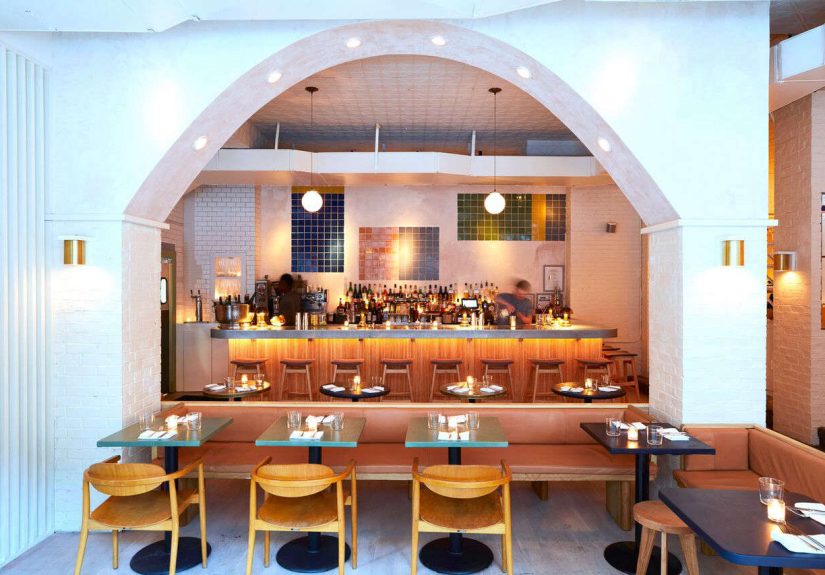
A central arch framed the bar and divided the dining zone without shutting it down. This is a classic hospitality trick done well: create “rooms within a room” so people feel oriented, while preserving flow. From the sidewalk, the arch also acted like a proscenium. You didn’t just see furnitureyou saw a scene.
2) White Brick + Warm Woods = Calm Backbone
White-painted brick and bleached flooring gave the interior daylight bounce and visual continuity. Warm woods and caramel leather banquettes kept the space from drifting into gallery coldness. In practical terms, this palette also made the room photogenic across morning sun, afternoon cloud, and evening artificial lightcritical for an all-day concept in a social-media city.
3) The Tile Mural as Identity Marker
Over the bar, a geometric tile mural provided the signature graphic moment. Not accidental decorationbrand architecture. According to design coverage, inspiration traced to work associated with artist David Novros and Donald Judd. This mattered because the mural carried art-world reference without alienating casual guests. You didn’t need an MFA to enjoy it; you just needed eyeballs.
4) Orb Lighting and Tactile Contrasts
Orb-like brass pendants, felt-topped stools, and layered wood tones added softness and tactility. The space never screamed luxury, but it whispered intentionality. In modern hospitality, “expensive” and “effective” are different categories. De Maria understood that comfort plus coherence beats one flashy object 100% of the time.
5) Playful Symbolism, Not Pretension
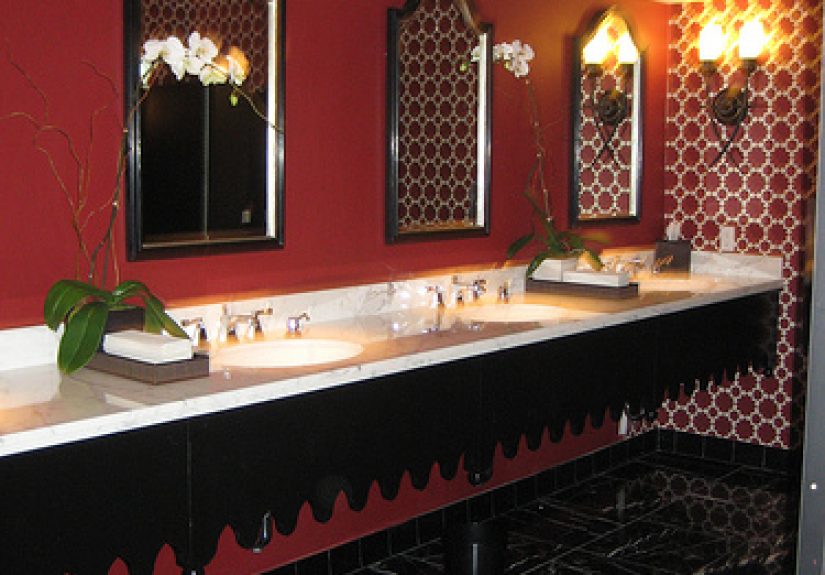
The bathroom portrait of the Virgin Mary with neon treatment became one of the most talked-about details. It was reverent enough to feel deliberate, irreverent enough to feel downtown, and memorable enough to become folklore. Every restaurant wants a conversation point; few find one that’s visually strong and culturally specific without becoming gimmicky.
Menu and Space: Why the Food Strategy Matched the Design Strategy
Design alone doesn’t carry an all-day cafe. If the menu can’t flex across dayparts, the room becomes expensive scenery. De Maria’s offering reflected the now-familiar all-day logic: lighter, vegetable-forward daytime options and dinner-ready plates that still fit the room’s tonal balance. Contemporary coverage highlighted grain bowls, fresh plates, and a style that felt healthy-ish without becoming joyless.
That menu profile matched the interior perfectly:
- Visual clarity on the plate mirrored visual clarity in the room.
- Day-to-night adaptability aligned with the all-day operating model.
- Approachable sophistication made the concept feel broad enough for different guests.
In brand terms, De Maria achieved message consistency. The room said one thing, the menu said the same thing, and the service format reinforced both. That alignment is harder than it looks and easier to feel than explain.
Recognition, Momentum, and the Short Arc
De Maria wasn’t just internet-pretty. It received major industry validation: the 2018 James Beard Foundation Restaurant Design Award (75 Seats and Under), credited to The MP Shift team for Project De Maria, NYC. Architectural design press also highlighted the project’s use of humble finishes and restrained branding powerproof that impact doesn’t require theatrical over-design.
Then came the hard part: restaurant economics. Despite cultural traction, De Maria closed in 2018. Reporting at the time cited lease and rent pressure as key factors. Like many beloved urban hospitality projects, it demonstrated a brutal truth: design excellence can build demand, but real estate realities can still end the chapter.
That ending does not erase the influence. If anything, it sharpened De Maria’s legacy. The project became a case study in how quickly a well-designed space can shape visual trends and guest expectationseven in a short operational life cycle.
What Hospitality Brands Can Learn from “Bauhaus on the Bowery”
Lesson 1: Build a Space That Works Before It Performs
The most Instagrammed restaurant in your city still has to function at 8:45 a.m. when two people are on laptops, one person is on a first date, and somebody is trying to carry three cups and dignity to a corner table. De Maria’s zoning and circulation made the space usable before it was stylish.
Lesson 2: Use Humble Finishes to Create Strong Identity
You don’t need rare stone from a mountain whispered about in design podcasts. Tile, wood, paint, leather, and good lighting can produce a signature environment when composition is disciplined. “Humble” is not the opposite of “high-end.” In great design, humble is often the secret to longevity.
Lesson 3: Make One Memorable Element Do Real Work
At De Maria, the archway, the bar mural, and the Mary portrait created high recall. Notice the strategy: a few strong moments, not twenty loud ones. Guests remember clarity, not clutter.
Lesson 4: Program for Time, Not Just Meal Periods
All-day cafe success requires temporal design. Morning needs brightness and low-friction seating. Midday needs dwell comfort. Evening needs atmosphere shift. If the room can’t transform emotionally, the business model strains.
Lesson 5: Design With Rent Reality in Mind
The most beautiful pro forma is still a pro forma. A compelling concept should include lease strategy, contingency planning, and operational flexibility from day one. Romance is great for mood boards. Lease terms are great for staying open.
Why the Story Still Resonates in 2026 and Beyond
De Maria sits in that interesting category of NYC places that were open briefly but referenced constantly. Designers cite it for restraint and composition. Operators cite it for daypart agility. Guests remember it as a room that felt curated but never stiffan increasingly difficult balance in cities where every space competes for both attention and endurance.
“Bauhaus on the Bowery” remains a useful phrase because it captures a paradox: rigor plus spontaneity. The Bauhaus side brings method, proportion, and function. The Bowery side brings noise, motion, improvisation, and personality. De Maria proved that these are not opposites. They are collaboratorsif the design team listens to both.
Extended Experience Section (Approx. )
A Day in the De Maria Mindset: What the Space Felt Like, Hour by Hour
You start outside on Kenmare, where traffic hums and the sidewalk choreography feels very New York: dodging strollers, side-stepping delivery carts, pretending you aren’t checking where everyone bought their shoes. Through the front windows, the interior reads clean and composed. Not intimidatingly minimalist, not cluttered-cutejust balanced. You step in and immediately understand the space. That’s design doing its first job: reducing friction before you’ve even ordered.
Morning is bright and forgiving. White brick and pale surfaces amplify daylight, making the room feel awake without shouting. You grab a seat where you can see the bar and part of the street. The archway frames movement like a slow film scene. People arrive in pulsessolo coffee drinkers, two friends catching up, someone opening a laptop with the solemnity of launching a startup. Nobody seems out of place, which is exactly the point.
By late morning, the room starts to reveal its real trick: it supports different behaviors at once. One table is in full creative brainstorm mode, another is quietly reading, another is splitting plates and laughing at a meme they absolutely will not explain to anyone over thirty. The bar mural catches your eye again. Geometric but not sterile. Artful but not trying too hard. It feels like the visual equivalent of a good playlistpresent, helpful, never needy.
Lunch leans social. Conversations get louder, chairs move, and the space absorbs the energy without feeling chaotic. That’s where material choices matter. Wood tones and leather surfaces warm the acoustics and the mood. Brass and tile reflect just enough light to keep things lively. You notice how staff movement seems efficient, almost choreographed. Clear routes, visible landmarks, no awkward dead zones. Good hospitality design is often invisible because it feels natural.
Afternoon is where a lot of restaurants lose coherence. De Maria’s type of all-day cafe can feel dead between peak periods if the room depends on “event energy.” Here, the opposite happens. The place settles into a soft humpeople working, meeting, pausing, resetting. The environment doesn’t demand performance. It gives permission to linger. That sounds simple, but it’s rare in New York, where many venues quietly communicate: order, consume, exit.
As evening approaches, lighting shifts and contrast deepens. The archway becomes more dramatic, the bar more magnetic. The room transitions from workspace-friendly to date-friendly without theatrical reinvention. Same bones, different mood. That continuity is the mark of a smart concept: the brand feels consistent while the emotional temperature changes.
You make one last lap before leaving, noticing details you missed the first time: the tactile stool tops, the measured spacing between objects, the absence of design noise. Nothing feels accidental, but nothing feels over-composed either. Outside again, Bowery motion returns full force. The contrast is sharpand that may be the entire thesis of “Bauhaus on the Bowery.” Inside: structure, clarity, calm. Outside: velocity, improvisation, grit. De Maria worked because it respected both worlds and let guests move between them without needing to pick a side.
Conclusion
De Maria’s lifespan was short, but its influence has outlasted its lease. It showed how an all-day cafe could blend modernist discipline, artistic reference, and neighborhood texture into a usable, lovable hospitality experience. “Bauhaus on the Bowery” wasn’t just a catchy headlineit was a practical blueprint: function first, identity through restraint, and design that supports real human behavior from morning coffee to evening conversation.