Table of Contents >> Show >> Hide
- Meet Cracked Pepper: Behr’s 2024 Color of the Year
- Why Black Works Like a Neutral (Even When It’s Being Dramatic)
- Soft Black vs. True Black: The Secret Sauce Is Undertone
- Where Cracked Pepper Looks Amazing: Room-by-Room Ideas
- Color Pairings That Make Soft Black Feel Effortless
- The Two Things That Make or Break Black Paint: Light and Sheen
- How to Use Cracked Pepper Without Regret (A Practical Mini-Playbook)
- So… Is Black Really the Perfect Neutral?
- Experiences With Soft Black: What People Notice After the “Ooh” Moment (Extra )
For years, “neutral paint” has meant an endless parade of beiges politely whispering, “I am here, but only barely.”
Then Behr showed up in 2024 with a spice-rack mic drop: Cracked Pepper (PPU18-01), a
soft black named Color of the Yearand suddenly the neutral conversation got a lot more interesting.
If “black” still makes you picture a cave where happiness goes to hibernate, take a breath. The modern case for black
is less “goth lair” and more “tailored blazer”: it goes with everything, makes the rest of your choices look intentional,
and somehow survives trend cycles like it has a lifetime subscription to relevance. In other words, black can be neutraland
it can be warm, inviting, and ridiculously versatile when you choose the right version and use it thoughtfully.
Meet Cracked Pepper: Behr’s 2024 Color of the Year
Behr describes Cracked Pepper as a versatile soft black that can elevate a roomaka,
the kind of color that does the most while saying the least. It’s not a harsh, inky “printer cartridge exploded” black.
It’s a softened, livable near-black that reads sophisticated in daylight and cozy at night.
And yes, people are ready for it. In coverage of Behr’s announcement, the brand pointed to consumer openness to deeper
huesReal Simple noted Behr survey findings that many Americans are willing to use darker colors at home.
Translation: you won’t be the only one making a bold-but-neutral move.
Why Black Works Like a Neutral (Even When It’s Being Dramatic)
1) Black plays “supporting actor” better than you think
The best neutrals don’t competethey coordinate. Black does this naturally because it provides a strong backdrop for
texture, shape, and color. Your wood grain looks richer, your brass looks shinier, your art looks gallery-level,
and your “I found this pillow online at 1 a.m.” impulse buy looks suddenly curated.
2) Dark walls can visually recede
Here’s the plot twist that keeps interior designers smirking: dark colors don’t automatically “shrink” a room. Used well,
black can make surfaces feel like they fall away, creating depth and a cocooning effect. Architectural Digest has highlighted
designers who treat black as a true neutral and argue that it can even help walls recede.
3) Black is a neutral “bridge” between warm and cool
Many neutrals lean warm (creams) or cool (grays). Black can sit between themespecially a soft blackmaking it easier to mix
metals, woods, and accent colors without the room looking like it’s hosting a family reunion of clashing undertones.
Soft Black vs. True Black: The Secret Sauce Is Undertone
“Black paint” isn’t one color. Some blacks lean blue, some lean brown, some lean green, and some are closer to charcoal.
That undertone changes everything: warmth, mood, and how your lighting will treat the walls at different times of day.
Better Homes & Gardens has specifically called out the rise of soft blacksshades that feel more flexible
and more forgiving than a stark true blackand even includes Cracked Pepper among notable examples.
The takeaway: Cracked Pepper lands in that “soft black” sweet spot. It’s bold without being brutal, and it behaves like a neutral
because it isn’t screaming for attentionit’s quietly upgrading everything around it.
Where Cracked Pepper Looks Amazing: Room-by-Room Ideas
Kitchen: instant “designer kitchen” energy
Want the quickest way to make a kitchen look custom? Use soft black strategically:
- Lower cabinets in Cracked Pepper + warm white uppers + aged brass pulls = classic, not trendy.
- Island in Cracked Pepper + natural oak perimeter cabinets = a focal point that still counts as neutral.
- Pantry door or built-ins in soft black = depth without committing your entire kitchen to darkness.
Pair it with veined white quartz, soapstone vibes, or warm wood. If you’re nervous, start with the islandkitchens forgive islands
more than they forgive, say, an all-black ceiling when you have zero recessed lighting.
Living room: the “gallery wall” cheat code
Black makes art pop because contrast does the heavy lifting. Paint one wall Cracked Pepper, then:
- Hang oversized art with generous white mats.
- Layer textures (bouclé, linen, leather) so the room reads rich instead of flat.
- Keep one large light element (a pale rug, a creamy sofa, or curtains) to balance the visual weight.
Bedroom: cozy without looking like a cave
Dark bedrooms work because sleep likes calm. Martha Stewart’s black bedroom inspiration leans into mood and sophistication,
often pairing black with layered textiles and softer accents.
Try Cracked Pepper behind the bed as an accent wall, then add:
- Warm bedside lamps (warm bulbs matter here more than your opinions).
- Natural textures: cane, walnut, linen bedding.
- One “soft contrast” paint on trimthink warm white, not icy bright white.
Bathroom: small space, big payoff
If there’s one place to be brave, it’s a small bathroom. Black walls can feel luxe when paired with:
- Polished nickel or brass fixtures
- White tile (classic) or stone with movement (elevated)
- Big mirror + good lighting so you don’t apply mascara like it’s a suspense film
The Spruce has shown plenty of examples where black walls look stunning in compact spaces, especially with metallic lighting and
strong contrast elements.
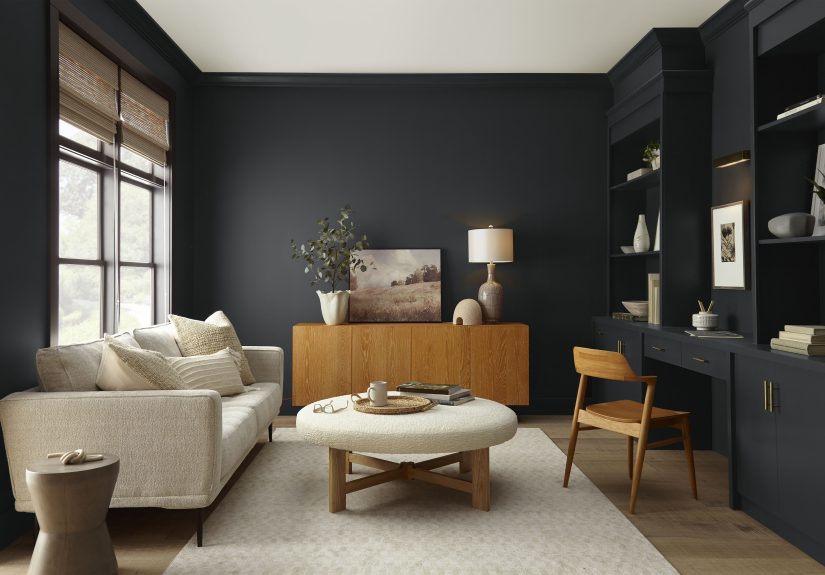
Home office: calm, focused, and surprisingly neutral
A soft black office can feel grounding and less visually noisy than busy color. Real Simple’s coverage of Cracked Pepper points out
it can work in multiple rooms and styles, including calmer spaces where you want focus.
Add a warm wood desk, a textured rug, and one accent color (olive, rust, or deep blue). Your background for video calls will look
expensive even if your chair squeaks.
Exterior + front door: curb appeal with confidence
Black (and soft black) has become a go-to for modern exteriors and front doors because it reads crisp, classic, and architectural.
A soft black door can coordinate with brick, stone, white siding, and natural wood accentswithout locking you into a trend.
Color Pairings That Make Soft Black Feel Effortless
One reason black is such a powerful neutral: it pairs with nearly everything. The Spruce notes that black works with a wide range
of colorsfrom neutrals and pastels to jewel tones and earth tones.
Six reliable palettes to try
- Black + warm white + oak: timeless, cozy-modern.
- Black + camel + brass: sophisticated, slightly vintage, very “boutique hotel.”
- Black + terracotta + cream: earthy, warm, and friendly.
- Black + olive + natural linen: organic, calm, high-design without trying too hard.
- Black + blush + off-white: soft, modern, surprisingly grown-up.
- Black + navy + crisp white: classic with edge (and it photographs beautifully).
The Two Things That Make or Break Black Paint: Light and Sheen
Lighting: black changes all day long
Soft black can look charcoal in bright daylight and deeper at night. That’s not a bugit’s the feature. But it does mean you should
sample it on multiple walls and watch it morning-to-night before committing.
Sheen: choose the finish like you choose shoes
This Old House breaks down where each sheen typically works best: matte for low-traffic walls, eggshell for more durability,
satin for high-traffic areas, and semi-gloss/gloss for trim and doors.
With black, sheen becomes even more important because it changes how the color reflects light:
- Matte/flat: velvety and forgiving on imperfect walls, but can absorb light and look “heavy” if the room is dim.
- Eggshell: a practical middle ground for most wallsstill soft, slightly easier to clean.
- Satin: great for kitchens, baths, and millwork; it reflects more, so wall flaws can show.
- Semi-gloss/gloss: ideal for doors and trim if you want a crisp, wipeable finish and a little drama.
Apartment Therapy has warned about common black-paint pitfallslike how super-matte black can absorb light and feel flatter than you intended
in some rooms. If your space is naturally dim, consider eggshell on walls or add layered lighting so the color looks rich, not sleepy.
How to Use Cracked Pepper Without Regret (A Practical Mini-Playbook)
Step 1: Sample smart
- Paint a large swatch (at least 2 ft x 2 ft) on multiple walls.
- Check it in daylight, at night, and under your actual bulbs.
- Compare it against your trim color and flooringundertones show up fast next to fixed finishes.
Step 2: Prep like you mean it
Dark colors highlight bumpy walls, rough patching, and sloppy cut lines. So:
- Patch, sand, and dust well.
- Use painter’s tape only if you burnish edges and remove it at the right time; otherwise, practice a clean cut-in.
Step 3: Prime when needed (and don’t skip the boring parts)
Retailer how-to guidance (like Lowe’s) commonly recommends primer when you’re making dramatic color changes and notes you can tint primer to help coverage.
A good primer helps with adhesion and consistent finishespecially if you’re painting over glossy paint, stains, or patchy repairs.
It also helps your black look even instead of “why does that corner look like a different decade?”
Step 4: Balance the room so black reads “neutral,” not “dominant”
- One large light element: rug, sofa, bedding, or curtains.
- Texture layering: woven shades, linen, wool, wood, stone.
- Shiny moments: mirrors, metal accents, glossy ceramicsblack loves contrast.
So… Is Black Really the Perfect Neutral?
If “neutral” means “goes with everything and makes the rest of your choices look better,” then yesblack belongs in the neutral hall of fame.
Designers have long argued that black can act like a grounding base color rather than a risky statement.
Behr’s Cracked Pepper is especially convincing because it’s a soft black: bold enough to feel current, restrained enough to feel timeless,
and flexible enough to work as an accent or an all-over envelope depending on your comfort level.
Experiences With Soft Black: What People Notice After the “Ooh” Moment (Extra )
Once the paint dries and the Instagram-worthy “after” photo is posted, real life happens: you make coffee, lose your keys, host friends,
and live in the space. That’s when soft black proves whether it’s a gorgeous idea or a high-maintenance roommate who never does the dishes.
Here are some common experiences homeowners and designers report when they actually live with a soft black like Cracked Pepper.
The room feels calmerespecially at night
People often expect black to feel intense, but the lived-in experience is frequently the opposite. In the evening, soft black walls can reduce visual clutter,
especially in rooms packed with furniture, shelves, and decor. Instead of your eyes bouncing off a dozen competing elements, the background quiets down.
That’s why bedrooms and offices are popular places to try it first: the color can feel like turning the volume down on the room.
Your “stuff” suddenly looks more intentional
This is the funniest part. The same lamp you’ve owned for years can look brand new against a soft black wall. Artwork looks sharper. Plants look greener.
Even neutral upholstery can read richer because black boosts contrast. Many people describe a “gallery effect”like the walls are politely stepping back so your
favorite pieces can take the mic.
Lighting becomes a bigger deal than you expected
In daylit rooms, soft black feels layered and dynamic. In darker rooms, it can feel heavy unless you add lighting. A lot of real-world black-paint regret
is actually “I didn’t change my lighting” regret. The fix is usually simple: add a floor lamp, swap to warmer bulbs, or introduce reflective surfaces
(mirror, metallic accents, glossy ceramics). The goal isn’t to fight the darknessit’s to make it look intentional and dimensional.
Smudges and scuffs depend on sheen and traffic
People love the idea of ultra-matte black until the wall becomes a fingerprint museumespecially in hallways, kids’ zones, or around light switches.
That’s why many DIYers end up preferring eggshell for walls in real life, saving matte for calmer, low-traffic spaces. And if you go black on doors or trim,
a more durable sheen (like satin or semi-gloss) can be the difference between “luxury” and “why is this door always dusty?” This Old House’s sheen guidance
lines up with what people discover the hard way: durability matters more where hands and elbows happen.
Small rooms can feel like a “secret lounge”
One of the most repeated experiences: black in a small powder room or nook feels surprisingly upscale. Instead of trying to pretend a tiny room is “bigger,”
people lean into the mood and treat it like a jewel box. Add a bold sconce, a framed mirror, maybe a playful wallpaper on the ceiling, and suddenly the smallest
room becomes the one guests talk about.
The biggest surprise: it doesn’t feel trendy
A lot of 2020s color trends are loud on arrival and exhausting a year later. Soft black tends to avoid that fate because it behaves like a classic neutral.
You can switch pillows, rugs, art, and even your whole stylemodern, traditional, eclecticand the background still works. That’s the core “perfect neutral”
argument: black doesn’t lock you in. It lets you change everything else without repainting… which is great, because repainting is where everyone remembers
they hate ladder work.