Table of Contents >> Show >> Hide
- What “Blackest” Actually Means (and Why It’s Not Just a Paint Color)
- A Brief Timeline of the “Blackest Material Ever” Race
- How Superblack Materials Work
- Where the Blackest Materials Are Actually Used
- Why the Record Keeps Changing
- How to Evaluate Any New “Blackest Black” Claim
- The Science Behind the Illusion: Why Superblack Looks So Weird
- Big Engineering Challenges Still Unsolved
- What Comes Next for the Blackest Material Ever?
- Conclusion
- Experience-Based Stories and Field Notes (Extended Section)
Imagine staring at an object so dark your brain gives up trying to read its shape. No highlights, no shadows, no texturejust a visual “nope.”
That’s the strange world of superblack materials, where scientists race to trap nearly every incoming photon. If normal black paint is a decent
night sky, these coatings are deep space with the porch light turned off.
The phrase blackest material ever sounds dramatic (because it is), but it also hides a serious engineering story. Ultra-black surfaces
improve space telescopes, calibrate precision sensors, reduce optical noise, and even boost emerging energy systems. Along the way, they have
sparked famous art controversies and inspired new manufacturing methods that are tougher, cheaper, and easier to scale.
In this guide, we’ll unpack what “blackest” really means, how records have changed over time, where these materials are used today, and why the
next breakthrough may come less from a new chemistry and more from clever geometry.
What “Blackest” Actually Means (and Why It’s Not Just a Paint Color)
In optics, “black” is about reflectance and absorption. If a surface reflects very little light and absorbs nearly all of it, it looks darker.
But serious researchers don’t stop at “looks dark in a photo.” They ask:
- How much light is reflected across the visible spectrum?
- What happens in near-infrared, mid-infrared, or ultraviolet bands?
- Does performance hold at different viewing and illumination angles?
- How stable is it under heat, vacuum, humidity, vibration, or handling?
This is why two materials can both be called “superblack” yet behave differently in real-world systems. One might win in a lab at normal incidence,
while another works better inside a spacecraft instrument after thermal cycling. In other words, the true winner depends on the mission.
A Brief Timeline of the “Blackest Material Ever” Race
Early benchmark leap: nanotube forests
A major milestone came from low-density, vertically aligned carbon nanotube arrays. Their structure acts like a forest of tiny light traps: photons
bounce between nanotubes, lose energy, and are absorbed. This pushed reflectance far below traditional black coatings and redefined what “dark” could mean.
Engineering adoption: from “cool demo” to metrology-grade
National labs then advanced practical integration. For precision optical detectors, black coatings are not cosmeticthey directly affect measurement accuracy.
If less light reflects, less noise contaminates readings. That made ultra-black coatings valuable for calibration systems and high-performance photonic instruments.
Public breakthrough moment: MIT’s record-setting CNT material
In 2019, MIT researchers reported a carbon nanotube material grown on chlorine-etched aluminum foil that absorbed at least 99.995% of incoming light in testing.
It became a defining headline in the modern “blackest black” conversation and reminded everyone that this record is a moving target, not a final finish line.
Newest wave: robust, flexible, low-cost superblack platforms
Recent progress shows that world-class darkness doesn’t always require fragile, expensive architectures. New microstructured approaches use geometry-driven
light trapping to produce flexible and durable superblack materials, opening the door to broader industrial use.
How Superblack Materials Work
1) Extreme light trapping via surface structure
Most ultra-black surfaces rely on multiple scattering. Light enters pores, cavities, cones, or nanotube gaps and ricochets repeatedly.
With each bounce, some energy is absorbed. After enough bounces, almost nothing escapes.
2) Low effective refractive index near the air interface
A sharp air-to-solid transition reflects light. Superblack structures soften this optical transition, allowing more photons to enter the material
rather than bounce away at the surface. Think of it as replacing a hard optical “wall” with a smooth on-ramp.
3) Broadband absorption across wavelengths
The best systems are dark beyond visible light. That matters for infrared sensors, thermal emitters, and space instruments where UV-to-IR behavior
determines real mission performance.
4) Geometry beats pigment alone
Regular black paint depends heavily on chemistry. Superblack materials often win through micro/nanostructure. A useful analogy: caves look dark not
because cave rock is magical, but because light gets trapped deep inside. Engineers now build tiny “caves” at micron and nanometer scales.
Where the Blackest Materials Are Actually Used
Space optics and astronomy
Space instruments fight stray light constantly. A tiny reflected signal can drown a faint target. Carbon nanotube coatings are used to suppress stray
light in optical paths and improve detection in demanding systems, including Earth-observing and exoplanet-oriented instrumentation concepts.
Precision metrology and detector calibration
In calibration hardware, blacker surfaces improve traceability by reducing uncontrolled reflections. That is vital when establishing accurate laser
power measurements, reflectance references, and thermal detector performance.
Energy systems and thermal engineering
Superblack surfaces can absorb radiant energy more effectively. New laser-blackened metal approaches have been reported to significantly improve
thermophotovoltaic output by enhancing absorption and emission characteristics at high temperature.
Solar and light-harvesting devices
“Black silicon” is a related strategy: texture the surface so incoming sunlight is trapped rather than reflected away. This approach supports improved
light capture and has been explored for simpler manufacturing routes.
Art, perception, and product design
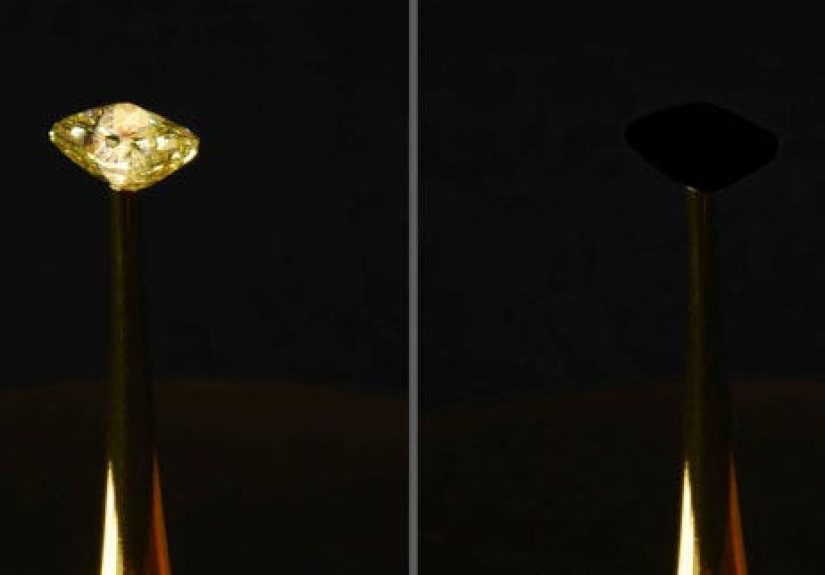
Superblack materials can flatten depth cues so objects appear uncannyalmost cutout-like. Installations that coat reflective gems or 3D objects make
them look like black voids. Great for conceptual art, mildly unsettling for your visual cortex.
Why the Record Keeps Changing
The term “blackest material ever” is true only under a defined test setup and for a moment in time. Different labs report:
- Different metrics: total hemispherical reflectance vs. diffuse reflectance vs. angle-dependent behavior.
- Different spectra: visible only vs. UV-to-far-IR.
- Different constraints: flexible vs. rigid, touchproof vs. fragile, scalable vs. boutique fabrication.
- Different objectives: ultimate darkness vs. durability, cost, and manufacturability.
So yes, one material may be darker in one experiment, while another is better for spaceflight, mass production, or consumer products. “Best” is always
application-specific.
How to Evaluate Any New “Blackest Black” Claim
Ask these seven questions:
- What reflectance metric is being reported?
- What wavelength range was measured?
- What were illumination and observer angles?
- How was uncertainty handled and with what reference standard?
- How durable is the surface under abrasion, heat, humidity, and vacuum?
- Can it be produced at useful scale and cost?
- Does performance survive real integration (not just a pristine sample)?
If a press release answers only “it looks really dark,” enjoy the photos and keep your engineer hat on.
The Science Behind the Illusion: Why Superblack Looks So Weird
Human vision estimates shape from highlights, gradients, and shadow transitions. Superblack surfaces erase those clues. When reflectance drops enough,
curved or faceted objects can appear flat and depthless. That’s why coated sculptures and objects can look like holes in reality rather than solid matter.
Nature discovered this trick first. Some birds and butterflies evolved microstructured surfaces that absorb extraordinary amounts of light and intensify nearby
colors by contrast. Engineers use similar structural principles in synthetic superblack materialsproof that evolution and materials science occasionally
reach the same answer by different routes.
Big Engineering Challenges Still Unsolved
Durability vs. darkness
The darkest coatings are often delicate. Touch, vibration, contamination, and thermal stress can degrade performance. Industry wants coatings that are
“very black” and “not precious.”
Scalability and process control
Lab samples can be stunning while large-area manufacturing remains tricky. Uniformity, adhesion, yield, and process repeatability are hard at production scale.
Cost and integration constraints
Aerospace-grade coatings may require specialized facilities and strict handling. For broader adoption, methods must work with common substrates, moderate
temperatures, and streamlined process steps.
Standardized comparisons
Comparing “blackness” across papers can feel like comparing lap times from different tracks in different weather. Better standardized protocols and reference
instrumentation remain essential.
What Comes Next for the Blackest Material Ever?
Expect progress in three directions:
- Geometry-first platforms: microcavity, honeycomb, and hierarchical textures tuned for angle-independent low reflectance.
- Flexible and robust coatings: materials that stay dark after handling, bending, and moderate mechanical stress.
- Application-specific superblack: customized coatings optimized for telescopes, sensors, thermal systems, and optics packaging.
In plain English: the future isn’t just “darker.” It’s darker and usable.
Conclusion
The blackest material ever is less a single champion and more a fast-moving championship. Carbon nanotube forests set historic records,
national labs advanced measurement-grade implementation, and new fabrication approaches are making superblack surfaces more durable and practical.
Whether the goal is detecting exoplanets, improving thermal-energy systems, calibrating instruments, or creating mind-bending art, one thing is clear:
we’re not done discovering how dark dark can get.
If you remember one line from this article, make it this: the most important question is no longer “What is the darkest sample?” but “What is the
darkest sample that still works in the real world?”
Experience-Based Stories and Field Notes (Extended Section)
To add practical perspective, here are experience-style observations drawn from published lab, engineering, and design contexts. First, teams working with
ultra-black coatings often describe the same first reaction: disbelief. A textured test coupon under bright illumination can appear “broken” to the eye
because the expected highlights vanish. Engineers used to judging surface quality by reflection have to switch mental models. Instead of asking “How glossy
is it?” they ask, “How consistently does it kill stray photons?” This shift sounds minor, but it changes everythingfrom quality control workflows to how
teams communicate results to non-specialists.
In instrumentation projects, one repeated experience is that gains from superblack coatings are cumulative, not always dramatic in a single component.
A single baffle upgrade might produce modest improvement, but once multiple reflective paths are treated, background noise drops enough to recover signals
that previously lived below detection confidence. Engineers often compare this to room acoustics: one acoustic panel helps, but complete treatment transforms
intelligibility. The same principle applies in optical systems where every uncontrolled bounce is a tiny liar in your data.
Another common field note involves durability surprises. Some early high-performance black coatings achieved superb numbers but demanded “museum behavior”:
minimal touching, careful transport, and strict cleaning restrictions. As soon as teams moved toward real deploymentwhere technicians wear gloves, tools
vibrate, and components are reworkedmaintenance burden rose fast. This is why newer robust and flexible superblack approaches are exciting. Engineers
repeatedly say they don’t just need “record darkness”; they need darkness that survives assembly lines, launch loads, and service intervals without turning
into a fragile specialty item.
In energy-related experiments, researchers report an interesting practical pattern: geometry-driven blackening can provide strong performance gains while
reducing dependence on exotic chemistries. Teams like this because geometry can be tuned. If a design needs more mechanical strength, cavity dimensions and
wall profiles can be adjusted. If optical capture is the top priority, the structure can be pushed toward deeper traps. This tunability turns superblack
development from a one-shot formula hunt into an engineering design spacemore like architecture, less like alchemy.
On the public-facing side, artists and educators note that superblack pieces are unusually effective at teaching perception science. Visitors quickly realize
how much of “seeing shape” depends on reflected light cues. When those cues disappear, people instinctively lean closer, move side to side, and still struggle
to parse geometry. That interaction becomes a live lesson in optics: depth is not a property your eyes simply read; it is an inference your brain builds from
light behavior. Superblack materials remove the clues and expose the algorithm.
Finally, project managers working across research, manufacturing, and communications have a shared takeaway: success requires cross-disciplinary translation.
Physicists discuss reflectance curves, manufacturing teams discuss yield and adhesion, and product teams discuss cost and reliability windows. The best programs
build a common language earlydefining which blackness metric matters, in what spectrum, under what angles, and for how long in operation. Without that shared
definition, teams can spend months “optimizing” different goals. With it, development accelerates and results become reproducible.
So the lived experience around the blackest materials is not just wow-factor darkness. It is disciplined measurement, careful integration, and constant tradeoff
managementplus occasional moments when a tiny coated sample makes a room full of experts say, “Wait… where did the object go?”