Table of Contents >> Show >> Hide
- Why This Model Rocket Landing Was Such a Big Deal
- Who Is Behind BPS.space?
- The Core Challenge: Landing With Solid Rocket Motors
- How Scout F Pulled It Off
- Why Seven Years of Testing Actually Makes Sense
- What the Landing Means for Model Rocketry
- Safety Still Matters More Than the Highlight Reel
- BPS.space and the Appeal of Public Iteration
- Why the Story Resonates Beyond Rocket Fans
- The Real Legacy of the Scout F Landing
- Experiences Related to “BPS.Space Succesfully Lands A Model Rocket”
- Conclusion
Some people celebrate success with a cake. Joe Barnard of BPS.space celebrated by doing something far less convenient and much more dramatic: landing a model rocket upright after years of failures, redesigns, rewiring, and probably enough desert dust to start a side business in sand. That breakthrough mattered because propulsive rocket landing is hard at any scale, but at model scale it becomes a special kind of engineering headache. There is less room, less margin for error, and absolutely no billion-dollar safety net waiting in the wings.
When BPS.space successfully landed its Scout F model rocket, it was more than a cool internet moment. It was proof that a self-taught builder with a serious obsession, a lot of iteration, and a stubborn refusal to quit could recreate one of modern rocketry’s most famous maneuvers using hobby-scale hardware. For model rocket fans, makers, STEM learners, and aerospace nerds everywhere, it was a tiny touchdown with very big meaning.
Why This Model Rocket Landing Was Such a Big Deal
At first glance, it is tempting to shrug and say, “Neat, a little rocket landed.” But that undersells the achievement by a country mile. The entire point of most model rockets is to go up, deploy a parachute or streamer, and drift back down in a mostly dignified fashion. A vertical landing changes the game completely. Instead of simply surviving descent, the rocket has to actively guide itself, fire at the correct moment, remain stable, reduce speed, and touch down upright without turning into modern art.
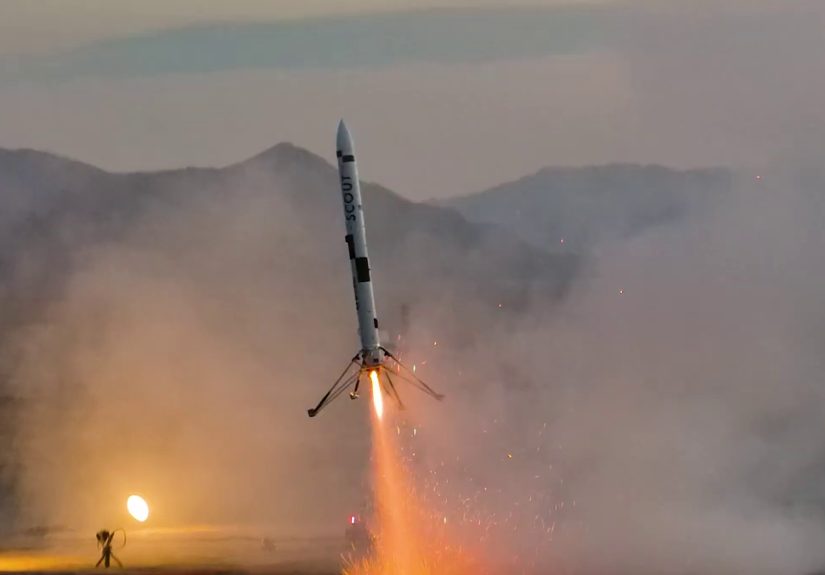
That is the magic of the BPS.space landing. It brought a SpaceX-style concept into hobby rocketry and made it real with solid rocket motors, custom avionics, thrust vector control, and relentless testing. This was not a lucky bounce or a “well, it was sort of standing for half a second” moment. It was the kind of success that only becomes possible after countless failures teach the builder what not to do.
In other words, Scout F did not just land. It earned the landing the hard way.
Who Is Behind BPS.space?
BPS.space is the project and company founded by Joe Barnard, a creator who did not start with the classic aerospace résumé. He has spoken openly about being self-taught and coming from an audio engineering background rather than a traditional engineering program. That twist is one reason his story resonates so strongly. It feels like a reminder that modern technical learning no longer lives only inside lecture halls. Sometimes it lives in textbooks, code editors, test fields, broken prototypes, and a stubborn YouTube upload schedule.
Barnard started BPS.space in 2015 with the goal of achieving vertical takeoff and vertical landing, or VTVL, in a scale model rocket. At first, the idea was partly personal ambition and partly career strategy. Over time, though, the project became something bigger: a public engineering journey and a contribution to the broader advanced rocketry community.
That shift matters. BPS.space is not only about showing off a flashy result. It is also about documenting development, improving hardware, building flight computers, and helping hobbyists think about rockets as actively controlled systems rather than passive flying tubes with a flair for dramatic disappearances.
The Core Challenge: Landing With Solid Rocket Motors
If you want to appreciate the Scout F landing, you need to understand the central engineering problem. Full-size reusable rockets like the Falcon 9 use liquid-fueled engines that can be throttled. That gives engineers precious control during descent. They can carefully shape the thrust profile and make constant adjustments as the vehicle approaches the pad.
Model rockets usually do not get that luxury. They often use solid motors, which are much simpler and more affordable but come with one giant catch: once ignited, they burn the way they burn. There is no delicate throttle control. No easing into the final seconds like a driver tapping the brakes at a red light. It is more like lighting a firework and hoping your math, software, and timing all showed up for work that day.
That means a landing system for a model rocket must be extremely precise. The rocket needs to know when to ignite the landing motor, how to orient itself, how to remain stable, and how to absorb touchdown without tipping over. A tiny timing mistake can mean firing too early and running out of impulse, or firing too late and introducing the ground to your rocket at a deeply unprofessional speed.
How Scout F Pulled It Off
Scout F represented the result of years of iterative design. The rocket used one motor for ascent and another for the landing phase, along with a custom flight computer and thrust vector control system. Instead of relying on fins alone, the vehicle could actively steer itself by adjusting the direction of thrust. That is a huge deal in small-scale rocketry because keeping a rocket upright and stable is not just a matter of making it look cool. It is the difference between a controlled landing and a spinning lawn dart.
The system also depended on guidance software tuned carefully over many tests. In a project like this, hardware gets a lot of attention because people can see it. Aluminum parts, motor mounts, landing legs, and clean airframes are photogenic. Software is less glamorous, but it is where a huge share of the battle happens. The rocket’s control logic has to interpret sensor data, decide how to respond, and do it fast enough to matter. That is not easy at model scale, where flight times are short and room for correction is tiny.
Barnard also refined the mechanical side of the system over time. Reports on the breakthrough landing highlighted improved thrust vectoring hardware and better control precision. That may sound like a dry engineering note, but in practice it means less flex, less slop, and fewer opportunities for the rocket to wobble itself into embarrassment.
Why Seven Years of Testing Actually Makes Sense
To outsiders, seven years can sound outrageous. “It took that long to land one model rocket?” Yes. And honestly, that might be the most believable part of the story.
Propulsive landing is the kind of problem that punishes overconfidence. A rocket is not only fighting gravity. It is juggling aerodynamics, structural rigidity, guidance, ignition timing, descent rate, sensor accuracy, landing leg design, and the wonderfully rude unpredictability of real-world conditions. When you make one improvement, it often exposes the next weakness. Fix the wobble, and suddenly the touchdown is too hard. Fix the touchdown, and now the leg geometry needs work. Fix the legs, and the control loop says it has opinions.
This is why the BPS.space success feels authentic. It was not presented as effortless genius. It was presented as engineering in the wild: test, fail, analyze, redesign, repeat. That makes the final result more impressive, not less. In aerospace, polished success is usually sitting on top of a mountain of ugly prototypes.
What the Landing Means for Model Rocketry
The successful Scout F landing pushed model rocketry into a more advanced and experimental direction. Traditional hobby rockets are still wonderful, of course. There is nothing wrong with a clean launch and a parachute recovery. But BPS.space showed that hobby-scale rockets can also become testbeds for active guidance, avionics development, thrust vectoring, and realistic flight profiles.
That opens the door for a new generation of makers and students who do not just want to assemble kits. They want to understand control systems. They want to code. They want to prototype flight computers, tune algorithms, and think like aerospace engineers without needing access to a giant corporate lab. In that sense, the landing was educational as much as it was technical.
It also helped normalize the idea that model rockets can be more than disposable thrill machines. They can be reusable platforms for experimentation. The closer hobby rockets get to full-scale engineering ideas, the more valuable they become as teaching tools. Suddenly a launch is not only about altitude. It is about systems thinking.
Safety Still Matters More Than the Highlight Reel
Now for the least glamorous but most important section: safety. Any article about model rockets needs to say this clearly. A vertical landing project may look cinematic online, but rocketry is not a casual backyard stunt. Organizations like NASA and the National Association of Rocketry emphasize safe launch areas, certified motors, proper ignition systems, recovery procedures, and distance rules for a reason.
That matters even more when the rocket is carrying active electronics and attempting something more complex than a standard recovery. Engineering ambition is exciting. Unsafe improvisation is not. The real lesson from BPS.space is not “go tape some parts together and improvise a landing this weekend.” The lesson is that ambitious flight projects require discipline, testing, careful setup, and respect for safety codes.
In other words, the coolest rocket person in the room should still be the one reading the checklist.
BPS.space and the Appeal of Public Iteration
One reason BPS.space has attracted such attention is that the process was visible. People did not only see the victory lap. They saw the crashes, the near misses, the redesigns, and the long stretch where success looked possible but never guaranteed. That public record gave the landing emotional weight. Viewers had context. They knew the rocket had a backstory.
This kind of open development is valuable online, where polished outcomes often get detached from the years of work behind them. BPS.space made the engineering journey legible. It showed that innovation at small scale often looks messy before it looks brilliant. That is useful for young builders, especially those who assume competent engineers emerge fully formed from a cloud of equations and confidence.
They do not. Most of them emerge from repeated failures, a laptop with too many tabs open, and at least one part they swore was machined correctly the first time.
Why the Story Resonates Beyond Rocket Fans
You do not need to be a rocketry specialist to enjoy this story. The appeal is broader than that. It is about a difficult goal, a very visible series of setbacks, and a final result that feels earned. It is about self-directed learning in an age when motivated people can teach themselves complex skills and then prove those skills in public. It is about the maker mindset colliding beautifully with aerospace ambition.
There is also something deeply satisfying about watching a giant spaceflight concept shrink down to hobby scale without losing its drama. A model rocket landing upright scratches the same mental itch as a full-size booster returning to Earth. The scale is smaller, but the physics still demand respect. That is why the success landed so well with audiences. It was tiny, yes. It was also epic.
The Real Legacy of the Scout F Landing
The Scout F touchdown was not the end of a story. It was a turning point. It proved that a vertical landing with a model rocket and solid motors was not just a fun fantasy for internet comment sections. It was possible. Once a thing becomes possible, other builders begin asking how to improve it, simplify it, teach it, or surpass it.
That is how niches evolve. One visible success becomes a reference point. More people experiment. Better components appear. Techniques spread. The hobby gets smarter. BPS.space helped move model rocketry toward that next stage, where control systems, reusable flight profiles, and realistic launch behavior feel less like weird side quests and more like legitimate branches of the craft.
So yes, BPS.space successfully landed a model rocket. But the bigger truth is that it also landed an idea: that hobby rocketry can be a serious playground for advanced engineering.
Experiences Related to “BPS.Space Succesfully Lands A Model Rocket”
If you have ever watched a project like this unfold over years, the emotional experience is almost as compelling as the engineering. A successful model rocket landing does not feel like a single moment. It feels like the final sentence in a very long book full of smoke, dust, coding, broken parts, and stubborn optimism. Even through a screen, you can sense the tension before launch. There is the setup, the checklist, the quick glances, the silent arithmetic running in someone’s head, and the tiny hope that this time the rocket will do exactly what the software thinks it should do instead of what gravity thinks would be funnier.
For hobbyists, moments like this are strangely familiar even if their own projects are far less dramatic. Maybe it is a robot that finally drives straight, a 3D print that stops warping, or a drone that quits arguing with the wind. The emotions are similar. The first feeling is suspense. The second is disbelief. The third is laughter, because after enough failures, success feels almost rude. You stare at the result like it has personally betrayed your expectations.
That is part of why the BPS.space landing resonates. It captures the rollercoaster of making something difficult in public. Viewers are not just seeing a rocket land; they are seeing what persistence looks like when it refuses to wear a superhero costume. Persistence looks dusty. It looks awkward. It looks like changing one small thing a hundred times until the whole system becomes trustworthy.
There is also a bigger inspiration here for students and builders. Watching Scout F land can make advanced engineering feel reachable. Not easy, of course. Nothing about this looks easy. But reachable. It reminds people that expertise can be built piece by piece. You do not need to begin as the world’s greatest rocket engineer. You need to begin as someone curious enough to keep learning after the first ugly result.
And honestly, ugly results deserve better public relations. They are doing important work. Every wobble, crash, bounce, and sideways disappointment in a project like this carries information. Failure is not the opposite of engineering. It is often the method. That is one of the most useful experiences tied to the BPS.space story: learning to see setbacks not as proof that you should stop, but as data with a slightly rude tone of voice.
Then comes the payoff. The rocket lands. Upright. Clean enough to count, dramatic enough to cheer, and real enough to change what people think model rockets can do. In that instant, years of effort compress into one image that feels simple only because the complexity finally worked. It is satisfying not just because the machine succeeded, but because the process did. The planning, testing, redesigning, and refusing to quit all become visible at once.
That is the kind of experience people remember. It is why these stories travel so far online. They are not just about aerospace, or hobby rocketry, or one creator’s milestone. They are about the thrill of seeing patience become proof.
Conclusion
BPS.space successfully landing a model rocket was a landmark moment in advanced hobby rocketry. It proved that vertical propulsive landing at model scale is not only possible, but possible with ingenuity, careful software, custom hardware, and years of stubborn iteration. Joe Barnard’s Scout F did more than touch down upright. It showed what happens when maker culture meets aerospace ambition and refuses to settle for “close enough.”
For readers interested in model rockets, STEM education, flight control systems, or modern DIY engineering, this story is more than a headline. It is a case study in persistence, experimentation, and problem-solving. And yes, it is also a reminder that sometimes the coolest thing on the internet is a tiny rocket behaving with the confidence of a Falcon 9.