Table of Contents >> Show >> Hide
- First, what exactly is CBD (and what it isn’t)?
- How could CBD affect hair growth? The biology in plain English
- What does the research say about CBD for hair growth?
- Potential benefits: what CBD hair products might realistically help with
- Side effects and safety: what to know before you try CBD
- Shopping tips: how to choose a CBD hair product without getting played by the label
- How to use CBD in a hair-growth plan (without replacing proven options)
- Will CBD make you fail a drug test?
- FAQs
- Real-World Experiences With CBD for Hair Growth (Anecdotes + Lessons)
Hair loss is stressful. The internet’s response is… enthusiastic. One minute you’re Googling “why is my part wider,” and the
next minute an ad is shouting, “CBD WILL FIX YOUR SCALP’S VIBES.” (Your scalp does not have vibes. It has follicles. But we
get the marketing.)
Cannabidiol (CBD) is everywhereoils, gummies, lotions, shampoos, serums. And because CBD is linked to inflammation pathways
and the skin’s endocannabinoid system, people naturally wonder: Can CBD help hair grow?
Here’s the honest, science-forward answer: CBD is promising, but the evidence for hair regrowth is still early.
There’s a small human case series that reported hair-count improvements with a topical CBD-rich hemp extract, plus a growing pile
of lab and dermatology research suggesting CBD may calm scalp inflammation and support skin barrier health. But we do not yet have
large, high-quality clinical trials proving CBD reliably treats hair loss.
Let’s break down what research says, what benefits are realistic, what side effects matter, and how to shop smarterwithout turning
your bathroom into a cannabis-themed chemistry lab.
First, what exactly is CBD (and what it isn’t)?
CBD is a cannabinoid found in Cannabis sativa. Unlike THC, CBD is not typically intoxicating. In the U.S., many consumer CBD
products are derived from hemp (cannabis with very low delta-9 THC). That said, “not intoxicating” isn’t the same as “risk-free,” and
quality can vary wildly from product to product.
CBD vs. hemp seed oil vs. “full spectrum”
- CBD: the cannabinoid that research usually focuses on.
- Hemp seed oil: pressed from hemp seeds; great for moisturization, but naturally contains little to no CBD.
- Full-spectrum hemp extract: may contain CBD plus other cannabinoids/compounds (and sometimes trace THC).
- Broad spectrum: multiple cannabinoids/terpenes, typically with THC removed (but not always truly “zero”).
- CBD isolate: CBD only (in theory), with other cannabinoids removed.
How could CBD affect hair growth? The biology in plain English
Hair follicles are mini-organs with their own growth cycle: growth (anagen), transition (catagen),
and rest/shedding (telogen). Many hair-loss conditions involve follicles spending too little time in growth or shrinking
over time (miniaturization), especially in androgenetic alopecia (pattern hair loss).
Skin (including the scalp) has an endocannabinoid systemreceptors and signaling molecules that help regulate inflammation,
cell growth, and barrier function. Research suggests hair follicles express cannabinoid receptors (like CB1), and CBD may influence pathways
involved in follicle behavior, inflammation, and the hair cycle.
Potential mechanisms researchers discuss
- Inflammation modulation: CBD has been studied for anti-inflammatory and antioxidant effects in skin.
- Follicle signaling: lab work suggests cannabinoid-related signaling can influence hair shaft elongation and cycle timing.
- Scalp comfort: reducing itch, redness, or irritation may help people tolerate proven treatments (like minoxidil) better.
- Barrier support: a healthier scalp barrier may reduce irritation-driven shedding and breakage.
Important nuance: “could” and “does” are different words. Mechanisms are not guarantees. Plenty of ingredients look amazing in a petri dish and then
do absolutely nothing for your hairline in real life (the petri dish never had to deal with stress, hard water, and heat styling).
What does the research say about CBD for hair growth?
1) Human evidence: a small topical CBD-rich extract case series
The most-cited human evidence is a case series in adults with androgenetic alopecia using a once-daily topical hemp oil formulation
containing a small amount of CBD for about six months. The authors reported a significant increase in hair counts in measured areas and noted no reported
adverse effects.
This is interestingbut keep expectations grounded. A case series:
does not include a placebo group, is not blinded, and can’t prove cause-and-effect. People may also change other hair habits during a study
(new shampoo, supplements, less heat styling, better consistency with other treatments). Still, it’s a signal worth studying more.
2) Scalp conditions research: CBD and inflammation-related issues
Not all hair problems start in the folliclesometimes the scalp environment is the villain. Dandruff/seborrheic dermatitis, scalp psoriasis, and chronic irritation
can increase shedding or breakage and make the scalp feel like it’s staging a tiny rebellion.
Research on cannabinoids in dermatology suggests CBD may help calm inflammation and itching in certain skin contexts. Some studies and reviews discuss CBD-containing
topical formulations (including shampoos) in inflammatory scalp conditionsoften in combination with established anti-fungal/anti-inflammatory ingredients.
That doesn’t automatically translate into “hair regrowth,” but it can matter if scalp inflammation is part of your hair story.
3) The big gap: we still need larger, well-designed trials
Right now, CBD for hair growth sits in the “promising but preliminary” category. We have:
- biological plausibility (the scalp and follicles have cannabinoid-related signaling),
- early human observations,
- and expanding cosmetic-dermatology research on topical CBD.
What we don’t have yet: multiple large randomized controlled trials comparing CBD products to placebo and to proven treatments, across different hair-loss causes.
Until then, CBD shouldn’t replace evidence-based options if you’re dealing with progressive thinning.
Potential benefits: what CBD hair products might realistically help with
If you’re considering CBD for hair growth, it helps to separate follicle regrowth from scalp support. Many people may see the most
noticeable value in scalp comfort and hair quality rather than dramatic regrowth.
Possible benefits (most plausible first)
- Less scalp irritation and itch: CBD’s anti-inflammatory/anti-itch potential may soothe reactive scalps (depending on formulation).
- Barrier and moisture support: oils and emollients commonly used in CBD hair serums can reduce dryness and breakage (CBD or not).
- Improved “treatment tolerance”: a calmer scalp may help you stick with proven therapies longer (consistency is the real miracle ingredient).
- Potential support in early thinning: if future studies confirm follicle effects, CBD might become a helpful add-onespecially in topical routines.
What CBD is unlikely to do on its own: resurrect a long-gone hairline like it’s a fantasy novel. If follicles are severely miniaturized or absent in an area, topical
cosmetics (CBD included) are limited.
Side effects and safety: what to know before you try CBD
Safety depends on how CBD is used. For hair growth, most people are looking at topical CBD (serums, oils, shampoos). Some consider oral
CBD, but that raises more systemic concerns and drug interactions.
Topical CBD (scalp oils, serums, shampoos)
- Skin irritation: redness, itching, or burningoften due to fragrance, essential oils, alcohol bases, or preservatives.
- Allergic reactions: possible with cannabis-derived ingredients or botanicals in the formula.
- Acne/folliculitis: heavy oils can clog follicles in some people, causing bumps along the hairline or scalp.
Oral CBD (oils, capsules, gummies): higher stakes
Oral CBD can cause side effects like drowsiness/fatigue, diarrhea, appetite changes, and it can interact with medications. The FDA has also warned about potential
liver injury risk and drug interactions based on available evidence (including data from prescription cannabidiol).
Bottom line: If you’re taking prescription medications, have liver disease, are pregnant/breastfeeding, or have a chronic medical condition,
talk to a qualified clinician before using oral CBD.
Special safety notes (especially important)
- Not for kids/teens unless a medical specialist specifically recommends a regulated, prescription product for an approved indication.
- Pregnancy/breastfeeding: avoid unless a clinician advises otherwise.
- Driving and sedating substances: oral CBD can cause drowsiness; combining with alcohol or sedating meds can amplify effects.
Shopping tips: how to choose a CBD hair product without getting played by the label
The CBD marketplace is famous for two things: pretty packaging and inconsistent labeling. Independent studies have found that many CBD products do not contain the amount
of CBD listed on the label, and some contain THC even when it isn’t clearly disclosed.
Use this checklist before you buy
- Look for third-party testing (COA): a Certificate of Analysis should show CBD/THC content and ideally screen for contaminants.
- Check the product type: “hemp seed oil” isn’t the same as “CBD.” If you want CBD, it should be listed as cannabidiol (or hemp extract with a stated CBD amount).
- Be cautious with “THC-free” claims: even topicals can sometimes contain trace THC due to manufacturing variability or labeling issues.
- Avoid miracle language: “hair restoration,” “regrows hair in 7 days,” and other dramatic claims are red flags.
- Fragrance and essential oils: if you have eczema, psoriasis, or a sensitive scalp, these may trigger irritation regardless of CBD.
A quick word on FDA and claims
In the U.S., the FDA has taken issue with CBD products marketed with drug-like claims (including hair restoration claims) and has issued warning letters for cosmetics and
personal care products making treatment promises. Translation: a label screaming “medical-grade hair regrowth” is not a flexit can be a sign the brand is comfortable
stretching the rules.
How to use CBD in a hair-growth plan (without replacing proven options)
If your goal is thicker hair, the smartest approach is usually: diagnosis first, then targeted treatment. “Hair loss” is not one single condition.
Common causes include androgenetic alopecia, telogen effluvium (stress/illness-related shedding), thyroid issues, iron deficiency, autoimmune conditions, traction alopecia,
and more.
Step 1: Confirm what kind of hair loss you have
A dermatologist can often tell the difference between pattern hair loss and shedding conditions by history, scalp exam, and sometimes labs. This matters because:
CBD won’t fix an untreated thyroid problem, and it won’t undo tight hairstyles that continuously stress follicles.
Step 2: Build a “boring but effective” foundation
- Topical minoxidil (for pattern thinning): often a first-line option; consistency is key.
- Prescription options (when appropriate): a clinician may discuss anti-androgen therapies or other treatments.
- Scalp health: treat dandruff/seborrheic dermatitis; control inflammation if psoriasis/eczema is present.
- Hair-care habits: gentle detangling, reduce heat/bleach frequency, avoid tight styles, prioritize scalp hygiene.
Step 3: Add CBD as a “support player,” not the star quarterback
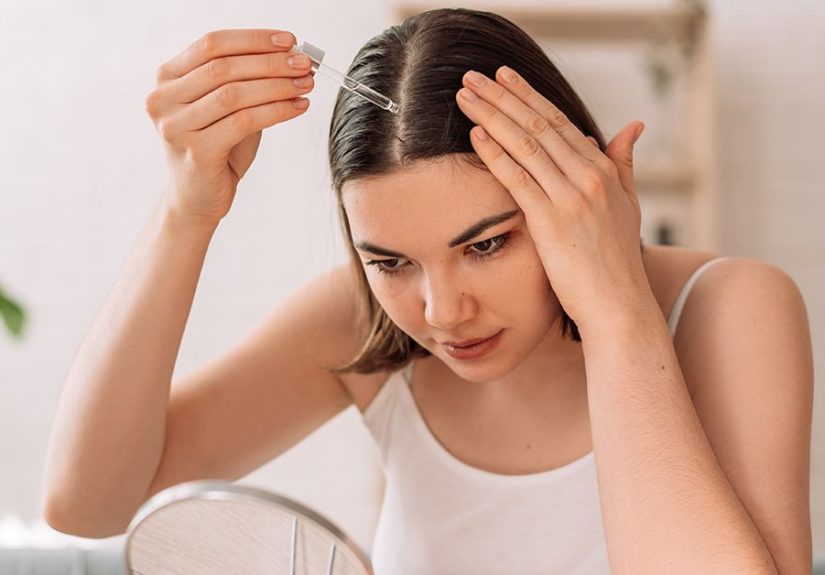
For many people, the most sensible way to try CBD is topically as part of a scalp-soothing routineespecially if dryness or irritation is blocking you from
sticking with your main treatment.
Patch test like a grown-up
Apply a small amount to a discreet area (like behind the ear) for a couple of days to check for irritation before putting it all over your scalp. This is especially important
if the formula contains fragrance or essential oils.
Will CBD make you fail a drug test?
Drug tests typically look for THC metabolites, not CBD. However, some CBD products contain THC (even when not clearly stated), and studies have found labeling inaccuracies in both
oral and topical cannabinoid products. If drug testing is a concern for your job or sports, choose caution:
avoid products that may contain THC and don’t rely solely on marketing terms like “pure” or “clean.”
FAQs
How long would it take to see results if CBD helps?
Hair growth is slow. Even proven therapies often take months to show visible improvement. If a product claims you’ll get dramatic regrowth in a week, that’s not
confidencethat’s fiction.
Is CBD better than minoxidil for hair growth?
Based on current evidence, no. Minoxidil has far stronger clinical support for pattern hair loss. CBD may become a useful add-on for some people, but it shouldn’t
replace established treatments when regrowth is the goal.
Can CBD help stress-related shedding (telogen effluvium)?
Telogen effluvium usually improves when the trigger (illness, stress, nutritional deficiency) is addressed. A soothing scalp product may improve comfort, but it won’t replace finding
and fixing the underlying cause.
Real-World Experiences With CBD for Hair Growth (Anecdotes + Lessons)
Ask a group of people why they tried CBD for hair growth and you’ll hear a familiar plot: “My hair started thinning, I panicked, I bought something at 1 a.m.” The product varies
CBD scalp serum, CBD shampoo, CBD oil blendbut the emotional energy is the same. Hair changes feel personal, and CBD feels like a modern, “natural” option that won’t require an awkward
pharmacy conversation.
In everyday use, the most common “wins” people report aren’t dramatic new baby hairs overnight. Instead, they describe scalp comfort: less itch, less dryness, and a
calmer feeling after washing. Some notice their scalp looks less red, or that flaking seems reduced when the formula is paired with classic dandruff-fighting ingredients. For people who
find certain hair-loss treatments irritating, a soothing routine can be the difference between quitting in frustration and sticking with a plan long enough to matter.
The second most common experience is… confusion. Someone buys a “CBD hair oil,” uses it faithfully for a month, and sees nothing. Later they learn the product was mostly hemp seed oil,
or the CBD amount was tiny, or the label wasn’t accurate. That’s why experienced users often become accidental detectives: they start checking Certificates of Analysis, scanning for CBD
listed as “cannabidiol,” and avoiding brands that promise “hair restoration” like it’s a limited-time coupon.
Another real-world pattern: people with early thinning sometimes feel like CBD “helped,” but when you zoom in, CBD is usually part of a larger upgrade. They started
taking scalp health seriously, reduced heat styling, improved nutrition, treated dandruff, or finally used minoxidil consistently. CBD may still have played a roleespecially by reducing
irritation and supporting scalp comfortbut it’s rarely the only variable. Hair responds to routines, not miracles.
On the flip side, some people have a rough first impression because the product stings, makes their scalp greasy, or triggers bumps along the hairline. In many of these cases, the issue
isn’t CBD itselfit’s the formulation (fragrance, essential oils, heavy occlusive oils, or alcohol bases). People who do best tend to use simpler formulas, patch test first,
and treat CBD as a supportive ingredient rather than a scalp “challenge.”
The most useful takeaway from real-world stories is this: CBD can be a reasonable adjunct if your goals include scalp comfort and a supportive routine, but it’s not a
replacement for diagnosis and proven therapiesespecially for pattern hair loss. If you treat CBD like a teammate instead of a superhero, you’ll be less disappointed (and your scalp will
thank you for the calmer, more consistent plan).