Table of Contents >> Show >> Hide
- Why Wolves Love Chernobyl: The Best Conservation Tool Is Sometimes “No People”
- The “Accidental Preserve” Idea: Chernobyl as an Involuntary Rewilding Experiment
- How Scientists Know Wolves Are Thriving: Camera Traps, Track Counts, and GPS Collars
- Radiation and Wolves: What We Know, What We Suspect, and What’s Still Murky
- So Is Chernobyl Becoming a “Wildlife Preserve” for Wolves?
- What Wolves Teach Us About ConservationEven Outside Chernobyl
- Conclusion: The World’s Weirdest Wolf Sanctuary
- Field Notes: Experiences That Make the Chernobyl Wolf Story Feel Real (and a Little Unreal)
Chernobyl was supposed to be a cautionary tale about technology, hubris, and why you should never let a safety culture be “optional.”
Instead, it’s also become something else: one of the strangest rewilding experiments on Earth.
Not because radiation is good (it’s not), but because humans leftand didn’t come back in normal numbers.
And when people vanish, nature doesn’t hold a committee meeting. It moves in. Fast.
In the Chernobyl Exclusion Zonean eerie patchwork of forests, marshes, abandoned villages, and cracked Soviet pavementwolves have flourished.
Researchers tracking wildlife there have repeatedly found thriving populations of large mammals, and wolves show up as a headline species again and again.
If you squint, it starts to look like a “wildlife preserve.” If you don’t squint, it still looks like a radioactive, overgrown time capsule…
with apex predators confidently treating it like premium real estate.
Why Wolves Love Chernobyl: The Best Conservation Tool Is Sometimes “No People”
Wolves are not complicated customers. They need space, prey, cover, and a low chance of being shot, trapped, or hit by a truck.
The Exclusion Zone offers all of that in bulkbecause the most dangerous species to wolves (humans) mostly cleared out after 1986.
That’s the central paradox: radiation creates risk, but the absence of people removes a daily, predictable pressure that wildlife faces almost everywhere else.
When researchers compared wildlife presence across the zone, they often found animals living broadly across the landscapeeven in areas with higher contamination
suggesting that habitat and human disturbance can be bigger drivers of where animals choose to be than we’d like to admit.
Wolves as the “Proof of Life” Species
Wolves sit at the top of the food web. If wolves are doing well, it usually means prey species are available and the ecosystem isn’t collapsing from the top down.
They’re also wide-ranging, sensitive to persecution, and hard to fake with a couple lucky sightings.
In other words, if wolves are thriving, it’s not because someone planted them like decorative shrubs.
Multiple reports and studies over the years have described wolf abundance in and around the Exclusion Zone as notably high compared with nearby protected areas.
Numbers vary by method and location, but the repeated pattern is difficult to ignore: the zone functions like a large, loosely human-free refuge where wolves can persist.
The “Accidental Preserve” Idea: Chernobyl as an Involuntary Rewilding Experiment
The phrase “accidental nature reserve” gets used a lot for Chernobyl, and it fitsawkwardly, but it fits.
This isn’t a carefully designed park with interpretive signs and a gift shop shaped like a paw print.
It’s a restricted landscape created by catastrophe, where access is controlled and human settlement is limited.
That constraint has created a kind of hands-off conservation zone, where forests have reclaimed buildings and wetlands spread into old fields.
Wolves, boar, deer, and other large mammals take advantage of the quiet.
If you want to understand what happens when humans stop managing every square inch, Chernobyl is the unplanned lab.
It’s Not “Radiation Made the Wolves Stronger”
Let’s retire a popular internet storyline: wolves are not thriving because radiation is a power-up.
The more realistic explanation is simplerand more unsettling: remove humans, and many ecosystems rebound even under imperfect conditions.
Radiation can harm living things, but the day-to-day absence of hunting, farming, traffic, and development can still shift the balance in wildlife’s favor.
How Scientists Know Wolves Are Thriving: Camera Traps, Track Counts, and GPS Collars
You can’t manage what you can’t measureand you definitely can’t measure wolves by politely asking them to fill out a survey.
So researchers have used a mix of methods: track surveys, motion-triggered cameras, and high-tech GPS collars that record movement and, in some cases, radiation exposure.
Camera Traps: The Zone Doesn’t Lie (Much)
One influential approach used systematic camera stations across parts of the Belarus-side evacuation landscape.
The cameras documented a suite of mammals, and wolves were among the most frequently recorded species.
Importantly, animals showed up even near highly contaminated areas, suggesting that wildlife distribution wasn’t simply “avoiding radiation” across the board.
Camera traps aren’t perfectdetection depends on placement, season, animal behavior, and sheer luck.
But when you deploy many stations across varied habitat, patterns begin to emerge.
In Chernobyl, the pattern has been persistent: wildlife is abundant, and wolves are regulars.
GPS Collars + Dosimeters: Following Wolves Through a Patchwork of Risk
Modern collars can do more than tell you where a wolf went. Some have been paired with radiation monitors to estimate external exposure as animals move.
In one peer-reviewed study of wolves in the Belarus portion of the broader exclusion landscape, collars recorded location and radiation readings at frequent intervals over months.
A key takeaway: exposure isn’t uniform. Wolves encounter a mosaicsome areas “hotter,” others much less so.
That matters because it challenges simplistic assumptions about how wildlife is exposed to contamination.
Models that rely on average contamination values can miss the real lived experience of an animal that spends time in micro-hotspots, dens in certain soils,
or travels corridors that happen to be more contaminated than the mean.
Radiation and Wolves: What We Know, What We Suspect, and What’s Still Murky
Here’s where the story gets nuancedand where good science refuses to be a clean Hollywood plot.
“Wolves are abundant” is a population-level statement. “Wolves are unaffected” is a biological claim that requires much more evidence.
Both can be true in parts and false in parts, depending on what you measure.
Population Success Doesn’t Cancel Individual Stress
Wolves can be numerically abundant while still experiencing physiological stress, DNA damage, altered immune function, or reproductive impacts.
A population can also look stable while quietly paying costs in lifespan, litter size, or disease risk.
That’s why newer work has leaned into blood samples, immune markers, and genetic analysesnot just “how many wolves exist.”
The Cancer-Resilience Conversation: Promising, Preliminary, and Easy to Overhype
In the last few years, public interest has surged around research suggesting Chernobyl-area wolves may show biological signatures associated with coping under chronic radiation exposure
including immune system patterns that resemble responses seen in humans receiving radiation therapy, and candidate genomic regions that might be linked to cancer resilience.
This line of research is fascinating for two reasons:
- It reframes the question from “Are they alive?” to “How are they coping internally?”
- It could have biomedical relevance if protective mechanisms are real, repeatable, and understood properly.
But it’s also the perfect setup for sensational headlines.
The responsible version is: researchers are investigating whether long-term exposure has shaped immune responses and selected for traits that help wolves tolerate stressors.
The irresponsible version is: “mutant super-wolves unlocked the cancer cheat code.”
Spoiler: biology doesn’t do cheat codes. It does trade-offs.
So Is Chernobyl Becoming a “Wildlife Preserve” for Wolves?
If by “wildlife preserve” you mean a formal, friendly place designed for conservation with clear rules and stable funding, then: not exactly.
If you mean a large area where human activity is restricted enough that wolves can live, hunt, raise pups, and disperse with relatively low interference, then: yes, functionally.
In practice, the Exclusion Zone behaves like a refugean awkward one, a dangerous one in spots, but a refuge nonetheless.
Wolves benefit from:
- Low human density (fewer direct conflicts, less hunting pressure)
- Expanding habitat as forests and wetlands reclaim abandoned land
- Strong prey base including wild boar and deer in many areas
- Landscape connectivity that lets wolves roam and disperse beyond the zone
But “Preserve” Doesn’t Mean “Safe”
Chernobyl still contains contamination hotspots, and not all risks are visible.
Wildfires can remobilize radioactive particles.
Illegal activity (like poaching or scavenging) can occur.
And geopolitical instability can disrupt research, monitoring, and conservation priorities.
Wolves don’t read warning signs. They can den where it’s quiet even if the soil chemistry is a mess.
That’s why scientists track not just movement, but exposureand why conclusions tend to be careful, conditional, and annoyingly full of words like “suggests” and “indicates.”
(Those words are not weakness. They’re the seatbelt.)
What Wolves Teach Us About ConservationEven Outside Chernobyl
The biggest lesson from Chernobyl isn’t “radiation is fine.”
It’s that human pressure can be so relentless that removing iteven in a compromised landscapecan allow wildlife to rebound.
That should be both hopeful and humbling.
Conservation Isn’t Only About Creating ParksIt’s About Reducing Pressure
Chernobyl is a dramatic example of something conservation biologists have argued for decades:
habitat and mortality pressures often matter more, at the population level, than a single stressor measured in isolation.
In many places, wolves struggle not because the forest can’t support them, but because humans won’t.
In the Exclusion Zone, wolves are effectively getting a rare gift: space to behave like wolves.
They hunt, patrol, compete, raise young, and occasionally wander far beyond home ranges.
That freedom is increasingly hard to find in a crowded world.
Conclusion: The World’s Weirdest Wolf Sanctuary
Chernobyl will always be synonymous with disaster.
But nature has a complicated talent for showing up where it’s least expected.
In the quiet left behindbetween birch trees and crumbling concretewolves have built a stronghold.
Not because the landscape is healed, but because the usual human machinery of disturbance is switched off.
Calling Chernobyl a “wildlife preserve for wolves” is less a celebration than a description of a strange ecological truth:
when people disappear, predators return.
The Exclusion Zone is not a model we’d ever choose on purpose.
But as a living laboratory, it keeps forcing the same uncomfortable question:
if wolves can thrive here, what are we doing to them everywhere else?
Field Notes: Experiences That Make the Chernobyl Wolf Story Feel Real (and a Little Unreal)
To understand why “Chernobyl as a wolf preserve” is more than a spooky headline, it helps to picture what work in the zone is actually likeat least as researchers describe it.
Field teams don’t stroll in with binoculars and a granola bar like it’s a weekend hike.
They plan routes, track exposure, and treat the landscape like a patchwork of “fine for now” and “don’t kick the dirt.”
That’s not drama; that’s procedure.
In camera-trap studies, teams have set stations across wide areas, spacing them carefully to avoid counting the same roaming animal at multiple sites.
The process can sound almost normalpick a tree, mount a motion-triggered camera, add scent lureuntil you remember the “extra steps”:
dosimeters to monitor personal exposure, minimizing time in higher-radiation spots, and added protective gear when disturbing soil or leaf litter.
In other words, it’s ecology with a side of radiological common sense.
The emotional experience, according to scientists who have worked there, is its own kind of whiplash.
You can be looking at a beautiful, quiet forest edgesunlight through pines, animal tracks in soft groundand then notice a roofless house with a child’s bicycle frame rusting into the grass.
It’s rewilding wrapped around human absence, and that contrast doesn’t fade with familiarity.
People describe it as “polarizing”: a landscape that feels alive and thriving, while also carrying the weight of what forced humans out in the first place.
Then there’s the wolf work itself.
Wolves don’t cooperate with your schedule, and in Chernobyl they don’t have to.
Researchers who collar wolves have described the value of pairing GPS tracking with radiation measurements: it turns the zone from a single scary number into a map of real animal decisions.
A wolf might spend days moving through comparatively lower-contamination habitat corridors, then cut across a “hotter” area because prey is there, cover is better, or the route is simply efficient.
That lived patternmovement through a mosaichelps explain why averages can be misleading.
If you’re imagining constant “mutant weirdness,” the day-to-day reality is often more grounded.
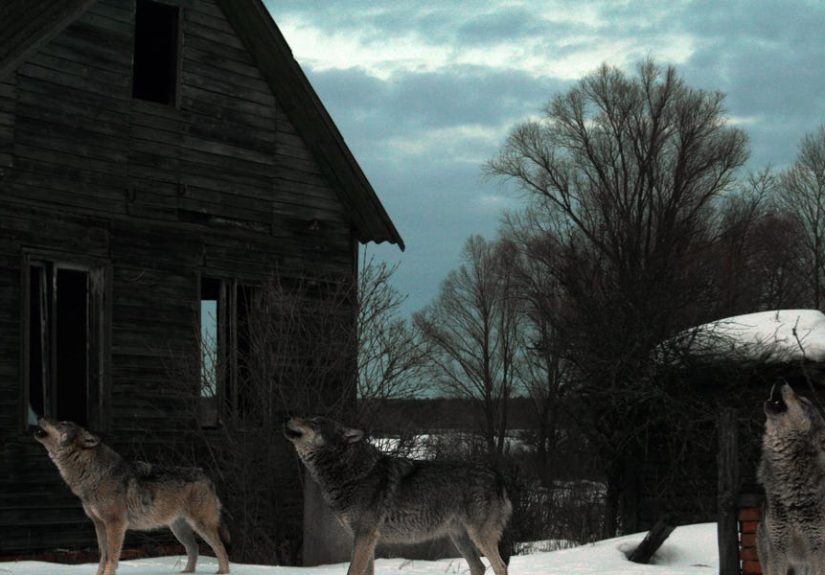
Camera footage shows wolves doing wolf things: traveling, checking scent posts, hunting opportunities, sometimes appearing near abandoned structures the way coyotes show up in American suburbs.
The uncanny part is the setting, not the behavior.
For the rare visitor who enters legally with guides (and follows rules about where you can walk, what you can touch, and how you exit),
the experience is often described as a mix of silence and sudden proof of life:
fresh tracks on an old road, distant movement at a tree line, birds calling in places that used to be busy streets.
You may not see a wolfmost people won’tbut you can feel the ecological vacancy humans left behind being filled.
It’s like visiting a city after closing time, except the new tenants are apex predators and the lease is… indefinite.
That’s why the “wolf preserve” framing sticks.
It’s not a neat conservation success story with a ribbon-cutting ceremony.
It’s a strange, uneasy lesson: remove humans, and the world doesn’t always become emptier.
Sometimes it becomes wilder.