Table of Contents >> Show >> Hide
Aircraft carriers are the kind of military hardware that make headlines on sight alone. They are huge, expensive, dramatic, and built to send a message long before they send aircraft into the sky. So when people say China’s newest aircraft carrier is nearing launch, they are really talking about more than one ship. In the old version of this story, that ship was the Fujian, China’s third carrier and the first one it fully designed at home. In the current version, the conversation has moved a step further. The Fujian has already been launched and commissioned, and the real suspense is about what comes next in China’s carrier program.
That matters because “launch” is one of those words that sounds final but really is not. In shipbuilding, a launch is often the moment a vessel first enters the water. It is not the same as sea trials. It is not the same as commissioning. And it is definitely not the same as being ready for high-end combat operations. A carrier can be launched to fanfare, commissioned with flags and speeches, and still need years of testing before it becomes a polished military tool. In other words, a new carrier may look ready for prime time while still doing the naval equivalent of trying to remember its Wi-Fi password.
That is why China’s newest aircraft carrier story is so important. It is not just about one hull, one ceremony, or one photo taken from a satellite. It is about how fast China is moving from a learner’s navy into a navy that wants sustained blue-water reach. It is about whether Beijing can move from owning carriers to actually mastering carrier operations. And it is about what the next ship could reveal about China’s industrial confidence, technological progress, and strategic ambition in the Pacific.
Why This Headline Still Matters in 2026
The first thing to understand is that China is no longer in the experimental phase of simply figuring out whether it can build a carrier. It already has three. The Liaoning started life as an unfinished Soviet vessel before China bought and refitted it. The Shandong followed as a domestic derivative that looked familiar because, frankly, it was. Then came the Fujian, the ship that changed the tone of the conversation.
The Fujian was the breakthrough platform. It has a flat deck, a catapult-assisted launch system, and a much more ambitious air wing concept than China’s earlier ski-jump carriers. It represents the point where China stopped merely iterating and started leaping. That is why any discussion of a “newest carrier nearing launch” now naturally drifts toward the next generation, often referred to by outside analysts as the Type 004.
So the headline still matters because it captures a live transition. China has already crossed the threshold into advanced carrier design, and the next launch, whenever it comes, will not just add one more ship. It could mark the beginning of a different kind of carrier force, one built not just for regional symbolism but for longer-range, more persistent power projection.
From Training Wheels to True Ambition
The Liaoning and Shandong taught China the basics
China’s first two carriers were important, but they were not revolutionary. They helped the People’s Liberation Army Navy learn deck operations, pilot training, logistics, maintenance cycles, and the choreography of putting aircraft, escorts, fuel, and command structures together at sea. That is no small thing. Carrier warfare is not just about building a ship with a very large parking lot on top. It is about learning how to make a floating air base work under pressure, far from shore, in bad weather, and ideally without turning every sortie into a committee meeting.
Those earlier carriers gave China experience, but they also revealed limits. Ski-jump decks restrict aircraft weight at takeoff. That affects fuel, payload, mission flexibility, and the ability to launch larger support aircraft. In simple terms, if your deck design forces your fighters to leave home with a lighter backpack, your carrier’s reach and options shrink fast.
The Fujian changed the conversation
The Fujian is where China’s carrier program became strategically more serious. Its electromagnetic catapults give it the ability to launch heavier, more fully loaded aircraft. That matters for strike fighters, but it matters even more for support aircraft such as airborne early warning planes. Once a carrier can launch those larger aircraft, the whole strike group becomes more capable. Detection improves. Coordination improves. Range improves. Suddenly, the carrier is not just a symbol of national prestige. It starts looking like a more complete combat system.
The ship also reflects a larger jump in confidence. China designed it domestically. It is larger than the Liaoning and Shandong. It fits a navy that is thinking beyond coastal defense and beyond short, carefully scripted deployments. Even so, the Fujian is not nuclear-powered, which means endurance remains one of its big limitations. It can go far, but not forever, and not with the same freedom as a U.S. nuclear carrier.
The next carrier is the one everyone is watching
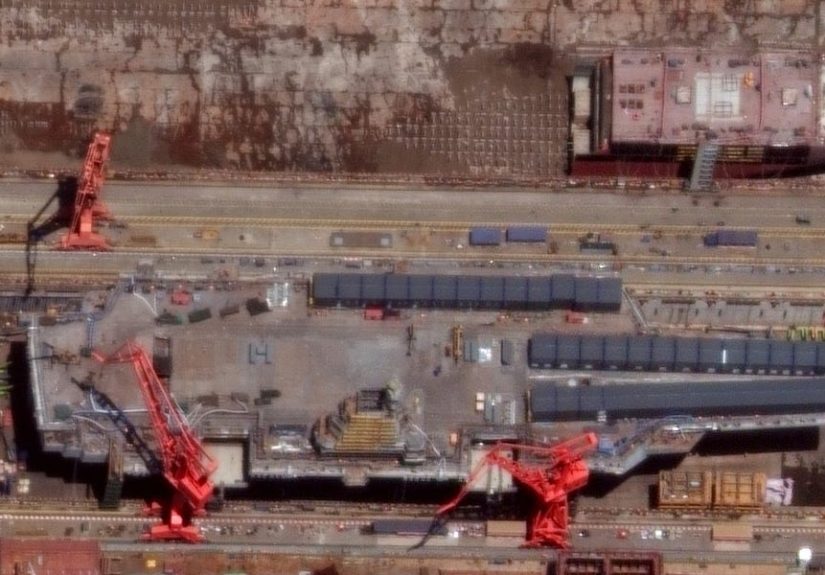
That brings us to the likely next step. Outside analysts and open-source imagery increasingly point to a fourth Chinese carrier under construction at Dalian. The working label for this ship is Type 004. Beijing has not officially laid out the full design, which means any serious analysis should keep its eyebrows raised and its adjectives under control. Still, the broad direction is hard to ignore.
If the next carrier is indeed larger and nuclear-powered, that would be a major shift. It would suggest China is no longer content with a carrier fleet that extends regional influence but still depends on refueling more often than its American counterpart. A nuclear-powered carrier would give China more endurance, more time on station, and more flexibility in blue-water operations. That does not automatically make it equal to the U.S. Navy, but it would make the comparison more meaningful.
What Makes a New Carrier So Significant
Catapults change the air wing
The single biggest operational difference between older Chinese carriers and newer concepts is the launch system. A ski-jump deck is simpler, but it limits what the ship can send into the air. Catapults, especially electromagnetic ones, open the door to heavier fighters, airborne early warning platforms, and a wider variety of support aircraft. That translates to more range, more awareness, and more punch.
Think of it this way: a carrier without strong support aircraft is a little like a football team with talented receivers and no quarterback. The deck may look impressive, but the entire system struggles to realize its potential. Once China fields a mature carrier air wing built around catapults, the story stops being about flashy shipbuilding alone and starts being about operational depth.
Nuclear propulsion changes endurance
This is the other big question hanging over China’s newest carrier program. Conventional carriers can still be formidable, but they face endurance limits that nuclear-powered carriers do not. That affects sustained deployments, global presence, and the ability to remain on station without frequent logistical support. If the next Chinese carrier truly adopts nuclear propulsion, it would be a statement that Beijing wants not merely a strong regional navy, but a more persistent global one.
Of course, propulsion is not magic. A nuclear-powered carrier still needs trained aviators, maintenance crews, escorts, replenishment ships, secure communications, and doctrine that works under stress. But propulsion does change the geometry of ambition. It widens the map.
Big decks do not guarantee big results
One of the easiest mistakes in carrier analysis is assuming that building the ship is the hardest part. It is difficult, yes, but operating it effectively is harder. Carrier operations demand practiced deck crews, seasoned pilots, synchronized escorts, steady logistics, and the institutional habit of doing complicated things without drama. That habit takes time.
The Fujian itself is a useful lesson here. Its sea trials, aircraft testing, and commissioning were major milestones, but outside analysts still caution that full operational maturity comes later. That is normal. The launch gets the cameras. Readiness gets the gray hair.
Why U.S. and Regional Analysts Care So Much
China’s newest carrier matters because the Indo-Pacific is not short on tension, and mobility matters. A stronger Chinese carrier force would give Beijing more options in the East China Sea, the South China Sea, around Taiwan, and farther into the western Pacific. It could also complicate military planning for the United States and its allies by forcing them to account for more Chinese aviation at sea, not just on land.
That said, China’s carrier force still operates in a very different strategic environment from America’s. The United States has decades of carrier experience, a deeper logistical network, more nuclear-powered carriers, and a global base structure. China is catching up in shipbuilding speed and industrial scale, but operational experience does not arrive overnight. You cannot download it like a software patch.
Even so, the trend line is obvious. China is sending its carriers farther from home, experimenting more, and building the supporting ecosystem that makes a carrier fleet credible. The Pentagon’s recent reporting points to larger long-term ambitions, not smaller ones. That alone is enough to keep defense ministries, naval planners, and satellite-image enthusiasts very busy.
What “Nearing Launch” Really Means
If the next Chinese carrier is nearing launch, that does not mean it is about to dominate the Pacific the next morning. It means the hull may be approaching the stage where it can be floated out of dry dock. That is an industrial milestone first and a military milestone second.
What happens after launch matters just as much. There will be outfitting. There will be power tests. There will be electronics integration. There will be flight deck work, sea trials, aircraft certification, and likely a very long list of boring but essential tasks that never trend on social media. In naval terms, boring is often the part that decides whether a ship becomes effective.
So when observers say China’s newest aircraft carrier is nearing launch, the sharper interpretation is this: China appears to be nearing another visible proof point in its long campaign to build a blue-water navy. The launch will be significant, but it will also be the beginning of another test, not the end of one.
What to Watch Next
There are several clues analysts will watch closely in the months ahead. The first is shipyard activity itself. Flooded dry docks, cleared deck areas, visible island structures, and movement by tugs can all hint that a launch is approaching. The second is propulsion-related evidence. If more reliable indicators point to nuclear architecture, the strategic implications grow quickly. The third is timing. China likes symbolism, and major military events often appear alongside political messaging, anniversaries, or moments designed to reinforce national strength.
Then comes the air wing question. What aircraft will the next carrier support? How quickly can China scale pilot training? Can it integrate early warning, electronic warfare, helicopters, drones, and fighters into a coherent carrier doctrine? Those are the questions that separate a shipyard triumph from an operational transformation.
Conclusion
China’s newest aircraft carrier story is no longer just about the Fujian. That ship already proved that China can move beyond refurbished Soviet DNA and field a modern domestically designed carrier with electromagnetic catapults. The bigger story now is what the next launch will reveal. If the follow-on carrier is larger, more refined, and potentially nuclear-powered, it will signal that China is accelerating its push toward a more persistent and credible blue-water fleet.
Still, steel does not equal mastery. A carrier launch is a powerful symbol, but a carrier force becomes truly meaningful only when the crews, aircraft, escorts, logistics, and doctrine all mature together. China is clearly moving in that direction. The question is no longer whether it wants a world-class carrier capability. The question is how quickly it can turn industrial momentum into operational confidence. For Washington, Tokyo, Taipei, and everyone else watching the western Pacific, that is the part of the story worth tracking very closely.
Experience Section: What This Story Feels Like From the Outside
One reason the carrier story grabs so much attention is that it feels different depending on where you stand. For a satellite-image analyst, the experience can seem almost strangely ordinary. There is no dramatic soundtrack, no fighter jet roaring overhead, no admiral pointing at a map. There are only new hull sections, changed shadows, altered dry-dock waterlines, and the quiet thrill of noticing that a construction site looks different from last month. It is industrial detective work. The excitement is real, but it arrives in pixels and patience.
For naval planners in the region, the emotional texture is different. The experience is less about curiosity and more about math. Another Chinese carrier means more possible flight decks at sea, more aircraft sorties to plan against, more escort combinations to monitor, and more uncertainty in a crisis. A carrier changes not just what a navy can do, but where it can do it from. That matters in the waters around Taiwan, in the East China Sea, and in the wider Pacific where distance is both shield and challenge.
For American observers, the reaction often mixes respect, skepticism, and urgency. Respect, because building modern carriers is brutally hard, and China has clearly become faster and more confident at doing it. Skepticism, because shipbuilding milestones do not erase the U.S. Navy’s decades-long edge in carrier operations, logistics, and global basing. Urgency, because trends matter. Even if China is not equal today, every launch, trial, and training cycle narrows the gap in some way. Strategy is rarely shaped by one moment. It is shaped by accumulation.
For the broader public, the experience is often one of visual power. Carriers are easy to understand as symbols. You do not need a naval degree to look at a giant flat-deck warship and conclude that a country is trying to say something loud. That is part of the political value of the platform. It sends a message to rivals abroad and to audiences at home. It says modernization is real. It says industry works. It says the country is not thinking small.
There is also a human experience hidden inside the steel. Carrier programs mean thousands of workers, engineers, welders, sailors, pilots, maintainers, and planners moving in step across years. Every launch photo freezes a moment, but the lived experience behind that moment is repetitive, technical, and exhausting. It is the long march of calibration, repair, training, and testing. In that sense, the biggest lesson of China’s carrier rise may be this: great-power competition often looks dramatic only at the very end. Most of the time, it looks like disciplined industrial work repeated over and over again until it changes the balance of power.
That is why the phrase “nearing launch” carries so much weight. It sounds like a headline, but it feels like a checkpoint in a much longer race. And for everyone watching the Pacific, checkpoints matter.