Table of Contents >> Show >> Hide
- What Makes It “Deep-Dish” (and Why It’s the Best Version)
- Ingredients You’ll Need
- Step-by-Step: How to Make Deep-Dish Chicken Pot Pie
- Step 1: Preheat and prep your setup
- Step 2: Build flavor with vegetables (don’t rush this)
- Step 3: Make the roux (this is where “creamy” is born)
- Step 4: Add liquids slowly for a smooth sauce
- Step 5: Add chicken, peas, and seasonings
- Step 6: Cool the filling briefly (this prevents a soggy crust)
- Step 7: Assemble the deep-dish pie
- Step 8: Bake until golden and bubbly
- Step 9: Rest before slicing (your filling needs to set)
- Pro Tips for a Pot Pie That Doesn’t Turn Into Soup
- Easy Variations (Because Your Fridge Is the Boss)
- Make-Ahead, Freezing, and Reheating
- What to Serve With Deep-Dish Chicken Pot Pie
- Troubleshooting: Common Pot Pie Problems (and Fixes)
- Deep-Dish Chicken Pot Pie Experiences: Lessons from Real Kitchens
- Conclusion
Deep-dish chicken pot pie is what happens when “comfort food” gets a cozy upgrade and starts wearing a puffy pastry hat.
It’s tall, creamy, packed with chicken and vegetables, and topped with a flaky crust that shatters just enough to make you feel
like a kitchen wizard (even if you used store-bought doughyour secret is safe with me).
This recipe is built for real life: weeknights, Sunday meal prep, “my fridge is full of random veggies,” and
“please let dinner feel like a hug.” You’ll get a thick, savory filling (not soup), a golden top crust (not pale sadness),
and a deep-dish format that feeds a crowd or guarantees leftovers worth fighting over.
What Makes It “Deep-Dish” (and Why It’s the Best Version)
Traditional pot pies can be shallow, double-crusted, or baked in individual ramekins. Deep-dish chicken pot pie goes for
maximum payoff: more filling, more cozy, and usually a single crust on top. That top-only crust is the genius moveless
chance of a soggy bottom, more room for the good stuff, and a dramatically satisfying “crack” when you break into it.
Translation: it’s the casserole’s classy cousin. It shows up with pastry, brings its own gravy, and immediately becomes the
favorite at the table.
Ingredients You’ll Need
For the creamy chicken pot pie filling
- Cooked chicken: 3 to 4 cups shredded or diced (rotisserie chicken is a weeknight cheat code)
- Butter: 6 tablespoons
- Onion: 1 medium, diced
- Carrots: 2 medium, diced
- Celery: 2 stalks, diced
- Garlic: 3 cloves, minced
- All-purpose flour: 1/2 cup (thickens the sauce)
- Chicken broth: 2 1/2 cups (low-sodium helps you control salt)
- Half-and-half or whole milk: 1 cup (for silky, not watery)
- Frozen peas: 1 cup
- Corn (optional): 1/2 cup
- Fresh herbs: 2 teaspoons chopped thyme (or 1 teaspoon dried) + 2 tablespoons parsley
- Seasoning: 1 to 1 1/2 teaspoons kosher salt (to taste), black pepper, and a pinch of paprika
- Optional flavor boosters: 1 teaspoon Dijon mustard OR 1 tablespoon lemon juice OR a splash of dry white wine
For the crust topper
- Pie dough: 1 double-crust package (you’ll use 1 crust) or 1 homemade crust
- Egg wash: 1 egg beaten with 1 tablespoon water (for that glossy golden top)
- Optional finishing salt: a pinch of flaky salt on top (not required, but very charming)
Pan options: A 9-inch deep-dish pie plate, a 2- to 2.5-quart baking dish, or a 10-inch cast iron skillet.
Deep-dish means you want taller sides than a standard pie plate if possible.
Step-by-Step: How to Make Deep-Dish Chicken Pot Pie
Step 1: Preheat and prep your setup
Preheat your oven to 425°F. Place a rimmed baking sheet on the middle rack (this catches bubbles so your oven
doesn’t smell like “regret”). If your pie dough is refrigerated, set it out so it’s pliable when you’re ready.
Step 2: Build flavor with vegetables (don’t rush this)
In a large, deep skillet or Dutch oven, melt 6 tablespoons butter over medium heat. Add the onion, carrots,
and celery. Cook for 7 to 9 minutes, stirring occasionally, until the vegetables soften and the onion looks
translucent (not browned, not crunchy, just happy).
Stir in the garlic and cook for 30 seconds. Your kitchen should now smell like you deserve a cooking show.
Step 3: Make the roux (this is where “creamy” is born)
Sprinkle in 1/2 cup flour. Stir constantly for 1 minute to cook out the raw flour taste.
You’re creating a rouxbasically the thickening foundation for the sauce.
Step 4: Add liquids slowly for a smooth sauce
Pour in the broth gradually while whisking or stirring, scraping up anything flavorful from the bottom of the pan.
Once smooth, add the half-and-half (or milk). Bring the mixture to a gentle simmer.
Let it simmer for 3 to 5 minutes, stirring often, until it becomes thick enough to coat the back of a spoon.
If it still looks like thin soup, keep simmering a bit longerthis is deep-dish pot pie, not chicken latte.
Step 5: Add chicken, peas, and seasonings
Stir in the cooked chicken, peas, optional corn, thyme, parsley, salt, pepper, and any flavor booster you like (Dijon is subtle
and excellent). Simmer for 2 minutes just to bring everything together.
Important: The filling should taste slightly more seasoned than you think it needs. The crust has no seasoning,
and it will mellow everything out.
Step 6: Cool the filling briefly (this prevents a soggy crust)
Turn off the heat and let the filling cool for 10 to 15 minutes. This step helps the crust stay flaky and
keeps the filling from boiling aggressively under the pastry.
Step 7: Assemble the deep-dish pie
Spoon the filling into your baking dish, deep-dish pie plate, or cast iron skillet. Roll out the pie dough so it’s about
1 to 2 inches larger than your dish. Drape it over the top, trim excess, and crimp the edges.
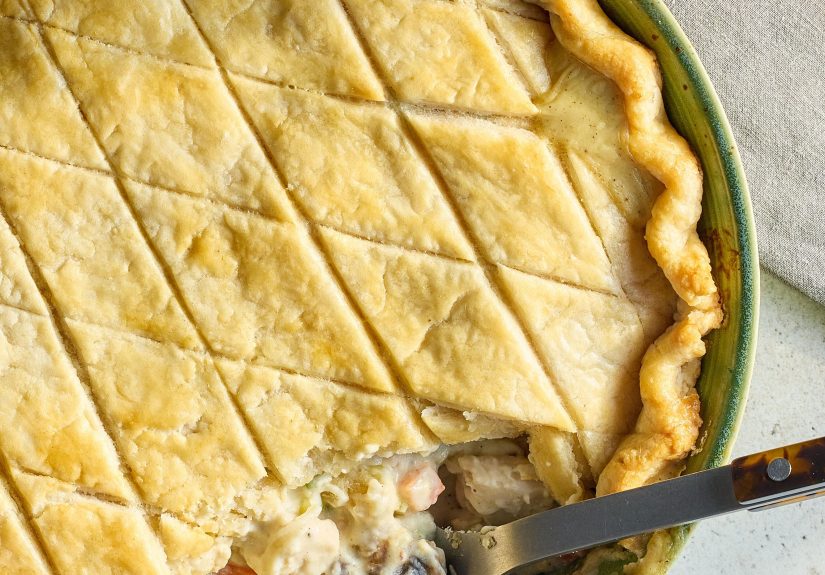
Cut 4 to 6 vents in the top crust (steam needs an exit plan). Brush with egg wash.
If you want to be a little extra (in a good way), sprinkle with a pinch of flaky salt.
Step 8: Bake until golden and bubbly
Set the dish on the preheated rimmed baking sheet. Bake at 425°F for 20 minutes, then reduce the oven to
375°F and bake for 25 to 35 minutes, or until the crust is deeply golden and the filling
is bubbling through the vents.
Step 9: Rest before slicing (your filling needs to set)
Let the pot pie rest for 15 to 20 minutes before serving. This gives the sauce time to thicken up so you get
rich slices instead of a lava flow.
Pro Tips for a Pot Pie That Doesn’t Turn Into Soup
- Thickness test: Your sauce should be gravy-thick before it goes into the oven. If it seems loose on the stovetop, it won’t magically tighten up later.
- Don’t boil the dairy: Keep the simmer gentle after adding milk/half-and-half to avoid grainy sauce.
- Cool the filling: Hot filling + cold dough = steam explosion + soggy crust. Let it calm down first.
- Vent like you mean it: Steam trapped under crust makes soggy pastry. Vents keep it crisp and flaky.
- Use a baking sheet: Deep-dish pies bubble. Catch it. Your future self (and your smoke detector) will be grateful.
- Rotisserie chicken is legit: Pot pie is about comfort, not suffering. Use shortcuts when they make sense.
Easy Variations (Because Your Fridge Is the Boss)
1) Puff pastry topper
Want extra flake with minimal effort? Swap pie dough for puff pastry. It bakes up lofty and crisplike your pot pie is wearing
a fancy winter coat.
2) Biscuit-topped “almost pot pie”
Drop biscuits on top of the filling and bake until the biscuits are cooked through. It’s less pie, more “comfort food with
good hair,” and no one complains.
3) Turkey deep-dish pot pie
Leftover turkey works perfectly. Add a little extra thyme and a splash of lemon juice to brighten it up.
4) Veggie-heavy (still cozy)
Add sautéed mushrooms, chopped green beans, or small broccoli florets. If you add watery vegetables, cook them first so they
don’t thin the sauce.
5) A tiny kick
Stir in a pinch of cayenne or a few dashes of hot sauce. The goal is warmth, not “why are my eyebrows sweating.”
Make-Ahead, Freezing, and Reheating
Deep-dish chicken pot pie is a meal-prep champion. You can make the filling up to 2 days ahead and refrigerate
it. When you’re ready to bake, bring the filling closer to room temp, top with crust, and bake as directed.
Freezing options
- Freeze the filling only: Cool completely, freeze in an airtight container up to 3 months, thaw in the fridge, then top with fresh dough and bake.
- Freeze the assembled unbaked pie: Assemble, wrap well, and freeze. Bake from frozen by adding extra baking time and tenting with foil if the crust browns too fast.
- Freeze baked leftovers: Cool, portion, wrap, and freeze. Reheat in the oven for best crust texture.
Reheating
Reheat individual portions in a 350°F oven until hot. (Microwaves are fast, but they make crust sad.)
If you do microwave, finish in a toaster oven or air fryer to bring back the crisp.
Food safety note: If you’re cooking chicken specifically for this recipe, make sure it reaches
165°F using a food thermometer.
What to Serve With Deep-Dish Chicken Pot Pie
Pot pie is rich, so pair it with something fresh and snappy:
- Simple green salad with lemony vinaigrette
- Roasted Brussels sprouts or broccoli
- Pickles or quick-pickled onions (trust meacidity is magic here)
- Apple slaw for crunch and brightness
Troubleshooting: Common Pot Pie Problems (and Fixes)
“My filling is too runny.”
Next time, simmer the sauce longer before baking. For a quick fix, you can spoon some filling into a small saucepan and
reduce it on the stove, then stir it back in. Also: let the baked pie rest longer before slicing.
“My filling is too thick.”
Thin it with a splash of broth or milk. Add slowly, stir well, taste, and adjust seasoning.
“My crust browned too fast.”
Tent the pie loosely with foil for the last 15 minutes. Also consider baking on the middle rack (not too close to the top).
“It bubbled over and now my oven looks haunted.”
That’s why we use the rimmed baking sheet. If it still escaped, sprinkle baking soda on the cooled spill, add a little water
to make a paste, let it sit, and wipe clean.
Deep-Dish Chicken Pot Pie Experiences: Lessons from Real Kitchens
Deep-dish chicken pot pie has a funny way of becoming a “signature dish” without anyone officially applying for the job.
It starts innocently: you make it once because you have leftover chicken and it’s cold outside. Then you make it again because
someone in your house says, “Remember that pot pie?” in the same tone usually reserved for life-changing vacation memories.
Before you know it, you’re the person who brings pot pie to friends who just moved, dropped off a casserole to someone who’s
had a long week, or “accidentally” made an extra one because you wanted leftovers.
Home cooks learn quickly that pot pie isn’t about perfectionit’s about strategy. The first strategy is time.
Most people don’t want to cook chicken, chop vegetables, make sauce, and deal with crust on a random Tuesday. That’s why
rotisserie chicken becomes the hero: it turns pot pie from an all-day project into something you can pull off while still
wearing socks that don’t match. Another time-saving move is making the filling ahead. When the filling is already done,
you’ve basically turned dinner into “put on a pastry lid and bake,” which is the culinary version of finding money in a coat pocket.
The second strategy is texture. Everyone wants a flaky crust, but the filling can sabotage you if it’s too hot
or too thin. Lots of cooks discover (usually after one slightly soggy attempt) that letting the filling cool is the difference
between “restaurant vibes” and “why is my crust sweating?” Vents matter, too. Cutting a few clean slits in the crust feels
decorative, but it’s really practical: it lets steam escape so the pastry stays crisp. The payoff is that shattering top layer
that makes people pause mid-bite like they’re listening to an orchestra.
Then there’s the “deep-dish” part, which changes the whole experience. A standard pot pie can be good, but deep-dish feels
generousmore filling, more creamy bites, more of that savory gravy hugging every vegetable. It’s also forgiving. If you have
more carrots than peas, it still works. If you swap corn for green beans, it still works. If you toss in mushrooms because
you found them in the back of the fridge and you refuse to be defeated by produce, it still works. Deep-dish pot pie is a
flexible friend.
Another common experience: the moment you realize pot pie is a “gateway recipe” for using leftovers. Some families end up
making turkey pot pie right after Thanksgiving because it’s honestly a better encore than reheated turkey slices. Others turn
it into a “clean out the vegetable drawer” ritualbits of broccoli, a handful of spinach stirred in at the end, roasted sweet
potato cubes, or even leftover roasted carrots. The trick is balancing moisture: watery veggies should be cooked first so they
don’t dilute the sauce. Once you get that, the recipe becomes less of a strict formula and more of a delicious framework.
Finally, there’s the emotional sideyes, food can be emotional, and no, you don’t have to make it weird. Pot pie is the meal
people request when they want something comforting, familiar, and satisfying. It’s what you make when you want dinner to feel
warm in a way that goes beyond temperature. And it’s what you serve when you want the table to go quiet for a minutenot
because you demanded silence, but because everyone is busy having a small, buttery-crust moment. If that’s not success,
what is?
Conclusion
Deep-dish chicken pot pie is the kind of recipe that earns a permanent spot in your rotation: cozy, flexible, crowd-pleasing,
and surprisingly doable once you understand the big ideas (thick sauce, cooled filling, vented crust, hot oven).
Whether you go all-in with homemade pastry or take the smart shortcut with rotisserie chicken and store-bought dough, the end
result is the same: a golden, bubbling, deep-dish masterpiece that makes an ordinary night feel a little more special.