Table of Contents >> Show >> Hide
- What “Exposed Wiring” Really Means (And Why It’s Not Always Wrong)
- Why Exposed Electrical Wiring Is a Bigger Deal Than It Looks
- How Code Thinks: “Protect It Where It’s Likely To Get Hit”
- Common Code Rules and Practices for Exposed Wiring
- 1) NM (Romex) cable: allowed in many places, but not “free-range”
- 2) Unfinished basements and crawl spaces: “spaghetti ceilings” are the classic fail
- 3) Attics: protect wiring where people can step on it
- 4) Studs and joists: the 1¼-inch rule (and why nail plates exist)
- 5) Splices and junction boxes: no “floating connections,” ever
- 6) “Just put it in conduit” isn’t always wrongbut do it correctly
- Where Exposed Wiring Shows Up Most (And What Usually Fixes It)
- DIY Reality Check: When to Call a Pro
- Inspector-Style Checklist: How to Self-Review Exposed Wiring
- Frequently Asked Questions
- Real-World Experiences: What Actually Happens With Exposed Wiring (Extra 500+ Words)
- Conclusion: Safe, Neat, and Code-Friendly Wins Every Time
Exposed electrical wiring is one of those home issues that looks minor until you realize it can be both
illegal and exciting in the “surprise spark” kind of way. The tricky part: not all visible wiring is a
code violation. Some wiring methods are designed to be surface-mounted. Others (looking at you, dangling
cable stapled like holiday tinsel) are just waiting for a ladder, a box, or a curious teenager to turn them
into a repair bill.
This guide breaks down how U.S. electrical codes (typically based on the National Electrical Code, or NEC)
think about exposed wiring, what “subject to physical damage” really means in practice, and the most common
ways homeowners and electricians bring things back to safe-and-inspectable.
What “Exposed Wiring” Really Means (And Why It’s Not Always Wrong)
In everyday language, “exposed wiring” means you can see a cable or conductors. In code-and-inspection
language, the concern is usually whether the wiring is protected against physical damage and installed
using an approved wiring method for the location.
Two different situations get confused all the time
-
Wiring that is meant to be visible: Examples include metal conduit (EMT), surface raceways, and
certain armored cables where allowed. These can be “exposed” and still perfectly compliant when installed
correctly. -
Wiring that is only supposed to be visible temporarily (or never): Like nonmetallic-sheathed cable
(NM-B, often called “Romex”) draped across a garage wall at shoulder height, or splices floating outside a
junction box. This is where inspectors start sharpening their pencils.
Why Exposed Electrical Wiring Is a Bigger Deal Than It Looks
Exposed wiring problems tend to fall into three buckets:
- Shock risk: Damaged insulation or unguarded energized parts can put live voltage within easy reach.
-
Fire risk: Loose connections, arcing, overheating, or damaged conductors can ignite nearby materials,
especially in unfinished spaces where wiring is more likely to get bumped. -
Mechanical damage: Wires get nicked by stored items, crushed by shelving, punctured by screws,
and “tested” by moving ladders more often than people think.
In other words: the wiring isn’t just “ugly.” It’s vulnerable.
How Code Thinks: “Protect It Where It’s Likely To Get Hit”
The NEC uses a simple principle: where wiring is subject to physical damage, it needs protection.
The frustrating part is that “subject to physical damage” isn’t a single measurement like “exactly 42 inches
above the floor.” It’s often a judgment call made by the AHJ (Authority Having Jurisdiction)your local
inspector or code official.
That’s why one garage passes with neatly routed NM cable while another fails because the cable is on the
face of studs right where bikes and trash cans live. Same house type. Different risk profile.
Common Code Rules and Practices for Exposed Wiring
1) NM (Romex) cable: allowed in many places, but not “free-range”
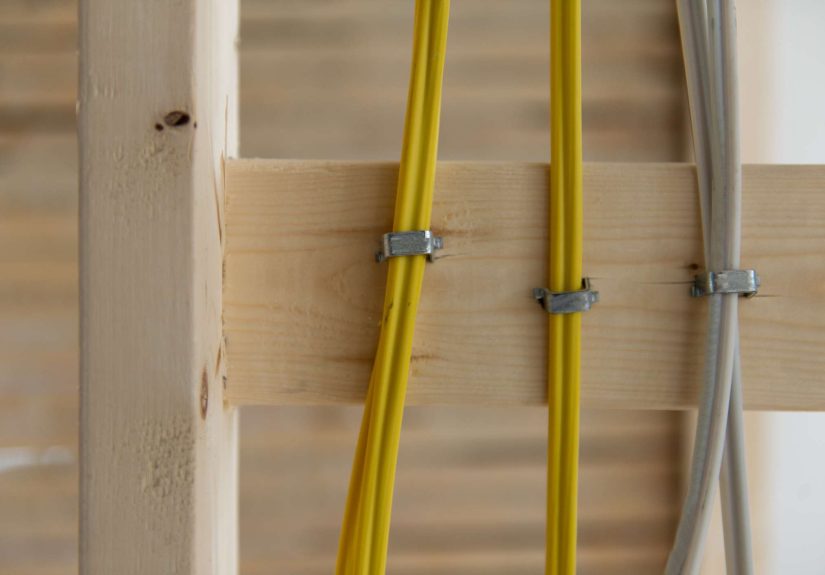
NM-B cable is commonly used in U.S. homes, but it has rules when it’s exposed. Generally, exposed cable
must be run close to the building surface or supported on running boards, and it must be protected where
it could be damaged.
Practical takeaway: If NM cable is riding the face of studs like a visible zipper and you can reach it,
bump it, or store stuff against it, expect to add protection (conduit, guard strips, a running board, or a
different wiring method).
2) Unfinished basements and crawl spaces: “spaghetti ceilings” are the classic fail
Unfinished basements are where good wiring goes to get bullied by storage bins. Code language and common
inspection practice typically favor these approaches:
- Through bored holes in joists: This keeps cables tucked up and protected.
-
On running boards: If you need to run perpendicular to joists or across exposed areas, a running
board can protect and organize the run. -
Limited direct support on lower edges: Larger cables may be allowed to be secured directly under
specific conditions, but smaller “typical branch circuit” cables often need the more protected routing.
Pro tip: If your basement ceiling wiring looks like it could be used to strain pasta, it’s time to
re-route. Neat, tight-to-structure runs are easier to protect, easier to inspect, and less likely to get
damaged.
3) Attics: protect wiring where people can step on it
Accessible attics are notorious for hidden hazards: low visibility, awkward footing, and “I’ll just set this
box here for a second” energy. In many cases, cables running across the tops of framing members or across
rafters within certain accessible zones need protection using guard strips or similar means.
Real-world meaning: If someone can walk, crawl, or store items near it, treat it like a high-traffic
areaeven if the only “traffic” is you once a year checking a furnace filter and regretting your life choices.
4) Studs and joists: the 1¼-inch rule (and why nail plates exist)
When cables pass through wood framing, they generally need to be set back from the face of the framing
member (commonly 1¼ inches). If you can’t maintain that setback, steel nail plates (or equivalent protection)
are used to prevent screws and nails from hitting the cable.
Translation: If your cable is too close to where drywall screws go, the code wants armor in the form of
a nail plate. It’s cheaper than rewiring and dramatically less exciting than discovering a live cable with a
drywall screw.
5) Splices and junction boxes: no “floating connections,” ever
One of the most consistent rules across electrical work: splices must be in an approved box, the box must
remain accessible, and it needs a proper cover. Open splices behind a shelf, taped connections outside a
box, or junction boxes buried behind drywall are common violations and common failure points.
- All splices in a box.
- Box remains accessible.
- Box has a cover.
- Cable entering the box is secured and protected.
If you remember nothing else, remember this: electrical connections need a “home” (a box) and that home needs a “door” (a cover).
6) “Just put it in conduit” isn’t always wrongbut do it correctly
Conduit can be a great way to protect wiring, especially in garages, basements, and utility areas. But the
details matter. When NM cable is run into conduit for protection, it must be protected against abrasion at
entry and exit points, and installations should avoid sharp edges and damaging bends.
Best practice: Use proper fittings, bushings, and transitions. Don’t rely on tape or “it’ll probably be fine.”
Inspectors love good fittings. They do not love mystery edges.
Where Exposed Wiring Shows Up Most (And What Usually Fixes It)
Garage walls with open studs
Garages are basically gyms for damage: ladders, rakes, bikes, car doors, storage totes, and occasional
“I’m building a workbench” weekends.
Common fixes:
- Route NM cable through bored holes (with proper setback) instead of across stud faces.
- Add steel nail plates where the setback can’t be maintained.
- Use conduit (like EMT) for exposed runs in high-contact areas.
- Consider finishing the wall with drywall or plywood (where allowed) to protect wiring from impact.
Basement ceilings with multiple branch circuits
The usual problem is cables stapled to the bottom edges of joists, running every direction like a subway map
designed by a raccoon.
Common fixes:
- Re-route through bored holes in joists where permitted.
- Use running boards to support and protect perpendicular runs.
- Bundle neatly (without over-tightening) and follow support/fastening requirements.
- Replace damaged cable rather than “patching” insulation.
Attic runs near access points
Cables placed where feet and storage happen often need guard strips or a protected pathway.
Common fixes:
- Install guard strips where required near the attic access and along travel paths.
- Route along framing members rather than across open tops where people step.
- Use a service walkway (where appropriate) and keep wiring out of it.
Exterior or damp locations
NM cable generally isn’t intended for wet or damp locations. Outdoor runs, many unfinished exterior walls,
and some high-humidity environments typically require wiring methods rated for the conditions (and often
conduit and wet-rated conductors).
Common fixes: Use wet-location approved wiring methods and fittings; protect entries with proper
weatherproof boxes and covers; and use GFCI protection where required.
DIY Reality Check: When to Call a Pro
If the issue is a single loose cable that needs better support and protection, many homeowners can handle
it safely if they understand local requirements and work de-energized with proper testing.
Call a licensed electrician (and consider a permit/inspection) when:
- You see damaged insulation, exposed copper, or signs of overheating (discoloration, odor).
- There are open splices or missing junction box covers.
- Wiring is in a damp/wet area or outdoors and you’re not sure it’s rated for it.
- The wiring layout is messy enough that you can’t confidently identify circuits and loads.
- Your area has special wiring rules (some cities require metallic conduit in most or all residential work).
Inspector-Style Checklist: How to Self-Review Exposed Wiring
- Is the wiring method allowed here? (Dry vs damp, interior vs exterior, accessible vs concealed)
- Is it protected from physical damage? (Height, traffic, storage, impact zones)
- Are cables supported properly? (Not drooping, not loosely draped, secured where required)
- Are penetrations protected? (Setback maintained or nail plates installed)
- Are all splices in covered, accessible boxes?
- Are transitions into conduit protected from abrasion?
- Is labeling reasonable? (Bonus points for a panel directory that matches reality)
Frequently Asked Questions
Is exposed Romex always a code violation?
Not always. The big question is whether it’s installed in a permitted location and protected from physical
damage. If it’s routed neatly, kept out of harm’s way, and meets support and protection practices, it may
pass. If it’s in a high-contact zone, expect required protection.
Can I “protect” exposed NM cable by putting it in conduit?
Often yes, but do it correctly: use proper fittings and abrasion protection where the cable enters and exits,
and follow local rules. Some places prefer or require different wiring methods for exposed areas.
What’s the simplest upgrade in a garage or unfinished basement?
Rerouting NM cable through bored holes (with proper setback) is frequently the cleanest option. When that’s
not practical, conduit, guard strips, or running boards can be effective.
Real-World Experiences: What Actually Happens With Exposed Wiring (Extra 500+ Words)
If you want to understand why codes get picky about exposed electrical wiring, spend five minutes watching
how a real home is used. Unfinished spaces aren’t museumspeople live in them. They store things. They
move things. They swing lumber around like it’s a lightsaber. And the wiring is either protected… or it
becomes the unwilling participant in every DIY project within a 20-foot radius.
One common “experience pattern” shows up in basements: a homeowner adds one circuit, then another, then a
third, and each one is stapled to the bottom of joists because it feels quick and “tidy.” A couple years
later, the ceiling looks like a cable octopus. The first time someone drags a long box (holiday decorations
are always the villain) and hooks a cable, a staple loosens, the cable sags, and suddenly it’s hanging low
enough that a future storage tote can rub it. Nobody notices. Until someone doesusually during a home
inspectionwhen it becomes a list item that reads “repair exposed wiring.” Translation: time to re-route and
protect.
Garages have their own greatest hits. The most common is the “stud-face highway,” where NM cable is run
right across the front of studs because it’s easy and there’s no drywall to hide it. Then life happens:
a bike handlebar catches it, a shovel leans on it, or a shelf bracket gets installed with a screw that lands
a little too close. Even when the cable isn’t punctured, the jacket can get scuffed or compressed. That’s
the kind of damage that looks harmless until you realize the whole goal of the jacket is to keep the
conductors insulated and protected. In garages, adding conduit in impact zones or rerouting through bored
holes tends to be the “sleep better at night” fix.
Attics are where people accidentally invent new forms of regret. The classic scenario: you climb up through
the attic access, step carefully onto a joist, then shift your weight… directly onto a cable that someone ran
across the top of framing members. Nothing dramatic happens, but the cable gets crushed slightly under a
boot. Repeat this a few times over years (plus a few storage boxes sliding around), and you’ve created the
perfect slow-motion problem: insulation compression, jacket wear, and potential conductor stress. Guard strips
and keeping cables out of “walk paths” aren’t just code theaterthey reflect how humans move in cramped
spaces when the lighting is terrible and the air is 20 degrees hotter than it should be.
Another real-world issue is “temporary becomes permanent.” Someone runs a cable for a freezer, a workshop
tool, or a new light, and plans to “clean it up later.” Later turns into two years, then five, and the cable is
still stapled across a wall at perfect shoulder heightexactly where a ladder will scrape it. Good practice
treats any exposed run as permanent from day one: route it tight to structure, protect it where it could get
hit, and keep splices in covered, accessible boxes. If you can’t make it look intentional, it probably isn’t
safe enough.
The last experience is the one nobody wants: “mystery fixes.” Tape wrapped around a nicked cable. A splice
twisted together and hidden behind insulation. A junction box without a cover “because it’s in the corner.”
These are the kinds of shortcuts that inspectors flag fastand for good reason. Electrical systems don’t fail
politely. When something goes wrong, it tends to go wrong as heat, sparks, and smoke. The best “experience”
you can have with exposed wiring is the boring one: you fix it properly once, it passes inspection, and you
never think about it again.
Conclusion: Safe, Neat, and Code-Friendly Wins Every Time
Exposed electrical wiring isn’t automatically a violation, but it is automatically a risk review. If the
wiring method is approved for the location and protected from physical damage, you’re usually in good shape.
If it’s hanging loose, easy to bump, improperly spliced, or routed like an obstacle course, the solution is
almost always the same: route it better, protect it better, box it correctly, and make it inspectable.
When in doubt, treat your wiring like it has to survive a real household: storage bins, ladders, kids, pets,
and the occasional “I’ll just drill here” moment. Code is largely the written version of those experiences
minus the sarcasm.