Table of Contents >> Show >> Hide
- What Is a Homestead Exemption in Florida?
- Who Qualifies for Florida Homestead Exemption?
- How to Apply for a Homestead Exemption in Florida: 15 Steps
- Step 1: Confirm that you owned the property on January 1
- Step 2: Make sure the property is your permanent residence
- Step 3: Check that your type of ownership qualifies
- Step 4: Stop claiming residency-based tax benefits somewhere else
- Step 5: Gather your property details
- Step 6: Collect your Florida residency documents
- Step 7: Gather Social Security numbers and co-owner information
- Step 8: Prepare proof that you gave up your previous residency
- Step 9: Review whether you qualify for additional exemptions
- Step 10: Decide whether portability applies to you
- Step 11: Choose how you want to file
- Step 12: Complete Form DR-501 carefully
- Step 13: Include special documents if your situation is not standard
- Step 14: File before March 1
- Step 15: Save your confirmation and watch for renewal notices
- A Quick Example of How the Tax Benefit Works
- Common Mistakes to Avoid
- What Happens After Approval?
- Final Thoughts
- Real-World Experiences: What Florida Homeowners Usually Learn the Hard Way
Applying for a homestead exemption in Florida sounds like one of those tasks that should come with a complimentary cup of coffee and a mild stress warning. The good news is that the process is much less scary once you know what the county property appraiser actually wants from you. The even better news is that a successful application can reduce the taxable value of your primary residence and make your property tax bill a little less dramatic.
If you are a Florida homeowner, this guide walks you through how to apply for a homestead exemption in Florida step by step, in plain English, with fewer bureaucratic headaches and more practical advice. We will cover eligibility, required documents, filing deadlines, portability, common mistakes, and what real homeowners tend to learn the hard way.
What Is a Homestead Exemption in Florida?
A Florida homestead exemption reduces the taxable value of a qualifying primary residence. For the 2026 tax year, eligible homeowners can receive up to $51,411 in homestead benefit when the property value is high enough to receive the full amount. Here is the simple version:
- The first $25,000 applies to all property taxes, including school taxes.
- The additional exemption, which is inflation-adjusted and equals $26,411 for 2026, applies to the portion of assessed value above $50,000 and only to non-school taxes.
That means the homestead exemption can lower your tax bill, but it does not magically wipe out everything. Florida is generous, but not “free unicorn house” generous.
Who Qualifies for Florida Homestead Exemption?
Before you race to the application form, make sure you meet the basic rules. In general, you qualify if you owned the property and made it your permanent Florida residence on January 1 of the tax year for which you are applying. Your county property appraiser decides eligibility, so the details matter.
You will usually need to show that the home is your true, primary residence, not your vacation place, rental, or “we stay there sometimes when the weather is nice” property. Counties often look at your Florida driver license or ID, vehicle registration, voter registration, IRS return address, utility records, bank statements, and other signs that you actually live there.
How to Apply for a Homestead Exemption in Florida: 15 Steps
Step 1: Confirm that you owned the property on January 1
This is the first gatekeeper. Florida homestead eligibility is tied to your ownership status on January 1 of the tax year. If you bought the house on January 2, the answer for that year is not “close enough.” In that case, you may be able to pre-file for the next tax year instead.
Step 2: Make sure the property is your permanent residence
This is not just about where your sofa lives. It is about where you live on a permanent basis. Your homestead should be the place you intend to keep as your main home. If you rent it out, split your time in a way that makes another state look like home, or treat it like a seasonal retreat, you may have a problem.
Step 3: Check that your type of ownership qualifies
Most applicants own their home directly, but some properties are held in a trust, life estate, or other arrangement. In many cases, beneficial or equitable title can still qualify, but the county may ask for extra documentation. If your ownership is anything other than straightforward, do not guess. Contact the county property appraiser before filing and ask what documents they require.
Step 4: Stop claiming residency-based tax benefits somewhere else
Florida does not want you trying to have two “primary” homes in two different states at the same time. If you previously claimed a residency-based exemption elsewhere, terminate it. The county may ask for proof that your former residency ended. This is where snowbirds sometimes discover that winter sunshine and tax paperwork are not the same thing.
Step 5: Gather your property details
Pull together the basics: parcel number, property address, deed information, and names exactly as they appear on title. If there are multiple owners, list them correctly. Tiny mismatches in names and ownership records are the kind of detail that can slow down your application for no glamorous reason at all.
Step 6: Collect your Florida residency documents
This is the heart of the application. Most counties want some combination of the following:
- Florida driver license or Florida ID
- Florida vehicle registration
- Florida voter registration, if you are a U.S. citizen
- Declaration of domicile, if recorded
- Address on your most recent IRS return
- Utility bills in your name at the homestead address
- Bank statements mailed to the home
- School location of dependent children, if relevant
The more your records point to your Florida house as your real home, the smoother the process usually goes.
Step 7: Gather Social Security numbers and co-owner information
Florida’s homestead application asks for Social Security information for the applicant and often for the spouse or co-applicant as well. Get that information ready before you begin. If you are married, your county may still ask for spouse information even when only one spouse is on title.
Step 8: Prepare proof that you gave up your previous residency
Counties may look for evidence that you cut ties with your old state. That can include surrendering an out-of-state driver license, ending a prior homestead benefit, changing your mailing address, updating bank accounts, or showing a new Florida vehicle registration. Think of this step as building a clean paper trail that says, “Yes, I live here now, and I brought my toothbrush for good.”
Step 9: Review whether you qualify for additional exemptions
Many homeowners stop at basic homestead and miss other benefits. Depending on your circumstances, you may also qualify for exemptions related to age, disability, veteran status, widow or widower status, or first responder benefits. Some of these require separate forms or supporting documents, so it is smart to check the county website before you hit submit.
Step 10: Decide whether portability applies to you
If you moved from one Florida homestead to another, you may be able to transfer some of your Save Our Homes assessment benefit to the new property. This is called portability. It is not the same as transferring the homestead exemption itself. Usually, you must file for your new homestead and submit the portability form, commonly DR-501T, within the required time window.
Step 11: Choose how you want to file
Most counties now allow online filing, and many also allow in-person or mail-in applications. Online filing is usually the easiest option because it walks you through the fields and lets you upload documents right away. In-person filing can be helpful if your ownership is unusual, your residency history is complicated, or you simply prefer a real human over a website that asks for the same thing three different ways.
Step 12: Complete Form DR-501 carefully
Form DR-501 is the standard Florida homestead application. Fill it out slowly and accurately. Double-check ownership names, occupancy dates, Florida residency dates, and supporting information. A rushed application often creates the kind of follow-up email nobody enjoys.
Step 13: Include special documents if your situation is not standard
If your home is held in a trust, if you have a life estate, if you are applying as a permanent resident who is not a U.S. citizen, or if your county requests extra documents, attach them the first time. That may include trust paperwork, immigration documents, recorded declarations, or proof tied to dependent occupancy. The goal is to make it easy for the property appraiser to say yes.
Step 14: File before March 1
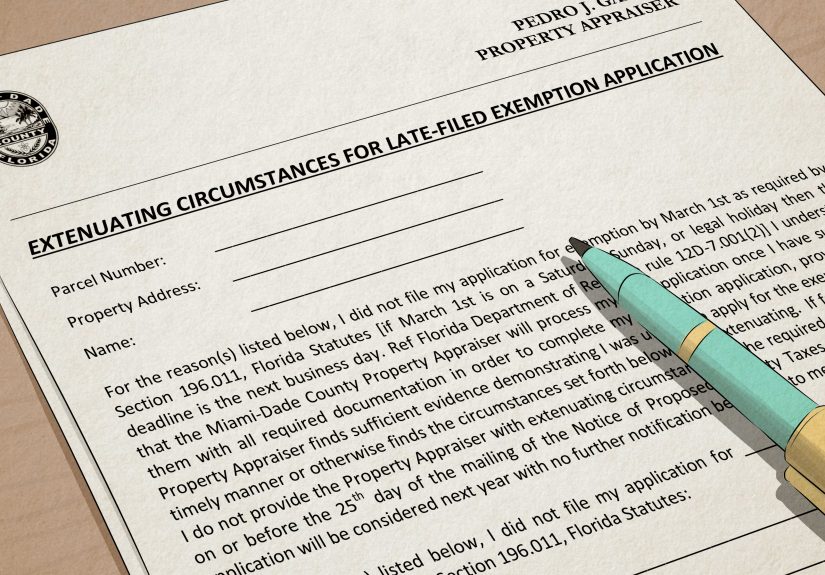
This is the deadline that matters most. To receive the exemption for the current tax year, your application generally must be filed by March 1. If you miss it, contact your county property appraiser immediately. Some counties can consider limited late applications under state law, but that is not something to treat casually. “I forgot” is not the world’s strongest legal strategy.
Step 15: Save your confirmation and watch for renewal notices
After you file, keep your confirmation number, screenshots, emails, or stamped receipt. If the county asks follow-up questions, answer them quickly. Once approved, your homestead exemption generally renews automatically each year unless ownership, residency, or use changes. That said, do not ignore mail from the property appraiser. Automatic renewal is wonderful, but it is not a substitute for reading your notices.
A Quick Example of How the Tax Benefit Works
Suppose your Florida home has an assessed value of $100,000 in 2026. The first $25,000 is exempt from all property taxes. The next $25,000 remains taxable. Then up to $26,411 above the $50,000 mark can be exempt from non-school taxes. In plain English, the homestead exemption lowers different parts of the taxable value in different ways, which is why property tax estimates can look a little weird at first glance.
Common Mistakes to Avoid
- Waiting too long to file: March 1 arrives faster than expected.
- Using inconsistent addresses: If your tax return, license, utilities, and registration all point in different directions, the county may have questions.
- Forgetting portability: If you moved from another Florida homestead, you may leave tax savings on the table.
- Assuming a trust automatically disqualifies you: It may not, but you need the right paperwork.
- Renting the property while claiming homestead: This can jeopardize your exemption.
- Ignoring a denial notice: If your application is denied, review the reason and ask about appeal options, including the Value Adjustment Board process.
What Happens After Approval?
After approval, your county will apply the homestead benefit to the property record. Beginning the following year, the Save Our Homes assessment limitation may also help cap annual increases in assessed value. If you later move to another Florida homestead, that cap benefit may become portable. In other words, filing once can set up future savings too.
Final Thoughts
If you have been wondering how to apply for a homestead exemption in Florida, the process is really about proving three things: you own the property, you live there permanently, and you filed on time. The paperwork is not exactly thrilling, but it is manageable, and the tax savings can be worth the effort. The smartest move is to treat the application like a mini audit of your residency life: get your documents aligned, file early, and make it easy for the property appraiser to connect the dots.
And yes, this is one of those rare adult tasks where being organized can actually save you money. That is as close to a Florida miracle as paperwork usually gets.
Real-World Experiences: What Florida Homeowners Usually Learn the Hard Way
In real life, the people who have the smoothest homestead exemption experience are usually not the people with the fanciest homes. They are the people whose paperwork tells one simple story. Their driver license matches the house. Their voter registration matches the house. Their utility bill matches the house. Their tax return matches the house. In the eyes of the county, consistency is beautiful.
One common experience is the first-time Florida buyer who assumes the exemption happens automatically at closing. It does not. Buying a house and qualifying for homestead are related, but they are not the same thing. Many homeowners discover this after moving in, unpacking for three months, and then realizing nobody filed anything except maybe the warranty registration for the refrigerator.
Another common scenario involves snowbirds. Someone has lived part of the year in another state for decades and then decides Florida is now the “real” home. The homeowner may honestly believe that intention alone is enough. But counties usually want evidence, not just enthusiasm. If your old state still has your driver license, your car registration, and your voting record, Florida may reasonably raise an eyebrow.
Trust-owned property creates a different kind of confusion. Many homeowners hear “trust” and panic, assuming they ruined their homestead chances by trying to do smart estate planning. In many cases, that fear is unnecessary. The real issue is not whether the word “trust” exists. It is whether the applicant has the right type of beneficial interest and can document it clearly. A quick call to the county before filing often saves weeks of back-and-forth later.
Portability is another area where experience matters. Homeowners who move from one Florida property to another often focus so hard on the new mortgage, movers, and furniture placement that they forget the old homestead benefit may have value. Later, when they learn they could have transferred some Save Our Homes benefit, the reaction is usually the same: deep regret, followed by a lot of searching through old folders.
Late filers tend to have the most stressful stories. Sometimes there is a legitimate reason, like illness, a family emergency, or confusion after a move. But the lesson is always the same: homestead is easier when filed early. Waiting until the last minute turns a straightforward application into a drama nobody requested.
The best experience-based advice is simple. File early. Keep your documents aligned. Save every confirmation. Read every county notice. And if your situation is unusual, ask questions before you submit. Florida homestead exemption is not impossible, mysterious, or designed to defeat you. It just rewards homeowners who can prove, clearly and calmly, that the house is home.