Table of Contents >> Show >> Hide
- First, Make Sure You Have the Right Cut
- Why Butterfly a Pork Loin?
- Tools You’ll Want (No Fancy Stuff, Promise)
- How to Butterfly a Pork Loin: Step-by-Step
- Common Mistakes (and How to Fix Them Without Crying)
- Turning a Butterflied Pork Loin Into a Stuffed, Rolled Roast
- How to Cook a Butterflied (or Stuffed) Pork Loin Safely Without Drying It Out
- Carving for Maximum “Wow”
- FAQ: Fast Answers to Common Butterflying Questions
- Extra: Real-World “What It Feels Like” Experiences (So You’re Not Surprised Later)
- Conclusion
Butterflying a pork loin is one of those kitchen skills that sounds like it requires a culinary degree and a tiny mustache.
In reality, it’s just a smart way to turn a thick roast into a wide, even sheet of meat you can stuff, roll, and cook more evenly.
Think of it as giving your pork loin a “hinge” so it opens like a bookexcept this book is delicious and doesn’t judge your reading level.
In this guide, you’ll learn how to butterfly a pork loin step by step, how to keep the cuts even, what to do if things go a little sideways,
and how to turn that butterflied pork loin into a stuffed showstopper that slices into neat spirals. (Yes, the spiral slice is the entire point.
We’re all just out here chasing the perfect swirl.)
First, Make Sure You Have the Right Cut
A pork loin and a pork tenderloin are not the same thingeven though grocery store labels sometimes act like they are.
Pork tenderloin is smaller, narrower, and usually about 1 pound. Pork loin is larger (often 2–5 pounds), wider, and commonly sold as a “pork loin roast”
or “boneless pork loin.” If you try to butterfly a tenderloin using pork-loin expectations, you’ll end up with a meat postage stamp and big feelings.
Quick visual cue
- Pork loin: wide, thick, often with a fat cap along one side, roast-sized.
- Pork tenderloin: long, slim, tapered at ends, filet-sized.
Why Butterfly a Pork Loin?
- Even thickness = even cooking: fewer dry edges and undercooked centers.
- More surface area: more room for seasoning, stuffing, and glorious flavor.
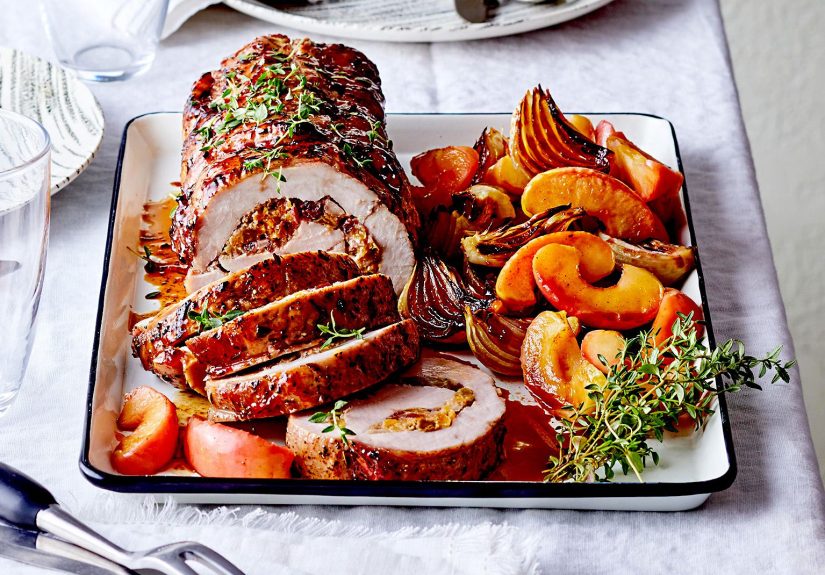
- Better presentation: rolled and tied, it slices into clean, impressive pinwheels.
- Faster roasting (sometimes): an even roll cooks more predictably than a lumpy roast.
Tools You’ll Want (No Fancy Stuff, Promise)
- Large cutting board (ideally with a damp towel underneath to prevent slipping)
- Long, sharp knife (a slicing knife or chef’s knife; sharp beats expensive)
- Paper towels (for drying and gripping)
- Plastic wrap or parchment (for gentle pounding)
- Meat mallet or rolling pin (optional, but very satisfying)
- Kitchen twine (if stuffing/rolling)
- Instant-read thermometer (the real MVP)
How to Butterfly a Pork Loin: Step-by-Step
Step 1: Chill and prep the pork
Cold meat is easier to slice cleanly. If your pork loin is super soft or slippery, pop it in the fridge for 15–20 minutes.
Pat it dry with paper towelsdry meat is safer to handle and less likely to skate around like it’s auditioning for ice capades.
Step 2: Position it for a stable cut
Set the loin on the cutting board so it’s stable and not rocking. Many cooks place the pork with the fat cap facing down (if it has one),
because it can create a flatter base and keeps your knife working through lean meat first. If the fat is too slippery, rotate the loin to the flattest side.
Step 3: Make the first long cut (create the “book hinge”)
Place your non-knife hand on top to steady the pork. Starting along one long side, slice lengthwise down the center,
keeping your blade parallel to the board. Here’s the key: do not cut all the way through.
Stop with about 1/2 inch of meat still intact on the far side. That intact strip is your hinge.
Open the pork like a book. At this point, you’ve “butterflied” it in the basic sense, but it’s likely still thick and unevenso we keep going.
Step 4: “Double butterfly” for a wider, flatter sheet
You now have two thick flaps. Working with one flap at a time, position your knife at the thicker edge of the flap and slice horizontally outward,
again keeping the blade parallel to the board. Use short, shallow strokes and let the board guide your blade.
Unroll the flap as you cut, aiming for an even thickness of about 1/2 to 3/4 inch.
Repeat on the other flap. When you’re done, you should have a large, more evenly thick rectangle-ish sheet of pork.
(It does not need to be a perfect rectangle. This is dinner, not geometry class.)
Step 5: Even it out (optional but highly recommended)
Lay plastic wrap or parchment on top and gently pound thicker areas with the flat side of a mallet (or rolling pin).
You’re not trying to turn it into deli meatjust smoothing out lumps so it rolls and cooks evenly.
Common Mistakes (and How to Fix Them Without Crying)
You cut all the way through the hinge
Congratulations, you now have two pork pieces. It’s fine. Line them up edge-to-edge like a puzzle and proceed.
If you’re stuffing and rolling, the twine will hold everything together. If you’re grilling it flat, treat it as two cutlets.
It’s uneven thickness
That’s normal at first. Pound thicker sections gently, and when rolling, start from the slightly thicker end so the roll evens out.
Also: shallow cuts are your friend. Deep cuts are how you end up inventing new shapes of pork.
The pork keeps sliding around
Dry it thoroughly. Anchor your board with a damp towel. And remember: a sharp knife requires less force, which means less slipping.
Turning a Butterflied Pork Loin Into a Stuffed, Rolled Roast
Butterflying is often step one for a stuffed pork loin. Here’s how to go from “flat meat” to “spiral masterpiece.”
Step 1: Season the inside
Salt and pepper are non-negotiable. After that, you can add garlic, dried herbs, lemon zest, Dijon, or a spice rub.
Seasoning the inside means flavor in every bitenot just on the surface where it can wave politely and then leave.
Step 2: Add filling (but don’t overdo it)
Spread your filling evenly, leaving a 1/2 to 1 inch border around the edges so it doesn’t squeeze out when rolled.
If your filling is wet (spinach, mushrooms, pesto), keep it thin. Too much filling is how your pork loin becomes a stuffing cannon.
Filling ideas that work well
- Garlic-herb breadcrumb mix (classic, tidy, forgiving)
- Prosciutto + pesto (salty, herby, very “I have my life together”)
- Spinach + cheese (crowd-pleasing, but squeeze spinach dry)
- Mushroom + apple (savory-sweet, great for fall)
- Olive tapenade + herbs (bold flavor, gorgeous slices)
Step 3: Roll it tight
Starting from a long edge, roll the pork up snugly into a cylinder. Use both hands and roll with purpose.
The tighter the roll, the cleaner the spiral and the less likely filling is to escape.
Step 4: Tie with kitchen twine
Cut 4–6 pieces of twine (depending on roast length) and tie the roll at intervals of about 1 to 1 1/2 inches.
You want it secure but not strangledover-tightening can squeeze out filling and distort the shape.
If you want extra stability, add one long piece of twine lengthwise down the roast before tying crosswise.
If tying knots makes you feel like your hands are wearing oven mitts emotionally, look up a “butcher’s knot.”
It tightens neatly and makes you look extremely competent, even if your kitchen is currently covered in twine confetti.
How to Cook a Butterflied (or Stuffed) Pork Loin Safely Without Drying It Out
Use temperature, not vibes
The most reliable way to keep pork loin juicy is to stop cooking it based on time alone and start cooking it based on internal temperature.
For whole cuts like pork loin, the USDA safe minimum is 145°F followed by a 3-minute rest.
Resting matters: it helps juices redistribute and finishes the safety window.
Basic roasting approach (works for most kitchens)
- Preheat your oven (many cooks roast pork loin in the 350–425°F range depending on recipe and desired crust).
- Optional but great: sear the outside in a hot pan before roasting for better color and flavor.
- Roast until the thickest part hits 145°F (thermometer in the center, not in filling pockets).
- Rest at least 3 minutes (10 minutes is often even better for slicing neatly).
A note about fillings and food safety
If your filling contains raw meat (like raw sausage), your target temperature and method may need to change.
The simplest path is to use fillings that are already cooked or safe to eatsautéed vegetables, cooked bacon, cheeses, breadcrumbs, herbs, etc.
When in doubt, treat the filling like it needs to be fully cooked through before it goes inside the pork.
Carving for Maximum “Wow”
Once rested, snip and remove twine. Slice crosswise into rounds, ideally 1/2 to 1 inch thick.
Use a sharp knife and clean strokes (sawing aggressively can tear the spiral and scatter your hard work).
Serve immediately, and accept compliments as your new part-time job.
FAQ: Fast Answers to Common Butterflying Questions
How thick should a butterflied pork loin be?
Aim for about 1/2 to 3/4 inch thickness. Thin enough to roll easily, thick enough to stay juicy.
Do I have to pound it after butterflying?
Not always, but it helps even out thickness and makes rolling easier. Gentle pounding is plenty.
Can I ask the butcher to butterfly it?
Yesand it can be a great option if you’re short on time or confidence. Still, learning the technique is handy
(and gives you bragging rights at dinner).
What if my pork loin is huge?
Work slowly, keep your blade parallel to the board, and consider cutting the loin in half crosswise first,
then butterflying each section. Two smaller rolls can be easier to tie and cook evenly.
Extra: Real-World “What It Feels Like” Experiences (So You’re Not Surprised Later)
The first time most people butterfly a pork loin, the biggest surprise is how much patience it takes.
Not “meditation retreat” patiencemore like “don’t rush the knife or you’ll invent modern art” patience.
The temptation is to press harder to get through faster, but butterflying rewards the opposite: light pressure,
shallow strokes, and frequent pauses to re-center your blade. If your knife starts drifting upward (making the flap too thin),
flatten the angle and let the cutting board guide you back into a level slice.
Another common experience: realizing that cold pork is easier to control. Slightly chilled meat is firmer,
so the blade glides instead of tearing. This also helps when you’re trying to keep thickness evensoft, room-temp pork tends to bunch.
And yes, the fat cap can be slippery. If the roast feels like it’s doing the cha-cha on your cutting board, pat it dry again,
rotate to a more stable side, and make sure your board isn’t sliding. A damp towel underneath is a tiny trick that feels like magic.
When it comes to stuffing, many cooks learn the “less is more” rule the messy way. Too much filling doesn’t make a better stuffed pork loin
it makes a leakier one. The sweet spot is a thin, even layer that allows the meat to roll tightly. If you want bigger flavor,
concentrate the filling (cook mushrooms until they’re not watery, squeeze spinach dry, choose bold ingredients like pesto, tapenade,
or a punchy herb-garlic mix). That way you get stronger taste without turning the roll into a pressure vessel.
Tying with twine is its own little rite of passage. The first couple of tries can feel like you’re wrapping a present for someone you don’t like:
the string slips, the roll shifts, and suddenly you’re holding six knots and no confidence. The trick people pick up quickly is to
start in the center. One tie in the middle stabilizes the roll, and then you can work outward toward the ends.
Also, you don’t need museum-quality knots. You need consistent spacing and gentle tension. If you can tie your shoes, you can tie a pork loin
it just might not be pretty on day one.
Finally, there’s the thermometer moment. Many home cooks have a “wait, that’s it?” reaction when pork hits 145°F sooner than expected,
because older habits say pork must be cooked until it’s well-done and dry. Cooking to temperature (and resting) is the experience that changes everything:
the slices stay juicy, the spiral holds together, and the pork tastes like it actually wants to be eaten.
After a couple of runs, butterflying stops feeling like a stunt and starts feeling like a practical, repeatable skillone that makes weeknight pork
look like a dinner-party flex.
Conclusion
Butterflying a pork loin is a small technique with big payoffs: more even cooking, more flavor, and the option to create a stuffed roast
that looks impressive without being complicated. Keep the meat stable, keep the blade parallel to the cutting board, use shallow strokes,
and don’t panic if the shape isn’t perfecttwine and confidence can fix a lot.
Once you’ve done it once, you’ll realize the secret isn’t fancy equipment. It’s simply going slow enough to stay in control.
And if anyone asks how you got those perfect spiral slices, you can casually say, “Oh, I butterflied it,”
like you do that sort of thing all the time.