Table of Contents >> Show >> Hide
- Why Horses Look Hard to Draw
- Supplies You Need to Draw a Simple Horse
- How to Draw a Simple Horse Step by Step
- Step 1: Draw Two Large Ovals for the Body
- Step 2: Add the Neck Guideline
- Step 3: Sketch the Head Shape
- Step 4: Place the Ears
- Step 5: Add the Front Legs
- Step 6: Add the Back Legs
- Step 7: Connect and Smooth the Outline
- Step 8: Draw the Mane
- Step 9: Add the Tail
- Step 10: Add the Face Details
- Step 11: Draw the Hooves
- Step 12: Erase the Guidelines
- Step 13: Add Simple Shading
- Simple Horse Drawing Tips for Better Results
- Easy Variations: Cartoon, Cute, and Realistic Horse
- Common Mistakes When Drawing a Horse
- Practice Exercises for Learning Horse Drawing
- Experience Notes: What Drawing a Simple Horse Teaches You
- Conclusion
Drawing a horse can feel like trying to assemble a bicycle while it is already galloping away. The legs bend in surprising places, the neck has a proud curve, and the head somehow looks noble even when your pencil insists on creating a confused llama. The good news? You do not need to become an expert in animal anatomy before you draw a recognizable horse. You only need a simple method, a few basic shapes, and permission to make the first sketch look a little wobbly.
This guide explains how to draw a simple horse step by step using beginner-friendly techniques: circles, ovals, light guidelines, clean outlines, and easy shading. Whether you are drawing for a school project, a sketchbook challenge, a handmade card, or just because horses are objectively excellent, this tutorial will help you build a horse from the body outward without overcomplicating the process.
Why Horses Look Hard to Draw
Horses are beautiful animals, but they are also built like a collection of elegant puzzles. Their bodies are long, their legs are thin but strong, and their heads have a distinctive shape that is neither round nor square. Beginners often run into the same problems: the body becomes too short, the legs look like table legs, the neck turns into a noodle, or the horse accidentally becomes a dog with hooves.
The secret is not to draw the final horse immediately. Instead, start with a simple horse sketch made from construction shapes. Artists often reduce animals into basic forms before adding details. For a horse, that means using ovals for the chest and hindquarters, a smaller shape for the head, lines for the legs, and curved guidelines for the neck and back.
Think of the first stage as building a pencil skeleton. It does not need to be pretty. In fact, if it looks like a horse made of potatoes and sticks, you are probably doing it right.
Supplies You Need to Draw a Simple Horse
You do not need expensive tools to learn how to draw a simple horse. A basic pencil and paper are enough. Still, having a few helpful supplies can make the process smoother.
Recommended Drawing Materials
- A regular HB pencil for sketching
- A softer pencil, such as 2B, for darker lines and shading
- An eraser that does not destroy the paper like a tiny office bulldozer
- A sketchbook or clean drawing paper
- A black pen or marker if you want a bold cartoon horse outline
- Colored pencils, crayons, or markers for finishing touches
If you are a beginner, sketch lightly at first. Light lines are easier to erase, adjust, and refine. Heavy lines can trap your drawing too early, and nobody wants to negotiate with a stubborn pencil line.
How to Draw a Simple Horse Step by Step
The following method works well for kids, beginners, and anyone who wants a clear horse drawing tutorial without getting lost in advanced anatomy. You can draw the horse standing sideways, which is the easiest pose for learning proportions.
Step 1: Draw Two Large Ovals for the Body
Start by drawing two horizontal ovals. The oval on the left will become the chest. The oval on the right will become the hindquarters. Leave a small space between them, then connect them with gentle lines along the top and bottom.
The back oval can be slightly larger than the front oval because a horse’s hindquarters are powerful. Do not worry if the shapes are not perfect. Real horses are not assembled with cookie cutters either.
Step 2: Add the Neck Guideline
From the top of the front oval, draw a curved line rising upward and forward. This will guide the horse’s neck. Add another curved line below it to create neck thickness. The neck should feel strong, not like a piece of spaghetti having an emotional day.
A simple horse drawing looks better when the neck flows naturally into the body. Keep the upper line graceful and the lower line slightly shorter.
Step 3: Sketch the Head Shape
At the end of the neck, draw a long, slightly angled shape for the head. A horse’s head is usually longer than it is wide, so avoid making it too round. You can begin with a rectangle-like shape, then soften the corners.
Add a small bump for the muzzle at the lower front of the head. This gives the horse its recognizable face. For a cartoon horse, you can exaggerate the muzzle slightly. For a more realistic horse, keep it slimmer.
Step 4: Place the Ears
Draw two small pointed ears on top of the head. Horse ears are usually shaped like narrow triangles with soft edges. Keep them close together, angled slightly outward. These little ears add personality fast. Tilt them forward and your horse looks alert. Tilt one sideways and suddenly it has opinions.
Step 5: Add the Front Legs
Under the chest oval, draw two long leg guidelines. Each front leg can be built from simple straight and slightly angled lines. Horses have joints, so do not draw each leg as one stiff tube. Divide the leg into upper and lower sections, then add a small hoof at the bottom.
For a simple standing horse, keep the front legs mostly vertical. One leg can be slightly behind the other to create depth. This small overlap helps the horse look less flat.
Step 6: Add the Back Legs
The back legs are a little trickier because they bend more noticeably. Start from the hindquarter oval and draw the upper part of the leg slanting slightly backward. Then angle the lower section forward before ending with the hoof.
If that sounds confusing, imagine the back leg as a gentle zigzag. Not a lightning bolt, not a pretzel, just a calm zigzag with hooves. Draw the far back leg slightly behind the near one.
Step 7: Connect and Smooth the Outline
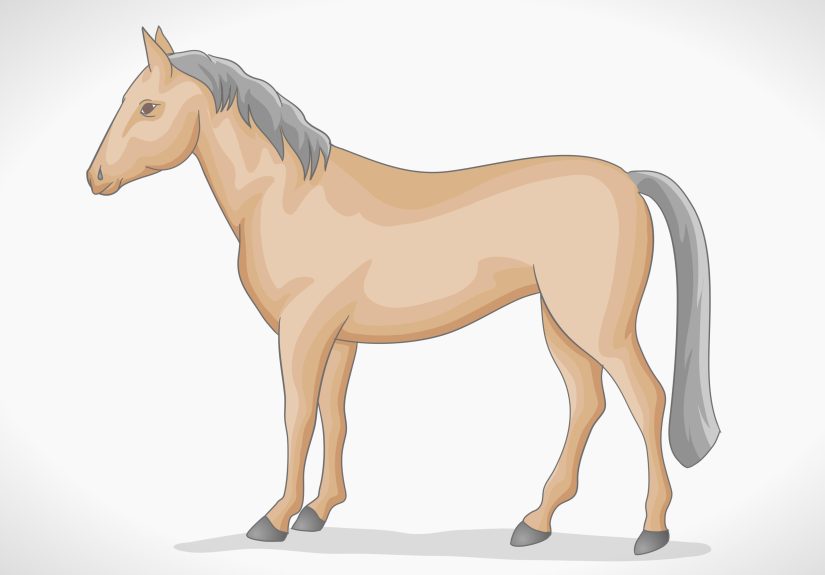
Now use your construction shapes as a guide to draw the final outline. Smooth the back, round the chest, define the belly, and shape the hindquarters. Connect the legs to the body with natural curves instead of sharp corners.
This is where your simple horse sketch starts to become a real drawing. Keep your line confident but not too dark yet. You may still want to adjust proportions before finishing.
Step 8: Draw the Mane
Add the mane along the top of the neck. For an easy horse drawing, use a series of short curved lines. The mane can lie flat, stand up in small tufts, or flow down the neck like your horse just walked out of a shampoo commercial.
A simple mane also helps hide awkward neck lines. This is not cheating. This is artistic problem-solving with hair.
Step 9: Add the Tail
Draw the tail coming from the back of the hindquarters. A simple tail can be made with two curved lines that taper to a point. Add a few inner lines to suggest strands of hair.
Keep the tail balanced with the pose. If the horse is standing still, the tail can hang down gently. If you want a lively look, let it curve outward.
Step 10: Add the Face Details
Draw a small almond-shaped eye near the upper part of the head. Place a tiny nostril near the muzzle. Add a short line for the mouth. For a beginner horse drawing, less is often better. Too many face details can make the horse look tired, angry, or like it just read your math homework.
Make the eye dark and leave a tiny white spot if you want it to look shiny. That little highlight can make the horse feel alive.
Step 11: Draw the Hooves
At the bottom of each leg, add small hoof shapes. Hooves can look like short trapezoids or slightly curved blocks. Make sure all four hooves touch the same ground line unless your horse is walking, jumping, or politely floating in space.
Step 12: Erase the Guidelines
Once your outline looks good, carefully erase the extra construction lines inside the horse. Do this gently so the final drawing stays clean. If some light sketch lines remain, that is fine. Sketches often keep a little evidence of the journey.
Step 13: Add Simple Shading
Shading gives your horse drawing more shape. Add light shading under the belly, beneath the neck, behind the legs, and where the mane overlaps the body. Use soft strokes instead of pressing hard.
If you are coloring the horse, choose simple colors such as brown, tan, black, gray, or white. You can also add patches, socks on the legs, or a white blaze on the face. Your horse does not need to be realistic to be charming.
Simple Horse Drawing Tips for Better Results
Use a Reference Photo
Even when drawing a simple horse, a reference photo can help you understand the body shape. Look at where the legs attach, how the neck curves, and how the head connects to the body. You do not have to copy every detail. Use the reference as a map, not a prison sentence.
Check the Body Length
A common beginner mistake is making the horse’s body too short. Horses have long torsos. If your drawing looks more like a pony, that may be cute, but lengthening the body can make it look more horse-like.
Make the Legs Thin but Not Fragile
Horse legs are slender, but they should still look strong enough to support the animal. If the legs are too thick, the horse may look like a cow. If they are too thin, it may look like it is standing on breadsticks. Aim for a middle ground.
Keep the Head Proportional
The head should be noticeable but not enormous. In a simple horse drawing, the head is usually smaller than the chest oval and connected by a sturdy neck. If the head becomes too large, your horse may drift into cartoon territory, which is fine if that is your goal.
Draw Lightly First
Light sketching gives you freedom. You can move a leg, adjust the neck, or reshape the head without feeling like you have ruined the drawing. Dark final lines should come after the structure is working.
Easy Variations: Cartoon, Cute, and Realistic Horse
Once you understand the basic steps, you can change the style of your horse drawing. The same construction method works for many versions.
How to Draw a Cartoon Horse
For a cartoon horse, make the head slightly larger, the eye bigger, and the legs simpler. Round the body shapes and exaggerate the mane. A cartoon horse can have a cheerful smile, expressive eyebrows, or a tail that looks like it has had three cups of coffee.
How to Draw a Cute Horse
For a cute horse, use softer curves and shorter legs. Make the eye large and shiny. Add a small muzzle and rounded ears. Keep the details simple and friendly.
How to Draw a More Realistic Horse
For a more realistic horse, study references more closely. Pay attention to the shoulder, hip, knee, ankle, and hoof placement. Use subtle shading to show muscle groups. You can also refine the head by adding the cheekbone, jawline, and nostril shape.
Common Mistakes When Drawing a Horse
Mistake 1: Drawing the Legs Too Straight
Horse legs have joints and angles. If all four legs are perfectly straight, the drawing may look stiff. Add slight bends at the knees and ankles to create a more natural pose.
Mistake 2: Forgetting the Chest and Hindquarters
Horses are not just long rectangles with legs. The chest and hindquarters give the body power and shape. Starting with two ovals helps you avoid a flat, boxy horse.
Mistake 3: Making the Neck Too Thin
A horse’s neck is muscular. A thin neck can make the drawing look weak or unnatural. Give the neck enough width, especially where it connects to the chest.
Mistake 4: Adding Details Too Early
Details are fun, but they should come after the structure. If you draw the mane, eyes, and shading before the body is correct, you may end up decorating a horse that still needs construction work.
Mistake 5: Quitting Too Soon
The first sketch often looks awkward. That does not mean you cannot draw. It means you are in the normal sketching stage. Keep refining. Every good drawing starts with lines that look a little suspicious.
Practice Exercises for Learning Horse Drawing
Practice does not have to be boring. Try these simple exercises to improve your horse drawing skills.
Exercise 1: Draw Only Horse Bodies
Fill a page with two-oval horse bodies. Do not add details. Focus only on the chest, belly, back, and hindquarters. This helps you understand the main structure.
Exercise 2: Practice Horse Legs
Draw several pairs of front and back legs. Notice how the front legs are straighter and the back legs have stronger angles. Keep the hooves simple.
Exercise 3: Draw Different Manes
Try a short mane, a long flowing mane, and a messy cartoon mane. This gives your horse personality without changing the whole body.
Exercise 4: Draw the Same Horse Three Ways
Draw one simple horse as a realistic sketch, one as a cartoon, and one as a cute character. This helps you learn how style changes the final result.
Experience Notes: What Drawing a Simple Horse Teaches You
Learning how to draw a simple horse is more than copying an animal. It teaches you how to see. At first, most beginners look at a horse and think, “That is a horse.” Useful, yes, but not very helpful for drawing. After practicing, you begin to see the horse as a combination of shapes, angles, curves, and rhythms. The chest becomes an oval. The hindquarters become another oval. The neck becomes a sweeping bridge. The legs become jointed columns. Suddenly, the impossible animal becomes a manageable drawing.
One of the best experiences you can have while drawing horses is realizing that mistakes are not disasters. A leg placed too far forward teaches you about balance. A head that looks too big teaches you about proportion. A strange-looking neck teaches you about flow. Every awkward sketch is giving you information, even if it does so while looking mildly ridiculous.
Beginners often expect the first attempt to look polished. In reality, the first attempt is more like meeting the subject. You are learning where the parts go. The second attempt is usually calmer. By the third or fourth drawing, your hand starts remembering the construction. You will draw the body ovals faster, place the legs with more confidence, and stop panicking when the back leg bends like it has a secret.
A useful personal practice is to keep a “horse page” in your sketchbook. On one page, draw several small horses instead of one large masterpiece. Small drawings reduce pressure. They also help you test poses quickly. Draw one horse standing still, one walking, one with a big mane, one with a short tail, and one that looks like it belongs in a children’s book. The goal is not perfection. The goal is mileage.
Another helpful experience is drawing from memory after using a reference. First, study a photo or tutorial and draw your horse. Then close the reference and draw another version from memory. You will immediately notice what you understand and what you forgot. Maybe the body is fine, but the legs become mysterious. Maybe the head is easy, but the hooves vanish into tiny triangles. That feedback is valuable because it tells you exactly what to practice next.
Drawing a simple horse also builds patience. Horses reward slow observation. If you rush, the drawing becomes stiff. If you pause and compare shapes, the sketch improves. Step back from the page often. Look at the whole horse, not just the part you are drawing. A beautiful eye will not save a body with legs in the wrong neighborhood.
Finally, remember that style matters. Your simple horse does not need to look like a museum study. It can be playful, cute, elegant, funny, or bold. The best drawing is not always the most realistic one. Sometimes the best drawing is the one that makes someone smile and say, “Yep, that is definitely a horse.” In beginner art, that is a victory worth celebrating.
Conclusion
Learning how to draw a simple horse becomes much easier when you stop chasing perfection and start building with basic shapes. Begin with two ovals for the body, add a curved neck, sketch a long head, place the legs carefully, and finish with the mane, tail, hooves, face details, and light shading. The process is simple, flexible, and beginner-friendly.
The most important rule is to draw lightly, adjust often, and keep practicing. Horses may look complicated, but once you break them into smaller parts, they become much less intimidating. And if your first horse looks like a pony, donkey, or suspicious farm creature, congratulationsyou are officially drawing animals. Keep going.
Note: This article is written as original, publish-ready educational content based on widely accepted beginner drawing principles, including shape construction, proportion checking, sketch refinement, and simple shading.