Table of Contents >> Show >> Hide
- What “Spectate” Means in Fortnite (Because Fortnite Has Layers)
- How to Spectate Your Friends in Fortnite
- How to Spectate Random Players in Fortnite
- Spectating in Creative and UEFN Islands
- Replay Mode: The Best Way to “Spectate” Random Players (Without the Limits)
- Competitive and Event Spectating: Watching Fortnite Like a Broadcast
- Troubleshooting: When Spectating Doesn’t Work (And It’s Not Your Fault)
- Spectator Etiquette: How to Watch Without Being “That Person”
- FAQ: Quick Answers About Fortnite Spectator Mode
- Conclusion
- Extra: of Spectating Experience (The Stuff You Only Learn After Doing It)
Sometimes you’re not in Fortnite to drop a 20-bomb. Sometimes you’re in Fortnite to watch the chaos:
your friend clutching a 1v3, a random player inventing new ways to ignore cover, or that one person who thinks
“quiet rotation” means sprinting across an open field while emoting.
Spectating in Fortnite is more useful than most people realize. It’s how you learn new routes, spot smart edits,
understand why you keep getting eliminated in the same spot, and keep hanging out with friends even when you’re not
actively playing. The catch? Fortnite has multiple “spectate” pathssome are automatic, some depend on
mode settings, and some are limited on purpose (yes, that limitation is real, and yes, it annoys everyone equally).
This guide breaks down how to spectate friends, how to spectate random players, and how to use
Replay Mode to watch matches like a mini film director with questionable taste in camera angles.
What “Spectate” Means in Fortnite (Because Fortnite Has Layers)
In Fortnite, “spectating” usually means one of these:
- Post-elimination spectating: After you’re eliminated, the game shows you another player’s POV (often the player who eliminated you, or a teammate if you’re on a squad).
- Party/lobby watching: You can sometimes watch a friend’s live match without joining it (the wording may show as “Watch” or “Watch Game,” depending on platform and UI).
- Replay Mode viewing: You watch a recorded match afterward with camera controls, timeline scrubbing, and different perspectives.
- Competitive/event spectating: Certain events and broadcasts have their own viewing pathways, often tied to official competitive tools or schedules.
The biggest thing to remember is that Fortnite tries to balance fun with fairness.
That’s why spectating can be restricted in some situationsespecially if it could be used to relay information to a live player.
(In other words: Fortnite doesn’t want “spectating” to turn into “free wallhacks by friendship.”)
How to Spectate Your Friends in Fortnite
There are two common ways to spectate friends: watching from the party/lobby and spectating after you’ve been eliminated in the same match.
Which one works depends on mode, settings, and sometimes pure Fortnite vibes.
Method 1: Watch a Friend’s Match from the Party/Lobby
If your friend is already in a match and you just want to watch (not queue into a new game), this is the cleanest option when it’s available.
The general flow looks like this:
- Join your friend’s party (or be in the same party already).
- Wait until they’re fully loaded into the match. Spectate options often appear only after the match actually starts.
-
Look for a Watch / Watch Game option on your friend’s party entry or player card.
Select it to load into their match as a spectator.
If you don’t see the Watch option, don’t assume you’re doing it wrong. The button can disappear based on:
your friend’s party/privacy settings, the game mode, platform differences, or temporary bugs that affect post-game and spectate UI.
(Fortnite occasionally has periods where Spectate buttons behave like they’re on vacation.)
Method 2: Spectate a Friend by Being in the Same Match (AKA “I’m Down, But I’m Still Here”)
This is the classic Fortnite spectate experience: you queue together, you get eliminated, and then you become your friend’s
loudest coach who definitely isn’t yelling “PICK UP MY REBOOT” every 12 seconds.
- Queue into a match with your friend (Duo/Trio/Squad, or any team-based mode).
- Play as normal until you’re knocked/eliminated.
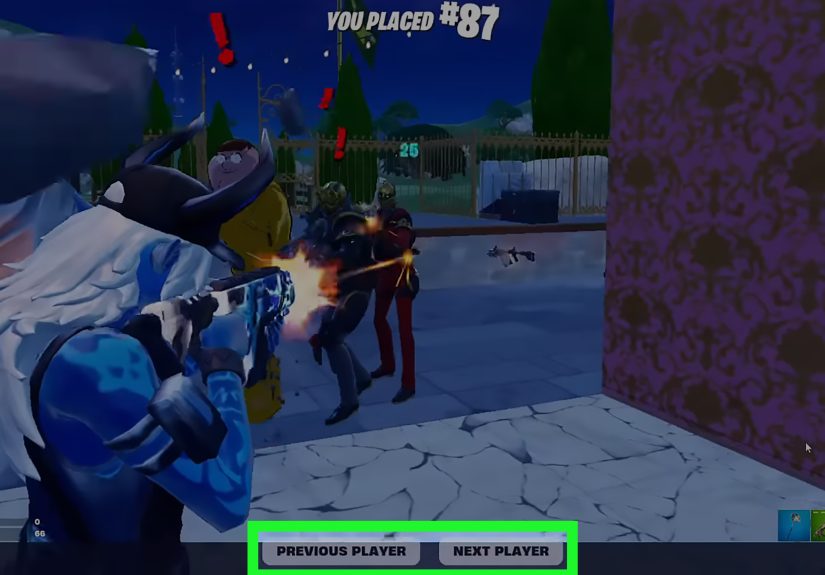
- After elimination, Fortnite will typically switch you into spectator mode where you watch your remaining teammates.
- If you have multiple teammates alive, you can usually cycle between teammate views (controls vary by platform).
Pro tip that saves friendships: if you want to keep spectating, tell your team whether you want to be rebooted.
If they grab your reboot card and bring you back, your “spectator era” ends immediately.
How to Spectate Random Players in Fortnite
“Random players” typically means: players who aren’t in your party or squadlike the person who just eliminated you,
or players still alive late-game. The truth is, Fortnite gives you some visibility here, but it’s intentionally limited.
After You Get Eliminated in Solo
In Solo modes, the most common outcome is:
you get eliminated → the game shows you the POV of the player who eliminated you.
In many cases, you can’t freely switch to the next random player just because you feel like doing a nature documentary on lobby behavior.
This is often intended to prevent information abuse and keep matches fair.
What you can do:
- Watch the eliminator’s POV briefly to understand what happened (positioning, angle, third party timing, etc.).
- Use that information to improve your next drop: “Okay, so standing still while reloading in the open was… not ideal.”
- If you want broader viewing, switch to Replay Mode after the match (more on that below).
After You Get Eliminated in Duos/Trio/Squads
In team modes, spectating is more generous because you’re still “in” the match as long as at least one teammate is alive.
Usually, you’ll spectate:
- Your surviving teammates first (most common).
-
Sometimes the POV of the player who eliminated you can appear in the immediate elimination flow,
but the long spectate experience typically centers on your team.
If your whole team is fully eliminated, your spectate options may end quickly depending on mode and rules.
Again, fairness mattersFortnite doesn’t want eliminated players feeding live information to teammates (or to anyone).
Spectating in Creative and UEFN Islands
Creative maps (including UEFN experiences) can behave differently because island settings can control
what happens after elimination: respawn, spectate, or other outcomes.
In some experiences (like Zone Wars), spectating after elimination is part of the design so players can watch the rest of the round.
If you’re playing a Creative experience and you’re surprised by the spectating behavior, it may not be “Fortnite being weird.”
It may be the island’s mode settings deciding whether spectating is allowed, and whether you can watch other teams.
Replay Mode: The Best Way to “Spectate” Random Players (Without the Limits)
If your goal is to watch random playersnot just your eliminator, not just your squadReplay Mode is where Fortnite becomes
a full-on analysis tool. Think of it as Fortnite’s built-in “theatre mode,” letting you revisit matches from different perspectives.
How to Find Replays
Replays are typically accessed from a menu area like Career and then Replays (UI names can vary slightly as Fortnite evolves).
You’ll see a list of recent matches you can open and watch.
What You Can Do in Replay Mode
- Scrub the timeline to jump to key moments: drops, fights, late-game rotations.
- Switch camera types (third-person, drone/free cam styles, follow cams).
- Follow a player and watch their movement choices, aim decisions, and positioning.
- Zoom and frame shots if you’re making content (or if you enjoy being dramatic about a missed snipe).
- Study patterns: how top players rotate, when they disengage, how they use height and cover.
Replay Mode is also your best friend if you’re trying to answer questions like:
“Was that actually a good peek by them, or did I just donate my health bar?” and
“How did that third party show up instantlywere they rotating early or camping?”
Competitive and Event Spectating: Watching Fortnite Like a Broadcast
Fortnite’s competitive ecosystem sometimes includes official viewing options for events and broadcast schedules.
If you’re into FNCS or official tournaments, you can often watch through official competitive channels and schedules.
For most everyday players, the practical takeaway is:
competitive viewing and tools are a separate lane from normal match spectating.
If your goal is simply “watch my friend” or “watch random players,” your best routes are still the in-match spectator flow and Replay Mode.
Troubleshooting: When Spectating Doesn’t Work (And It’s Not Your Fault)
If spectating feels inconsistent, you’re not imagining it. Here are the most common causesand the fixes that usually help.
1) “I don’t see the Watch button for my friend.”
- Wait until they’re actually in-match. The option often appears only after the match starts.
- Rejoin the party. Leaving and rejoining can refresh party state.
- Check party privacy. Some settings can restrict how others interact with your session.
- Consider mode restrictions. Some limited-time modes and experiences may not support party spectating the same way.
2) “The Spectate button after a match isn’t working.”
Occasionally, Fortnite has known issues where post-game buttons (including Spectate and Return to Lobby) don’t behave normally.
If that happens, using the pause/menu option to leave the match is a common workaround.
3) “Why can’t I switch to other random players while spectating?”
Because Fortnite often intends it that way. In many scenariosespecially Soloyour spectate view is limited by design to reduce
the risk of live information being shared unfairly. If you want broad perspective switching, Replay Mode is your best bet.
4) “Replay Mode is missing.”
Some platforms or settings can affect Replay availability, and Replay options may be toggled off in settings depending on platform and performance constraints.
If you can’t find it, check your settings and your platform limitations.
Spectator Etiquette: How to Watch Without Being “That Person”
Spectating is social. Which means it can be awesome… or it can become the digital equivalent of backseat driving.
If you want your friends to keep inviting you, try this:
- Ask before coaching. Some players love callouts; others are locked in and don’t want commentary.
-
Be specific, not loud. “Two teams fighting northeast behind the rock” is useful.
“HE’S RIGHT THERE” is emotional, but not directional. - Don’t demand a reboot. If the play is unsafe, it’s unsafe. Your reboot card is not a moral obligation.
- Use Replay Mode for deep analysis. Live spectating is for vibes and quick learning. Replays are for “okay, what did we do wrong?”
FAQ: Quick Answers About Fortnite Spectator Mode
Can I spectate random players whenever I want?
Not usually in live matches. Fortnite often limits live switching to prevent unfair information sharing.
If you want full control over perspectives, use Replay Mode after the match.
Can I spectate my friend without joining their match?
Sometimes, yesvia party/lobby “Watch” optionsif the mode and settings allow it.
If you can’t see the option, it may be restricted, unavailable in that mode, or temporarily affected by a bug.
Is Replay Mode better than live spectating?
For learning and analysis: absolutely. Live spectating is limited and real-time. Replay Mode is flexible and lets you view fights and rotations from multiple angles.
Conclusion
Spectating in Fortnite isn’t just something you do after getting eliminatedit’s a tool.
Use party/lobby watch options when you want to hang out while friends play. Use in-match spectating to stay engaged in team modes.
And when you want to understand the “why” behind a fight (or the “how did that even happen”), Replay Mode is the real MVP.
The best part? Once you start spectating with intentionwatching rotations, timing heals, tracking how players take anglesFortnite stops feeling random.
You begin to see patterns. And patterns are exactly how you turn “I got deleted instantly” into “okay, next time I win that.”
Extra: of Spectating Experience (The Stuff You Only Learn After Doing It)
If you’ve never spectated intentionally, your first few sessions will probably feel like watching a squirrel drink espresso.
The camera snaps to someone, they sprint, they build, they stop, they swap weapons six times like they’re picking an outfit, thenboomanother fight.
The trick is realizing spectating isn’t just entertainment. It’s pattern recognition.
One of the most useful “spectator lessons” is how good players treat the map like a schedule, not a surprise. When you watch a strong teammate late-game,
you’ll notice they rotate before the storm forces them. They’re not panicking. They’re not sprinting at the last second.
They’re moving early, taking a position, and letting other teams run into them. Spectating makes this obvious, because you’re not busy lootingyou’re watching choices.
Another big aha moment comes from watching the player who eliminated you in Solo. The goal isn’t to rage-watch. It’s to answer:
“What did they know that I didn’t?” Sometimes the answer is aim, sure. But a lot of the time, it’s timing.
You’ll see that they waited for you to open a chest, reload, heal, or stand still in an open doorway like a cardboard cutout.
Spectating turns a mystery elimination into a checklist item: next time, reposition before healing; don’t reload in the open; stop peeking the same angle twice.
Spectating friends also teaches communication discipline. You’ll quickly learn that “he’s right there” is basically meaningless.
The helpful spectators give location + context: “Two on your left hill, one cracked, they’re looking at you now.”
The unhelpful spectators give vibes and volume. (Vibes are great. Volume is not a compass.)
If you want to be a legendary teammate, practice short callouts and let the player decide.
And then there’s Replay Modethe place where spectating becomes a detective show. Watching a replay and switching perspectives can reveal
the third party you never saw, the rotation path you didn’t consider, and the moment you accidentally announced your location by breaking a wall
like you were ringing a dinner bell. Replays also help you learn “safe aggression”: when a push is smart because another team is distracted,
and when a push is a trap because the zone is about to force you into open space.
The funniest part? Once you get used to spectating, you start noticing habits everywhere. That teammate always reloads after every shot.
That random player always builds too high and forgets to look down. That squad always rotates late and fights at the storm edge.
Spectating doesn’t just show you what happenedit shows you what keeps happening. And that’s how you improve fast without grinding endlessly.