Table of Contents >> Show >> Hide
- What Is a Literary Commentary?
- How to Write a Literary Commentary in 14 Steps
- Step 1: Read the Text More Than Once
- Step 2: Annotate Like a Curious Detective
- Step 3: Identify the Literary Devices That Actually Matter
- Step 4: Turn Observations Into a Real Question
- Step 5: Draft a Clear, Arguable Thesis
- Step 6: Narrow Your Focus
- Step 7: Gather the Best Evidence
- Step 8: Introduce Every Quotation Smoothly
- Step 9: Analyze the Language, Not Just the Event
- Step 10: Keep Asking “So What?”
- Step 11: Build Paragraphs Around Claims
- Step 12: Use Transitions That Show Logical Movement
- Step 13: Write a Conclusion That Evolves the Idea
- Step 14: Revise for Precision, Depth, and Style
- Example of Literary Commentary in Action
- Common Mistakes to Avoid
- Why Literary Commentary Matters
- Extended Experience: What It Feels Like to Learn Literary Commentary
- Final Thoughts
- SEO Tags
Writing a literary commentary can feel a little like being asked to explain a magic trick while the magician keeps changing hats. You read a poem, a short story, or a novel chapter, and your brain says, “Cool.” Your instructor says, “Now analyze how it works.” That is where literary commentary comes in. A strong literary commentary does not simply retell what happened. It explains how the writer’s choices create meaning, shape tone, build character, or push a theme into the spotlight.
If you have ever stared at a blank page thinking, “I know this passage means something, but it refuses to introduce itself,” you are not alone. The good news is that commentary writing is a skill, not a lightning strike. Once you learn how to close read, form a clear thesis, choose the right evidence, and explain the “so what,” the whole process becomes much less mysterious and much more manageable.
This guide breaks the process into 14 practical steps so you can write a literary commentary that is insightful, organized, and actually enjoyable to read. Yes, enjoyable. Even school writing can have a pulse.
What Is a Literary Commentary?
A literary commentary is a focused piece of analytical writing about a text or a specific passage. Its job is to interpret, not summarize. Instead of telling readers what happened, you show them how the language, imagery, symbols, structure, diction, or character choices produce meaning. In other words, you move from plot to purpose.
Think of it this way: summary says, “The character closes the window.” Commentary says, “The image of the slammed window reinforces the character’s desire to shut out both the weather and the emotional truth outside.” One tells what happened. The other explains why it matters. That difference is the whole ballgame.
How to Write a Literary Commentary in 14 Steps
Step 1: Read the Text More Than Once
Your first reading is for basic understanding. Your second reading is where the real work begins. Slow down and notice repeated words, unusual images, strange shifts in tone, contradictions, and moments that feel important. Literary commentary is built on close reading, and close reading takes patience. The text will not hand over its secrets after one casual glance. It is not a vending machine.
Step 2: Annotate Like a Curious Detective
Underline key phrases, circle patterns, and write questions in the margins. Mark moments that seem emotionally intense, stylistically unusual, or connected to a larger theme. Good annotations are not random highlights that make your page look festive. They are breadcrumbs that help you trace the author’s method. Ask yourself: What is this passage doing? Why here? Why this word and not another?
Step 3: Identify the Literary Devices That Actually Matter
Do not try to mention every metaphor, alliteration, or comma within a three-mile radius. Choose the literary elements that contribute most directly to meaning. Focus on devices such as imagery, symbolism, irony, diction, syntax, tone, point of view, or structure when they help prove your interpretation. In commentary writing, device-spotting is not the goal. Explaining the effect of the device is the goal.
Step 4: Turn Observations Into a Real Question
Before you write a thesis, write a question. Ask something analytical, not obvious. For example: Why does the narrator describe the house with such cold, mechanical language? How does the poem’s repetition create both comfort and unease? What does the change in imagery reveal about the speaker’s emotional state? A strong literary commentary usually grows from a strong question, because questions force you to think instead of merely reporting.
Step 5: Draft a Clear, Arguable Thesis
Your thesis should make an interpretation, not announce a topic. “This commentary is about symbolism in the story” is not a thesis. It is a label wearing a fake mustache. A better thesis would be: “In the story, the recurring image of broken glass reflects the protagonist’s fractured sense of self and foreshadows her final refusal to return to her old life.” That statement is specific, arguable, and ready to be supported.
Step 6: Narrow Your Focus
One of the fastest ways to weaken a literary commentary is to make it too broad. You do not need to explain everything the text has ever done in the history of literature. Focus on one main idea and a few strong supporting points. If you are analyzing a passage, stay anchored to the passage. If you are writing about a larger work, choose a manageable lens such as a single symbol, relationship, contrast, or pattern.
Step 7: Gather the Best Evidence
Once you know your claim, choose quotations and details that directly support it. The best textual evidence is specific, relevant, and rich enough to analyze. One vivid line can do more work than a giant block quote that just sits there like an overstuffed couch. Select passages with interesting diction, imagery, or tension. Then make sure every quotation earns its place by helping you prove something meaningful.
Step 8: Introduce Every Quotation Smoothly
Never drop a quotation into a paragraph without context. That is called a plop quote, and it lands with all the grace of a bowling ball on a piano. Instead, introduce the quotation with a phrase or sentence that identifies who is speaking, what is happening, or why the line matters. A quotation should enter your paragraph as part of your argument, not as a surprise guest no one invited.
Step 9: Analyze the Language, Not Just the Event
After presenting evidence, zoom in. Explain how particular words, sounds, images, or sentence structures support your claim. If the author uses harsh consonants, fragmented syntax, or repeated color imagery, say how those choices shape tone or meaning. Good literary commentary lives in the details. It does not stop at “this shows sadness.” It asks, “How exactly does the language manufacture that sadness, and why does that matter here?”
Step 10: Keep Asking “So What?”
This is the step that separates decent commentary from strong commentary. After every major point, ask what the insight adds to your larger interpretation. Why should the reader care that the speaker repeats a phrase three times? Why does that symbol matter beyond one scene? Why does this shift in tone deepen the theme? Commentary becomes persuasive when it links local details to broader significance.
Step 11: Build Paragraphs Around Claims
Each body paragraph should begin with a clear point that supports your thesis. Then follow that point with evidence and analysis. A useful pattern is claim, context, quotation, analysis, and mini-conclusion. Keep each paragraph focused on one main idea. If you find yourself discussing weather, family trauma, political symbolism, and shoe color in the same paragraph, it may be time to split that paragraph before it bursts into confetti.
Step 12: Use Transitions That Show Logical Movement
A literary commentary should feel like a guided argument, not a sack of disconnected observations. Use transitions to show whether you are adding a related idea, shifting to a contrast, deepening a point, or moving from image to theme. Even simple phrases such as “more importantly,” “by contrast,” “this tension continues,” or “at a deeper level” help readers follow your reasoning and see how each paragraph fits the whole.
Step 13: Write a Conclusion That Evolves the Idea
Your conclusion should not simply repeat the introduction with a new haircut. Revisit the thesis in fresh language and explain the broader significance of your analysis. What does your commentary reveal about the character, the text’s message, or the author’s larger purpose? A strong conclusion leaves readers with a sharpened understanding, not a sleepy echo. End with insight, not with “In conclusion,” unless your paragraph truly needs a tiny marching band.
Step 14: Revise for Precision, Depth, and Style
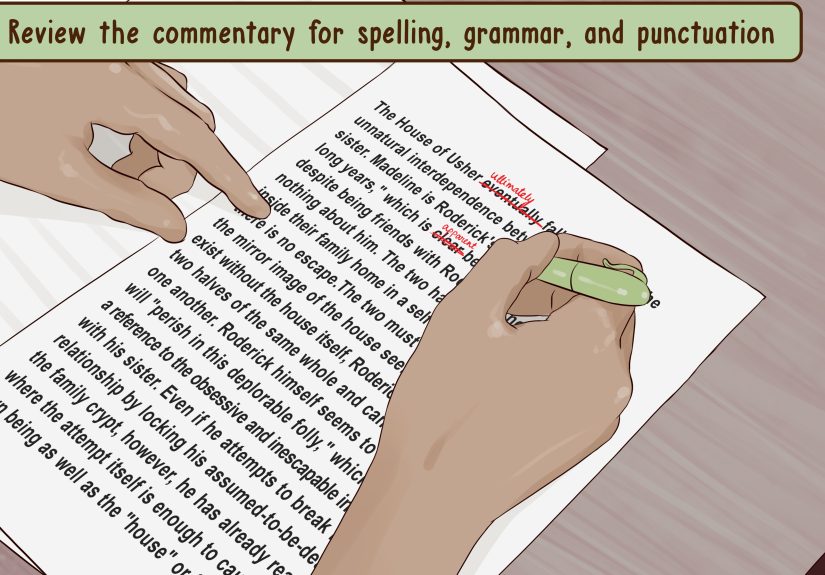
Revision is where smart commentary gets smarter. Check whether each paragraph clearly supports the thesis, whether each quotation is explained, and whether your analysis is more prominent than summary. Cut vague phrases and replace them with specific language. Read your commentary aloud to hear weak transitions, repetitive wording, or confusing sentences. Then proofread for grammar and format. A brilliant idea loses some sparkle when it trips over avoidable errors.
Example of Literary Commentary in Action
Imagine you are analyzing a line from a poem: “The moon hung like a bruise above the town.” A weak response would say, “This is a simile. It compares the moon to a bruise.” True, but that is only identification. Commentary needs to go further.
A stronger response would say: “By comparing the moon to a bruise, the poet turns a familiar night image into a mark of injury. The simile creates an unsettling tone and suggests that the town itself exists under a kind of emotional damage. Rather than presenting the night as peaceful, the poem frames it as wounded and tense.”
Notice the difference. The second version explains effect, tone, and implication. That is what literary analysis and commentary are supposed to do.
Common Mistakes to Avoid
Too much summary: If you spend more time retelling the scene than interpreting it, your commentary starts sounding like a book report in disguise.
Too many quotations: Evidence matters, but analysis should do the heavy lifting. Your voice must lead.
Vague claims: Phrases like “this is important” or “this creates emotion” need specifics. Which emotion? Important in what way?
Device listing: Naming literary devices without explaining their function is not analysis. It is inventory.
Overblown certainty: Good commentary is confident, but it also stays grounded in the text. Do not force an interpretation the evidence cannot support.
Why Literary Commentary Matters
Learning how to write a literary commentary improves more than your English grade. It teaches you how to observe carefully, think analytically, support claims with evidence, and explain complex ideas clearly. Those skills travel well. They show up in history essays, college applications, workplace writing, and just about any situation where you need to make an argument without sounding like you guessed in the dark.
At its best, literary commentary also changes the way you read. You stop seeing a text as a pile of words and start seeing it as a set of deliberate choices. That is where literature gets exciting. You are no longer just reading the page. You are reading the mind at work behind it.
Extended Experience: What It Feels Like to Learn Literary Commentary
For many students, the hardest part of writing a literary commentary is not the grammar, the citations, or even the thesis. It is the strange moment when they realize that reading for class is not the same as reading for pleasure. When you read for pleasure, you want to know what happens next. When you read for commentary, you also have to stop and ask why the author made it happen in that way. That switch can feel awkward at first, like trying to dance while also taking notes on the choreography.
A very common experience goes something like this: a student reads a short story, understands the plot perfectly, and then gets the assignment sheet asking for analysis of tone, imagery, or theme. Suddenly, confidence evaporates. The student knows the story, but not what to say about it. So the first draft becomes a tidy summary with a few brave words like “symbolism” sprinkled on top. This is normal. Almost everyone begins there. Strong commentary usually develops after a student learns that interpretation is not about guessing the professor’s secret answer. It is about making a logical claim that the text can support.
Another familiar experience is the over-highlighting phase. At first, every line looks important. Every adjective seems dramatic. Every sentence feels like it must mean seven different things. Then, with practice, writers become more selective. They stop trying to analyze the entire universe and start looking for patterns. They notice that a color repeats, that a character always speaks in clipped sentences, or that one object keeps appearing at emotionally charged moments. That is usually the turning point. Commentary gets easier when the writer sees patterns instead of isolated details.
Revision creates its own set of lessons. Many students discover that the sentence they were most proud of is actually the one making everything fuzzy. Others realize that a body paragraph they thought was analytical is really just summary wearing glasses. This can be humbling, but it is also productive. Commentary improves dramatically when writers begin asking practical revision questions: Does this quote prove my point? Have I explained the key word? Did I connect this detail back to my thesis? Why would a reader care about this observation?
There is also a satisfying moment that tends to arrive somewhere between the second draft and the final one. A sentence clicks. A paragraph suddenly makes sense. A quotation that seemed ordinary starts revealing something sharp and unexpected. The writer is no longer forcing meaning onto the text. The writer is noticing meaning that was already there. That moment is one of the best parts of literary study. It feels less like completing homework and more like solving a puzzle with language as the evidence.
Over time, students who practice literary commentary often become better readers in daily life too. They become more sensitive to tone, more alert to contradiction, and less likely to accept words at face value. They notice how arguments are framed, how emotion is built, and how small choices shape big impressions. So yes, learning literary commentary helps with essays. But it also sharpens attention, patience, and critical thinking. Not bad for an assignment that starts with a poem and a sigh.
Final Thoughts
If you want to know how to write a literary commentary well, remember this simple formula: read closely, make a clear claim, choose smart evidence, and explain the significance of every detail you use. The goal is not to sound fancy. The goal is to sound thoughtful, precise, and persuasive. A great literary commentary shows readers not only what the text says, but how it works and why it matters.
Once you stop treating commentary as a hunt for the one perfect answer, the process becomes much more interesting. You are not there to decorate the page with literary terms. You are there to build an interpretation that the text itself can support. That is where the real power of commentary lives.