Table of Contents >> Show >> Hide
- Why Tabletop Middle-earth Works So Well
- The Artist Behind the 8 Pics
- From Foam and Wood to the Shire
- The Camera Gear: Why the 35mm Look Matters
- Lighting: The Secret Ingredient in the Illusion
- Photoshop and the Art of Seamless Compositing
- What the 8 Pics Capture About The Lord of the Rings
- Why Fans Love Miniature Movie Recreations
- Lessons for Anyone Who Wants to Try Tabletop Fantasy Photography
- The Experience of Recreating Lord of the Rings Scenes on a Tabletop
- Conclusion
Miniature photography is the kind of art that makes you lean closer to your screen and mutter, “Wait… that’s not a real mountain?” When it is done well, a few inches of foam, paint, grass fiber, wood, and clever lighting can suddenly become Middle-earth. That is exactly the charm behind the viral tabletop project in which photographer and scale-model artist Nicholas “Nick” Busch recreated beloved Lord of the Rings scenes as cinematic miniature worlds.
The project feels like a love letter written in moss, plaster, and patience. Instead of flying to New Zealand, hiring a wizard, and politely asking a Balrog to hold still for lighting tests, Busch built small-scale dioramas inspired by Tolkien’s universe and photographed them so they looked vast, dramatic, and alive. The result: eight pictures that capture the spirit of The Lord of the Rings on a tabletop without losing the grandeur that made Peter Jackson’s films feel mythic.
What makes this series so engaging is not just the final illusion. It is the process behind it. These images combine scale model photography, portrait photography, compositing, practical effects, and careful cinematic staging. In other words, it is not simply “toys on a table.” It is more like a tiny film production where the budget goes mostly toward glue, grass, lighting, and the artist’s ability to not scream when one miniature fence refuses to behave.
Why Tabletop Middle-earth Works So Well
The Lord of the Rings is practically designed for miniature recreation. The Shire has round doors, cozy hills, winding fences, and an inviting visual language. Mordor, on the other hand, offers ash, fire, jagged rocks, and the general feeling that your vacation package has gone terribly wrong. Between those extremes, Middle-earth gives artists endless textures: mossy gardens, stone paths, smoky skies, ancient ruins, forests, mountains, and heroic silhouettes.
Busch’s tabletop approach works because the original films themselves were famous for blending practical craftsmanship with digital wizardry. Wētā Workshop designed and built armor, weapons, prosthetics, miniatures, costumes, creatures, and environments for the trilogy. That practical DNA is part of why the films still look convincing decades later. Busch’s work taps into the same old-school magic: build something real, light it carefully, photograph it from the right angle, and let the camera do some of the spellcasting.
There is also a wonderfully hobbit-like quality to the whole idea. A huge fantasy world is being made with small hands-on details. A hill can be carved. A tree can be planted. A fence can be placed with tweezers. The epic becomes intimate, and somehow that makes it even more charming.
The Artist Behind the 8 Pics
Nicholas Busch is known for scale model photography inspired by classic films. His work has included scenes influenced by The Wizard of Oz, Alice in Wonderland, Mary Poppins, and, of course, The Lord of the Rings. The common thread is nostalgia, but not the lazy kind. These are not quick fan edits. They are built environments, photographed and composited with the precision of someone who knows that one awkward shadow can ruin the illusion faster than Pippin touching something he absolutely should not touch.
For this Lord of the Rings tabletop recreation, Busch started with the idea of merging portrait photography and toy photography into a single convincing image. That is a deceptively simple goal. Toy photography often focuses on small figures and props, while portrait photography deals with real people, skin tones, body posture, and studio lighting. Combining them means every element must share the same visual language: perspective, light direction, color temperature, contrast, depth of field, and mood.
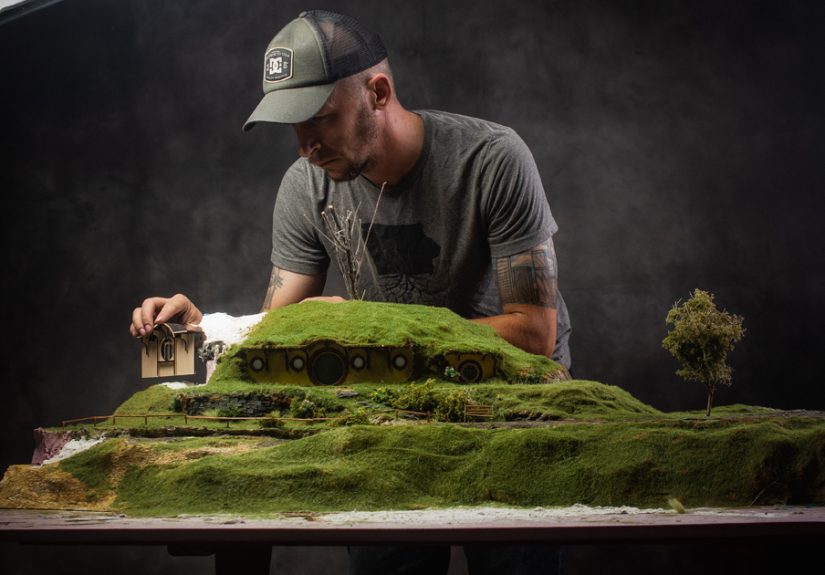
The project reportedly began with plans for Bilbo’s hobbit house. Busch designed the structure digitally, created blueprints, laser-cut wood for the base, and then built the surrounding landscape. The final touches included trees, fences, and ground texture. The level of patience required here is heroic. Frodo carried the Ring to Mordor, yes, but have you ever tried to make tiny grass stand upright and look natural under a macro-level lens? That is its own quest.
From Foam and Wood to the Shire
A believable tabletop scene begins long before the camera appears. The first stage is planning. Composition matters because a diorama is not just a model; it is a model built for a specific viewpoint. A hill that looks perfect from above may block the subject when photographed at ground level. A fence may seem charming until it slices across the model’s face in the final frame. In miniature work, tiny mistakes become giant problems.
Busch’s workflow reflects that reality. A foam base provides the basic shape of the land. Wood, plaster, paint, miniature grass, and hobby materials bring texture to the scene. The landscape must be sculpted with the camera in mind. In many tabletop photographs, the lens is placed low, close to the miniature ground, which makes small objects appear towering and immersive. This is one reason the final images feel cinematic rather than like a craft project photographed from a kitchen chair.
The Shire-style environment depends heavily on softness and detail. Grass cannot look like green carpet. Dirt cannot look like chocolate cake. Trees need irregular shapes, not plastic perfection. The trick is controlled imperfection: leaning fence posts, varied grass tones, uneven paths, little clusters of plants, and enough texture to suggest a lived-in world. Middle-earth should feel ancient, not freshly unboxed.
The Camera Gear: Why the 35mm Look Matters
Busch used a Canon 5D Mark IV and a Sigma 35mm Art lens for the series. That combination makes sense for this kind of cinematic miniature photography. The Canon 5D Mark IV is a full-frame DSLR with a high-resolution sensor, giving the photographer enough detail to capture textures such as bark, stone, plaster, moss, costume fabric, and atmospheric effects. The Sigma 35mm Art lens is known for its sharpness and wide aperture, and the 35mm focal length has a natural cinematic feel because it can show a subject and its environment without exaggerating the scene too dramatically.
In miniature photography, focal length is more than a technical choice. It affects whether the viewer believes the image. A lens placed low and close can make a small set feel large. A lens that sees enough of the environment can create the impression that the camera is standing inside the world rather than observing it from outside. That is why Busch’s images do not feel like “a model of Hobbiton.” They feel like a camera somehow wandered into a pocket-size Middle-earth and came back with evidence.
Lighting: The Secret Ingredient in the Illusion
Lighting is where many miniature photos either come alive or fall apart. Real outdoor scenes have complex light: sky fill, bounce light, shadows, haze, and atmospheric softness. A tabletop set sitting under a ceiling lamp will not magically become the Shire. It will become, very clearly, a tabletop set sitting under a ceiling lamp. Not exactly Oscar-worthy.
Busch photographed the diorama and then photographed the human model separately, using the same lens and lighting setup so the color tones would match in camera. This detail is crucial. When a person is composited into a miniature landscape, the viewer’s eye immediately checks the light. Are the shadows falling in the same direction? Is the face too warm compared with the background? Does the model look sharper than the set? Does the sky match the ground? If anything is off, the illusion cracks.
That is why the project feels closer to filmmaking than casual photography. It uses the same basic visual logic that movie crews rely on: maintain continuity, match the lighting, control the frame, and make sure every element belongs to the same world.
Photoshop and the Art of Seamless Compositing
After the miniature and the human model are photographed, the final image comes together in Photoshop. This is where compositing turns separate pieces into one scene. The sky may be added or adjusted. Edges must be blended. Shadows need refinement. Color grading pulls the image into a unified mood. The goal is not to show off editing tricks; the goal is to make the viewer forget editing happened at all.
In Busch’s process, adding the sky is one of the most difficult stages because the light must match the diorama and the human figure. A dramatic sky can make a scene feel epic, but if it is too bright, too saturated, or lit from the wrong direction, it will look pasted on. The best compositing is humble. It does not wave its arms and shout, “Look what I can do!” It quietly supports the illusion until the viewer simply accepts the scene.
That restraint is especially important with The Lord of the Rings. Fans know the visual tone of the films. The Shire should feel warm and earthy. Mordor should feel harsh and dangerous. A heroic travel scene needs atmosphere and scale. The edit must respect those expectations while still allowing the artist’s own style to shine through.
What the 8 Pics Capture About The Lord of the Rings
The most successful fan-made art does not merely copy famous scenes. It understands why those scenes matter. The Lord of the Rings scenes on a tabletop work because they capture emotional memory. A hobbit hole is not just a round door; it is home, comfort, and the quiet life Frodo leaves behind. A dark volcanic landscape is not just black rocks; it is dread, sacrifice, and the end of a long journey. A small figure placed against a large environment reminds us of Tolkien’s central idea: even the smallest person can affect the course of the future.
That theme fits miniature photography beautifully. A tiny set can tell a huge story. A small figure can stand in for courage. A handmade landscape can suggest a world far beyond the edges of the frame. In that sense, the tabletop format is not a limitation. It is part of the poetry.
The project also highlights how strongly the films shaped modern fantasy visuals. Peter Jackson’s trilogy, released from 2001 to 2003, became one of the most influential fantasy film achievements of the 21st century. The Return of the King famously won all 11 Academy Awards for which it was nominated, including Best Picture. That kind of cultural footprint explains why artists still return to Middle-earth for inspiration. The films are not just movies people remember; they are worlds people want to rebuild, revisit, and sometimes fit onto a table.
Why Fans Love Miniature Movie Recreations
There is something deeply satisfying about seeing a grand cinematic universe recreated by hand. In an age of digital everything, miniature art feels tactile. You can imagine the materials. You can sense the time. You can almost smell the glue, paint, and coffee that probably powered the whole operation.
Miniature movie recreations also give fans a new way to appreciate familiar stories. Instead of watching the finished film pass by at 24 frames per second, we get to pause and look at construction, texture, and mood. We notice how a path curves. We notice how a doorway frames a character. We notice how color tells us whether a place is safe, magical, threatening, or tragic.
For Lord of the Rings fans, this is especially rewarding because Tolkien’s world has always invited making. People draw maps, paint miniatures, build costumes, write music, learn Elvish phrases, and design home libraries that look suspiciously like Bag End. Busch’s project belongs to that larger tradition of participatory fandom. It says: “I love this world enough to build a piece of it.”
Lessons for Anyone Who Wants to Try Tabletop Fantasy Photography
Start with one scene, not all of Middle-earth
The temptation is to build everything: Hobbiton, Rivendell, Helm’s Deep, Minas Tirith, Mordor, and maybe a tiny Prancing Pony with working lanterns. Resist. Start with one manageable scene. A path to a round door, a rocky slope, or a small forest clearing can teach composition, scale, lighting, and texture without requiring a second breakfast budget.
Build for the camera
A diorama does not need to look perfect from every angle. It needs to look convincing from the angle you plan to photograph. Test your composition early with your camera or phone. Move the lens low. Check what blocks the frame. Adjust before you glue everything permanently, because future-you deserves kindness.
Use texture variety
Real landscapes are not uniform. Mix grass lengths, paint tones, dirt textures, and plant shapes. Even a small patch of ground looks more realistic when it has variation. Static grass, hobby shrubs, handmade plants, foam rocks, and layered paint can turn a flat base into a believable environment.
Match the light before editing
If you plan to composite a human model into the miniature scene, photograph both under similar lighting. Matching in camera saves time later and makes the final image more believable. Photoshop can do many things, but it cannot fully rescue a model lit like noon in Florida from a background lit like midnight in Mordor.
Think like a filmmaker
Ask what the scene is supposed to feel like. Cozy? Dangerous? Mysterious? Heroic? Then make every choice serve that mood: lens height, background, shadow, color, pose, costume, and sky. A tabletop fantasy photo is not only about objects. It is about atmosphere.
The Experience of Recreating Lord of the Rings Scenes on a Tabletop
Recreating The Lord of the Rings scenes on a tabletop is less like making a craft and more like going on a tiny, dusty adventure. The first experience is excitement. You look at a blank piece of foam and think, “This could become the Shire.” Then reality arrives carrying sandpaper. The hill is too steep. The door is too clean. The fence looks like it came from a suspiciously cheerful dollhouse. Suddenly, you are not just an artist; you are a landscape architect, carpenter, painter, lighting technician, photographer, and emergency repair goblin.
The planning stage teaches humility. Middle-earth looks effortless on screen because hundreds of artists made it feel that way. On a tabletop, even a simple path requires decisions. How wide should it be? Should the dirt be reddish, gray, or warm brown? Where should the grass be worn down? Would a hobbit maintain this fence better, or has Gandalf knocked it over with his cart again? These questions sound tiny, but they create story. Every scratch, pebble, and crooked post makes the scene feel lived in.
The building stage is slow in the best possible way. Foam becomes land. Plaster becomes rock. Paint becomes weather. Grass fibers become meadows. Small trees start to suggest distance. You learn that realism is not about perfect detail everywhere. It is about placing the right detail where the camera will care. A richly textured foreground can sell the illusion, while the background can be softer and simpler. That is not cheating. That is composition wearing comfortable shoes.
Photography brings a new set of challenges. When the camera drops to miniature eye level, the world changes. A twig becomes a tree trunk. A pebble becomes a boulder. A shallow dip becomes a valley. This is the magical moment when the tabletop begins to disappear. It is also the moment when every flaw becomes visible. Glue shine, dust, fingerprints, awkward scale, and unnatural shadows all step into the spotlight like uninvited orcs.
Lighting is the emotional turning point. Warm light can make a hobbit-hole scene feel like late afternoon in the Shire. Hard side light can make a rocky landscape feel dangerous. Backlight can turn a small figure into a heroic silhouette. The more carefully the scene is lit, the less the viewer thinks about size. Instead, they begin to feel story: a journey beginning, a home left behind, a dangerous road ahead.
Compositing adds the final layer of enchantment. Bringing a real human model into a miniature environment requires discipline. The model must be posed as though they belong in the world. Their lighting must match the set. Their scale must feel natural. Their edges must blend without looking smudged. Done well, the viewer never asks, “How was this made?” until after they have already enjoyed the image.
The greatest experience, though, is emotional. Recreating Lord of the Rings scenes by hand reminds you why the story endures. It is not only about battles, rings, monsters, or kingdoms. It is about small people stepping into large stories. That idea becomes literal in tabletop photography. The artist works with small materials to suggest enormous meaning. A tiny doorway can represent home. A little road can represent destiny. A handmade mountain can hold the weight of myth.
And yes, the process can be messy. Paint dries the wrong color. Grass lands everywhere except where it is supposed to. A miniature tree may collapse at the exact moment you feel proud of it. But that is part of the charm. The finished photo carries all those invisible struggles inside it. Like the journey to Mordor, the project succeeds not because it is easy, but because someone cared enough to keep going.
Conclusion
I Recreate the ‘Lord of the Rings’ Scenes on a Tabletop (8 Pics) is more than a clever fan-art project. It is a reminder that practical creativity still has a special kind of magic. Nicholas Busch’s work shows how miniature landscapes, portrait photography, careful lighting, and thoughtful compositing can transform a tabletop into Middle-earth. The project honors Tolkien’s world, the visual legacy of the films, and the hands-on tradition of model making that helped make fantasy cinema feel real.
For fans, the appeal is obvious: it lets us revisit the Shire, Mordor, and the emotional scale of the journey from a fresh perspective. For artists, it is a useful case study in planning, patience, and visual storytelling. And for anyone who has ever looked at a pile of foam and thought, “Could this become a mountain?” the answer is yes. Just bring glue, imagination, and possibly lembas bread. You may be there a while.
Note: This article is an original editorial feature based on publicly available information about Nicholas Busch’s tabletop Lord of the Rings scale-model photography project, practical filmmaking craft, and miniature photography techniques. No source links or citation markers are displayed for publication convenience.