Table of Contents >> Show >> Hide
- What Is the “Mars Engine”?
- Why Ion Propulsion Is Different from Chemical Propulsion
- The Record-Breaking X3 Test
- Inside the Blue Glow: How a Hall Thruster Works
- Why Scaling Up Is So Hard
- What the X3 Means for Mars Missions
- From Deep Space 1 to Dawn to Psyche
- The Rise of High-Power Electric Propulsion
- Why the Record Still Matters
- Challenges Ahead for Ion Propulsion
- Experience Notes: What the “Mars Engine” Teaches Us
- Conclusion
The phrase “Mars engine” sounds like something that should come with a dramatic movie trailer, a booming orchestra, and at least one astronaut staring bravely through a helmet visor. But behind the nickname is a very real breakthrough in electric propulsion: the X3 Hall thruster, a record-breaking ion propulsion system developed through work involving the University of Michigan, NASA, the U.S. Air Force, NASA Glenn Research Center, and industry partners. It is not the kind of engine that blasts off from a launchpad with a thunderclap. It does not roar like a chemical rocket. In fact, if you judged it by raw push alone, it would seem almost comically gentle.
And yet, in the vacuum of space, patience is power. The X3 demonstrated what high-power ion propulsion could become when engineers scale up a technology already proven on satellites and deep-space missions. During testing at NASA Glenn Research Center, the thruster produced 5.4 newtons of thrust, operated at about 102 kilowatts of power, and pushed operating current into record territory for a Hall thruster. For a machine meant to move spacecraft over long periods rather than launch them from Earth, those numbers were a big deal.
The record matters because future missions to Mars will not be won by brute force alone. Chemical rockets are excellent for leaving Earth, but once a spacecraft is already in space, electric propulsion can stretch propellant dramatically farther. Think of a chemical rocket as a sprinter with fireworks in its shoes. Ion propulsion is more like a marathon runner with perfect pacing, a tiny appetite, and an alarming ability to keep going long after everyone else wants a snack.
What Is the “Mars Engine”?
The so-called “Mars engine” refers mainly to the X3, a nested-channel Hall thruster designed for high-power electric propulsion. A Hall thruster is a type of ion engine that uses electric and magnetic fields to accelerate charged particles, usually ions of xenon gas, out of the back of the thruster. That stream of ions creates thrust. It is a small amount of thrust compared with a chemical rocket engine, but it is extremely efficient.
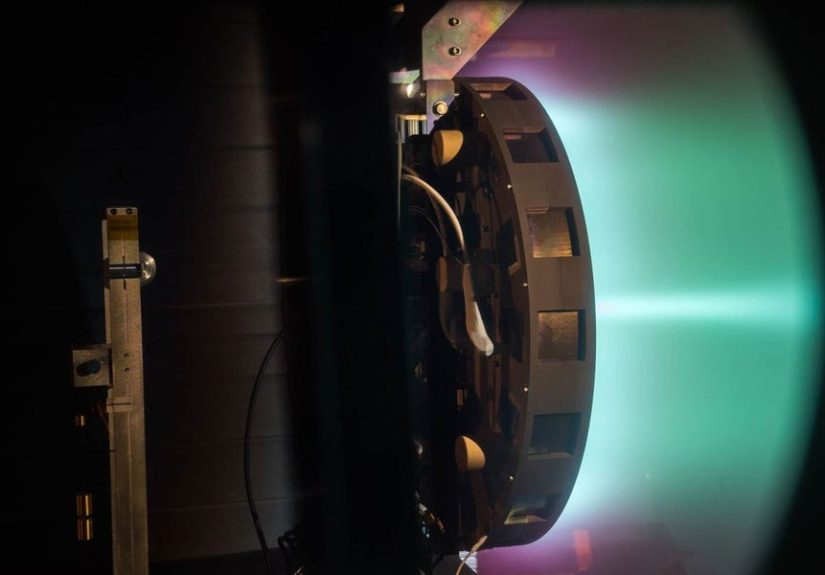
The X3 is not small by electric-propulsion standards. It weighs roughly 500 pounds and measures close to a meter across, making it a heavyweight in a field often associated with small satellite thrusters. Its most distinctive feature is its nested-channel design. Instead of relying on a single annular channel, the X3 uses three concentric channels. Engineers can operate different combinations of those channels, allowing the thruster to throttle across a wide range of power levels.
That flexibility is one reason the X3 became such an important test article. Mars mission planners do not need a one-trick engine. They need propulsion systems that can handle different mission phases, from moving heavy cargo slowly and efficiently to potentially shortening crewed transit times. The X3 was built to explore whether Hall thrusters could scale into the 100-kilowatt class and beyond.
Why Ion Propulsion Is Different from Chemical Propulsion
Traditional rockets burn chemical propellants, throwing hot gas out at high speed to generate enormous thrust. That is perfect for escaping Earth’s gravity, where engines must fight atmosphere, gravity losses, and the small problem of a fully loaded rocket weighing as much as a skyscraper with ambition. Ion engines work differently. They use electricity to ionize a propellant and accelerate the charged particles using electromagnetic forces.
The result is a propulsion system with very high specific impulse, which is a measure of how efficiently an engine uses propellant. In plain English: ion engines get far more mileage from their fuel. NASA’s Dawn spacecraft showed why that matters. Dawn used ion propulsion to orbit Vesta and then travel onward to orbit Ceres, becoming the first spacecraft to orbit two extraterrestrial bodies. That kind of mission would have been much harder, and likely impossible within the same mass limits, using chemical propulsion alone.
The tradeoff is thrust. Ion engines do not deliver the explosive shove needed for launch. They deliver a whisper that never gets tired. In space, where there is no road friction and no air resistance, a steady whisper can become a serious push over weeks, months, or years.
The Record-Breaking X3 Test
During its high-power testing campaign at NASA Glenn Research Center in Ohio, the X3 Hall thruster broke records for thrust, power, and operating current in its class. The headline figure was 5.4 newtons of thrust, surpassing the previous Hall thruster record of about 3.3 newtons. That was more than a modest bump; it showed that nested Hall thruster architecture could deliver meaningful scaling.
The X3 also operated at about 102 kilowatts and reached roughly 247 to 250 amperes of discharge current during the record-setting campaign. For comparison, many electric propulsion systems used on spacecraft operate at only a few kilowatts. NASA’s Psyche spacecraft, for example, uses Hall-effect thrusters powered by solar arrays, but each operating thruster provides thrust measured in hundreds of millinewtons, not several newtons.
Five newtons may not sound heroic. It is roughly the force needed to hold a small object in your hand. But in electric propulsion, that is a muscle-flexing moment. The achievement showed that Hall thrusters could be pushed toward power levels relevant to cargo transport, deep-space logistics, and eventually Mars mission architectures.
Inside the Blue Glow: How a Hall Thruster Works
Hall thrusters often produce a beautiful blue plume, which makes them look as if they were designed by a science-fiction art department. The glow comes from ionized xenon gas. Xenon is popular because it is inert, dense, and relatively easy to ionize. Once xenon atoms lose electrons, they become positively charged ions. Electric fields accelerate those ions outward, and magnetic fields help control the electron motion inside the thruster.
As ions shoot out of the engine, the spacecraft receives an equal and opposite push. A neutralizer adds electrons back into the exhaust stream so the spacecraft does not build up an electrical charge. The basic idea is elegant: use electricity to throw tiny particles very fast. The engineering, however, is anything but simple.
High-power Hall thrusters must deal with extreme heat, plasma erosion, magnetic-field complexity, cathode lifetime, vibration, power processing, and propellant-flow precision. In other words, the X3 is not just a fancy glowing ring. It is a carefully balanced plasma machine that has to behave itself while operating at power levels that would make smaller thrusters sweat nervously.
Why Scaling Up Is So Hard
Building a small ion thruster is difficult. Building a very powerful one is a different beast. As power rises, engineers must manage more heat, more current, more plasma interactions, and more demanding test conditions. The X3 was so powerful that not every vacuum chamber could properly test it. The thruster produced enough exhaust that only facilities with serious pumping capacity could keep the test environment close to space-like conditions.
That is why NASA Glenn Research Center played such a major role. Its vacuum facilities allowed researchers to run the X3 under conditions that could produce meaningful data. Testing involved mounting the heavy thruster on a specialized thrust stand, supplying xenon and electricity, pumping the chamber down for many hours, and then running through test points carefully.
The glamorous part is the glowing plume. The less glamorous part is waiting for a vacuum chamber to pump down, fixing small leaks, checking hardware, and repeating procedures with the patience of a person assembling furniture using instructions translated through four languages. Space engineering is thrilling, but it is also a lot of disciplined troubleshooting.
What the X3 Means for Mars Missions
Mars mission planning is a giant math problem wearing a spacesuit. Every kilogram matters. Every day in deep space matters. Every tank of propellant adds mass, and extra mass demands more launch power. Electric propulsion offers a way to move large payloads while using much less propellant than chemical propulsion would require after launch.
One likely use case is cargo. Before humans travel to Mars, mission planners may want to send habitats, supplies, power systems, ascent vehicles, and scientific equipment ahead of time. A high-power solar electric or nuclear electric propulsion system could slowly move heavy cargo through space, reducing the mass that must be launched from Earth.
Crew transport is more complicated. Astronauts cannot simply take the slow scenic route forever. Radiation exposure, life-support needs, and mission risk all make travel time important. High-power electric propulsion may help reduce transit time when paired with sufficient power generation, although chemical propulsion, nuclear thermal propulsion, and hybrid mission designs remain part of the broader discussion.
The X3 does not magically solve Mars travel by itself. It is better understood as a milestone: proof that a Hall thruster can scale toward the power range needed for serious deep-space transportation studies. It moves the conversation from “Can this kind of engine get bigger?” to “How do we turn this into a reliable integrated propulsion system?”
From Deep Space 1 to Dawn to Psyche
The X3 did not appear out of nowhere. NASA has been building confidence in electric propulsion for decades. Deep Space 1, launched in 1998, demonstrated ion propulsion beyond Earth orbit and helped prove that electric propulsion could do real mission work. Dawn then turned that promise into one of the most impressive travel stories in planetary science, using ion propulsion to visit and orbit two worlds in the asteroid belt.
More recently, NASA’s Psyche mission has brought Hall-effect thrusters into deep-space operations. Psyche uses solar electric propulsion and four Hall-effect thrusters, operating one at a time, to travel toward a metal-rich asteroid between Mars and Jupiter. Its blue xenon glow is not just photogenic; it is another step in the normalization of electric propulsion for ambitious missions.
NASA’s Gateway program also depends on high-power solar electric propulsion. The Power and Propulsion Element is designed to use advanced Hall thrusters to help move and maintain the small lunar space station’s orbit. That lunar infrastructure is connected to the larger goal of preparing for human exploration beyond the Moon, including Mars.
The Rise of High-Power Electric Propulsion
The future of ion propulsion is not limited to one engine. NASA and its partners have continued developing advanced electric propulsion systems, including the 12-kilowatt Advanced Electric Propulsion System for Gateway and newer research into very high-power concepts such as lithium-fed magnetoplasmadynamic thrusters. These systems aim at a future where electric propulsion handles more of the heavy lifting once spacecraft are already in space.
High-power electric propulsion could be especially valuable when paired with large solar arrays or nuclear electric power. Solar electric propulsion is practical closer to the Sun, but power drops as spacecraft travel farther away. Nuclear electric propulsion could provide steady megawatt-class power for deep-space missions, including human Mars transportation concepts. That is why researchers are studying propulsion systems that can eventually handle hundreds of kilowatts or even megawatts.
In that context, the X3 is not yesterday’s headline. It is part of a technology ladder. Each test teaches engineers how plasma behaves at higher power, how components wear, how cathodes perform, how thermal loads move through hardware, and how to design systems that can operate for thousands of hours.
Why the Record Still Matters
Records in space technology are not just trophies. They are evidence. When the X3 produced 5.4 newtons of thrust at 102 kilowatts, it gave researchers valuable data about efficiency, thermal behavior, channel interaction, and scalability. That information helps shape future designs, even if the exact X3 hardware is not bolted onto the first crewed Mars transfer vehicle.
The record also helped the public understand a subtle truth: space exploration is not only about bigger rockets. It is about smarter propulsion after the rocket has done its job. A launch vehicle gets a spacecraft off Earth. Electric propulsion can help that spacecraft move with extraordinary efficiency once it is free to cruise.
Challenges Ahead for Ion Propulsion
The path from record-setting test to operational Mars engine is long. Engineers must prove lifetime, reliability, power processing, propellant storage, thermal control, and integration with spacecraft systems. A Mars-class electric propulsion system would not be just one thruster. It would include multiple thrusters, power processors, tanks, feed systems, radiators, structures, control software, and a power source capable of supporting sustained operation.
There is also the question of mission architecture. Electric propulsion changes how missions are planned. Instead of a short powerful burn, mission designers may use long spirals, continuous thrust arcs, and carefully optimized trajectories. That requires different navigation strategies and different assumptions about travel time.
Still, the appeal is obvious. If future spacecraft can move large payloads using far less propellant, Mars logistics become more realistic. Sending cargo ahead becomes easier. Building infrastructure beyond Earth becomes less punishing. The dream of sustained human exploration moves one careful engineering step closer.
Experience Notes: What the “Mars Engine” Teaches Us
Following the story of the X3 feels a bit like watching a quiet athlete break a world record in an empty gym. There is no fireball, no launch countdown, no crowd chanting from the bleachers. Instead, there is a vacuum chamber, a blue plasma plume, and a team of engineers staring at data with the intense focus of people who know one loose fitting can ruin everyone’s week.
The first lesson is that progress in space technology often looks slow from the outside. A record like 5.4 newtons of thrust may not impress someone expecting rocket-engine drama. But the people who understand propulsion know the magic is in endurance. Ion propulsion rewards patience. It is the engine version of compound interest: tiny gains repeated over long periods become enormous.
The second lesson is that engineering breakthroughs are rarely single “eureka” moments. The X3 record came after years of design, modeling, testing, fixing, and retesting. Engineers had to understand nested plasma channels, cathode behavior, magnetic fields, heat flow, and facility effects. Even the test chamber mattered. When a thruster is powerful enough to overwhelm ordinary vacuum facilities, the laboratory becomes part of the story.
The third lesson is that Mars exploration will probably depend on a toolbox, not a miracle engine. Chemical rockets, solar electric propulsion, nuclear power, aerobraking, robotics, orbital assembly, and surface systems may all play roles. The X3 is exciting because it expands that toolbox. It gives mission designers more options for moving mass through deep space.
There is also something wonderfully humbling about ion propulsion. It reminds us that speed does not always begin with violence. Sometimes it begins with a quiet stream of charged atoms leaving a spacecraft hour after hour. On Earth, that sounds underwhelming. In space, where nothing is pushing back, it becomes a strategy.
For students, space fans, and future engineers, the X3 story is a useful antidote to the myth that innovation is always flashy. Real innovation often involves test stands, spreadsheets, vacuum pumps, and people who can stay calm when hardware refuses to cooperate. The blue glow is beautiful, but the discipline behind it is even more impressive.
If humans eventually travel regularly between Earth, the Moon, Mars, and beyond, the spacecraft may not all move like rockets from old science-fiction posters. Some may glide outward under electric thrust, accelerating slowly and efficiently, guided by software and powered by sunlight or nuclear energy. The X3 will be remembered as one of the machines that helped prove high-power Hall propulsion was not just a laboratory curiosity.
That is why the “Mars engine” nickname works, even if it sounds a little theatrical. The X3 is not a finished Mars ship engine. It is a signpost. It points toward a future where the hardest journeys are made possible not only by explosive power, but by persistence, precision, and a glowing blue plume that refuses to quit.
Conclusion
The X3 Hall thruster’s record-setting performance marked an important moment for ion propulsion and deep-space exploration. By demonstrating 5.4 newtons of thrust at roughly 102 kilowatts, the “Mars engine” showed that Hall thrusters can scale into power ranges relevant to future cargo and crewed mission concepts. It built on decades of electric propulsion success, from Deep Space 1 and Dawn to Psyche and Gateway, while pointing toward more ambitious systems that may one day help carry hardware, habitats, and perhaps humans toward Mars.
The most exciting part is not just the record itself. It is what the record represents: a shift in how we think about moving through space. Chemical rockets will remain essential for launch and fast maneuvers, but electric propulsion may become the workhorse of deep-space logistics. The X3’s quiet blue glow is a reminder that the future of space travel might not always roar. Sometimes, it hums patiently all the way to another world.
Note: This article is based on publicly available technical and educational information from reputable U.S. aerospace, university, government, and science communication sources, including NASA, NASA Glenn Research Center, NASA JPL, the University of Michigan, Guinness World Records, Space.com, Popular Mechanics, Universe Today, Phys.org, Futurity, and related electric propulsion research summaries.