Table of Contents >> Show >> Hide
- Why Mr. Burns Is Springfield’s Gold-Standard Villain
- “Who Shot Mr. Burns?”: The Moment Springfield Turned on Its Richest Man
- Maggie Simpson: Innocent Baby or Silent Menace?
- Mr. Burns vs. Maggie: Two Very Different Kinds of Chaos
- The Moral Scale: Evil, Accidental Evil, and Springfield Evil
- Mr. Burns: Evil With Excellent Catchphrases
- Maggie Simpson: The Quietest Scene-Stealer on Television
- What This Duo Says About The Simpsons
- Experiences Related to “Meet Springfield’s Most Evil Citizens: Mr. Burns And Maggie Simpson”
- Conclusion: Springfield’s Evil Has Range
Springfield is not exactly a town built on good decisions. Its nuclear plant glows with the confidence of a microwave burrito. Its police department treats evidence like optional confetti. Its mayor can usually be found smiling near a scandal, a ribbon-cutting, or both. Yet when fans talk about Springfield’s most evil citizens, two names rise above the radioactive fog: Mr. Burns, the ancient billionaire who can turn greed into an Olympic sport, and Maggie Simpson, the pacifier-powered baby who may be small, silent, and adorablebut has one of the most suspicious résumés in town.
At first glance, the pairing feels unfair. Charles Montgomery Burns is a classic cartoon villain: cruel, rich, theatrical, and so allergic to empathy that he probably files it under “workplace hazard.” Maggie, meanwhile, is a one-year-old with starfish hair, a blue onesie, and the emotional range of a baby who has heard Homer sing in the shower. But The Simpsons has never been a show that lets appearances do all the talking. In Springfield, evil can wear a tailored suit, sit behind a massive desk, and release the hounds. It can also crawl across the living room carpet, say nothing, and somehow end up at the center of a mystery that gripped America.
Why Mr. Burns Is Springfield’s Gold-Standard Villain
Mr. Burns is not merely evil; he is evil with brand consistency. As the owner of the Springfield Nuclear Power Plant, he represents corporate greed, environmental carelessness, and old-money arrogance in one brittle package. He does not just underpay workers or ignore safety problems. He does these things with the satisfied grin of a man who thinks “human resources” means “things to exploit before lunch.”
One reason Mr. Burns remains such a memorable villain is that he is absurd and recognizable at the same time. He is exaggerated enough to be funny, but grounded enough to sting. He monitors employees, manipulates politicians, hoards wealth, and treats Springfield like a chessboard where everyone else is a very replaceable pawn. He is the kind of boss who would install a trapdoor in a performance review, then deduct the repair cost from the employee’s paycheck.
The Power Plant: Evil With Fluorescent Lighting
The Springfield Nuclear Power Plant is more than Mr. Burns’s business. It is his fortress, cash machine, and personal kingdom. Homer Simpson works there as a safety inspector, which tells you everything you need to know about Springfield’s relationship with danger. Under Burns’s control, the plant becomes a symbol of what happens when profit outruns responsibility by several counties.
Burns’s villainy often comes from his willingness to sacrifice public safety for money. The joke works because the show pushes the logic of unchecked corporate power to ridiculous extremes. Instead of pretending to care about the community, Burns frequently behaves as if the town exists to fund his next scheme, polish his ego, or provide a larger audience for his cruelty. That makes him the perfect villain for a satire about American life: he is not a monster hiding in the woods. He is a monster with a boardroom, a mansion, and excellent legal representation.
“Who Shot Mr. Burns?”: The Moment Springfield Turned on Its Richest Man
If there is one story that proves Mr. Burns deserves a lifetime achievement award in villainy, it is “Who Shot Mr. Burns?” The two-part mystery became one of the most famous events in The Simpsons history because it turned nearly the entire town into a suspect list. And honestly, after what Burns did, Springfield did not need a detective so much as a town-wide therapy session.
In the episode, Springfield Elementary discovers oil beneath the school. For once, the town has a chance to improve something for the children. Naturally, Mr. Burns looks at that opportunity and thinks, “Excellenthow can I ruin this for minors?” He steals the oil, wrecking the school’s hopes and creating a chain reaction of misery across Springfield. Then, as if basic villainy were not enough, he constructs a giant device to block out the sun, forcing the town to use more electricity from his plant.
This is not petty evil. This is big-screen, cape-swirling, “please check the building code” evil. Blocking out the sun is the sort of plan most villains would reject for being too obvious. Burns does it anyway, because subtlety has never been his strongest organ, assuming he still has all of them.
Why the Mystery Worked So Well
The genius of “Who Shot Mr. Burns?” is that almost everyone has a motive. Principal Skinner loses the school’s oil money. Groundskeeper Willie is injured. Moe, Barney, Smithers, Homer, and others all have reasons to resent Burns. The episode turns Springfield into a comedic pressure cooker, with Burns’s selfishness finally catching up to him. For a show built around episodic chaos, the cliffhanger gave fans a rare long-form mystery that felt both dramatic and completely ridiculous.
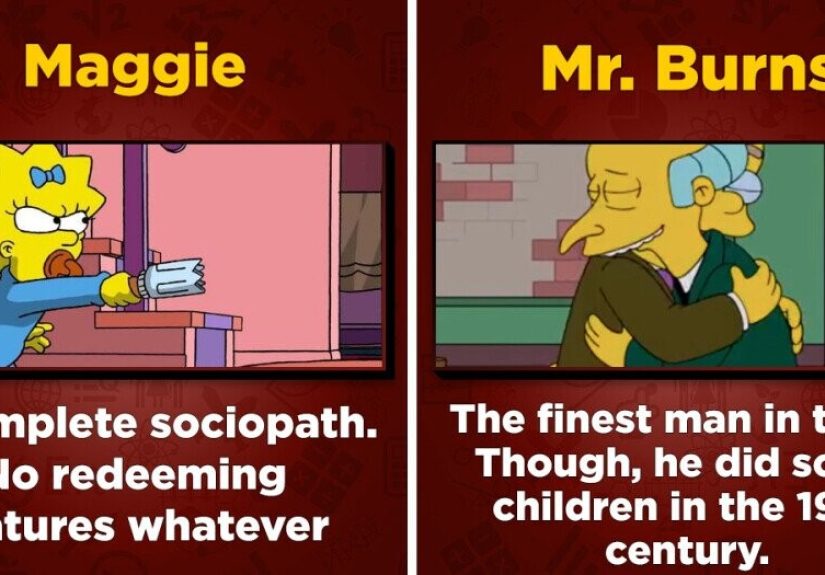
When the truth comes out, the culprit is not Homer, Smithers, or any of the adults who spent years being insulted, cheated, or endangered by Burns. It is Maggie Simpson. The baby. The one who can barely walk without face-planting. In the show’s explanation, Burns tries to take candy from Maggie, the gun falls into her hands, and the shot happens in a cartoonish accident. But that has never stopped fans from joking that Maggie might be Springfield’s tiniest mastermind.
Maggie Simpson: Innocent Baby or Silent Menace?
On paper, Maggie Simpson should not be on any list of evil Springfield citizens. She is the youngest Simpson child, usually seen sucking her pacifier and watching the chaos around her with wide, unreadable eyes. She rarely speaks, which makes her one of the few Springfield residents smart enough not to say anything incriminating.
But silence is powerful in comedy. Maggie’s lack of dialogue turns her into a mystery. Bart announces his trouble. Lisa explains her principles. Homer loudly negotiates with his own stomach. Maggie simply observes. Then, every so often, she does something shockingly capable. She escapes danger, imitates adults, handles situations no baby should understand, and occasionally seems more aware than everyone else in the room.
The Pacifier Is Cute. The Track Record Is Suspicious.
Maggie’s “evil” is not the same as Mr. Burns’s evil. Burns chooses cruelty. Maggie operates in a stranger zone: baby innocence mixed with impossible competence. The joke is not that Maggie is truly wicked; it is that The Simpsons repeatedly gives this tiny child moments that make viewers wonder whether she knows more than she lets on.
Her role in the Burns mystery is the biggest example, but it is not the only time Maggie seems unusually formidable. She has been shown as resourceful, fearless, and surprisingly good at surviving Springfield’s nonsense. In a town where adults regularly fail at basic reasoning, Maggie’s quiet competence can look downright supernatural. Perhaps she is not evil. Perhaps she is simply the only Simpson who understands that the less you speak, the harder it is for Chief Wiggum to build a case.
Mr. Burns vs. Maggie: Two Very Different Kinds of Chaos
What makes this comparison so funny is the contrast. Mr. Burns is all intention. Maggie is all implication. Burns plans, plots, bribes, threatens, and congratulates himself before the disaster is even finished. Maggie sits in her car seat and lets everyone underestimate her. Burns wants control. Maggie often creates confusion simply by being present at the wrongor perfectmoment.
Mr. Burns is evil as a system. He has money, power, employees, lawyers, security gates, and hounds. Maggie is “evil” as a punchline. She has a pacifier, a onesie, and the terrifying advantage of being too cute to interrogate. If Burns represents the corruption of institutions, Maggie represents the chaos that slips through every institution because nobody thinks to baby-proof the plot.
The Real Villainy Is in the Joke
Calling Maggie one of Springfield’s most evil citizens is obviously playful. The show does not present her as morally corrupt. Instead, it uses her innocence to create comic tension. The audience knows she is a baby, yet the story occasionally places her in situations that would be serious if handled by an adult. That mismatch is the joke. Maggie is not a miniature supervillain; she is a reminder that Springfield’s reality is so broken that even a baby can become a major suspect.
Mr. Burns, on the other hand, is genuinely villainous within the show’s satirical universe. His crimes and schemes are funny because they are exaggerated, but they also point toward real anxieties about wealth, pollution, labor exploitation, and public indifference. He is ridiculous, but his type of power is not. That is why he remains one of television’s most durable villains: he is both a Halloween mask and a business-school cautionary tale.
The Moral Scale: Evil, Accidental Evil, and Springfield Evil
To properly judge Springfield’s most evil citizens, we need a moral scale. At one end, there is accidental chaos: Homer forgetting something important, Bart pulling a prank, or Grandpa telling a story that somehow causes property damage. In the middle, there is selfish chaos: Krusty endorsing a terrible product, Moe making a questionable business choice, or Mayor Quimby smiling through another scandal. At the far end is Mr. Burns, who treats ethics like a rumor started by poor people.
Maggie does not belong at the Burns end of the scale. She belongs in a special category: adorable chaos with suspicious timing. She is less “evil citizen” and more “tiny wildcard.” Still, in a town defined by incompetence, that wildcard can be more effective than a room full of adults. Burns may own the power plant, but Maggie owns the art of the silent reveal.
Why Fans Love This Pairing
Fans love comparing Burns and Maggie because they sit at opposite ends of the show’s comic universe. Burns is ancient, wealthy, verbal, and openly malicious. Maggie is young, dependent, quiet, and apparently innocent. Put them together, and the result is perfect Simpsons logic: the most powerful man in Springfield can be undone by the least powerful member of the Simpson family.
That reversal is classic comedy. It is also oddly satisfying. Burns spends so much time bullying workers, manipulating institutions, and mistreating Springfield that viewers want to see him humbled. Having him brought down by Maggie is not just a twist; it is poetic humiliation in a blue bow. Evil meets innocence, and innocence somehow walks away holding the smoking plot device while everyone else argues.
Mr. Burns: Evil With Excellent Catchphrases
Part of Burns’s appeal is his language. He speaks like a man who learned English from dusty contracts, haunted mansions, and villains who tie people to railroad tracks. His famous “Excellent” is not just a catchphrase; it is a tiny window into his soul, assuming that soul has not been auctioned off for a tax advantage.
Burns’s physical design also enhances the joke. He is frail, narrow, and birdlike, yet he controls enormous wealth and power. His body says “strong breeze,” while his bank account says “regional threat.” That visual contrast makes him funny before he even speaks. He is not physically intimidating, but he has the resources to make life miserable for an entire town. In Springfield, money is muscle, and Burns never skips wallet day.
Maggie Simpson: The Quietest Scene-Stealer on Television
Maggie’s comedy works in the opposite direction. She often says nothing, yet her silence makes her more expressive. The pacifier sound becomes her signature, a tiny rhythm of babyhood that can mean confusion, judgment, or “I have seen things in this house no child should process.” When Maggie finally does speak in rare moments, it becomes an event because the show has trained viewers to treat her voice as precious.
She is also emotionally central to the Simpson family. Episodes like “And Maggie Makes Three” show how much she means to Homer. The famous office-photo ending, where Homer turns a cruel workplace reminder into a tribute to his daughter, is one of the show’s sweetest moments. That matters because it prevents Maggie from becoming just a joke machine. She is funny because she is mysterious, but she is beloved because she represents the softest part of a chaotic family.
What This Duo Says About The Simpsons
Mr. Burns and Maggie Simpson show why The Simpsons has lasted so long. The series can satirize billionaires, workplace culture, environmental negligence, family love, media hype, and murder-mystery tropes while still finding time for a baby sucking a pacifier. It can be cynical and tender in the same episode. It can make Mr. Burns monstrous without making him boring, and Maggie adorable without making her simple.
Their connection also highlights the show’s favorite trick: turning social hierarchy upside down. The rich man is not untouchable. The baby is not powerless. The town is not logical. Springfield runs on reversals, and the biggest laughs often come when status collapses. Burns can block out the sun, but he cannot control a baby with candy. That is not just comedy; that is cosmic justice wearing footie pajamas.
Experiences Related to “Meet Springfield’s Most Evil Citizens: Mr. Burns And Maggie Simpson”
Rewatching episodes centered on Mr. Burns and Maggie feels like visiting a museum where every painting is slightly on fire. You know the jokes are coming, but the timing still works because the characters are built on such clear comic engines. Burns walks into a scene and instantly lowers the moral temperature. Maggie appears, and the room becomes unpredictable. Together, they create the kind of contrast that makes The Simpsons endlessly rewatchable.
One of the most enjoyable viewing experiences is noticing how the show uses Mr. Burns as a pressure test for Springfield. When Burns makes a selfish decision, everyone else’s flaws start bubbling up. Homer gets angry. Smithers gets conflicted. The town panics. The police stumble around. The school suffers. Burns is not just a villain; he is a story generator. Put him near money, power, or an opportunity to behave decently, and he will almost certainly choose the option that requires ominous music.
Maggie offers a different kind of pleasure. Her scenes reward attention. Because she rarely explains herself, viewers watch her body language, her eyes, and her timing. A small reaction from Maggie can be funnier than a full Homer monologue because it feels like the show is whispering, “Yes, the baby understands this better than the adults.” That quiet intelligence gives her a special place in the family. She is not the loud rebel like Bart or the moral voice like Lisa. She is the tiny witness to everything, and sometimes the tiny consequence.
The “Who Shot Mr. Burns?” storyline is especially fun to revisit because it feels like a community event from another era of television. The mystery invited fans to guess, debate, and inspect clues. Today, viewers are used to online theories exploding within minutes, but this episode did it before social media turned every plot twist into a courtroom. The reveal still works because Maggie is both absurd and weirdly perfect. She is the last person anyone expects and the only person who could make the ending feel innocent, funny, and unforgettable at the same time.
There is also something satisfying about the way Maggie punctures Burns’s power. Burns spends his life believing wealth makes him untouchable. He can intimidate workers, influence officials, and treat Springfield like a private toy box. Yet his downfall comes from underestimating the smallest person in town. That is a timeless comedy lesson: arrogance rarely looks down far enough. In Burns’s case, looking down would have been useful. The baby was right there.
For longtime fans, the Burns-and-Maggie connection is a reminder that The Simpsons is at its best when it mixes sharp satire with emotional absurdity. Burns gives the show its bite. Maggie gives it its strange sweetness. One represents everything wrong with unchecked power; the other represents the unpredictable innocence that can accidentally expose it. Watching them share narrative space is like watching a haunted bank vault get defeated by a rattle.
That is why the title “Meet Springfield’s Most Evil Citizens: Mr. Burns And Maggie Simpson” works as a playful invitation. It sounds like a criminal lineup, but it opens the door to a bigger joke about how evil functions in Springfield. Sometimes evil is deliberate, polished, and extremely rich. Sometimes it is accidental, silent, and wearing a bow. And sometimes the funniest thing television can do is put both in the same story and let the baby win.
Conclusion: Springfield’s Evil Has Range
Mr. Burns and Maggie Simpson are not equally evil, but they are equally important to Springfield’s comic mythology. Burns is the town’s most reliable villain, a walking satire of greed and power who can make even a sunny day feel like a hostile takeover. Maggie is the adorable anomaly, the baby whose silence and surprising competence make her one of the show’s funniest wildcards.
Together, they prove that The Simpsons understands comedy better than almost anyone: power is funniest when it fails, innocence is funniest when it looks suspicious, and Springfield is funniest when morality gets knocked sideways by a pacifier. Mr. Burns may be the face of evil in town, but Maggie Simpson is the tiny reminder that even the biggest villain can be humbled by the smallest citizen.
Note: This article is written as an original, SEO-ready analysis based on established The Simpsons canon, episode history, character profiles, and reputable entertainment references, with source links intentionally omitted from the visible web copy as requested.