Table of Contents >> Show >> Hide
- Table of Contents
- From Dream to Day Job (Without Losing the Joy)
- My Embroidery Toolkit (Tiny, Mighty, Occasionally Pointy)
- 28 Pics: The Embroidery Artworks I Made
- What Going Full-Time Taught Me (Besides Patience)
- How I Photograph, Share, and Sell Embroidery Art
- Extra: of Real-Life Full-Time Artist Experience
- Final Stitch: A Neat Little Conclusion
I used to treat embroidery like a “cute little hobby” the way people treat houseplants: lovingly, obsessively, and with a quiet fear that I’d somehow kill it with enthusiasm.
Then one day I looked around at the growing pile of hoops, floss bobbins, and tiny snips, and realized: this isn’t a hobby anymorethis is a lifestyle choice.
The kind that leaves glitter-adjacent thread bits in your socks and makes you judge paintings by whether they could be “improved” with French knots.
Somewhere between late-night stitching sessions and posting progress pics online, my dream happened: I became a full-time artist.
Not in a movie-montage way (sadly no background music, just a lot of froggingaka pulling stitches out like you’re un-texting a mistake),
but in the real, practical way: consistent work, a recognizable style, and a business backbone sturdy enough to hold up my creative chaos.
From Dream to Day Job (Without Losing the Joy)
Turning embroidery into a full-time job isn’t about “going viral” (which is luck plus timing plus the internet deciding you’re its favorite child for 12 minutes).
It’s about building a practice you can repeat, refine, and scalewithout turning your art into a joyless production line.
The shift that changed everything: treating art like a practice
I stopped waiting for “inspiration” and started working in small, repeatable systems:
sketch → thread palette → test stitches on scrap fabric → stitch in layers → photograph in daylight → share with a story.
The magic wasn’t a sudden burst of talent; it was the boring consistency that quietly made my work better.
Style is just your habits with better lighting
My style emerged when I noticed what I did on autopilot: clean outlines, bold color blocks, and texture that begged to be touched (politely).
Once I leaned into that, people started recognizing my work before reading my nameand that’s when “pretty embroidery” became “your embroidery.”
My Embroidery Toolkit (Tiny, Mighty, Occasionally Pointy)
If you’re building a full-time embroidery practice, your tools matterbut not in a “buy the fanciest thing” way.
More like a “buy the right thing so you don’t hate your own hands” way.
The essentials I actually use
- Hoops or frames: Good tension is half the battle and 80% of my personality.
- Needles: I keep a few sizes on hand; generally, smaller numbers mean bigger needles (useful when switching fabrics and thread thickness).
- Stranded cotton floss: The classic “six strands in one skein” situationseparating strands before stitching makes the thread lay smoother and reduces tangles.
- Fabric: Linen blends for crisp detail, cotton for everyday pieces, and whatever scrap I can test on without emotional commitment.
- Stabilizer: When fabric needs structure (or when I need emotional support).
- Small scissors + needle minder: The scissors do the work; the minder prevents me from becoming a human pincushion.
- Lighting: I used to stitch in “mystery shadows.” Never again.
Stitch-wise, I come back to a core set: back stitch, split stitch, stem stitch, satin stitch, chain stitch, long-and-short shading, and French knots.
If you know those well, you can fake your way through an alarming number of “advanced” designs.
28 Pics: The Embroidery Artworks I Made
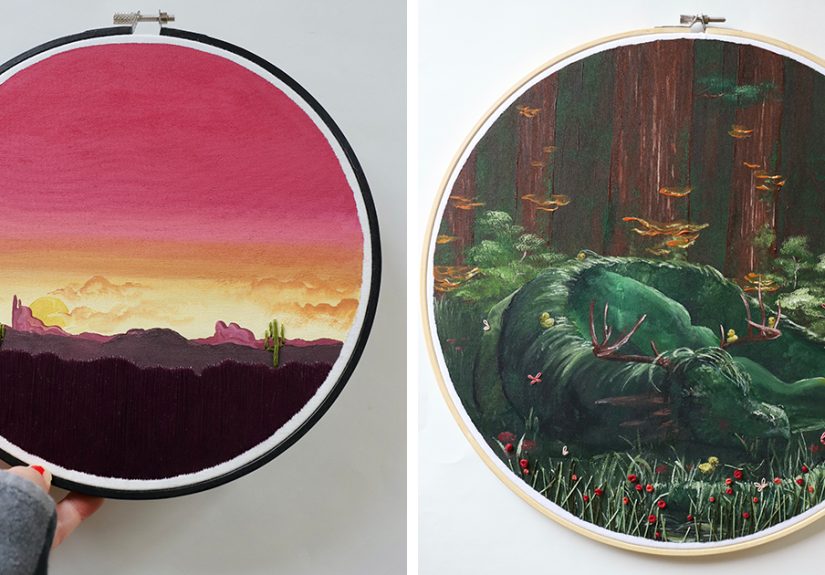
Below are 28 pieces from my embroidery art journeyeach one a little snapshot of what I was obsessed with at the time:
texture experiments, color moods, and the occasional “why did I choose this many tiny petals” life decision.
Replace the image filenames with your real photos when publishing.
Theme 1: Botanicals & Bloom Energy (1–7)


Theme 2: Food, Still Life, and Cozy Chaos (8–14)


Theme 3: Places, Portraits, and “I Was Feeling Sentimental” (15–21)


Theme 4: Weird, Wonderful, and Slightly Unhinged (22–28)


What Going Full-Time Taught Me (Besides Patience)
1) Pricing is math, not vibes
I used to price based on “what feels fair,” which is basically the business equivalent of seasoning soup by staring at it.
Now I price with structure: materials + labor time + overhead, then add room for profit and growth.
If you want consistency, build a pricing framework and stick to itespecially as your skills improve and demand rises.
Real example: A 6-inch hoop piece might use $8–$15 in materials. If it takes 5 hours and you pay yourself $25/hour, that’s $125 labor.
Add overhead (packaging, tools wear, fees) and you’re quickly past “cute craft price.”
That’s not greedthat’s sustainability. Your hands are not a nonprofit.
2) Business basics protect your creative life
Going full-time meant choosing a structure, registering where needed, and getting my admin house in order so art could be my main jobnot a constant panic soundtrack.
Even if you’re solo, it helps to understand how your setup affects taxes, paperwork, and liability.
I’m not giving legal advice here; I’m saying the boring stuff is what keeps the fun stuff alive.
3) Taxes: the least aesthetic part of artistry
When you’re self-employed, taxes don’t get automatically withheld the way they do at many traditional jobs.
You’ll likely deal with tracking income/expenses, filing the right forms, and making estimated payments if needed.
The good news is: once you build a monthly routine (like saving a percentage of every payment), it stops being scary and becomes… mildly annoying. Which is progress.
4) Protect your work (and your sanity)
Embroidery art is still art. Original designs, photos, and written descriptions can be protected under U.S. copyright rules once they’re fixed in a tangible form.
If your work becomes a real business asset, learn the basics of what protection exists and when registration makes sense for you.
The goal isn’t paranoiait’s professionalism.
How I Photograph, Share, and Sell Embroidery Art
Photographing embroidery so people can “feel” it
- Use natural light: texture shows better without harsh shadows.
- Get close: detail shots prove it’s handmade and highlight stitch quality.
- Show scale: hold the hoop, include a hand, or add a simple prop.
- Keep backgrounds calm: let color and thread do the flexing.
- Write strong alt text: it helps accessibility and can support SEO when published.
Marketing that doesn’t feel like selling your soul
I learned to share process, not just the final result: time-lapses, “before/after” thread palettes, and quick stitch close-ups.
People connect to the story behind the artworkthe why, the struggle, the tiny win when a gradient finally looks right.
Also: email lists matter. Social platforms change; your list is yours.
Turning one-time buyers into long-term collectors
The most sustainable growth I’ve had came from consistency: a predictable release schedule, a recognizable style, and clear communication.
When customers know what you make and how to buy it, they become repeat supportersespecially if you treat them like humans, not “conversions.”
Extra: of Real-Life Full-Time Artist Experience
The first month I went full-time, I thought I’d wake up every day feeling like a creative superhero. What I actually felt was: “Wait… I’m in charge now?”
There’s a specific kind of terror that comes from realizing your boss is you, your HR department is you, your marketing team is you, and your break-room gossip is also you.
I celebrated by making coffee and immediately spilling itan early reminder that “full-time artist” is not the same thing as “person who suddenly becomes graceful.”
My routine didn’t become glamorous; it became intentional. Mornings are for the work that requires a fresh brain: sketching, planning palettes, answering messages,
and doing the annoying-but-important stuff like invoices and inventory. Afternoons are for stitching, because that’s when my focus becomes less “laser beam”
and more “friendly flashlight.” I set tiny goalsfinish the outline, complete one color section, test one new stitchso progress stays visible.
Big goals are great, but tiny goals are what get you to Friday without eating your own feelings.
I also learned the hard way that creativity is not an unlimited resource you can mine 14 hours a day. If I push too hard, my work gets stiff, my wrists complain,
and my brain starts suggesting “fun new ideas” like reorganizing floss by emotional vibe. (Spoiler: that’s not rest. That’s avoidance with a color chart.)
So I schedule actual breakswalks, stretching, phone-free mealsand I treat them like part of the job, not a reward I have to earn.
The biggest mindset change was separating “making” from “selling.” When I tried to create what I thought would sell, my work got cautious.
When I made what I genuinely lovedand then learned how to present it clearlysales followed with less friction.
That doesn’t mean I ignore the market; it means I listen without letting it drive the whole car. I keep notes on what people respond to:
bold color, clean outlines, cozy themes, a little humor. Then I remix those elements in ways that still feel like me.
And yes, there were rough moments: slow weeks, algorithm tantrums, projects that looked better in my head, and that one commission where I learned the importance
of a detailed agreement (politely, but firmly). Still, the payoff is real. I get to build a life where my hours belong to my craft,
where improvement is visible thread by thread, and where “work” is something I can touch in my hands at the end of the day.
My dream didn’t arrive as a perfect finishit arrived as a practice. And I keep choosing it, one stitch at a time.
Final Stitch: A Neat Little Conclusion
Becoming a full-time embroidery artist wasn’t a single leapit was a hundred small steps: learning core stitches, separating floss strands so they lay smoother,
building a portfolio, pricing with math, showing up consistently, and treating the business side like a tool (not a monster under the bed).
If you’re chasing the same dream, start where you are, stitch what you love, and make the next decision that supports your future self.
And if you’re here for the gallery: thank you for letting my tiny thread paintings live in your brain for a bit.
Now go drink water. Your shoulders are probably up by your ears. You’re welcome.