Table of Contents >> Show >> Hide
- Start Here: The Budget-Friendly Organizing Rules That Actually Work
- The “Core Kit” of Budget-Friendly Organizers (Under $25)
- Room-by-Room: Where Budget Organizers Make the Biggest Difference
- Kitchen: Turn cabinets into categories
- Bathroom: Contain the chaos (especially under the sink)
- Closets: Add layers without remodeling
- Entryway: Create a “drop zone” that prevents pile-ups
- Home office: Paper needs boundaries
- Garage, utility room, or hobby area: Tiny parts deserve tiny homes
- Your car: Make it a mini-zone system
- How to Shop Smart: Getting the Best Value (Not Just the Lowest Price)
- Maintenance: The 10-Minute Habit That Keeps You Organized
- Experience-Based Add-On: 5 Real-Life Budget Organizing Wins (About )
- Conclusion: A More Organized Home Doesn’t Have to Cost a Lot
If clutter were an Olympic sport, your “miscellaneous pile” would already have a gold medal and a sponsorship deal.
The good news: you don’t need a celebrity closet makeover (or a second mortgage on matching baskets) to get your
home under control. You need a simple plan, a few smart organizers, and the courage to finally decide what’s
actually living in that one drawer everyone pretends is “temporary.”
Inspired by Bob Vila’s roundup of wallet-friendly organizing helpers, this guide breaks down the best
budget-friendly organizers (many under $25), how to choose them, and exactly where they earn their keepkitchen,
closet, bathroom, entryway, office, garage, and even your car. You’ll get practical examples, room-by-room
strategies, and a realistic way to stay organized without turning your life into a label-making reality show.
(Although… no judgment if you do. Labels are oddly satisfying.)
Start Here: The Budget-Friendly Organizing Rules That Actually Work
1) Declutter first, or you’ll just create “organized clutter”
Organizers aren’t magic. If you buy bins before you edit your stuff, you’ll end up with beautifully categorized
chaoslike a museum exhibit titled “Artifacts I Didn’t Want to Decide About.” Before you shop, pull
everything out of the problem area (yes, all of it), sort into categories, and remove what you don’t use, need,
or like. Then you’ll know what you’re storing and how much space it truly requires.
2) Measure twice, buy once
One of the fastest ways to waste money is purchasing organizers that don’t fit your drawers, shelves, or cabinet
heights. Measure the width, depth, and height of your space, then measure the items you’re storing (or at least
estimate the “pile footprint”). Budget organizing isn’t about cheap stuffit’s about buying the right stuff one time.
3) Choose “zones,” not “vibes”
A zone is a dedicated home for a category: coffee station, snack bin, cleaning caddy, charging corner, mail drop,
or “I swear I’ll file it” paperwork tray. When every category has a zone, your brain stops treating surfaces like
a free-for-all.
4) Use vertical space like it owes you rent
Shelves, stackable totes, hanging closet organizers, over-the-door pockets, and under-bed bins all do the same
thing: they unlock space you already have. This is especially helpful in small homes where square footage is limited
and the only “extra room” is the space above your eyeballs.
5) Label for maintenance (not for aesthetics)
Labels aren’t just cute. They reduce decision fatigue and help other people in your home put things back where they
belong (which is basically a miracle). If you hate labels, use clear containers so you can still see what’s inside.
The goal is less rummaging, fewer duplicates, and faster cleanup.
The “Core Kit” of Budget-Friendly Organizers (Under $25)
Think of these as your organizing starter packthe versatile pieces that work in multiple rooms and adapt as your
needs change. Bob Vila’s list highlights lots of affordable options under $25, and the real organizing win is picking
items that can move with you (and your ever-evolving hobbies).
Under $5: Small tools that tame daily messes
-
Small drawer bins and trays: Great for junk drawers, makeup, office supplies, and kitchen tools.
Example: compact drawer organizers like IKEA-style bins and simple modern trays. -
Handled caddies: A carry-anywhere solution for cleaning supplies, craft tools, hair products,
or “I’m organizing but make it mobile.”
These tiny organizers are deceptively powerful because they prevent the “everything slides into one sad corner”
effect. Even one small tray for keys and wallets can eliminate the daily scavenger hunt.
Under $15: Closet helpers and problem-solvers
-
Fabric cube drawers: Perfect for socks, baby items, craft supplies, or gym accessoriesespecially
inside cube shelves. -
Valet trays (foldable catch-alls): Your entryway’s best friend. Keys, sunglasses, earbuds, lip balm,
loose changeeverything that usually disappears into the void. -
Cord organizers: Cable chaos is still chaos, even if the rest of your home is tidy.
Clips and holders keep charging cords reachable and less annoying. -
Accessory hangers: Loop hangers for scarves, belts, and ties keep closet rods functional instead of
turning into a fabric traffic jam.
Under $25: The “why didn’t I buy this sooner?” upgrades
-
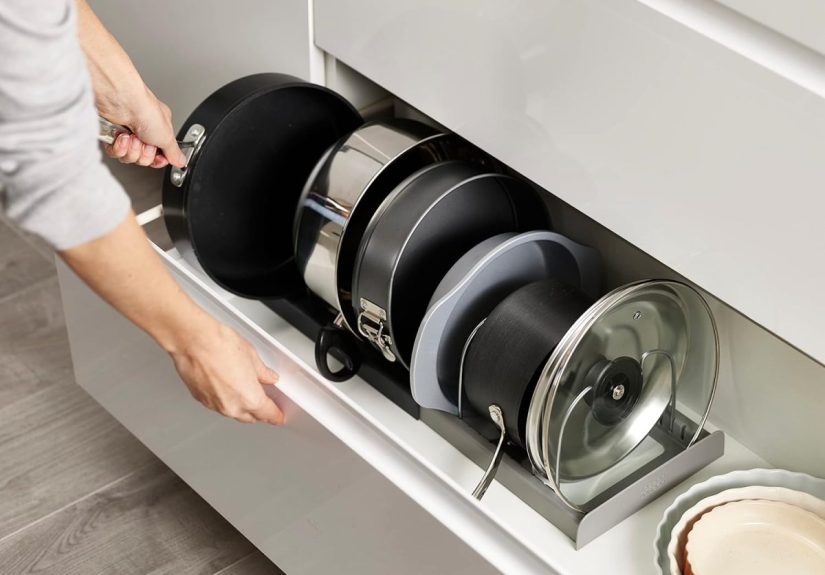
Expandable cookware organizers: Adjustable dividers help stand up pans, lids, and baking sheets
so you can grab one without triggering a metal avalanche. -
Wall-mounted tool holders: Broom-and-mop organizers free up floor space and stop handles from
falling like dominoes. -
Over-the-door pocket organizers: Add storage without drilling. Great for pantry items, cleaning
supplies, kids’ accessories, and shoes (as long as you respect weight limits). -
Under-bed bins and large storage bags: Ideal for seasonal clothes, extra linens, and “I only use
this twice a year” items. - Two-tier sliding cabinet organizers: A big win under sinks where you need access, not just storage.
Room-by-Room: Where Budget Organizers Make the Biggest Difference
Kitchen: Turn cabinets into categories
The kitchen is where clutter multiplies fastest because it’s a high-traffic zone with lots of small items. The goal
is to make everyday tools easy to reach and occasional tools easy to store.
-
Drawer bins: Use shallow bins to separate measuring spoons, chip clips, and that one tiny whisk you
love but never admit you own. - Cookware dividers: Stand pans and lids vertically; you’ll stop stacking (and restacking) every time you cook.
-
Box organizers: Give foil, plastic wrap, and sandwich bags a dedicated shelf so they stop flopping around
like unruly paper accordions. - Bag dispensers: Upgrade the “bag of bags” into a system that doesn’t explode when you open a cabinet.
Pro move: create micro-zones. One bin for baking, one for snack refills, one for lunch-packing. The more specific the
zone, the less likely it is to become a junk drawer wearing a chef hat.
Bathroom: Contain the chaos (especially under the sink)
Bathrooms have two classic problems: too many small products and not enough sensible storage. The fix is containers
that slide, stack, or hangso you can actually see what you own.
- Two-tier organizers under the sink: Pull-out baskets help you access items without doing yoga around plumbing.
- Small trays for drawers: Separate hair ties, skincare, grooming tools, and medicine so you don’t buy duplicates.
- Portable caddies: A handled caddy for daily products keeps counters clear and makes cleaning faster.
If you share a bathroom, labels become a peace treaty. “Mine,” “yours,” and “shared” is a surprisingly effective
system. It’s not dramatic. It’s just… organized.
Closets: Add layers without remodeling
Closets get messy when they’re forced to do too much with too little structure. Budget closet organizers work best
when they add a second level (or prevent stacks from collapsing).
- Hanging shelf organizers: Add soft shelves for sweaters, shoes, or bags.
- Double-hang rods: Instantly create more hanging space for shirts and kids’ clothing.
- Wonder-style hanger cascades: Fit more clothing on the same rod without buying a new closet system.
- Shelf dividers: Stop towel towers and sweater stacks from slumping into an unholy pile.
- Under-bed bins and large storage bags: Store off-season items where they’re close but out of the way.
Entryway: Create a “drop zone” that prevents pile-ups
If your entryway is a landing strip for mail, keys, and bags, you need two things: a catch-all and a rule. The
catch-all holds essentials; the rule is “nothing touches the floor unless it’s furniture.”
- Valet tray: Keys and wallet live here. Always. No exceptions.
- Small bins: One for incoming mail, one for returns, one for “to file.”
- Wall hooks or small organizers: Keep bags and hats visible and off chairs.
Home office: Paper needs boundaries
Desk clutter isn’t just messy; it slows you down. A simple file organizer creates instant structure: inbox, action,
and archive. That alone can make your workspace feel calmer in about five minutes.
- Desk file organizer: Separate papers, notebooks, and devices so they stop stacking into a leaning tower.
- Drawer trays: Create categories for pens, sticky notes, chargers, and small tools.
- Cord organizers: Keep charging cables reachable and stop the “cord tumbleweed” phenomenon.
Garage, utility room, or hobby area: Tiny parts deserve tiny homes
This is where budget organizers really shine: stackable totes, small drawer units, and portable toolboxes make it
easier to keep categories separate. “Hardware,” “paint supplies,” “batteries,” and “craft stuff” should never be
roommates in the same bin.
- Stackable totes: Label by category and store by frequency of use.
- Small drawer organizers: Ideal for screws, nails, picture hooks, LEGO pieces, beads, or electronics parts.
- Wall-mounted broom holders: Get long-handled tools off the floor and neatly in place.
- Compact toolboxes: Keep frequently used tools accessible without scattering them across three shelves.
Your car: Make it a mini-zone system
If your car routinely becomes a traveling storage unit, a backseat organizer is a practical fix. Use pockets for
wipes, snacks, chargers, first-aid basics, and kid supplies. Bonus: you’ll stop losing things between seats, which is
basically a portal to another dimension.
How to Shop Smart: Getting the Best Value (Not Just the Lowest Price)
Budget-friendly organizers are worth it when they solve a recurring problem and fit your real life. Before you buy,
ask three questions:
- Will this reduce friction? (Meaning: will it make daily routines easier?)
- Does it fit the space and the stuff? Measure and confirm.
- Can I reuse it if my needs change? The best organizers migrate to new jobs over time.
Also consider material choices. Clear bins are great when you want visibility (pantries, closets, garages), while
opaque or fabric bins can look tidier in open areas (living rooms, shelves, entryways). Matching containers can look
cohesive, but don’t let aesthetics bully you into buying something that doesn’t function well.
Maintenance: The 10-Minute Habit That Keeps You Organized
A system only sticks if it’s easy to maintain. Try a quick reset routine:
- Daily (2 minutes): Put items back into their zones. Reset the drop zone.
- Weekly (10 minutes): Quick scan of clutter hotspots: kitchen counter, entryway, bathroom sink, nightstand.
- Monthly (15 minutes): Re-label if needed, donate drift items, and adjust zones that aren’t working.
The secret is not perfectionit’s quick corrections. Organization is less like building a statue and more like brushing
your teeth. Small, regular effort beats one huge, exhausting weekend that ends with you sitting on the floor whispering,
“Why do I own so many cords?”
Experience-Based Add-On: 5 Real-Life Budget Organizing Wins (About )
Let’s talk about what actually happens in real homeswhere the laundry is never fully “done,” the kitchen junk drawer
keeps recruiting new members, and everyone swears they’ll put things back later (they won’t). The best budget-friendly
organizers aren’t the fanciest; they’re the ones that match how people naturally move through a space.
1) The Junk Drawer Rescue (aka “Where Scissors Go to Disappear”)
In many households, the junk drawer isn’t a drawerit’s a lifestyle. The fix is usually three small trays: one for
tools (scissors, tape, tiny screwdriver), one for paper bits (stamps, coupons, takeout menus), and one for random
essentials (batteries, lighters, earbuds). When those categories are separated, the drawer becomes usable again.
The funniest part? People often “discover” they already own three scissors. They just had them buried in different
layers of chaos like archaeological artifacts.
2) The Under-Sink Glow-Up (Plumbing-Proof Organization)
Under-sink cabinets are tricky because pipes steal space and everything gets shoved behind them. A sliding two-tier
organizer or pull-out baskets can change the whole game. Put daily items in the front basket (dish pods, sponges,
spray cleaner), backups in the back basket (refills, extra cloths). Add one handled caddy for “grab-and-go cleaning”
so you can wipe a bathroom counter without rummaging like a raccoon in a snack bag. People love this setup because it
reduces the “I have no idea what we have” problem, which is the #1 cause of buying duplicates out of frustration.
3) The Closet Space Multiplier (No Renovation Required)
Closets often fail because everything is on one rod and one shelf, so stacks collapse and hangers fight each other.
A simple double-hang rod instantly adds capacity for shirts and kids’ clothing. Shelf dividers stop piles from leaning.
A hanging organizer creates vertical cubbies for shoes, bags, or folded clothes. The “wow” moment usually happens when
someone can finally see what they ownso getting dressed takes two minutes instead of ten minutes plus a dramatic
wardrobe speech.
4) The Pantry That Stays Organized (Even After Snack Attacks)
Pantries get messy because food comes in odd shapes, and people put things wherever they fit. Clear bins fix that by
grouping categories: snacks, breakfast, baking, pasta, canned goods. Add labels so everyone knows where things go.
The most realistic trick? Create a “snack bin” at kid height (or adult heightno one is judging your granola bar
lifestyle). When snacks have a home, they stop wandering across shelves like they’re exploring a new continent.
5) The Nightstand Reset (Stop the Bedside Pile)
Nightstands become mini clutter hubs: remotes, glasses, chargers, books, lotion, mystery receipts. A bedside caddy
that tucks under the mattress or a small tray on top gives items a defined spot. Add one cord organizer to keep a
charging cable from sliding behind the bed every night (that cable has places to be, apparently). People stick with
this change because it makes mornings smoother: you can find your essentials without starting the day with a scavenger
hunt and a sigh that could power a small fan.
Conclusion: A More Organized Home Doesn’t Have to Cost a Lot
Organizing on a budget is less about finding the cheapest item and more about choosing the right tools for your
routines. Start by decluttering, measure your spaces, create zones, and use versatile organizers that can move from
room to room as your needs change. Small drawer bins, handled caddies, closet helpers, over-the-door pockets, under-bed
storage, and a few smart upgrades (like pull-out cabinet organizers) can make your home feel calmer, faster, and easier
to maintainwithout blowing your budget.
If you do nothing else this week, set up one “drop zone” and one “high-friction” fix (like under-sink storage or a
junk drawer). That single win will motivate the next one. And before you know it, you’ll be the kind of person who
can find tape in under 10 seconds. Legends say it’s possible.