Table of Contents >> Show >> Hide
- Why Moss, of All Things?
- What Scientists Actually Tested
- How Harsh Is “Harsh,” Exactly?
- So, Did the Moss Make It?
- Why NASA and Space Biologists Care
- What Moss Can Do for Space Habitats
- What Moss Cannot Do Yet
- What These Experiments Teach Us Back on Earth
- Conclusion
- Experience Section: What Following Moss-in-Space Research Feels Like
- SEO Tags
Space is rude. It is cold, hot, dry, bright, dark, radioactive, airless, and generally uninterested in your comfort. Humans need pressurized spacecraft, carefully engineered suits, and about a million checklists just to survive a short visit. Moss, meanwhile, shows up looking like the green fuzz on a damp rock and says, “I might be able to work with this.”
That is why scientists have become increasingly interested in testing the survivability of moss in space. What sounds like a niche science-fair project with a very ambitious guidance counselor is actually a serious line of research in space biology and astrobiology. If future missions to the Moon, Mars, or deep-space stations are going to last a long time, astronauts will need resilient living systems around them. That means plants that can tolerate radiation, dehydration, temperature swings, and the general chaos of life off Earth.
Moss is not a glamorous salad crop. Nobody is daydreaming about a Caesar salad made entirely of bryophytes. But moss might be one of the most useful small plants scientists can study when asking a big question: what kind of life can endure the harsh conditions of space, and what does that teach us about building ecosystems beyond Earth?
Why Moss, of All Things?
Moss belongs to a group of nonvascular plants called bryophytes. Unlike tomatoes, lettuce, or your neighborhood oak tree, moss does not have the same elaborate plumbing system for moving water and nutrients around. It stays small, absorbs water through its surfaces, and reproduces through spores rather than seeds. That makes it simple, ancient, and surprisingly tough.
Scientists like moss for space research because it already does well in places that seem deeply unfriendly to plant life. Many mosses survive freezing, drying out, intense sunlight, and nutrient-poor surfaces. Some live in deserts. Others endure polar regions. In the lab, certain moss species have shown remarkable tolerance to dehydration, cold, and even heavy radiation exposure. In other words, moss is the plant-world equivalent of that friend who forgets a jacket in January and still says, “Honestly, I’m fine.”
Its biology also makes it useful as a research model. Mosses are relatively simple, grow in compact spaces, and can reveal how plant cells respond to stress. That matters because space is basically one giant stress test. If a moss cell can protect itself against UV damage, vacuum, and radiation, scientists want to know how it pulls off that trick. Those answers could eventually help researchers breed or engineer more resilient crops for both space farming and harsh environments on Earth.
What Scientists Actually Tested
The most attention-grabbing recent study focused on the moss Physcomitrium patens, a small species already used widely in plant research. Scientists examined several parts of its life cycle and asked which form was most likely to handle space conditions. That is important because “moss” is not just one uniform blob of green. Different tissues do different jobs, and some are much better armored than others.
The star of the show turned out to be the sporophyte, the structure that contains and protects spores inside a capsule called a sporangium. Before sending samples into orbit, researchers tested how well different moss structures handled ultraviolet light, freezing, heat, and vacuum-like conditions. The sporophytes came out looking much tougher than the juvenile tissues. That protective outer structure appears to work like a tiny biological shield, helping the inner spores survive damage that would otherwise be catastrophic.
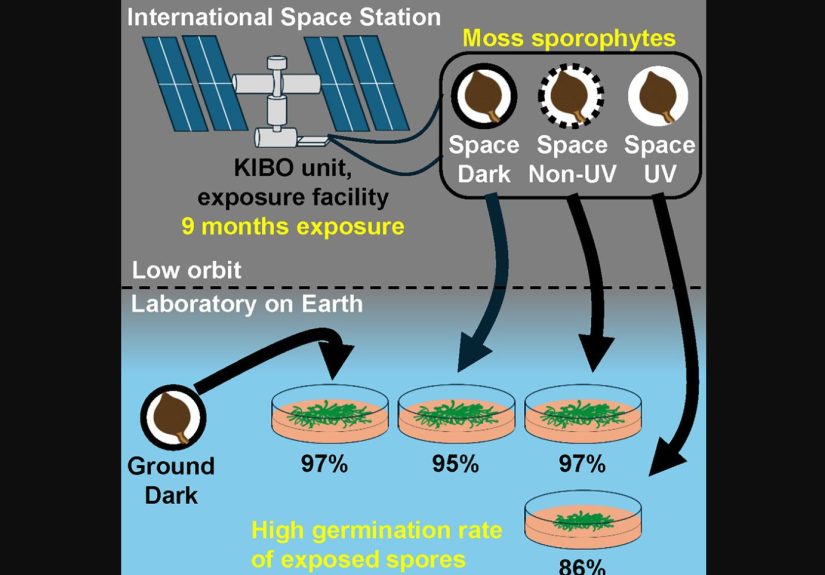
Then came the real headline test. Moss samples were placed outside the International Space Station for roughly nine months, or about 283 days, on an exposure facility attached to Japan’s Kibo module. This was not a cozy greenhouse experiment. These samples were exposed to the actual outside environment of low Earth orbit, where they encountered vacuum, wild temperature shifts, radiation, and fierce solar ultraviolet light. Space was not asked to be nice, and space, true to form, declined.
How Harsh Is “Harsh,” Exactly?
When people hear that something survived in space, it is easy to picture a dramatic but vague movie montage. In reality, the hazards are very specific. Outside the ISS, biological samples can face vacuum, which strips away water and creates severe desiccation stress. They experience extreme temperature cycling as the station moves in and out of sunlight. They are hit with radiation and unfiltered ultraviolet light. On top of that, hardware on the exterior of the station can be exposed to atomic oxygen and charged particles.
For living tissue, this is a nasty combination. Vacuum dehydrates cells. UV can damage pigments, membranes, and DNA. Radiation can disrupt molecular structures and biochemical processes. Temperature swings can stress proteins and cell walls. The miracle is not that most organisms fail these tests. The miracle is that any organism passes them at all.
That is one reason moss in space is such a fascinating subject. Moss is not merely surviving one bad day. It is being asked to tolerate a full buffet of orbital abuse all at once. Ground simulations are useful, but researchers often point out that orbit is the only place where all those factors combine in exactly the same way.
So, Did the Moss Make It?
Yes, and that is the part that made researchers do a scientific double take.
After the samples returned to Earth, the team found that most of the spores had survived. More than 80 percent remained viable, and about 86 percent of them germinated after the trip. That does not mean the moss came back from orbit wearing sunglasses and asking for a smoothie, but it does mean the spores retained the ability to resume growth after direct exposure to space.
That result matters because survival is one thing and post-flight recovery is another. A sample can limp across the finish line and technically still be called alive. What impressed researchers here was that many spores did not merely endure; they were still capable of normal-looking development once conditions improved.
There were signs of damage. Ultraviolet exposure appeared to be the hardest stressor, and some pigments tied to photosynthesis, especially chlorophyll-related compounds, were reduced after the mission. But the overall outcome was still startlingly positive. In short, the experiment suggested that the spore-bearing structures of moss are built with a level of resilience that most life forms can only envy from a safe, breathable distance.
Researchers even modeled how long such spores might last under similar conditions and estimated a possible survival time approaching 15 years. That figure should not be treated like a guarantee stamped on a warranty card from the universe. It is a model-based estimate, not proof that moss can happily camp out in orbit for a decade and a half. Still, it highlights just how durable these tiny plant cells may be.
Why NASA and Space Biologists Care
This is where the story shifts from “wow, neat moss” to “okay, this could actually matter.” NASA and other space agencies are interested in long-duration missions where crews may need some version of bioregenerative life support. That phrase sounds complicated, but the basic idea is simple: use living systems to help recycle air, water, and waste while supporting human life.
Plants are central to that dream. They can produce oxygen, help manage carbon dioxide, contribute to humidity control, and eventually provide food and psychological benefits for crews. NASA has already spent years growing crops on the ISS through systems such as Veggie, which has supported lettuce, kale, cabbage, mustard, and zinnia experiments. Those projects are about much more than astronaut snacking. They are early steps toward sustainable life-support systems for deep-space exploration.
Moss fits into this bigger picture as a rugged research candidate. NASA’s ARTEMOSS investigation uses Antarctic moss, Ceratodon purpureus, to study how plants respond to the combined effects of cosmic radiation and microgravity. NASA describes moss as appealing for spaceflight because it is small, low-maintenance, able to absorb water from the air, and especially tolerant of harsh conditions. Antarctic moss is especially interesting because it comes from an environment already blasted by intense solar radiation.
In plain English: if you are trying to figure out what kind of plant biology might still function after a long, ugly journey through space, moss is a pretty good place to start.
What Moss Can Do for Space Habitats
Let’s be realistic. Moss is not going to replace wheat, potatoes, or leafy greens in a future lunar pantry. It is not a complete food system. It is not a miracle terraform-in-a-box product. And it is definitely not a charming shortcut that lets engineers skip the hard parts of habitat design.
What it can do is serve as a biological pioneer. On Earth, moss often acts as an early colonizer of bare surfaces. It helps retain moisture, interacts with microbes, and can contribute to the first steps of making rough environments more biologically active. In controlled space habitats, or in carefully designed closed systems, moss could someday help with humidity regulation, oxygen production at a small scale, surface stabilization, or biological conditioning for other organisms.
It also gives scientists a compact, resilient model for understanding plant stress responses. If researchers identify which genes, pigments, or structural traits help moss survive vacuum and radiation, some of that knowledge may translate into better crops. Think of moss as less of a final product and more of a biological tutor with a very tiny face.
What Moss Cannot Do Yet
It is tempting to jump straight from “moss spores survived outside the ISS” to “great, we are halfway to gardens on Mars.” That would be a very online conclusion, but not a very scientific one.
First, surviving in a dormant spore state is not the same as actively growing in space. A spore can ride out terrible conditions by going quiet. Building a working ecosystem requires active metabolism, nutrient cycling, water control, reproduction, and long-term stability. Scientists still need to learn much more about whether moss can reliably grow, reproduce, and contribute useful functions under extraterrestrial conditions.
Second, low Earth orbit is not identical to deep space or the Martian surface. The ISS exists within Earth’s broader protective neighborhood. Mars has different gravity, a thin carbon-dioxide-heavy atmosphere, brutal dust, and a surface radiation environment that creates its own set of problems. The Moon brings other headaches. So while these moss experiments are exciting, they are stepping-stones, not the final staircase.
Third, even a super-resilient moss still has practical limits. It needs water, suitable temperatures for growth, and a system that can support its biological activity. Tough does not mean magic. It just means hard to kill, which, to be fair, is already an excellent start for life in space.
What These Experiments Teach Us Back on Earth
One of the best parts of space research is that it often turns into Earth research wearing slightly cooler branding. When scientists study how moss protects itself against radiation, dehydration, and freezing, they are also learning about stress tolerance in living systems more broadly. That could matter for agriculture in drought-prone regions, crop breeding, conservation, and even materials inspired by biological defense systems.
Moss research also reminds us that the future of exploration may depend as much on humble organisms as on flashy rockets. Big missions need small survivors. If humanity ever builds reliable off-world ecosystems, it may happen not just because of giant engineering breakthroughs, but because scientists learned something useful from a plant most people only notice when a sidewalk gets slippery.
Conclusion
Testing the survivability of moss in space may sound quirky, but it sits right at the intersection of plant science, astrobiology, and long-term exploration. The recent ISS exposure study showed that moss spores can endure months outside the station and still germinate back on Earth, especially when protected inside their natural spore-bearing structures. That does not mean moss is ready to become the mayor of Mars. It does mean that some of Earth’s simplest plants are more space-tolerant than we once imagined.
NASA’s ongoing interest in moss, including ARTEMOSS and broader plant-growth work on the ISS, shows why this research matters. Space agencies are not studying moss because it is trendy. They are studying it because resilience is a priceless trait when every drop of water, every ray of radiation, and every square inch of habitat counts. The big lesson is wonderfully weird and wonderfully practical: sometimes the future of life beyond Earth starts with a tiny green organism that already knows how to survive where almost nothing should.
Experience Section: What Following Moss-in-Space Research Feels Like
There is something oddly moving about following a story like this in real time. On the surface, it sounds almost comical: scientists sent moss into space, and the moss refused to be dramatic about it. No triumphant soundtrack. No Hollywood explosion. Just a tiny spore, quietly doing what life has apparently been practicing for hundreds of millions of yearsholding on until conditions improve.
Reading about these experiments feels like getting your sense of scale scrambled in the best possible way. Space is usually presented to us through giant images and giant language: giant rockets, giant planets, giant ambitions. Moss shrinks that whole conversation down to something you could almost miss on a damp brick wall. Yet somehow that tiny plant ends up asking some of the biggest questions in science. What are the limits of life? What counts as survival? How much damage can a living thing absorb and still come back growing?
There is also a strangely human comfort in it. The idea that life can go dormant, take a beating, and still return when the environment becomes kinder feels bigger than botany. Moss is not “trying” to inspire anybody, of course. It is just being moss. But the image of those spores coming home from orbit and germinating anyway has a stubborn optimism to it. It suggests that life is often more patient, more adaptable, and frankly more hardheaded than we expect.
If you imagine the lab side of this work, the experience becomes even more vivid. Researchers collect tiny structures, prepare samples, send them into orbit, wait through months of exposure, bring them back, and then peer into petri dishes to see what survived. That waiting must be intense. You are not checking whether a machine powered on. You are checking whether a living thing endured vacuum, radiation, and UV exposure and still has enough biological spark left to grow. When green appears, even a little, it must feel less like a data point and more like a tiny act of defiance.
And then there is the future-facing part of the experience. Moss in space is not only about curiosity; it is about rehearsal. Every such experiment feels like a small dress rehearsal for environments humans have not built yet. A lunar greenhouse. A Martian life-support module. A deep-space habitat where every organism has to earn its place. In that context, moss stops being a botanical oddball and starts looking like an early team member.
That is why this topic sticks with people. It is scientific, yes, but it is also imaginative without becoming fantasy. It invites you to picture a future where the first truly successful off-world ecosystem is not lush and cinematic, but modest, experimental, and green in a very small way. A patch of moss may never be the star attraction of space exploration, but it might become one of its most important supporting characters. And honestly, that is a pretty great role for a plant that already made a career out of thriving where nobody expected much from it.