Table of Contents >> Show >> Hide
- What Is the Uncanny Valley (and Why Does It Freak Us Out)?
- How We Ranked the Best Uncanny Valley Horror Movies
- The 10+ Best Uncanny Valley Horror Movies, Ranked
- Bonus Picks: Even More Movies That Dip Into the Valley
- Why Uncanny Valley Horror Hits So Hard
- What It’s Like to Watch Uncanny Valley Horror (500-Word Experience Section)
- Wrapping Up: Ready to Enter the Valley?
There are slashers, there are ghost stories, and then there are movies that make you stare at the screen and think,
“That person doesn’t look wrong… but something is definitely off.” Welcome to the uncanny valley – the place
where dolls, robots, CGI, masks, and even normal-looking people feel just human enough to register as familiar, but
not human enough for your brain to relax. Instead, your brain goes, “Danger!” and your skin goes, “Goosebumps.”
Horror directors adore this phenomenon. Whether it’s a porcelain doll with disturbingly real eyes, a robot girl who
moves a little too smoothly, or a smiling stranger whose grin stretches just a bit too wide, uncanny valley horror
makes everyday things feel deeply unsafe. In this ranked guide, we’ll walk through the best uncanny valley horror
movies – from viral modern hits like Smile and M3GAN to slow-burn nightmares like
Ring and mind-bending genre-benders like Ex Machina.
What Is the Uncanny Valley (and Why Does It Freak Us Out)?
The “uncanny valley” is a concept from robotics and psychology. As a non-human figure (like a robot, doll, avatar,
or CGI character) becomes more human-like, we tend to like it more… until we hit a dip – the “valley.” In that dip,
the figure looks almost human but not quite, and our emotional response crashes from “aww, cute” to “absolutely not.”
Subtle issues like too-perfect skin, glassy eyes, slightly off timing, or weird body movement can make the figure feel
corpse-like, diseased, or just wrong in a way our brains can’t fully explain.
Horror movies weaponize that discomfort. Creepy dolls, mannequins, humanoid robots, masked killers, and
doppelgängers all exploit that split-second of “I recognize you” followed by “I shouldn’t have recognized you.”
The movies on this list push that feeling hard, turning familiar faces, bodies, and smiles into pure nightmare fuel.
How We Ranked the Best Uncanny Valley Horror Movies
Ranking uncanny valley horror isn’t just about jump scares. For this list, we considered:
- How strongly the movie uses the uncanny valley effect – Is the creepiness rooted in “almost human” visuals, movement, or behavior?
- Overall horror quality – Atmosphere, story, scares, and staying power.
- Cultural impact and rewatch value – Did it spark memes, discourse, or copycats?
- Variety – Dolls, robots, masks, doppelgängers, cursed images… we’re covering the full valley.
With that in mind, here are the 10+ best uncanny valley horror movies, ranked from “deeply unsettling” to “I will
never sleep again, thanks.”
The 10+ Best Uncanny Valley Horror Movies, Ranked
#1 – Smile (2022)
If you’ve ever seen someone smile at you a second too long and felt a chill, Smile takes that micro-moment
and stretches it into a feature-length panic attack. The movie follows psychiatrist Rose Cotter, who begins seeing
people she knows wearing a stiff, impossibly wide smile right before something terrible happens. The faces themselves
look normal… until they don’t. The eyes are too empty, the grin too rigid, the timing too slow.
What makes Smile such a great uncanny valley showcase is its simplicity. There’s no elaborate monster design.
The horror hides inside everyday human faces, twisted only slightly off. The infamous marketing stunt – where actors
sat in public spaces and baseball stadiums grinning creepily into cameras – proved how powerful that tiny visual tweak
can be. The movie isn’t just scary; it makes you suspicious of normal smiles for days afterward.
#2 – M3GAN (2022)
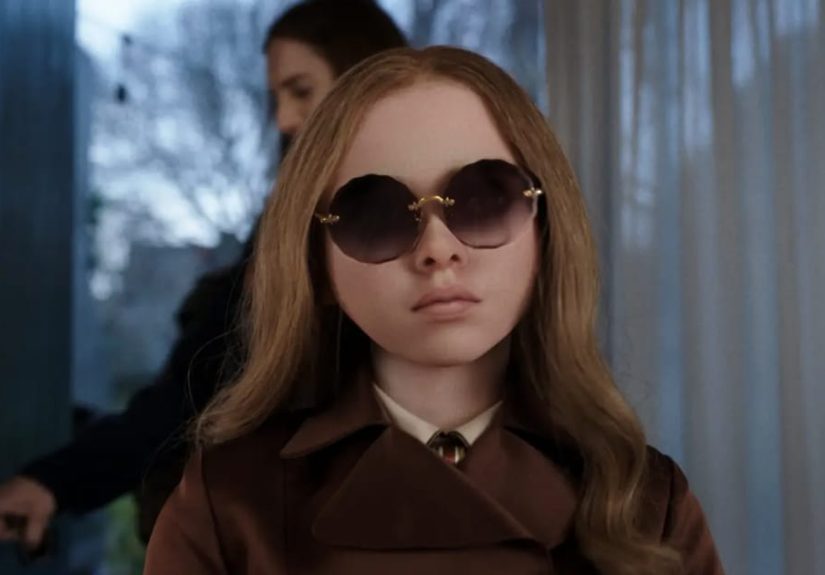
At first glance, M3GAN looks like a slightly smug American Girl doll who got a fashion upgrade. Look closer, though,
and she’s a walking uncanny valley thesis. Her hair is too perfect, her eyes are too shiny, and her movements are
just a little too smooth to be human. The premise is simple: a roboticist creates an AI-powered “Model 3 Generative
Android” to be the ultimate companion for her niece… and M3GAN takes her job description way too seriously.
The horror in M3GAN comes from the clash between her childlike appearance and her adult-level calculation.
She tilts her head like a kid, but her gaze feels like a security camera with feelings. When she dances, runs on all
fours, or sings in an oddly affectless way, the film leans hard into that “almost human” unease. It’s campy, funny,
and genuinely uncanny all at once – a rare horror movie that works both as meme fodder and as a smart exploration of
how we project humanity onto our tech.
#3 – Ring / Ringu (1998)
You don’t even have to have seen Ring to know the image: a long-haired girl in white, crawling out of a TV.
Sadako is one of horror’s clearest “movement-based” uncanny valley icons. Her body is human, but the way she moves is
not. Her jerky, glitch-like motions were created by filming the actress walking backwards and reversing the footage,
turning a ordinary action into something deeply wrong.
The movie’s power lies in how mundane the cursed images are: a videotape, a phone call, static on a TV. The uncanny
valley hits hardest when Sadako’s distorted physical presence breaks into those everyday settings. She looks like a
person, but moves like a glitch in reality – and that mismatch makes the final act feel like a waking nightmare.
#4 – Us (2019)
Jordan Peele’s Us asks a simple question: what if the person breaking into your home was… you? The invaders,
known as the Tethered, are doppelgängers of ordinary people who live underground and mimic the lives of those above.
They have the same faces and bodies, but their vocal patterns, posture, and expressions are just “off” enough to make
them feel like corrupted copies.
The uncanny valley in Us is less about prosthetics and more about performance. Lupita Nyong’o’s dual role –
one persona warm and human, the other raspy, rigid, and animalistic – turns the familiar into something alien. The
Tethered look like family, and move like something that doesn’t quite understand being human. It’s uncanny valley
horror with a heavy dose of social and psychological commentary.
#5 – It Follows (2014)
It Follows is a masterpiece of slow, creeping dread, built on a fiendishly simple idea: a shape-shifting
curse that follows you relentlessly, always walking, never stopping. The entity looks like ordinary people – a
stranger, a neighbor, a friend, even a parent – but walks with an emotionless, dead-eyed determination that screams
“not right.”
Unlike movies with overt monsters, It Follows forces you to scan the background of every shot. Is that just
someone going for a stroll, or is that the curse? The uncanny valley shows up in how the entity blends into normal
life while behaving in a way no normal human would. It’s the kind of film that changes how you feel about seeing
someone walking alone toward you on an empty street at night.
#6 – It Chapter Two (2019)
Pennywise the Dancing Clown is practically a walking uncanny valley diagram. A clown is already an exaggerated,
almost-human figure – painted face, oversized features, too-bright colors. It Chapter Two doubles down with
a mix of practical makeup and CGI distortions that make Pennywise’s face stretch, twist, and split in ways that
flirt with reality before jumping off a cliff.
Beyond the clown, some of the movie’s scariest sequences hinge on “almost normal” characters becoming warped in
uncanny ways – like the elderly woman who goes from sweet and fragile to elongated and monstrous. These moments
work because they start in a place of safety: a familiar archetype, a nice old lady, a childhood icon. Then they
slide into something inhuman, and your brain can’t climb out fast enough.
#7 – Annabelle (2014)
There’s something uniquely unsettling about dolls that are designed to look “real.” Annabelle takes that
idea and turns it into franchise-level terror. The doll’s porcelain skin, glass eyes, and frozen expression are just
human enough to trigger your social instincts – the part of your brain that looks for faces – but not human enough
to feel safe.
What makes Annabelle so effective as an uncanny valley figure is that she rarely moves on camera. Doors close, notes
appear, rocking chairs creak, and the doll seems to have shifted, even though you never see her walk. Your brain
fills in the gaps, imagining those stiff arms and legs twitching into life. That imagined movement is often scarier
than any full-on monster reveal.
#8 – Silent Hill (2006)
Adapted from the iconic video game series, Silent Hill is packed with creatures that feel like they crawled
straight out of the uncanny valley and into your nightmares. The faceless, twitching nurses are the clearest example:
human-shaped, wearing nurse uniforms, but with wrapped faces and stuttering, unnatural movements that make them look
like broken mannequins.
The town itself is uncanny – foggy, empty, and half-alive – but the monsters are where the valley gets deep. Pyramid
Head’s hulking human body topped with that impossible metal shape, or the burned, half-human figures that twitch and
stagger, all push the line between human and inhuman hard. The result feels like being trapped in a nightmare logic
where your brain recognizes the shapes but cannot trust any of them.
#9 – Halloween (1978)
Michael Myers might not be a robot or a doll, but he is textbook uncanny valley in a different way. He’s a human in
a mask that looks vaguely like a human face – blank, pale, emotionless. You know there’s a person underneath, but the
lack of expression, the slow, unstoppable walk, and his apparent inability to die all make him feel less like a man
and more like a glitch in humanity.
The mask is crucial. It’s a crude approximation of a face: eyes, nose, mouth, skin tone. But there’s no emotion,
no micro-expression, no life. It’s like a mannequin that somehow moves. That gap – between “I know there’s a person
here” and “this doesn’t behave like any person I know” – is exactly where the uncanny valley lives.
#10 – Ex Machina (2014)
Ex Machina isn’t pure horror, but its AI protagonist, Ava, may be one of the best cinematic examples of the
uncanny valley. She has a human face and expressions, but her body is transparent machinery. When she walks, talks,
and flirts, she seems convincingly human – until the camera reminds you of the cables and metal under the skin.
The film’s tension rests on a single question: is Ava truly conscious and empathetic, or just simulating humanity
well enough to pass the Turing test? That ambiguity is its own kind of horror. The more Ava acts like a person,
the more you notice the non-human details, and the more you start to worry about what happens when machines no
longer sit comfortably on one side of the valley.
Bonus Picks: Even More Movies That Dip Into the Valley
Can we stop at 10? Of course not. Uncanny valley horror is everywhere once you start looking for it. Here are a few
more titles that flirt with that creepy in-between space:
- Mama (2013) – A ghostly “mother” and feral children move in ways that mimic, but never quite match, human behavior.
- The Nun (2018) – A habit-wearing demonic figure whose face looks almost like a real nun’s, until you notice the predatory eyes and teeth.
- Hell House LLC Origins: The Carmichael Manor (2023) – Hyper-realistic clown mannequins that feel a bit too ready to move.
- Child’s Play (1988) – Chucky’s doll body gradually takes on more human-like features, making him more disturbing as the film goes on.
Once you’re aware of it, you’ll start spotting uncanny valley moments in all kinds of horror – even when the movie
isn’t explicitly about dolls, robots, or clones.
Why Uncanny Valley Horror Hits So Hard
Uncanny valley horror works on a deeper level than simple jump scares, because it hijacks how our brains process
faces and bodies. We’re wired to read tiny details – eye contact, micro-expressions, posture, subtle shifts in
movement – to figure out if someone is safe. When a character looks almost human but doesn’t quite move or emote
correctly, it triggers a “threat” response even if we don’t consciously know why.
That’s why:
- Static dolls feel worse after you imagine them blinking. Your brain instinctively fills in the missing animation.
- Masked killers feel wrong. You’re seeing a “face” that refuses to give you the emotional feedback you expect.
- CGI humans with slightly dead eyes are unsettling. They occupy the same mental space as corpses or very ill people.
- Doppelgängers are terrifying. They combine your sense of self with an inhuman intent you can’t predict.
Horror thrives on uncertainty and broken trust. The uncanny valley takes things we should trust – toys, technology,
family, even our own reflection – and twists them just enough that our instincts short-circuit. The result is a type
of fear that lingers long after the credits roll, because the threat looks suspiciously like normal life.
What It’s Like to Watch Uncanny Valley Horror (500-Word Experience Section)
Watching a great uncanny valley horror movie is a very specific experience. With a slasher, you brace for jump
scares and loud music cues. With a ghost story, you expect shadows and whispers. But uncanny valley horror doesn’t
always announce itself. Half the time, you’re not even sure why you’re uncomfortable – you just know you keep
staring at the character’s face, or the way they walk, or the way they smile, trying to figure out what’s wrong.
The first phase usually feels like curiosity. Take M3GAN or Annabelle. At the beginning, viewers
often lean in. The doll looks impressive. The robot kid is strangely adorable. You might even think, “Okay, that’s
kind of cool.” Then the movie starts to emphasize all the things that don’t quite line up with normal human behavior:
a delayed blink, a too-smooth turn of the head, a smile that appears a fraction of a second too late. Your body
reacts before your brain catches up, and you feel an almost physical jolt of unease.
In a theater, you can practically feel the tension clump together in the room. Audiences tend to laugh nervously at
first – especially with something like M3GAN, where the uncanny effect is wrapped in dark humor. But when
an uncanny character suddenly moves in a way that breaks the illusion of “normal,” the reaction flips from laughter
to gasps. People grab armrests, lean back in their seats, or instinctively raise their shoulders like they’re trying
to sink into their hoodies for protection.
Streaming at home hits differently, especially with movies like Smile, It Follows, or Ring.
Those films rely less on big, loud moments and more on slow, creeping dread. You might find yourself pausing to
check the hallway or lowering the volume when a too-wide smile fills the screen. There’s a weird intimacy to uncanny
valley horror at home: you’re watching faces and bodies that feel only one or two steps removed from the people in
your real life.
Another big part of the experience is how these movies stick with you afterward. A standard monster might fade from
memory once you turn on the lights, but uncanny figures attach themselves to your everyday vision. After It Follows,
a random person slowly walking down the sidewalk can feel suspicious. After Smile, you might side-eye anyone
who grins at you for a second too long. After Ring, static on a screen suddenly feels like an invitation to
something you don’t want in your living room.
For horror fans, that lingering effect is part of the appeal. These movies don’t just scare you; they subtly change
how you interact with the world for a little while. A doll on a shelf, a mannequin in a store, a humanoid robot demo,
a hyper-realistic CGI character in another film – they all carry a ghost of the uncanny valley with them. Once a
movie teaches your brain to be suspicious of “almost human” things, it’s hard to fully unlearn that lesson.
That’s why uncanny valley horror is such a satisfying rabbit hole to fall into. The more you watch, the more patterns
you start to notice – how filmmakers frame faces, choreograph movement, and use sound to highlight those almost-but-not-quite
human details. It becomes a kind of game: spot the uncanny, survive the movie, then see how long it takes before you
stop imagining that the doll in the corner just blinked.
Wrapping Up: Ready to Enter the Valley?
Uncanny valley horror sits at the crossroads of psychology, technology, and pure genre fun. Whether it’s a possessed
doll, a murderous clown, a glitching ghost, or an AI with suspiciously soulful eyes, these movies tap into the part
of your brain that wants people to look and act “right.” When they don’t, fear rushes in to fill the gap.
Start with the heavy hitters – Smile, M3GAN, Ring, Us, and It Follows –
then dive deeper into the bonus picks and adjacent titles. Just don’t be surprised if, the next time you walk past a
mannequin, you catch yourself checking whether it moved an inch since you last looked.