Table of Contents >> Show >> Hide
- What Counts as a “Space Drill,” Anyway?
- Meet the Pistol Grip Tool: NASA’s Bolt-Turning Celebrity
- How the PGT Became the Spacewalk Workhorse
- “Won’t the Astronaut Spin?” Torque Reaction in Microgravity
- What Astronauts Actually Use the PGT For on the ISS
- Under the Hood: What Makes the PGT “Space-Rated”
- Before the ISS: Apollo’s Lunar Surface Drill
- Orbit vs. Moon: Same Word “Drill,” Totally Different Problems
- Training: You Don’t “Wing It” With a Space Drill
- What’s Next: Drills for Artemis and Future EVAs
- Conclusion
- Astronaut Experiences: Life With the Space Drill (Extended Add-On)
- The Suit Turns Every Bolt Into a Workout
- “Where Did My Tool Go?” The Comedy of Floating Objects
- The “Break Torque” Moment Feels Like a Tiny Victory
- Mission Control Is Basically Your Shop Foreman (With Better Coffee)
- Training Memories: Underwater Drills for a Vacuum Job
- The Emotional Weirdness of Doing “Normal Work” in an Unreal Place
If you’ve ever tried to tighten a stubborn screw under your kitchen sink, you already understand about 12% of spacewalking. The other 88% is doing it in a pressurized suit, in a vacuum, while your “workbench” is a $100+ billion space station and the penalty for dropping a tool is… well, watching it become the world’s most expensive piece of space junk.
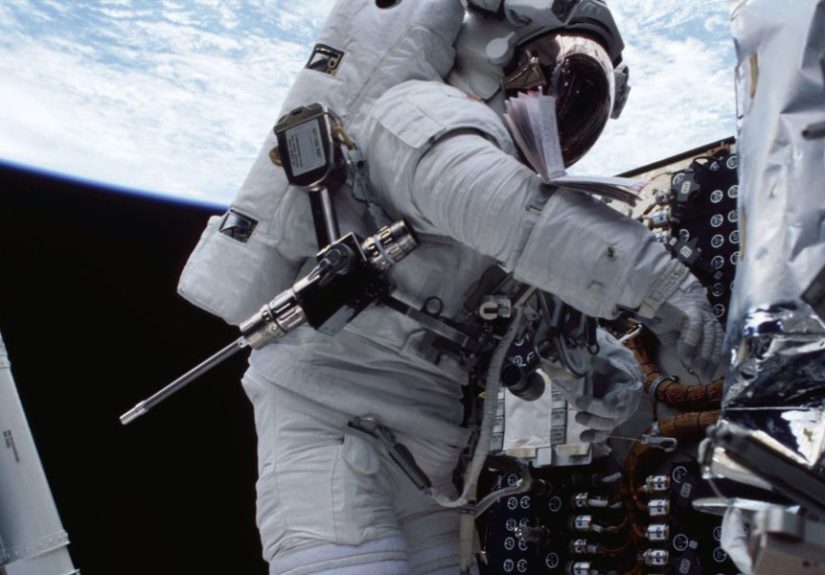
So when people ask about “the space drill used by NASA astronauts,” they’re usually talking about one legendary workhorse: the Pistol Grip Tool (PGT). It looks like a rugged cordless drill’s overachieving cousin, but it’s really a precision, computer-controlled torque machine built for spacewalks (EVAs), satellite servicing, and the kind of bolt-turning that keeps the International Space Station (ISS) alive and humming.
In this deep dive, we’ll unpack what the PGT is, why it exists, how astronauts keep from becoming human propellers when it kicks, and how NASA’s “space drill” story stretches all the way back to Apollo’s lunar surface drills. Along the way: real spacewalk examples, engineering tradeoffs, and a few moments where the universe reminds everyone that even a bolt can have an attitude.
What Counts as a “Space Drill,” Anyway?
On Earth, “drill” usually means “make hole.” In orbit, “drill” often means “turn fasteners accurately, repeatedly, and without drama.” NASA uses both kinds, but the phrase space drill used by NASA astronauts most commonly points to the EVA tool that drives bolts on the outside of spacecraft:
- The Pistol Grip Tool (PGT): the iconic astronaut “space drill” for spacewalksused to loosen, tighten, and torque bolts on ISS hardware and during Hubble servicing.
- Lunar surface drills: Apollo-era rotary-percussive drills used on the Moon to collect deep core samples and place instruments (a different environment, a different kind of drilling headache).
The rest of this article focuses on the PGT as the main character, with a cameo (okay, more like a supporting role) from the Apollo Lunar Surface Drillbecause NASA doesn’t do “simple tools.” NASA does “tools that become history.”
Meet the Pistol Grip Tool: NASA’s Bolt-Turning Celebrity
A Drill Look, a Machine-Tool Brain
The PGT is best described as a battery-powered, computer-controlled hand tool with a 3/8-inch drivemeaning it can take sockets and extensions like a ratchet, but it can also act like a powered driver. The key difference from your garage drill is not raw speed. It’s control.
Space hardware is full of critical fastenersbolts holding panels, electronics boxes, cameras, pumps, solar-array components, and “orbital replacement units” (ORUs). Many of these interfaces need very specific torque values and turn counts. Too loose and it can vibrate, leak, or fail. Too tight and you can strip threads, crush seals, or ruin an expensive day.
Programmable Torque, Speed, and Turns (Because Space Hates Surprises)
Astronauts can set the PGT to apply a chosen torque limit, a chosen speed, and a chosen number of turns. Think of it like a drill that’s also a rule-followerone that won’t “just send it” because you got impatient.
Public NASA fact sheets and mission documentation have described ranges like:
- Motorized torque in selectable bands (commonly cited as roughly a few to a couple dozen foot-pounds).
- Manual mode torque higher than motorized, used when astronauts need extra muscle (but still want control).
- Speed that’s deliberately modestmore “precision driver” than “construction-site screamer.”
- Turn limits so a bolt doesn’t accidentally get spun into infinity (or until something snaps).
This is why the PGT is sometimes called a “space drill” and sometimes a “bolt turner.” It’s not trying to be the fastest tool. It’s trying to be the safest one.
Designed for Gloves, Vacuum, and Bad Angles
The PGT has to work while an astronaut’s hands are inside thick pressurized gloves that fight every finger movement. Controls must be large enough to manipulate, feedback must be visible in bright sunlight or deep shadow, and the tool must tolerate temperature swings as astronauts move between sunlit and shaded surfaces.
Also: nobody in orbit wants a tool that off-gasses weird fumes, sheds particles, or decides to become brittle at the worst possible moment. The PGT is built with space-rated materials and a “weirdly practical” aesthetic: robust housing, clear display, and a form factor that’s easy to secure and stow.
How the PGT Became the Spacewalk Workhorse
Hubble: The Origin Story With Real Stakes
One of the most famous chapters in astronaut tool history is servicing the Hubble Space Telescope. Hubble was designed to be serviced in orbit, but doing that meant astronauts needed tools that could safely and reliably open panels, remove fasteners, and install new hardwarewhile free-floating hundreds of miles above Earth.
NASA has credited the PGT as a major tool development from the Hubble servicing era, and it later became a standard EVA tool used beyond Hubbleespecially as the ISS grew into a sprawling mechanical and electrical ecosystem that demands constant maintenance.
Why NASA Didn’t Just Buy a Hardware-Store Drill
A consumer drill is designed for Earth: convection cooling, normal pressure, human hands with full dexterity, and gravity providing stability. In space, you lose most of that. If a drill stalls or jerks, the astronaut can twist, drift, or lose contact with the worksite. If torque is uncontrolled, fasteners can be overdriven. If the tool is too fast, it can strip threads before anyone can react.
The PGT is more like a compact, programmable industrial driver than a typical cordless drill. That’s not a flexit’s a safety requirement disguised as engineering.
“Won’t the Astronaut Spin?” Torque Reaction in Microgravity
Let’s address the most common mental image: astronaut squeezes trigger, immediately pinwheels into the void like a confused sprinkler head.
In theory, torque reaction is real. Newton is undefeated. If the tool applies torque to a bolt, an equal and opposite torque tries to twist the astronaut and tool housing the other way.
So Why Don’t Spacewalkers Become Human Fidget Spinners?
Because NASA plans for torque like a chess player plans for checkmate:
- Body restraint: Astronauts often anchor themselves using foot restraints, handrails, tethers, or robotic arm platforms so their body can resist torque without drifting.
- Tool settings: The PGT’s controlled speed and programmable torque limits help prevent sudden “kick” moments.
- Procedure: EVAs use step-by-step checklistsoften including “break torque” and “run torque” phasesto reduce surprises.
- Technique: Astronauts brace with elbows, use two-handed control when possible, and align their body with the axis of the fastener to keep forces predictable.
In short: the PGT is safe partly because it is smart, and partly because the astronaut operating it is literally strapped in and trained like a space mechanic in a physics-themed escape room.
What Astronauts Actually Use the PGT For on the ISS
The ISS is a giant, modular machine with components that age, wear, and occasionally decide to misbehave right on schedule. During spacewalks, astronauts use the PGT to remove and install bolts that secure major replaceable hardware.
Common Jobs for the “ISS Spacewalk Drill”
- Swapping ORUs: electronics boxes, camera units, pumps, and other external systems mounted on trusses.
- Solar array work: installing brackets, modification kits, and hardware used for power upgrades.
- External inspections and repairs: loosening covers, accessing panels, and securing new components.
Spacewalk coverage has repeatedly noted astronauts using the pistol grip tool to loosen bolts holding hardware in placeoften as part of battery upgrades, solar array modifications, or equipment swaps. The point isn’t that the tool is flashy; it’s that it’s dependable enough to be routine. In spaceflight, “routine” is the highest compliment.
When a Bolt Doesn’t Want to Cooperate
Not every fastener reads the memo. Sometimes a bolt runs in smoothly… and one decides it’s the main character. In at least one spacewalk story, three bolts behaved and the fourth refused to cooperateleading mission control to weigh risk, evaluate the integrity of the installation, and decide whether “good enough” is actually good enough.
This is where the PGT’s controlled approach matters. When a bolt feels wrong, the crew can stop, back it out, reassess, and consult the ground. In orbit, patience isn’t just a virtue. It’s a tool.
Under the Hood: What Makes the PGT “Space-Rated”
Power, Batteries, and Thermal Reality
The PGT runs on a rechargeable battery pack designed for EVA conditions. Batteries in space experience temperature extremes, and their performance can shift depending on how warm or cold they get. NASA hardware choices tend to be conservative for a reason: an EVA battery failure isn’t “annoying,” it’s “mission-impacting.”
The tool also needs to reject heat without normal air convection. That affects everything from motor performance to electronics packaging to how long it can run continuously.
A Display You Can Read While the Sun Is Trying to Blind You
Earth tools assume you can squint, tilt your head, and maybe take your glove off (please don’t) if you need fine control. EVA tools assume none of that. The PGT’s interface is built so astronauts can confirm settings and status quicklybecause outside the station, you want fewer “wait, what mode is this in?” moments.
Modularity and Compatibility
Another quiet superpower is how the PGT works with a family of EVA sockets, extensions, and adapters. It’s part of a whole ecosystem: tool stowage, tethers, “don’t let it float away” rules, and procedures tuned for specific tasks. On orbit, the “space drill” is never alone. It travels with a support cast.
Before the ISS: Apollo’s Lunar Surface Drill
If the PGT is NASA’s most famous orbital drill-like tool, the Apollo program’s drilling legacy is the most famous surface one.
Why Apollo Astronauts Needed a Drill on the Moon
Apollo wasn’t just about footprints. It was a science expedition. Astronauts drilled into lunar regolith to:
- Collect deep core samples that preserved layers of lunar history.
- Emplace heat flow probes to measure thermal properties below the surface.
The Apollo Lunar Surface Drill system was battery-operated and designed to work in the Moon’s environmentlow gravity, vacuum, abrasive dust, and a surface that can be both fluffy and deceptively resistant depending on depth and local conditions.
Rotary-Percussive Drilling: Spin + Hammer
Apollo deep drilling used a rotary-percussive approachmeaning it combined rotation with a hammering action to help break and penetrate compacted material. That percussive element matters when the surface isn’t behaving like a neat, uniform sandbox.
Apollo’s drilling experience proved deep drilling was possible, but it wasn’t always easy. Extracting the drill stem could be difficult, and operations had to be designed around the realities of a suited astronaut doing physical work in a hostile environment.
Orbit vs. Moon: Same Word “Drill,” Totally Different Problems
In Orbit (PGT World)
- Main task: drive bolts and fasteners on spacecraft structures.
- Main enemy: torque reaction, limited body control, thermal cycling, and complex hardware interfaces.
- Big win: programmabilityset torque, speed, turns; reduce the chance of overdriving a fastener.
On the Moon (Apollo Drill World)
- Main task: penetrate regolith and pull up a clean, meaningful core.
- Main enemy: abrasive dust, variable soil density, extraction difficulty, and limited EVA time/energy.
- Big win: rotary-percussive drilling that can handle compacted layers.
Both environments force the same core lesson: astronaut tools must be predictable, rugged, and designed around the human inside the suit.
Training: You Don’t “Wing It” With a Space Drill
Astronauts train EVA tool use with obsessive realismbecause the real thing doesn’t offer refunds. They rehearse tasks in underwater facilities that simulate neutral buoyancy, practice with flight-like mockups, and drill (yes, pun intended) the sequence of settings and steps until muscle memory kicks in.
Why? Because tool work outside a spacecraft is never just “turn a bolt.” It’s “turn a bolt while staying anchored, managing tether routing, watching your suit constraints, protecting delicate surfaces, avoiding contamination, and communicating with mission control in real time.” Easy!
What’s Next: Drills for Artemis and Future EVAs
As NASA plans more ambitious explorationespecially surface work where astronauts will sample, drill, and deploy instruments tool design keeps evolving. Future EVA concepts discuss powered and manual sample acquisition tools, dust mitigation, and workflows that reduce astronaut fatigue. The goal is the same as it’s always been: keep the human safe, make the work repeatable, and design for reality rather than wishful thinking.
Conclusion
The “space drill used by NASA astronauts” isn’t just a cool gadgetit’s a symbol of how spaceflight turns ordinary human tasks into precision engineering challenges. The Pistol Grip Tool looks familiar because it borrows a language we understand: handle, trigger, bit, fastener. But under that familiar silhouette is a tool shaped by vacuum, gloves, torque physics, and unforgiving consequences.
Whether it’s tightening bolts on the ISS, enabling delicate work on Hubble, or echoing the legacy of Apollo’s lunar drilling, NASA’s drill story is really a story about control. In space, power is easy. Control is everything.
Astronaut Experiences: Life With the Space Drill (Extended Add-On)
Let’s talk about the part that spec sheets can’t fully capture: what it’s like to use a space drill while wearing a spacesuit that behaves like a stubborn inflatable couch.
The Suit Turns Every Bolt Into a Workout
Astronauts often describe EVA work as physically demanding in a way that surprises people. Not because they’re lifting heavy things (microgravity handles that), but because the suit resists motion. Your hands are fighting glove pressure, your arms are working against stiffness, and every movement costs energy. Now add a tool that applies torque and requires careful alignment.
On Earth, you might casually hold a driver with fingertips and feel the fastener “seat.” In a suit, “fingertips” is mostly a concept from your past life. Astronauts must rely on body positioning, visual cues, and deliberate movementsalmost like operating a precision tool while wearing mittens made of engineering.
“Where Did My Tool Go?” The Comedy of Floating Objects
Inside the station, a tool can drift away if it’s not secured. Outside, it can drift away forever if it’s not tethered. That’s why EVA life is full of tether management and tool discipline. Astronauts secure the PGT to themselves or to the worksite and treat it like a living creature that will absolutely escape the moment you stop paying attention.
It’s not paranoiait’s physics. You can’t just set a tool down on a ledge and assume it’ll stay. There’s no “down.” There’s only “still attached” and “goodbye, sweet prince.”
The “Break Torque” Moment Feels Like a Tiny Victory
EVA procedures often include deliberately “breaking torque” firstovercoming the initial resistance of a fastener that’s been sitting outside in thermal cycles, vibration, and time. Astronauts have described these moments as oddly satisfying: everything is aligned, the tool is set, the body is braced, and thenfinallythe bolt gives. It’s a small click in a huge silence, a mechanical confirmation that the plan is working.
But when the bolt doesn’t give, that’s when experience matters. Astronauts may back off, re-seat the socket, adjust body position, confirm settings, and consult the ground. This isn’t “struggle until it works.” It’s controlled troubleshooting, because forcing hardware in space can break things that are not replaceable on the timeline you’d like.
Mission Control Is Basically Your Shop Foreman (With Better Coffee)
During an EVA, astronauts are in constant communication with teams on the ground who track timelines, procedures, and tool settings. One astronaut might be holding position while the other drives bolts; both are listening to calls from mission control about what to do next. It can sound calm on the broadcast, but it’s a carefully managed dance: the crew describes what they see and feel, the ground compares it to expected behavior, and together they decide whether to continue, adjust, or stop.
That teamwork shows up most clearly when something is “almost” rightlike a bolt that won’t fully seat, a component that’s slightly misaligned, or hardware that behaves differently than it did in training. Astronauts have joked on comms, celebrated small wins, and narrated their progress in a way that reveals the human side of a very technical job. It’s not a solo hero moment; it’s a collaboration between the person holding the tool and the people who designed, tested, and planned every move.
Training Memories: Underwater Drills for a Vacuum Job
Many astronauts spend countless hours rehearsing EVA tasks underwater. The neutral buoyancy environment is not a perfect match for spacewater adds drag, and motion feels differentbut it forces the same kind of careful choreography: where to place the body, how to approach a worksite, how to control a tool with limited dexterity, and how to manage the sequence without dropping anything.
Astronauts have noted that the real EVA often feels smoother than the pool in some ways (less drag), but also more intense in others (temperature extremes, lighting, and the knowledge that you’re not in a training facility). The PGT becomes a familiar object through repetition: the grip, the display, the feel of the trigger, the rhythm of engaging a fastener and watching it respond.
The Emotional Weirdness of Doing “Normal Work” in an Unreal Place
Perhaps the most striking experience astronauts describe is the contrast: you’re doing something ordinarytightening bolts while Earth rolls beneath you and the station structure stretches like a metallic city. The PGT is a reminder that space exploration isn’t only about rockets and grand speeches. It’s also about maintenance, reliability, and the unglamorous miracles of good engineering.
And when the job goes well, the satisfaction is deeply practical: a component is secure, a system is restored, and the spacecraft continues doing what it was built to do. In space, that’s not just “fixing something.” That’s keeping the future on schedule.