Table of Contents >> Show >> Hide
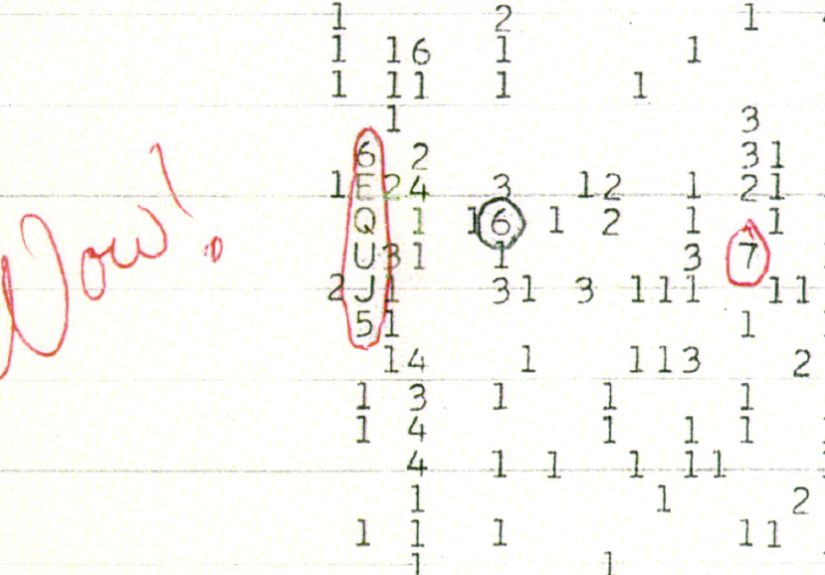
Every field has that one mystery it keeps in a glass case and whispers about. In astronomy and the search for extraterrestrial intelligence, that mystery is the Wow! Signal. It was not a spaceship landing on the White House lawn. It was not a dramatic transmission saying, “Greetings, Earthlings.” It was a brief, powerful radio signal detected in 1977 by Ohio State University’s Big Ear telescope, scribbled over by astronomer Jerry Ehman with one unforgettable reaction: “Wow!”
That handwritten word turned a line of data into one of the most famous scientific cliffhangers ever recorded. Decades later, the signal still sits in the strange middle ground between hard science and cosmic folklore. It is not proof of aliens. It is not proof there are no aliens, either. It is, instead, the kind of puzzle scientists both love and mildly lose sleep over: an event that looked interesting, arrived at exactly the sort of frequency researchers cared about, and then vanished like a party guest who drops one perfect line and leaves before anyone gets their name.
To understand why the Wow! Signal still matters, you have to zoom out. It is not just a story about one mysterious burst from the sky. It is also a story about SETI, radio telescopes, scientific patience, failed follow-ups, clever ideas about interstellar communication, and humanity’s ongoing attempt to answer the biggest question of all: Are we alone?
What Was the Wow! Signal?
The Wow! Signal was detected on August 15, 1977, by the Big Ear radio telescope in Ohio during a routine sky survey. Big Ear was not a Hollywood-style silver dish dramatically swiveling under moonlight. It was a huge, practical instrument designed to scan the sky for narrowband radio signals, which are especially interesting because nature usually produces radio emissions spread across a broader range of frequencies. In plain English, a narrowband signal can look more like technology than like random cosmic static.
When Jerry Ehman reviewed the printout, one sequence jumped off the page: 6EQUJ5. Those characters represented a sudden spike in signal intensity. The signal also appeared near the hydrogen-line region around 1,420 megahertz, a frequency long considered attractive for interstellar communication. Why? Because hydrogen is the most abundant element in the universe. If intelligent civilizations wanted to pick a natural “meeting point” on the radio dial, this would be a sensible place to start. Cosmic Wi-Fi etiquette, if you will.
What made the signal even more intriguing was the way it rose and fell in strength. That pattern matched what researchers would expect if a fixed source in space drifted through the telescope’s beam as Earth rotated. In other words, it did not behave like an obvious local interference source, such as a nearby transmitter, random electronics, or a badly behaved piece of human technology having a chaotic little meltdown.
And yet the case for extraterrestrial intelligence never became airtight. The reason is painfully simple: the signal never repeated. Scientists searched again. Other telescopes searched. Later generations of instruments, far more capable than Big Ear, kept listening. The skies remained stubbornly quiet. A signal that only appears once is scientifically fascinating, but it is also deeply annoying. Science loves repeatability. The Wow! Signal offered charisma instead.
Why the Wow! Signal Became So Famous
The Wow! Signal became legendary because it checks so many boxes at once. It was strong. It was narrowband. It appeared where SETI researchers expected a potentially meaningful transmission might show up. It was recorded by a real scientific instrument during a real observational program. And the human response to it was perfect. Had Jerry Ehman written “Mildly Unusual,” this story might have died a quiet death in a filing cabinet.
There is also something emotionally irresistible about the signal. It was not a blurry photo or a secondhand story from a guy who swears he saw something weird near a cornfield. It was data. Cold, technical, stubborn data. That makes the mystery more durable. People can roll their eyes at alien tabloid headlines, but a strange signal captured by astronomers in the course of legitimate research is harder to shrug off.
Still, serious scientists have always treated the signal with caution. “Interesting” is not the same as “confirmed.” In SETI, the bar has to be brutally high because the universe is noisy, Earth is noisier, and our own technology is constantly trying to sabotage our dignity. A candidate signal must survive repeated checks, cross-observatory verification, and careful elimination of terrestrial interference before anyone gets to pop open the cosmic champagne.
The Bigger Story: What SETI Is Really Trying to Do
SETI is often caricatured as people sitting in dark rooms waiting for aliens to call. The real picture is more disciplined and much more interesting. SETI is a scientific effort to search for technosignatures, signs of technology produced by an intelligent civilization. That can include radio transmissions, optical pulses, or other detectable traces of advanced activity. The underlying idea is wonderfully simple: if physics is the same everywhere, another civilization might use some of the same tools we would use to communicate across space.
From Project Ozma to the Drake Equation
The modern scientific search for alien intelligence is usually traced back to Project Ozma in 1960. Led by Frank Drake at Green Bank, it was the first serious, scientific radio search for signals from nearby stars. Project Ozma did not detect aliens. What it did detect was a new scientific attitude: this question was testable. You did not have to leave it entirely to philosophers, science fiction writers, or your uncle at Thanksgiving.
A year later, Drake introduced the famous Drake Equation, a framework for thinking about how many detectable civilizations might exist in the Milky Way. The equation was never meant to spit out one magical final answer. It was a way to organize uncertainty. How often do stars form? How many have planets? How many planets could support life? How often does intelligent life arise? How long do technological civilizations last? Ask those questions together and you get not certainty, but a roadmap.
This shift mattered enormously. SETI stopped being just a romantic idea and became a structured scientific program. You could design instruments, define search strategies, argue over frequencies, improve data processing, and test assumptions. In other words, the search grew up.
The Water Hole, Arecibo, and Humanity’s Side of the Conversation
Early SETI research focused heavily on the so-called water hole, the relatively quiet radio region between the hydrogen and hydroxyl lines. Because hydrogen plus hydroxyl gives you water, the name stuck, and the metaphor was irresistible: a quiet place where galactic civilizations might gather. Scientists are not immune to good branding.
Meanwhile, humans also flirted with the idea of sending messages, not just listening for them. In 1974, the Arecibo message was transmitted from Puerto Rico as a demonstration of the telescope’s power. It was more symbolic than practical, more cosmic postcard than serious conversation starter. The Voyager Golden Record, launched in 1977, carried another kind of message into the dark: sounds, images, and music intended as a portrait of Earth for any intelligence that might someday find it.
These efforts reveal something important about the search for extraterrestrial intelligence: it is not only about finding others. It also forces us to decide how we would describe ourselves. That can get awkward quickly. Do we send Bach? Whale songs? Highway traffic? A recipe for brownies? Humanity contains multitudes, and not all of them are equally flattering.
NASA, Project Phoenix, and the Modern Era
NASA gradually became involved in SETI-related work and launched a more formal program in 1992. Less than a year later, Congress canceled it. The search, however, did not die. It pivoted. Private funding and nonprofit organizations kept the work alive, including the SETI Institute’s Project Phoenix, which ran from 1995 to 2004 and became one of the most sensitive and comprehensive searches of its time.
Today, SETI is broader than many people realize. NASA now talks more explicitly about technosignatures, reflecting the idea that intelligent life might reveal itself in ways beyond traditional radio beacons. At the same time, large-scale programs such as Breakthrough Listen have pushed the field forward with enormous data sets, broad surveys, and more computing power than earlier generations could dream of. Breakthrough Listen’s scope is massive, including a survey of the one million stars nearest Earth, the galactic center, the galactic plane, and even nearby galaxies.
That matters because the old stereotype of SETI as a fringe hobby is badly outdated. Modern SETI is computationally sophisticated, methodologically cautious, and increasingly connected to mainstream astronomy. It shares tools with exoplanet science, signal processing, machine learning, and observational astrophysics. The field is still bold, but it is not sloppy.
So, Was the Wow! Signal Aliens?
The honest answer is the least dramatic one: we do not know. That uncertainty is not a weakness. It is the entire point of doing science carefully. The signal remains unexplained, but unexplained is not the same as extraterrestrial. Over the years, researchers have proposed terrestrial interference, space-based reflections, comet-related ideas, and other natural explanations. None has settled the case in a way that satisfies everyone.
More recently, scientists have explored whether the signal might have been caused by a natural astrophysical event involving neutral hydrogen and a powerful transient trigger, possibly something like a magnetar-related outburst. This idea is interesting because it treats the Wow! Signal not as a one-off alien hello, but as a rare natural phenomenon that only happened to resemble what SETI researchers were looking for. It is a clever hypothesis, but not a final verdict.
That is why the Wow! Signal still haunts the field in the best possible way. It teaches humility. It reminds researchers that extraordinary signals deserve extraordinary follow-up. It also highlights how much better modern searches are designed. Real-time processing, multi-station verification, better filtering of interference, and faster response systems all reduce the odds that the next “wow” moment will remain stuck in mystery for half a century.
Why the Search Still Makes Sense
Some critics argue that SETI is too uncertain, too speculative, or too likely to end in silence. But that criticism misses the point. The search for extraterrestrial intelligence is not reckless guessing. It is a measured exploration of one of the most important open questions in science. Even a null result tells us something about the rarity, behavior, or detectability of technological civilizations.
SETI also produces useful side benefits. It advances signal-processing methods, improves radio astronomy tools, encourages careful thinking about interference, and pushes scientists to define what counts as evidence. It sharpens our understanding of our own technological footprint as well. After all, if we wonder what alien technosignatures might look like, we also have to ask what Earth looks like from far away.
And if a real signal is ever confirmed, the intellectual and cultural consequences would be staggering. It would instantly become one of the most important discoveries in human history. Compared with that possibility, spending serious time listening to the sky seems not only reasonable but almost embarrassingly sensible.
The Human Experience of Listening for the Sky
For all the equations, receivers, and spectral analyses, the story of the Wow! Signal is also a story about human experience. The public usually meets SETI through giant ideas: aliens, contact, civilizations, the fate of humanity. But on the ground, the experience is often quieter. It lives in observatories, control rooms, computer logs, late-night monitoring sessions, and the strange emotional weather that comes from spending your life listening for something that may never answer.
Imagine what that kind of work feels like. You are not chasing explosions or dramatic celestial collisions. You are watching for anomalies that might be tiny, narrow, and easy to miss. You sit with static, with repetition, with long stretches of nothing. Most days, the universe behaves like a very polite houseguest and offers absolutely no plot twists. Then one day, a line of data looks different. Not fireworks-different. Spreadsheet-different. And yet your pulse jumps anyway.
That is part of what makes the Wow! Signal so enduring. It captures the emotional whiplash of SETI in a single moment. One minute, you are reviewing printouts. The next, you are staring at something that appears to be exactly the sort of signal people have been theorizing about. Not proof, not certainty, not a flying saucer doing donuts over Ohio, but enough to crack open the imagination. Enough to make a scientist write one astonished word in red ink. Enough to make generations of readers, listeners, and researchers lean forward.
There is also the experience of disappointment, which is far less glamorous but just as real. The next observation does not confirm it. The follow-up searches come up empty. Better telescopes listen and hear nothing. What do you do with that? In SETI, you learn to live with unresolved tension. You learn that an exciting candidate is not a discovery. You learn that silence after a promising signal can be as scientifically meaningful as the signal itself. You also learn not to fall in love too quickly with your favorite explanation, because the universe has a talent for humiliating confident people.
For the public, the experience is different but related. The Wow! Signal gives ordinary people a doorway into astronomy that feels personal. You do not need advanced training to understand why it matters. A strange signal came from space. We do not know what caused it. We kept listening. That narrative is simple, but it lands hard because it touches a deep human instinct: the hope that we are part of a bigger story. The signal turns the sky from scenery into possibility.
There is also something unexpectedly moving about the physical places tied to this history. Green Bank, with its radio-quiet culture. Arecibo, which for decades symbolized both listening and speaking. Big Ear, which no longer stands, but still echoes in scientific memory. These places remind us that the search for extraterrestrial intelligence is not abstract. It is built by real people in real places using machines designed, funded, repaired, upgraded, and argued over by generations of researchers. Cosmic wonder runs on cables, budgets, coffee, and patience.
And then there is the experience of perspective. SETI has a way of shrinking human ego while enlarging human ambition. You look up and confront distances so vast that everyday complaints start to feel delightfully small. At the same time, you realize our species is capable of asking astonishing questions and building instruments to pursue them. That combination of humility and boldness may be the most beautiful thing about the whole enterprise. We are tiny, yes. We are also listening.
In that sense, the Wow! Signal is more than an unsolved radio event. It is a symbol of the emotional life of science itself: curiosity without guarantees, wonder without surrendering rigor, hope balanced by skepticism. It reminds us that discovery is not always a neat, triumphant march. Sometimes it is a scribble in the margin, a mystery that refuses to leave, and a half-century of people deciding that the question is still worth asking.
Conclusion
The Wow! Signal remains one of the most compelling mysteries in the history of the search for extraterrestrial intelligence. It was not confirmed as a message from aliens, but it also was not neatly explained away. That unresolved status is exactly why it continues to matter. The signal stands at the crossroads of astronomy, skepticism, hope, and technological ambition.
More importantly, it represents the larger SETI mission: not blind belief, but disciplined curiosity. From Project Ozma and the Drake Equation to Project Phoenix, Breakthrough Listen, and modern technosignature research, scientists have kept refining how we search, how we verify, and how we avoid fooling ourselves. The Wow! Signal may never be solved. Even so, it did something important. It proved that one strange blip in the data can keep humanity listening to the stars for generations. And honestly, that is pretty wow-worthy.