Table of Contents >> Show >> Hide
- Who Is Brutus in Pixie & Brutus?
- The Short Answer: Brutus Got His Scars During Military Service
- How the Scar Reveal Happens in the Comic
- Why Brutus’s Scars Matter So Much
- Ben Hed’s Approach: Cute Comics With Serious Weight
- Military Working Dog Context Behind Brutus’s Story
- How Pixie Changes the Meaning of Brutus’s Scars
- Why Fans Had Such a Strong Reaction
- What Brutus’s Scars Teach About Character Design
- Experience Section: Why Reading Brutus’s Story Feels So Personal
- Conclusion
Some comic characters enter a story with a cheerful grin. Others arrive with a thousand-yard stare, one cloudy eye, and the emotional baggage of a retired action hero who has seen too many explosions and not enough squeaky toys. Brutus from Pixie & Brutus belongs firmly in the second group.
Created by illustrator Ben Hed, also known for the Pet Foolery comics, Pixie & Brutus follows an unlikely friendship between Pixie, a tiny kitten with sunshine where her survival instincts should be, and Brutus, a massive scar-faced German Shepherd who once served as a military working dog. The contrast is the joke, the hook, and the heart of the series. Pixie is curiosity wrapped in fluff. Brutus is trauma wrapped in muscle. Together, they form one of the internet’s most beloved animal-comic duos.
But one question followed Brutus from the start: how did he get those scars? The answer is not just a quick character-design detail. It is one of the most serious, emotional, and memorable moments in the Pixie & Brutus storyline.
Who Is Brutus in Pixie & Brutus?
Brutus is a large German Shepherd with a stern face, a damaged eye, and the attitude of a security system that learned sarcasm. In the series, he is introduced as a retired military working dog adopted into the same home as Pixie. His job in civilian life should be simple: relax, enjoy the couch, maybe judge squirrels from a safe distance. Instead, he spends most of his time protecting Pixie from danger, bad ideas, raccoons, birds, imaginary threats, and occasionally Pixie herself.
That protective instinct is what makes Brutus funny and moving at the same time. He is not simply “the tough dog.” He is the character who understands danger because he has lived through it. Pixie, meanwhile, moves through the world with the confidence of a kitten who believes every unknown object is either a toy, a friend, or lunch. Brutus becomes her shield, teacher, and reluctant emotional support grump.
His scars are central to that identity. They tell readers, before a single speech bubble appears, that Brutus has a past. The scar over his eye, his guarded expression, and his careful behavior all signal that he carries memories he does not discuss lightly. In a comic series often packed with adorable jokes, those marks create depth. They make readers wonder what happened before the jokes began.
The Short Answer: Brutus Got His Scars During Military Service
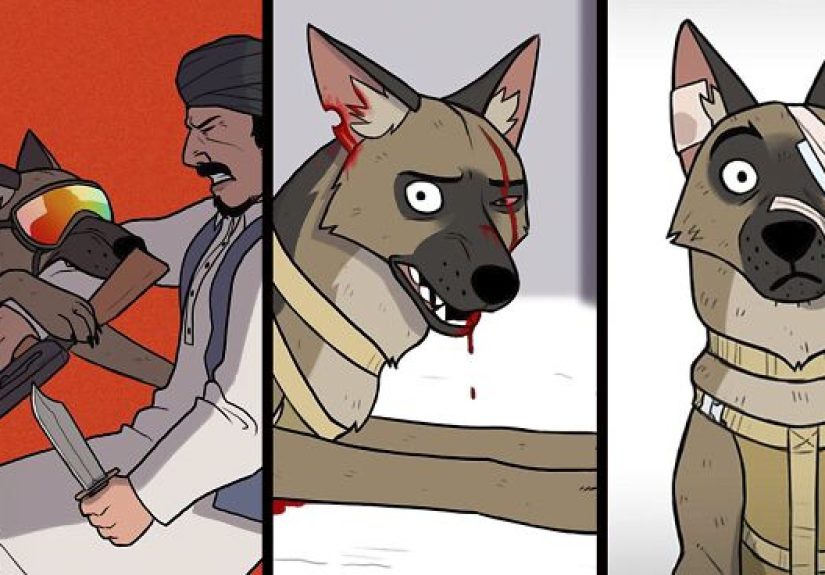
Brutus got his scars while serving as a military working dog. In the scar-origin comic, he finally tells Pixie about a mission from his past. The story shows Brutus working alongside soldiers, including his handler Sergio, during a dangerous search. What starts as a tense but controlled operation turns into a violent ambush. Brutus notices danger, reacts fast, and rushes toward the threat, but he is injured badly in the chaos.
The scene explains the visible marks that fans had wondered about for years. His face, eye, and body were damaged during the attack. More importantly, the comic reveals that his wounds are not only physical. Brutus survived, but his handler Sergio was hurt worse. That loss is the emotional center of the story. The scars on Brutus’s body are reminders of the day he tried to protect his team and could not stop everything from happening.
That is why the reveal hit readers so hard. The comic does not treat Brutus’s scars like a cool action-movie accessory. They are not there to make him look edgy, though admittedly the dog does have “don’t test me before coffee” energy. The scars represent service, sacrifice, grief, and survival.
How the Scar Reveal Happens in the Comic
The reveal begins quietly. Brutus tells Pixie that he once promised to explain what happened when she was older. Pixie, now mature enough to ask gently, realizes he means the scars. Her response matters: she tells him he does not have to explain if he does not want to. That small exchange immediately changes the tone. This is not Pixie poking at a mystery for entertainment. It is a friend giving another friend permission to speak, or not speak, about pain.
Brutus decides to tell her. He describes being with Sergio and several other men during a mission. They enter a home while searching for dangerous people. At first, things are unclear. That uncertainty is part of the tension. Brutus explains that sometimes threats do not look obvious. In the comic, the danger emerges suddenly, and the story moves from careful search to violence in an instant.
Brutus spots the threat and lunges. He is brave, but bravery is not the same as invincibility. The attacker fires. Brutus is struck and badly wounded. The artwork shows the moment with a sharper, darker tone than the usual playful Pixie & Brutus strips. The pacing is fast, almost breathless, making readers feel how quickly a terrible event can unfold.
Then comes the heartbreak: Sergio gets hurt worse. Pixie understands enough to ask the question readers are thinking. Brutus confirms that Sergio did not survive. The conversation returns to the present, where Brutus admits the memory still hurts, though time has made it easier to carry. Pixie comforts him in the only way Pixie can: by staying close.
Why Brutus’s Scars Matter So Much
Brutus’s scars matter because they transform him from a funny “scary dog” into a layered character. Before the reveal, readers could already infer that he had a rough past. After the reveal, those scars become visual storytelling. Every time Brutus looks annoyed, alert, or overly protective, readers understand there is more beneath the expression.
The scars also explain why he treats Pixie with such care. He is not protecting her because he thinks she is weak in a simple way. He protects her because he knows the world can change without warning. He has seen innocence collide with danger. So when Pixie happily wanders toward trouble, Brutus is not being dramatic. Well, sometimes he is being dramatic. He is still a German Shepherd in a comic. But his fear comes from experience.
This emotional foundation is what gives the series its staying power. The funniest Pixie & Brutus moments often work because readers know Brutus is trying, in his gruff way, to preserve Pixie’s joy. He cannot erase what happened to him, but he can help her live in a world where she does not have to learn every hard lesson the hard way.
Ben Hed’s Approach: Cute Comics With Serious Weight
Ben Hed’s Pet Foolery comics often use animal characters to explore everyday humor: pets acting weird, predators being awkward, tiny creatures behaving like they own the planet. With Pixie and Brutus, however, Hed found a formula that could handle both comedy and emotion. A small kitten and a retired military dog may sound like the setup for a five-second internet joke, but it became a long-running character relationship with real dramatic range.
The scar-origin comic stands out because it is darker and more serious than the average strip. It includes combat, violence, and grief. Hed has explained that he researched the subject and treated the story carefully. That matters because military working dogs are not fantasy props in real life. They are trained animals partnered with handlers, often working in dangerous environments. A story about one should avoid turning trauma into decoration.
The comic still uses the simplified language and visual style of Pixie & Brutus, but the emotional intent is clear. Brutus is not telling a war story to seem impressive. He is sharing a memory with someone he trusts. That makes the scene feel personal instead of sensational.
Military Working Dog Context Behind Brutus’s Story
Brutus is fictional, but his background draws from a real-world role. Military working dogs are trained for demanding tasks such as detection, patrol, search, and protection. German Shepherds, Belgian Malinois, and similar high-drive breeds are commonly associated with this kind of work because they are intelligent, athletic, trainable, and intensely focused. In other words, they are excellent at serious jobs and also excellent at making civilians feel underqualified while holding a tennis ball.
Real military working dogs can face injuries, stress, and difficult transitions into retirement. Some retired dogs are adopted by handlers or qualified homes, while others require specialized care because of age, medical issues, behavioral needs, or trauma. This context helps explain why Brutus feels believable. His caution, strength, and protectiveness are exaggerated for comic storytelling, but they are rooted in the idea of a working dog who has returned from a dangerous life and is learning how to exist in a peaceful home.
That civilian setting is essential. Brutus is no longer on a mission, but his mind has not completely left the mission behind. Many of the series’ jokes come from this mismatch. Pixie sees a strange noise as an adventure. Brutus sees a potential threat. Pixie sees a bug. Brutus sees a tactical situation with legs. The comedy works because Brutus is overprepared for ordinary life, but the scar reveal reminds readers why.
How Pixie Changes the Meaning of Brutus’s Scars
Pixie does not erase Brutus’s past. That would be too easy, and frankly, even Pixie’s giant eyes do not have that kind of medical license. What she does is change the present around him. She gives him a reason to be gentle. She gives him someone to protect who also, in her own innocent way, protects him back.
In the scar reveal, Pixie’s role is not to fix Brutus. She listens. She asks softly. She stays. That is a surprisingly mature emotional beat for a comic about a kitten and a dog. It shows that comfort does not always require a speech, a solution, or a dramatic rescue. Sometimes comfort is simply presence.
This is why fans love their friendship. Brutus teaches Pixie caution, but Pixie teaches Brutus that life after pain can still contain warmth. The final feeling of the scar story is not pure sadness. It is bittersweet survival. Brutus carries grief, but he is not alone. He has a home. He has Pixie. He has a new life where danger is more likely to be a Roomba than an ambush, although Brutus would probably argue that Roombas remain suspicious.
Why Fans Had Such a Strong Reaction
Fans reacted strongly because the story answered a long-running visual mystery while deepening a beloved character. In internet comics, many characters stay exactly where the joke needs them to be. They are funny, recognizable, and emotionally simple. Brutus is different. His design promised a backstory, and the reveal delivered one that made his behavior more meaningful.
Readers also responded to the contrast. The same series that can make a joke about Pixie misunderstanding danger can suddenly ask readers to sit with grief. That shift is risky, but it works because the emotional groundwork was already there. Brutus had always seemed like a dog with history. The reveal did not come out of nowhere; it confirmed what his character design had been quietly saying all along.
The comic also sparked discussion because it touched on war, violence, and how conflict is portrayed. That reaction is understandable. Stories involving military action can be sensitive, especially when they simplify complex situations into a few comic panels. The best way to read the strip is as a character-focused memory rather than a broad political statement. Its main purpose is to explain Brutus’s trauma, his bond with Sergio, and the reason his scars still matter.
What Brutus’s Scars Teach About Character Design
From a storytelling perspective, Brutus is a strong example of how visual design can create curiosity. His scars are not random marks. They invite questions. Why is one eye damaged? Why is he so serious? Why does he seem ready to protect Pixie from a leaf if that leaf so much as twitches suspiciously?
Good character design often works this way. It gives the audience clues before giving them answers. Brutus’s size, posture, and scars tell readers he is experienced and dangerous. Pixie’s tiny body, bright expression, and cheerful energy tell readers she is innocent and open-hearted. Put them together, and the entire premise becomes instantly understandable without a long explanation.
The scar reveal then turns design into story. Once readers know what happened, the marks stop being only visual shorthand. They become emotional continuity. Every future panel of Brutus carries that history, even when the joke is light. That is why the character feels memorable: the comedy sits on top of real stakes.
Experience Section: Why Reading Brutus’s Story Feels So Personal
For many readers, the experience of reading Brutus’s scar story begins with curiosity and ends with a lump in the throat. At first, the question feels simple: how did the big dog get hurt? It sounds like a piece of lore, the kind of detail fans enjoy collecting. Then the comic answers, and suddenly the question feels heavier. The scars are not trivia. They are memory.
That emotional shift is part of why the story stays with people. Readers may come for the adorable dog-and-kitten dynamic, but they leave thinking about how past pain follows someone into safer places. Brutus is living in a home now. He has grass, windows, food, and Pixie’s endless supply of tiny chaos. Yet he still carries the old mission inside him. That idea is easy to understand even outside the military context. Many people know what it is like to move on physically while still reacting emotionally to something that happened long ago.
The comic also creates a gentle lesson about asking sensitive questions. Pixie wants to know, but she does not demand. She gives Brutus space. That moment is small, but it is powerful. In real life, people often ask about scars, losses, or difficult histories with the subtlety of a raccoon opening a trash can at 2 a.m. Pixie shows a better way. Curiosity can be kind. Questions can come with permission. Listening can matter more than getting the full story.
Another reason the story resonates is the bond between Brutus and Sergio. Even though Sergio appears mainly through Brutus’s memory, his role is central. He represents partnership, trust, and loss. Brutus’s grief is not abstract; it is attached to someone he loved and served beside. That makes the story feel less like a generic battle scene and more like a memory Brutus has replayed many times. Readers understand that the worst wound is not necessarily the one that left the visible scar.
Finally, the ending offers a kind of quiet comfort. It does not pretend everything is fine. Brutus does not announce that he is magically healed. Instead, he admits that time has made the pain hurt less than it once did. That is a more honest kind of hope. Healing is not always fireworks and inspirational music. Sometimes it is a tired dog lying down while a small cat curls beside him. Sometimes life going on is not a cliché; it is the bravest thing left to do.
That is the real strength of Brutus’s scar story. It gives readers sadness, but not despair. It gives them trauma, but also tenderness. It reminds us that even the toughest characters need softness, and sometimes the softest characters are the ones who help them survive.
Conclusion
Brutus from Pixie & Brutus got his scars during a violent mission as a military working dog. While serving with Sergio and other soldiers, he encountered danger, rushed to protect his team, and was badly wounded. Sergio was hurt worse, leaving Brutus with both physical scars and emotional grief.
That reveal is one of the most important moments in the series because it explains more than Brutus’s appearance. It explains his protectiveness, his caution, and his deep attachment to Pixie. His scars are not just marks from the past. They are part of the reason he chooses to guard innocence whenever he can.
In the end, the story works because it balances heartbreak with warmth. Brutus cannot undo what happened, but he can keep living. He can love Pixie, protect his new home, and find small moments of peace. For a comic about a kitten and a German Shepherd, that is surprisingly profound. Also, yes, it is perfectly acceptable to blame “dust in the room” if your eyes get watery. We will all politely pretend to believe you.
Note: This article is written for web publication in standard American English and discusses a fictional comic scene involving military violence with a sensitive, character-focused approach.