Table of Contents >> Show >> Hide
- Meet the Pillars: What They Are (and Where They’re Hiding)
- The 1995 Image That Turned Space Into Pop Culture
- A Science Story Hidden in a Gorgeous Picture
- Hubble vs. Webb: Same Pillars, Different Truths
- So Why Do We Love Them So Much?
- How to Experience the Pillars Without Owning a Space Telescope
- Conclusion: Three Ghostly Towers, One Very Human Reaction
- 500-Word Experience Add-On: Your First “Pillars Moment”
The universe has a lot of great content. Black holes doing black-hole things. Galaxies throwing glitter in every direction. Stars living dramatic, messy lives like they’re auditioning for reality TV. But if we’re being honest, few cosmic celebrities have the staying power of the Pillars of Creation.
These towering, smoky columns inside the Eagle Nebula aren’t just “pretty space wallpaper.” They’re an entire storybook: about how stars are born, how harsh starlight can sculpt (and slowly shred) clouds of gas, and how humanstiny, snack-powered mammalscan fall in love with something that’s thousands of light-years away.
Meet the Pillars: What They Are (and Where They’re Hiding)
The Pillars of Creation live in a star-forming region called the Eagle Nebula, also known as Messier 16 (M16). From Earth, that’s roughly 6,500–7,000 light-years awayclose enough to inspire awe, far enough to make your GPS quit in protest.
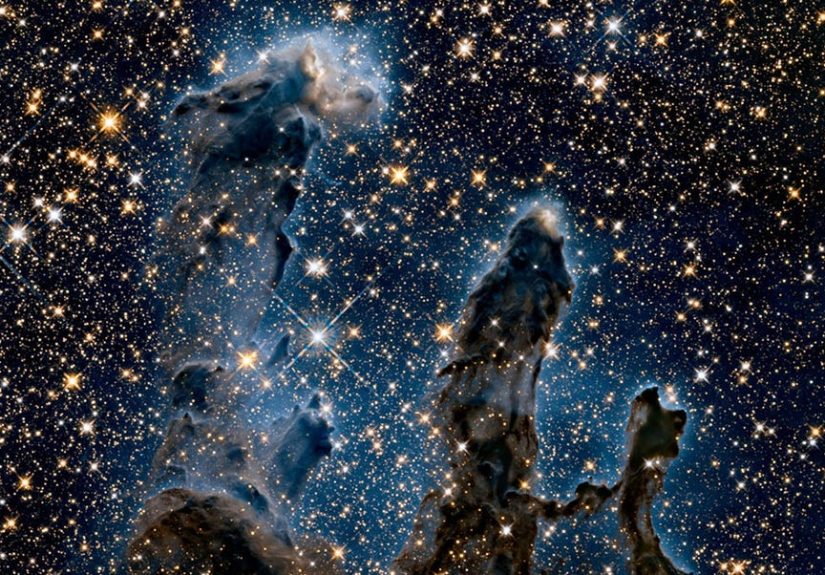
What we call “pillars” are actually dense columns of cold hydrogen gas and dust, rising like stalagmites from a larger molecular cloud. They look solid, almost rocky, but they’re more like cosmic fog that learned how to pose for a portrait. Depending on the measurement and the exact feature you’re looking at, the tallest structures are on the order of about 4–5 light-years high.
And here’s the twist: the pillars aren’t calmly sitting there. They’re being sculpted by radiation and winds from young, massive stars nearby. In other words, the Pillars of Creation are alsogently, poeticallypillars in the process of getting wrecked.
The 1995 Image That Turned Space Into Pop Culture
The Pillars became famous because of one unforgettable moment in astronomy history: Hubble’s 1995 portrait. The image was captured on April 1, 1995 (yes, reallycosmic prank energy, but make it iconic) using Hubble’s Wide Field and Planetary Camera 2.
A huge part of the magic is that this wasn’t a single “click.” It was built from multiple exposures through different filters that isolate light from specific atoms. In the classic color mapping, emission from sulfur, hydrogen, and oxygen gets assigned to different colors, creating a dramatic, high-contrast view that feels both scientific and cinematic.
That image hit the world like a mic drop. It wasn’t just “astronomy people” who cared. Suddenly, everyone had a favorite nebula. The Pillars appeared in classrooms, magazines, posters, documentaries, and the collective imagination. It was the kind of photo that made you stop mid-scroll before “mid-scroll” was even a thing.
Why did it land so hard?
- It looks familiar. The pillars resemble cliffs, mountains, or desert spiresEarth-like shapes in a place that is aggressively not Earth.
- It’s scale-breaking. “Those are gas clouds” is already wild. “Those are gas clouds taller than the distance between stars” is even wilder.
- It’s a story in one frame. You can practically see creation (and destruction) happening at once.
A Science Story Hidden in a Gorgeous Picture
If the Pillars were only beautiful, we’d still love them. But they’re also a perfect crash course in how stars form and how young stars reshape their environment.
How ultraviolet light carves cosmic “cliffs”
Nearby massive stars pour out intense ultraviolet (UV) radiation. That UV light ionizes and heats the gas at the pillars’ surfaces, driving a slow “boil-off” into space. The result is a bright, glowing edge where radiation meets dense materiallike a shoreline, but instead of waves you get ionization fronts and photoevaporation.
The pillars exist because they’re denser than the surrounding gas. The thinner material gets blasted away first, leaving behind these stubborn columnsnature’s version of, “I’m not leaving, you can’t make me.”
EGGs: the tiny pockets that grow stars
One of the most lovable details is also the most delightfully named: EGGs, short for Evaporating Gaseous Globules. As the pillars erode, they reveal these compact knots of denser gas. Inside some of them, gravity can win the tug-of-war and collapse material into newborn stars.
So the Pillars aren’t just scenery. They’re a working nurserywhere dust shields fragile regions long enough for stars to take shape.
Creation and destruction in the same sentence
The phrase “Pillars of Creation” sounds serene, like the universe is gently assembling a masterpiece. The reality is more metal: this is a region where radiation is actively tearing structures apart while stars form inside. It’s cosmic life: growth, pressure, disruption, and reinventionjust with fewer emails.
Hubble vs. Webb: Same Pillars, Different Truths
One reason the Pillars stay fresh is that we’ve seen them through multiple “eyes,” and each one changes the story.
Hubble’s visible-light drama
Hubble’s classic view is visible-light theater: dark, sculpted shapes against glowing gas, with a sense of depth and menace. Later Hubble revisits provided sharper, wider views and comparisons across visible and near-infrared, showing how dramatically the scene changes when you switch wavelengths.
Webb’s infrared reveal: the universe removes the curtain
In 2022, NASA’s James Webb Space Telescope delivered a stunning new portrait in near-infrared. Infrared light can pass through much of the dust that blocks visible light, so Webb’s view pulls back the curtain: suddenly you see more background stars and a richer tapestry of structure inside the pillars.
Webb’s mid-infrared view shifts the emphasis again. In mid-infrared, many stars that pop in the near-infrared become less prominent, while dust features take center stage. Same region, different cast of charactersbecause the physics of what’s glowing changes.
Put Hubble and Webb side by side and you get a masterclass in astronomy: the universe isn’t one picture. It’s a stack of realities, and your telescope decides which pages you can read.
So Why Do We Love Them So Much?
Plenty of nebulae are beautiful. Plenty of astronomical data is important. The Pillars of Creation sit at the rare intersection of beauty, meaning, and accessibility.
1) They turn “space” into a place
Most deep-space photos feel abstract: swirls, dots, gradients. The Pillars look like a landscape you could hikeif you ignored the small problem of being vaporized. Our brains love patterns and familiar shapes, and the Pillars deliver that in full IMAX.
2) They capture time in a single frame
When you look at the Pillars, you’re seeing an ancient scene. The light traveling to Earth is a reminder that the universe has built-in time travel: every image is a postcard from the past. That’s not just coolit’s emotionally weird in the best way.
3) They are honest about how nature works
The Pillars are a reality check for the word “creation.” Creation isn’t tidy. It’s turbulent, messy, and often destructive. Stars form because clouds collapse, but those same stars then reshape and erode their birthplace. The Pillars show that nature’s “making” and “unmaking” are roommates.
4) They’re a reminder that science can be art (without pretending)
Some people worry that colorful telescope images are “fake.” In reality, color is often a translation: different filters capture data, and imaging specialists assign colors to help reveal structure. The point isn’t to trick youit’s to show you more. The Pillars are a perfect example of how good data visualization can spark wonder and understanding at the same time.
How to Experience the Pillars Without Owning a Space Telescope
You can’t exactly “visit” the Pillars, but you can absolutely build your own relationship with them. Here are a few ways people make the Pillars feel personal:
- Do a Hubble vs. Webb comparison night. Pull up both images and play detective: Where does dust hide stars? Where does infrared reveal new structure? It’s surprisingly funlike a cosmic spot-the-difference puzzle.
- Go to a planetarium or science museum. Seeing the Pillars in a dome show or large-format exhibit makes the scale feel real in your bones.
- Try astrophotography (with realistic expectations). You won’t capture the Pillars’ finest details from your backyard in one evening, but you can image the broader region or other nebulae and learn the same principles: filters, stacking, and the joy of turning faint photons into something visible.
- Use them as a gateway topic. The Pillars are an easy “yes” for curiosity. From there you can explore star formation, nebula chemistry, telescope technology, or even how scientific images are processed.
Conclusion: Three Ghostly Towers, One Very Human Reaction
We love the Pillars of Creation because they do something rare: they make the universe feel both vast and intimate. They’re huge, violent, and remoteyet they look like something you could reach out and touch. They’re a reminder that beauty can be a data point, and that wonder is often the first step toward understanding.
The Pillars aren’t just a famous space photo. They’re proof that the universe has storytelling instinctsand that humans, given half a chance, will fall in love with a cloud of gas the size of multiple solar systems.
500-Word Experience Add-On: Your First “Pillars Moment”
Most people don’t remember the exact day they first saw the Pillars of Creation. It’s not like we stamp it on a calendar“Happy Anniversary, Honey, it’s been seven years since you stared at interstellar dust and felt emotional.” But you do remember the feeling.
Maybe it happens in a classroom, where the lights dim and the projector clicks on. You expect a generic space slidesome dots, maybe a spiral galaxy and then the Pillars show up like a movie set built by a universe with unlimited budget. For a second, you don’t even register “nebula.” You register “canyon,” “castle,” “storm cloud,” “something ancient.” Your brain tries to file it under places you’ve been, because “6,500 light-years away” does not fit neatly into human mental folders.
Or maybe your first Pillars moment is a late-night internet rabbit hole. You zoom in, and you keep zooming in, and the details keep multiplying. You read that the scene isn’t staticthat radiation is stripping material awayand suddenly the image isn’t a portrait anymore. It’s a video paused mid-action. That realization hits like, “Wait… this is happening.” Not in a metaphorical way, but in a physics way.
Then you see the “same” Pillars againthis time from Webb. And it’s like meeting a friend in a different city: familiar silhouette, completely new vibe. Hubble gave you dramatic shadows and glowing rims; Webb hands you a star-filled background and dust structures that look carved, layered, and alive. You find yourself flipping between the two images like you’re taste-testing the universe: “Ah yes, today I’m in a visible-light mood.”
The best Pillars experiences are the ones you share. Someone says, “I don’t get the hype,” and you get to be the friendly tour guide: “Okay, so these are columns of gas and dust. Those bright edges? That’s radiation heating material. And those little dense knots? Some are incubating stars.” You watch their expression change from polite to genuinely stunned. You didn’t just show them a pictureyou handed them a story.
And sometimes, the Pillars sneak into ordinary life. You’re stressed about something small (and real), and you remember that there are structures in space that are several light-years tall, being sculpted by stellar radiation, in a region that makes new suns. Perspective doesn’t solve your problems, but it can loosen their grip. The Pillars don’t whisper “nothing matters.” They whisper “so much exists.”
That’s the magic. The Pillars of Creation aren’t only famous because they’re beautiful. They’re famous because they give you a repeatable experience: the sudden, quiet shock of realizing the universe is not just out thereit’s doing things. And somehow, you get to look.