Table of Contents >> Show >> Hide
- The Setup: A Pact, A Crush, And A “Keep My Options Open” Guy
- The Twist: The People Who Burned the Bridge Need to Drive Over It
- Why This Story Hits So Hard: It’s Not About the House
- Boundaries vs. Revenge: What a “No” Actually Means
- The Practical Side Everyone Ignores: “Temporary” Housing Has a Way of Becoming Permanent
- “But They’re Family”: A Better Question to Ask
- If You Want to Help Without Hosting: Options That Don’t Hand Over Your Life
- How to Talk to Parents Who Pressure You (Without Starting World War III)
- Forgiveness, Reconciliation, And the Myth of the Instant Reset
- So… Is She Wrong for Refusing?
- Conclusion: Boundaries Are Not a Lack of LoveThey’re a Limit on Damage
- Real-Life Experiences & Lessons From Similar Family Situations (Extra Insight)
- 1) The “Temporary” Guest Who Brings Permanent Chaos
- 2) The Guilt Trap: “If You Don’t Help, You’re the Bad One”
- 3) The Non-Apology Apology and the Instant Reset Fantasy
- 4) The Healthier Middle Path: Help With Conditions (If You Truly Want That)
- 5) The Most Important Lesson: Your “No” Is a Complete Sentence
Some family drama arrives quietlylike an awkward group text. And then there’s the kind that kicks your front door in,
eats your leftovers, and asks to “just crash here for a little while.”
This story (pulled from a very relatable corner of the internet) centers on a woman who made one thing painfully clear:
being related doesn’t automatically turn your boundaries into a community pool.
The Setup: A Pact, A Crush, And A “Keep My Options Open” Guy
Years ago, the woman had a best frienda guy she’d adored since childhood and, by her early 20s, was fully in love with.
Meanwhile, her sister had a crush of her own. One night at a party, the sister’s crush flirted with the woman. She shut it down.
Her sister still got upset, and the sisters made what a lot of people would call “common sense with a signature”:
don’t pursue people the other one likes.
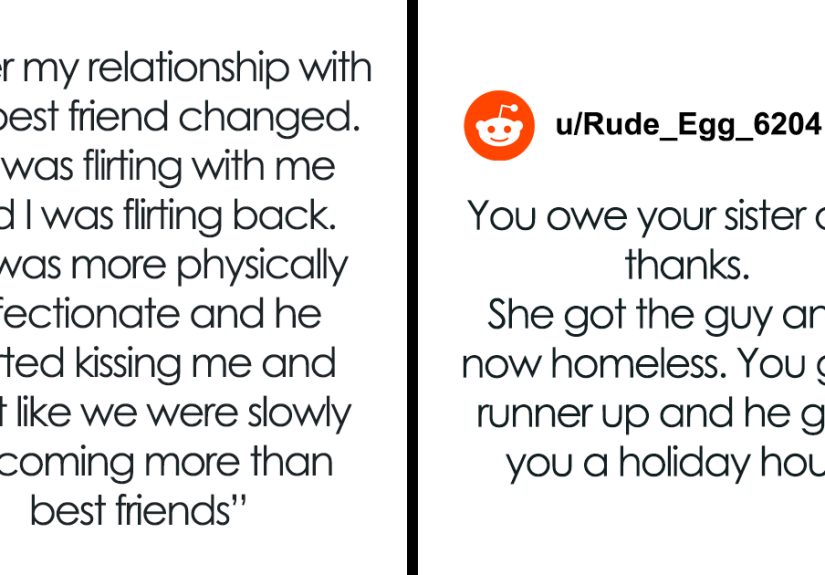
Fast-forward a year or two. The woman’s dynamic with her best friend starts shifting. Flirting. Affection. Kissing.
It feels like the slow burn finally caught fireuntil she discovers the guy is also secretly involved with her sister.
His explanation is the kind that makes you want to throw your phone into a lake: he wanted to “keep his options open.”
Her sister’s explanation isn’t much better. It’s basically: “I really like him, so you should understand.”
Which is a bold take from someone who authored the original pact.
The fallout is immediate. Trust detonates. The relationship with her sister becomes estrangement. And eventually, the sister marries the guy.
Life moves on. The woman builds a different lifemarriage, kids, stability, and a vacation home she and her husband sometimes loan to friends and family.
The Twist: The People Who Burned the Bridge Need to Drive Over It
Now the sister and husband are in trouble: they’ve been renting, but due to “landlord issues,” they’re suddenly without housing.
The parents help float the request: can the couple stay in the woman’s vacation home “until they get back on their feet”?
She says no. Her husband agrees. Her other siblings support her. The parents push back. The sister and husband get angry and insult her.
Suddenly, the very people who asked her to “put the past behind” are actively adding fresh material to the past.
So the internet debates what families have debated forever:
Is refusing help a cruel actor a reasonable boundary?
Why This Story Hits So Hard: It’s Not About the House
The vacation home is the prop. The real storyline is about betrayal, loyalty, and emotional accounting.
When someone breaks a core agreementespecially one they insisted onit’s not “petty childhood drama.”
It’s a lesson you learned the hard way about who that person becomes when they want something.
1) Betrayal Doesn’t Expire Just Because Someone Needs a Favor
A lot of families operate on an unspoken rule: time passing equals forgiveness. But time passing often just equals…
less screaming. The injury can still live in the same place it always did, especially if there was never a real apology,
never any repair, and no evidence the person has changed.
And here’s the part people miss: forgiveness and access are not the same thing.
You can wish someone well from a distance and still not hand them the keys to your property and peace of mind.
2) Adult Sibling Conflict Isn’t RareIt’s Just Quiet
Pop culture loves “siblings as built-in best friends,” but adult sibling relationships can be complicated,
particularly when old rivalries, favoritism, or trust breaks go unaddressed.
That’s why stories like this explodebecause many readers recognize some version of the dynamic,
even if their version involves Thanksgiving seating charts instead of a stolen crush.
3) Family Pressure Often Targets the Most Stable Person
Notice who gets asked to solve the problem: not necessarily the person who created it, but the person with the resources.
In many families, the “responsible one” becomes the default safety netuntil they say no, and then they become the villain.
That’s not generosity; that’s a system. And systems get loud when someone changes the rules.
Boundaries vs. Revenge: What a “No” Actually Means
It’s tempting to frame her refusal as revengebecause revenge is a clean story. Neat. Cinematic.
But most real-life boundaries look boring from the outside and feel brave on the inside.
A boundary is simply: “I’m not available for this.” Not “I hate you.” Not “You deserve pain.”
Not “I hope your Wi-Fi is slow forever.” (Though, to be fair, that last one is a very human thought.)
In this case, “I’m not available” is backed by two realities:
- Emotional reality: The sister and husband represent a major breach of trust, never repaired.
- Practical reality: Letting newly homeless relatives move into your property can become legally and financially messy.
The Practical Side Everyone Ignores: “Temporary” Housing Has a Way of Becoming Permanent
Even if you remove every emotional detail, the request is still high-risk. When someone is housing-insecure,
“two weeks” can turn into “two months” fastespecially if they’re already in conflict with a landlord.
That doesn’t automatically make them bad people, but it does mean the situation is unstable.
Common problems when family stays “just for a bit”:
- Unclear timelines: Everyone hears a different end date.
- Property wear-and-tear: A vacation home isn’t set up for full-time living by extra adults.
- Boundary creep: One night becomes a month, then they want mail sent there, then they want guests.
- Conflict escalation: Old resentments plus new stress equals emotional wildfire.
And here’s the underrated issue: if someone already feels entitled to what you have,
they may treat the home like compensation, not like a favor.
“But They’re Family”: A Better Question to Ask
When people say, “But they’re family,” what they usually mean is: “Family should be obligated.”
That idea sounds noble until you realize it can also protect the person who behaves the worst,
as long as they share DNA and can deliver a guilt speech with confidence.
A better question is:
If they weren’t family, would I do this?
If the honest answer is “absolutely not,” then “family” is being used as a override button.
And override buttons are dangerous. They bypass your instinctsthe very instincts that exist because you learned something.
If You Want to Help Without Hosting: Options That Don’t Hand Over Your Life
One reason people get stuck is the false choice: either let them move in, or you’re heartless.
Reality has more lanes.
Low-Contact Help (If You Choose It)
- Information support: Send local resources, listings, or housing assistance contacts.
- Short-term buffer: Offer a limited hotel stay (paid directly) instead of access to your property.
- Practical aid: Provide boxes, storage help, or a one-time grocery gift card.
- Employment support: Connect them with job leads or resume resources.
Important: help is only help if it doesn’t set you on fire. If any option creates a new channel for abuse, manipulation,
or entitlement, it’s allowed to be off the table.
How to Talk to Parents Who Pressure You (Without Starting World War III)
Parents often push reconciliation because they’re exhausted, scared, or ashamed. Sometimes they want peace.
Sometimes they want the problem to go away. And sometimes they genuinely can’t tolerate the idea that their family “failed.”
You can be firm without being cruel. Here are scripts that don’t invite negotiation:
Script 1: The Simple Boundary
“I’m not able to host them. Please don’t ask again.”
Script 2: The Safety Boundary
“I’m protecting my home and my family. I won’t take on the risk.”
Script 3: The Responsibility Redirect
“If you feel they need help urgently, you’re free to help them directly.”
Script 4: The Emotional Reality
“This isn’t petty to me. It changed our relationship permanently, and they haven’t repaired it.”
Notice what’s missing: long explanations. Detailed evidence. Courtroom exhibits.
Explanations can become invitations for debate, especially in families that treat boundaries like personal insults.
Forgiveness, Reconciliation, And the Myth of the Instant Reset
A lot of people use “forgive” to mean “pretend it never happened.” But forgiveness (when someone chooses it)
is often an internal processletting go of rumination, reducing stress, finding peace.
Reconciliation is external. It requires trust-building, accountability, and consistent respectful behavior.
If the sister and husband truly wanted reconciliation, the first step wouldn’t be:
“Can we move into your vacation home?”
It would be something like:
“We hurt you. We understand why you walked away. If you ever want to talk, we’ll do it on your terms.”
The difference matters. One is repair. The other is a resource grab.
So… Is She Wrong for Refusing?
If you view family as a permanent obligation, then any refusal looks wrong.
But if you view family as a relationship that still requires respect, accountability, and safety,
her refusal is not only understandableit’s predictable.
She wasn’t refusing to save someone from a random accident.
She was refusing to hand over access to a homepossibly for an undefined amount of timeto the exact two people
who proved they could violate her trust and then justify it.
You can have compassion for someone’s hardship and still decline to become their solution.
That’s not cruelty. That’s adulthood.
Conclusion: Boundaries Are Not a Lack of LoveThey’re a Limit on Damage
The headline makes it sound like a rom-com gone feral, but the real message is simple:
People who break trust don’t get to demand trust laterespecially not in the form of keys and a spare bedroom.
If you’re the person in the family who “always helps,” this story can feel like a permission slip.
You are allowed to say no. You are allowed to protect what you built. And you are allowed to stop confusing guilt with responsibility.
Real-Life Experiences & Lessons From Similar Family Situations (Extra Insight)
In stories like this, the details changesometimes it’s a sister’s long-time crush, sometimes it’s a business loan,
sometimes it’s a “temporary” move-in after a breakupbut the emotional mechanics tend to repeat.
If you’ve ever watched a family conflict unfold in slow motion, you’ll recognize these patterns.
1) The “Temporary” Guest Who Brings Permanent Chaos
People often underestimate how stressful shared housing becomes when there’s unresolved history.
Even if everyone starts polite, small frictions pile up fast: noise, privacy, chores, money, schedules,
parenting differences, and “why do you do it like that?” commentary. When the relationship is already strained,
a living arrangement can turn your home into a 24/7 conflict zone.
Many families learn the hard way that hosting isn’t just offering a roofit’s offering daily access to your routines,
your spouse, your kids, your quiet, and your nervous system. And once someone is inside, asking them to leave can become
the new family war.
2) The Guilt Trap: “If You Don’t Help, You’re the Bad One”
In a lot of families, the most functional person becomes the designated rescuer. When that person sets a boundary,
the family reacts as if the boundary is the betrayal. This is where you hear things like:
“Be the bigger person,” “Let it go,” or “Family is family.”
But “be the bigger person” can be code for: “Absorb the consequences so the rest of us don’t have to.”
If the parents pushing the request aren’t offering their own home (or money, or concrete support),
it’s worth noticing who is being volunteeredand who is volunteering.
3) The Non-Apology Apology and the Instant Reset Fantasy
Another common pattern: someone only reaches out when they need something. The outreach is framed as reconciliation,
but the timeline skips all the hard parts: accountability, empathy, repair. Instead, the person jumps straight to a favor.
When the answer is no, they may respond with anger or insultsbecause the “reconciliation” was actually a transaction.
That reaction becomes information. It tells you what the relationship would look like if you said yes:
pressure, entitlement, and punishment when you don’t comply.
4) The Healthier Middle Path: Help With Conditions (If You Truly Want That)
Some people decide they want to help in a limited way. When it works, it usually has three ingredients:
a clear boundary, a written timeline, and a backup plan that doesn’t rely on emotional promises.
For example: paying for a week at a hotel, providing a list of resources, or offering a small one-time amount
you can afford to losewithout expecting gratitude.
The key is not letting “help” become a permanent role you never agreed to.
The moment help requires you to tolerate disrespect, manipulation, or repeated violations,
it stops being kindness and starts being self-erasure.
5) The Most Important Lesson: Your “No” Is a Complete Sentence
People who are used to your flexibility will act shocked when you become consistent.
They may call you cold. They may rewrite history. They may recruit relatives to pressure you.
None of that automatically means your boundary is wrong. It usually means your boundary is effective.
If you relate to this story, the takeaway isn’t “never help anyone.”
It’s: don’t confuse family ties with unlimited access.
Real relationships can survive boundaries. Only dysfunctional systems collapse when someone says no.